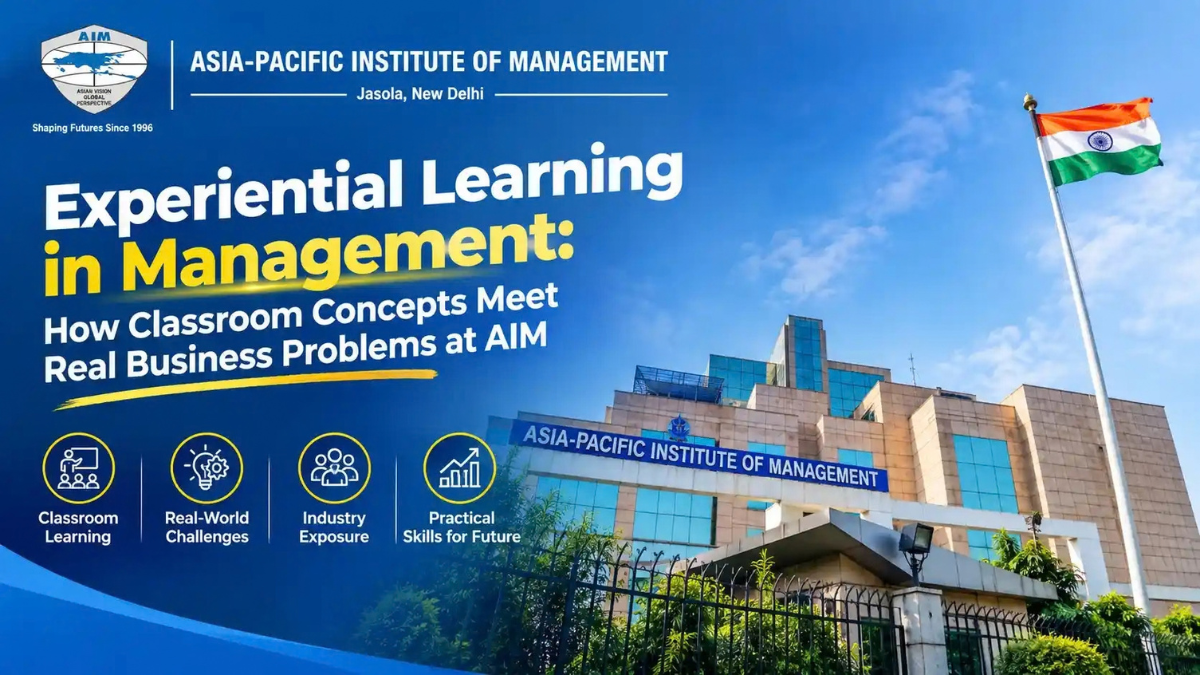
Experiential Learning in Management: How Classroom Concepts Meet Real Business Problems at AIM
Posted on 07 Oct 2026
By Dr. Vikas Gupta
Introduction
Most management applicants have heard the phrase "practical learning" so often that it has stopped meaning anything. Every brochure promises it. The harder question is what it looks like once classes begin: who does the work, what problem is on the table, and how an idea from a textbook ends up shaping a decision. This guide looks at experiential learning in management with that question in mind, and at how the PGDM – General programme at Asia-Pacific Institute of Management (AIM), New Delhi, describes its own approach.
By the end, you will know what experiential learning is, how it differs from ordinary coursework, what AIM publishes about its practical components, and which questions to put to any business school before you commit.
Inviting Applications for PGDM 2027–29
Explore AIM PGDM and build skills for a future-ready management career.
Experiential learning in management is a way of learning in which students build understanding by doing management work, such as analysing a case, running a simulation or handling a live project, and then reflecting on the result rather than only listening to explanations.
The idea is usually traced to the educational theorist David Kolb, whose model describes a cycle with four stages: a concrete experience, reflection on that experience, a general principle drawn from the reflection, and a test of the principle in a new situation. Management suits this cycle well. A pricing decision, a hiring dilemma or a supply delay never arrives labelled with the chapter that explains it. Students must recognise which concept applies, and often discover that two concepts pull in opposite directions. Bonus:From Orientation to Graduation: The Student Journey at Asia Pacific Institute of Management
How It Differs From Traditional Teaching
In a lecture-led course, the instructor explains, the student absorbs and an exam follows. In an experiential course, students make decisions with incomplete information, defend them to peers and faculty, and see the consequences, even if those consequences play out inside a simulation.
Neither approach replaces the other. A student who has not understood the cost structure of a business learns little from a live project built on it. The strongest practical management education pairs sound concepts with repeated chances to apply them.
How Do Management Concepts Meet Real Business Problems?
Concepts meet real business problems when a classroom idea is used to analyse a situation that has no tidy answer. A student applies a framework such as segmentation, ratio analysis or capacity planning to a case, simulation or project, finds where it falls short, and refines the approach.
The table below shows how that usually works, using generic examples.
Concept
Practical format
What the student does
Market segmentation
Live project
Studies a business's customers and proposes which groups to prioritise
Financial statement analysis
Case study
Reads a company's accounts to judge whether its growth is sustainable
Operations and capacity planning
Simulation
Sets production levels over several rounds as demand shifts
Human resource management
Case discussion or role-play
Weighs pay, workload and retention trade-offs in a team scenario
Research methodology
Research project
Frames a question, collects data and presents findings
These are illustrations of each format, not descriptions of specific assignments at AIM.
Consider a student interested in brand management who is asked to help a small business position a new product. The segmentation theory is familiar. What is new is that the budget is limited, customer data is patchy and the owner disagrees with the first recommendation. Working through that gap between neat theory and untidy reality is what real world business learning is meant to teach.
What Does AIM Publish About Its Practical Learning?
AIM's PGDM – General page describes a two-year, six-trimester, AICTE-approved programme in which every trimester blends theory with live projects, case studies, simulations and corporate internships. Programme details can change by academic session, so applicants should verify the latest information on the official programme page.
Live Projects, Cases and Simulations
AIM states that these formats run through the programme, which gives AIM practical learning a place in the structure itself rather than in occasional events. The published curriculum also lists subjects that give students something to apply. Trimester I includes Organizational Behavior, Financial Reporting, Statement and Analysis, and Marketing Management-I. Trimester III adds Corporate Finance, Strategic Management, and Innovation & Entrepreneurship. Fundamentals of Artificial Intelligence and Big Data Fundamentals appear in the first year, and a subject on AI-ML applications across domains appears later.
Internships and Industry Training
AIM's internships page says students undertake internships and live industrial training intended to connect academic concepts with real business challenges, working on live projects and corporate assignments. The page refers to a network of more than 150 industry partners. The curriculum also lists a summer internship project report seminar in Trimester IV.
Experiential Learning Courses and the Research Project
The published structure lists an Experiential Learning or Certificate Course in both Trimester IV and Trimester V. Since the choices on offer can change, applicants should ask the admission team which options are currently available.
In the second year, students undertake a six-month research project alongside Trimesters V and VI. They choose a topic in their area of specialisation, submit a synopsis to a faculty guide, carry out the work with periodic reviews, and present a detailed report to a panel that includes faculty and external members from industry or academia. Because the student owns a real question from start to finish and must defend the answer, this is a good example of experiential learning in a PGDM.
PGDM – General also offers dual specialisation in areas such as marketing, finance, HR, operations and business analytics, so students can direct this practical work towards the two domains they choose.
Learning With Others: Teams, Clubs and Industry Interaction
Experiential learning in management is rarely a solo activity. Case discussions, simulations and projects usually involve teams, so students also practise negotiation, disagreement and shared deadlines, which are skills many managers use every day.
Imagine a student from a finance background and a classmate drawn to marketing disagreeing over a pricing recommendation. Resolving that disagreement, with evidence, is part of the lesson.
AIM's published clubs information lists a Finance Club, a Marketing Maestro Club and an HR Club, each built around a business function. Its events page shows examples such as an Innovation Masterclass on AI, circular economy and sustainable business, an industry-exposure webinar and career seminars. These indicate the kind of activity AIM has organised, not a guaranteed calendar for every batch.
How Can You Judge Experiential Learning at a Business School?
Judge experiential learning by asking for specifics: which projects exist, who supervises them, how they are assessed and what evidence shows how the work connects to careers. A brochure that says "live projects" tells you little. Details show whether practical learning is built into the programme or added on top.
A useful checklist for any business school experiential learning claim:
Is practical work part of the credit structure, or an optional extra?
Who supervises projects, and how often are progress reviews held?
Do projects involve real organisations and real data, or only textbook cases?
How are students assessed: reports, presentations, panel reviews?
Can you link a project to your own specialisation?
What dated, programme-specific evidence exists for career outcomes?
The last question matters most. Practical exposure can strengthen your skills and your evidence of capability, but it cannot guarantee a job, salary or role. Outcomes depend on effort, prior experience and market conditions, so be cautious with any institute that implies otherwise.
For AIM, the published structure answers some of these questions directly, such as the supervised research project and its panel review. For others, such as which organisations are involved in a given batch, the admission team is the right source. Applicants should also check eligibility on the programme page: it lists a bachelor's degree with at least 50% marks, with final-year students allowed to apply, and shortlisting on CAT, MAT, XAT, CMAT, ATMA or GMAT scores followed by a group discussion and personal interview. AIM also publishes a daily guided campus tour on weekdays, which is a practical way to ask these questions in person.
How Can Students Get More Out of Experiential Learning?
Students get more from experiential learning by taking real responsibility, preparing before each activity and reflecting afterwards. The experience alone does not build skill. What the student does with it, and what they notice about their own decisions, determines the benefit.
Own a specific piece of the work. Take a section, a dataset or a presentation slot, rather than staying in the background.
Prepare the concept first. A framework you understand is easier to test and challenge in a live setting.
Write short reflections. A few lines after each project on what worked, what failed and why turns an activity into learning.
Ask for feedback early. Faculty reviews and peer comments are most useful before the final submission.
Connect activities to a goal. A student drawn to analytics might choose projects and certificate options that build that skill.
Experiential learning in management works because business problems rarely resemble textbook exercises. The value lies in applying a concept, seeing where it breaks and improving it, ideally with supervision and in the company of peers. AIM's published PGDM – General structure describes live projects, case studies, simulations, internships, experiential courses and a supervised research project, which together give that cycle several places to happen.
For an applicant, the sensible next step is to test any practical learning claim against specifics. Read the programme page, ask the admission team what is currently offered, and choose the environment where you expect to do the work, not just attend it.
Inviting Applications for PGDM 2027–29
Explore AIM PGDM and build skills for a future-ready management career.
Dr. Vikas Gupta is a distinguished academic in the education and research domain, specializing in finance and related interdisciplinary studies. He is known for his...
These answers cover how experiential learning in management works in a PGDM, what AIM describes on its official pages, and how applicants can check practical claims.
01.
What is experiential learning in management?
It is a learning approach in which students develop management skills by doing real or realistic work, such as projects, cases and simulations, and then reflecting on the outcome. It treats experience as the starting point for understanding concepts.
02.
How is experiential learning different from the case method?
The case method is one form of experiential learning. Experiential learning also covers live projects, simulations, internships and research work, where students act on a problem rather than only analyse a written account of it.
03.
What practical components does AIM describe for its PGDM – General programme?
AIM’s programme page describes live projects, case studies, simulations and corporate internships, a summer internship project report seminar, experiential learning or certificate courses, and a six-month research project in the second year. Check the page for current details.
04.
Does experiential learning in a PGDM replace classroom teaching?
No. Concepts still come first, and practical work tests them. A programme that offers projects without sound foundations gives students activity without understanding.
05.
Is a PGDM less academic than an MBA because it is more practical?
Not necessarily. AIM states that its AICTE-approved PGDM is considered equivalent to an MBA by the Association of Indian Universities. Whatever the label, compare the curriculum, practical components and assessment.
06.
Does practical management education guarantee a job?
No. It can build skills, evidence of capability and professional contacts, but placement and salary depend on individual effort, specialisation, prior experience and market conditions. Be wary of any promise otherwise.
07.
What is the eligibility for PGDM – General at AIM?
AIM’s programme page lists a bachelor’s degree with at least 50% marks, with final-year students eligible to apply. Admission is based on scores in CAT, MAT, XAT, CMAT, ATMA or GMAT, followed by a group discussion and personal interview. Confirm current requirements with the admission team.
08.
How can I check whether a business school's practical learning is genuine?
Ask who supervises projects, how work is assessed, whether real organisations are involved and what dated evidence exists for outcomes. Visit the campus if you can, and compare answers across the institutes on your shortlist.










.webp) Call Us
Call Us