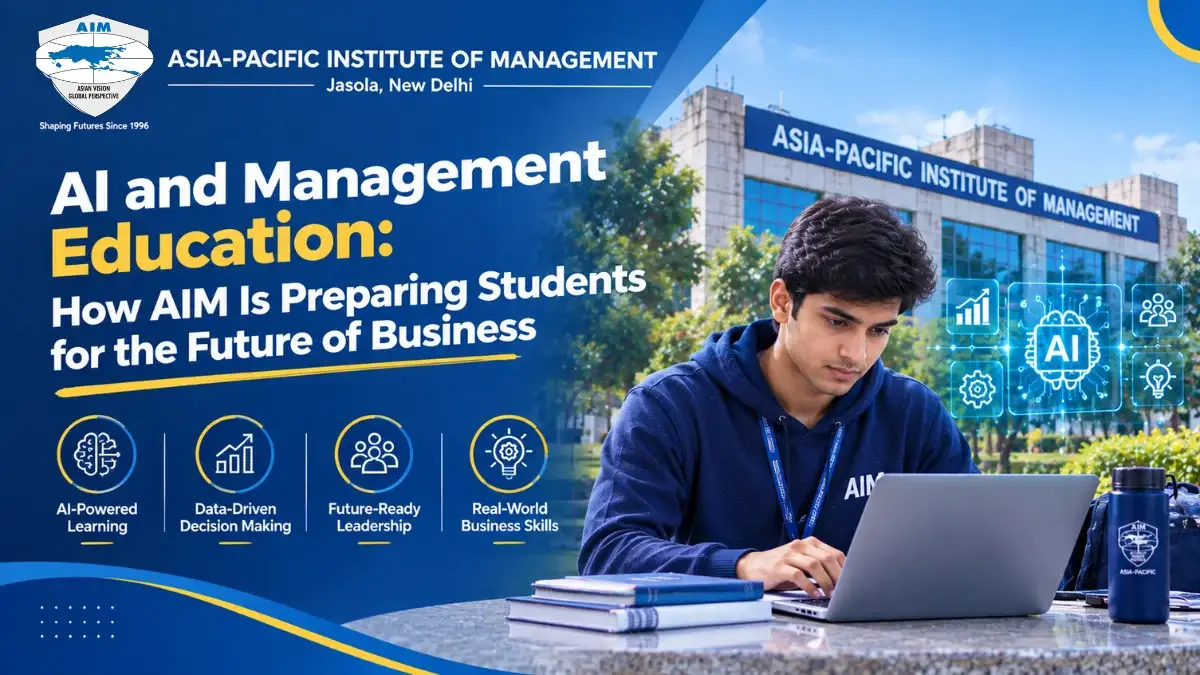
AI and Management Education: How AIM Is Preparing Students for the Future of Business
Posted on 14 Oct 2026
By Dr. Vikas Gupta
Introduction
Artificial intelligence is changing how businesses understand customers, evaluate risks, manage operations and make strategic decisions. As organisations adopt intelligent technologies, AI in management education is becoming increasingly relevant for students who want to build careers in marketing, finance, human resources, operations and business strategy. Future managers will need more than traditional business knowledge; they will also need to understand how AI-generated insights can support decisions, where automated systems can fail and when human judgement must take priority.
For management aspirants, this shift raises an important question: how can business education prepare students for a workplace where technology and managerial responsibility increasingly intersect? At Asia-Pacific Institute of Management (AIM), New Delhi, the institute's published discussions of AI, data analytics and digitally enabled management reflect the growing importance of technology-aware business learning. Its PGDM programme portfolio also includes Big Data Analytics, a pathway relevant to students exploring the relationship between data and managemen
Understanding this evolution can help students evaluate management education more thoughtfully and identify the capabilities needed to contribute to technology-driven businesses.
Executive MBA in Healthcare
Explore the curriculum, eligibility, career opportunities, and key details of the Executive MBA in Healthcare.
AI literacy is becoming a management skill: Students need to understand how artificial intelligence supports business decisions, rather than simply learn how to operate individual tools.
Business fundamentals remain essential: Finance, marketing, operations, strategy and organisational behaviour provide the context needed to interpret AI-generated recommendations.
Practical application matters: Case analysis, business problems and data interpretation help students connect emerging technologies with real managerial decisions.
Responsible AI use requires judgement: Data privacy, bias, accuracy, transparency and accountability must inform decisions involving intelligent systems.
AIM offers a relevant learning context: Its published AI-focused management content and PGDM Big Data Analytics programme provide starting points for exploring the relationship between management and technology.
AI in management education means preparing students to understand, evaluate and apply artificial intelligence in business contexts. This includes recognising appropriate use cases, interpreting analytical outputs, assessing risks and translating technological possibilities into decisions that support organisational objectives.
The shift is significant because AI is no longer relevant only to technical specialists. Marketing managers may use it to examine customer behaviour, finance teams may use predictive models to support forecasting, and operations managers may assess demand patterns using analytical systems.
Management education must therefore connect technology with business fundamentals. Knowing that an AI tool can generate a sales forecast is not enough. A manager must understand the assumptions behind the forecast, the quality of the available data and the consequences of acting on an inaccurate prediction.
This is where business education can make a difference. By combining managerial concepts with analytical thinking and practical problem-solving, institutions can help students develop a more balanced understanding of technology's capabilities and limitations.
How AI Is Changing Business Functions
Business function
Potential AI application
Managerial responsibility
Marketing
Customer segmentation and campaign analysis
Check relevance, fairness and customer response
Finance
Forecasting, anomaly detection and risk analysis
Evaluate assumptions and financial exposure
Human resources
Recruitment support and workforce analysis
Protect candidate privacy and assess potential bias
Operations
Demand forecasting and inventory planning
Validate predictions against operational realities
Strategy
Scenario analysis and market research support
Challenge assumptions and select appropriate actions
These are examples of possible business applications, not guarantees of outcomes. AI systems depend on data quality, suitable implementation and human oversight. The manager remains responsible for understanding the business problem and evaluating whether a proposed solution is appropriate.
How AIM Connects Management Learning with the AI Era
Preparing for an AI-enabled workplace requires an approach that connects business understanding with data awareness, technology and responsible decision-making. For management aspirants evaluating AIM, the useful question is how the institute's published programme offerings and learning resources relate to these evolving requirements.
AIM's website features dedicated content on the role of AI in management education and the use of AI and data science in PGDM learning. Its published PGDM portfolio also includes PGDM Big Data Analytics, which is particularly relevant to students interested in the connection between analytical methods and business decisions.
These resources provide a starting point for understanding the institute's engagement with the subject. However, students should distinguish between an institute's published discussion of AI, a programme's stated curriculum and evidence of particular classroom activities. Aspirants should consult the current programme curriculum to establish which AI tools, subjects and practical exercises are formally included.
1. Connecting Business Knowledge with Data Analytics
Data is useful only when it helps answer a meaningful business question. Management students therefore need to learn how to interpret evidence, identify patterns and explain the implications of analytical findings to different stakeholders.
For example, a student analysing a retail company's sales data might notice that revenue has declined in one region. An AI-enabled analytical tool could help identify possible patterns in customer demand, pricing or product availability. The student must still investigate whether the available information supports those explanations and recommend an appropriate response.
This approach brings together business reasoning and analytical thinking. AIM's PGDM Big Data Analytics offering is a relevant programme to examine for students seeking more focused exposure to data-oriented management learning. The precise subjects and practical requirements should be checked against the current official curriculum.
2. Understanding AI Across Business Functions
AI is most useful to future managers when they understand how its applications differ across business functions. A marketing student may focus on customer insights, while a finance student may be more interested in forecasting, risk assessment and financial analysis.
Likewise, operations and human resources present different challenges. An operations manager must evaluate the reliability of demand forecasts, while an HR manager must consider fairness, confidentiality and the limitations of automated screening systems.
A broad management foundation helps students understand these differences. It also helps them communicate with technology teams without assuming that every business problem requires an AI solution.
AIM's published article on AI in management education discusses applications across strategic management, HR, marketing, operations, finance and business analytics. This cross-functional perspective is relevant to students exploring how AI can support decisions throughout an organisation. Bonus: AI and Data Science in PGDM Curriculum 2026
Understanding AI concepts is different from applying them to a business problem. Management aspirants should look for opportunities to evaluate evidence, compare alternatives, explain recommendations and consider implementation risks.
A useful learning exercise might involve analysing customer feedback, developing a preliminary market assessment or comparing inventory-planning scenarios. Students could use an approved AI tool to organise information, then verify important claims and explain the reasoning behind their recommendations.
The objective is not to use AI in every assignment. It is to learn when the technology adds value, when conventional analysis is sufficient and when the available evidence is too weak to support a confident conclusion.
When evaluating AIM or another management institute, students should ask how its current curriculum uses cases, projects, simulations or other applied learning methods. They should also establish whether AI-related work is formally assessed, which tools are available and how faculty members guide responsible use. These questions help separate practical learning opportunities from broad statements about technological readiness.
Essential AI Skills for Management Students
AI for management students is not simply about writing prompts or generating reports. It involves a combination of technical awareness, business understanding, critical thinking, communication and ethical judgement.
The depth required will vary by role. A future marketing manager may need to interpret campaign analytics, while someone pursuing a data-focused career may need deeper statistical and technical knowledge.
The following capabilities provide a practical foundation.
1. AI and Data Literacy
Students should understand basic AI concepts, recognise common applications and know the difference between a generated answer, a statistical estimate and a verified business fact.
Data literacy also includes reading charts, understanding percentages, identifying missing information and recognising that correlation does not necessarily establish causation.
2. Critical Thinking and Verification
AI tools can produce plausible but inaccurate statements, incomplete summaries and recommendations based on unsuitable assumptions. Students must learn to check claims against reliable evidence, examine alternative explanations and identify information that requires further investigation.
For instance, an AI-generated market report should not be treated as conclusive evidence of demand unless its figures, sources, timeframe and methodology can be assessed.
3. Prompting and Analytical Communication
Clear instructions help students use AI tools more effectively. A useful prompt identifies the business problem, available information, intended output and relevant constraints.
However, prompt quality alone is not enough. Students must also communicate their findings in language that business stakeholders can understand, separating verified findings from assumptions and suggestions.
4. Ethics, Privacy and Responsible Use
Management students should understand the risks of sharing confidential information with external AI tools. They should also consider algorithmic bias, consent, intellectual property, security and accountability.
A recruitment model, for example, may produce systematically unfair recommendations if its training data reflects past discrimination. Managers need to question such outputs rather than assume that automated decisions are objective.
5. Adaptability and Collaboration
AI capabilities and workplace practices will continue to evolve. Managers therefore need the ability to learn new tools, collaborate with specialists and reconsider established processes when better evidence becomes available.
These skills are complementary. Technical familiarity without business understanding can lead to poorly targeted solutions, while strong managerial judgement without digital awareness may limit a student's ability to evaluate emerging opportunities.
What the Future of Management Education Could Look Like
The future of management education is likely to involve a closer relationship between traditional business disciplines, analytical methods and responsible technology use. The precise pace of change will differ between institutions, industries and job roles.
Several developments are particularly relevant for management aspirants.
More Data-Informed Case Analysis
Students can examine business cases using larger datasets and analytical tools, where suitable data and teaching resources are available. Rather than relying only on a written scenario, they may compare evidence-based alternatives and discuss how uncertainty affects the decision.
Greater Attention to Human–AI Collaboration
Managers will increasingly need to decide which tasks can be supported by automation and which require human interaction, negotiation, creativity or contextual judgement. Management learning should help students understand this division of responsibility instead of presenting AI as a substitute for every professional skill.
Stronger Emphasis on Governance
As organisations introduce AI into business processes, questions about privacy, reliability, transparency and accountability become managerial concerns. Students who understand these issues can participate more thoughtfully in technology adoption and organisational change.
Continuous Learning Beyond the Classroom
A management qualification provides a foundation, but it cannot cover every future tool or business application. Students will need to keep learning through professional reading, relevant projects, additional training and reflection on their work.
These developments suggest that future-ready management education should combine enduring business principles with the flexibility to assess new technologies critically.
How Management Aspirants Can Prepare for an AI-Enabled Career
Students do not need to become software engineers to build AI awareness. They can start by connecting familiar business concepts with practical technology use and progressively developing stronger analytical capabilities.
A simple preparation plan can help:
Strengthen business fundamentals. Understand accounting, marketing, economics, operations and organisational behaviour before relying on automated recommendations.
Practise with appropriate tools. Use institution-approved AI applications to summarise non-confidential material, generate research questions or compare business scenarios.
Verify every important output. Check factual claims, numerical calculations, sources and assumptions before incorporating AI-generated material into an assignment or presentation.
Build a portfolio of business analysis. Where permitted, document projects that explain a business problem, the evidence considered, the analytical approach and the reasoning behind a recommendation.
Learn responsible-use principles. Follow institutional assessment rules, protect personal information and disclose AI assistance when required.
Evaluate management programmes carefully. Compare published curricula, analytical learning opportunities, practical exposure and faculty support instead of relying on AI-related terminology in programme descriptions alone.
For example, a hypothetical student interested in marketing could analyse publicly available campaign data, use an AI tool to explore possible explanations for performance differences, and then evaluate those explanations using the underlying evidence. The resulting work should demonstrate the student's own reasoning rather than simply reproduce generated content.
For students considering AIM, reviewing the current PGDM curriculum alongside its published material on AI and analytics can help establish which opportunities align with their interests.
Choosing an AI-Aware Management Programme: What Should You Check?
The presence of AI-related terminology does not automatically establish the depth or quality of a programme's technology education. Management aspirants should evaluate the substance of the learning experience.
Evaluation area
Questions to ask
Curriculum
Are AI, analytics and digital business topics identified in the current curriculum?
Business application
Do students apply analytical concepts to relevant business problems?
Practical learning
Are there documented projects, case exercises or other opportunities to apply learning?
Faculty guidance
How are students taught to verify outputs and evaluate limitations?
Responsible AI
Does learning address privacy, bias, security and appropriate use?
Career relevance
How do the programme's learning outcomes relate to the student's intended business function?
Aspirants comparing AIM's PGDM options can use these questions to examine whether the available learning pathways match their goals. Students interested in analytics should pay particular attention to the published PGDM Big Data Analytics programme information, while those pursuing other management areas should investigate how digital and analytical capabilities relate to their chosen discipline.
The most useful comparison is not between programmes that mention AI and those that do not. It is between programmes that offer clearly described, relevant learning opportunities and those whose claims are difficult to evaluate.
Conclusion
AI is reshaping business decision-making, making technology awareness, analytical thinking and responsible judgement increasingly relevant to management education. Students who combine these capabilities with strong foundations in finance, marketing, operations and strategy will be better equipped to evaluate AI-supported recommendations and contribute to organisational decisions.
For management aspirants, AIM's published focus on AI in management education and its PGDM Big Data Analytics offering provide relevant starting points for further investigation. The next step is to examine current curriculum details, practical learning opportunities and programme-specific evidence. Ultimately, effective management education should prepare students not merely to use new tools, but to understand their limitations and make better-informed business decisions.
Executive MBA in Healthcare
Explore the curriculum, eligibility, career opportunities, and key details of the Executive MBA in Healthcare.
Dr. Vikas Gupta is a distinguished academic in the education and research domain, specializing in finance and related interdisciplinary studies. He is known for his...
These answers address common questions about AI in management education, the skills students need and how to evaluate relevant management programmes.
01.
What is AI in management education?
AI in management education involves teaching students how artificial intelligence and related analytical technologies can support business decisions. It connects technology with subjects such as marketing, finance, operations and strategy, while developing critical thinking, verification skills and an understanding of responsible AI use.
02.
Why is artificial intelligence in MBA and PGDM programmes important?
Artificial intelligence in MBA and PGDM programmes can help students understand how businesses analyse information, automate selected tasks and evaluate possible outcomes. Its value depends on how effectively students connect these applications with business fundamentals, practical problems and the limitations of AI-generated results.
03.
Do management students need coding skills to learn AI?
Not necessarily. Many managerial applications require data literacy, tool familiarity, critical thinking and the ability to interpret results rather than advanced programming. However, students pursuing analytics-heavy roles may benefit from learning statistics, programming and other technical skills relevant to their intended careers.
04.
How can AI help students learn business management?
AI tools can support brainstorming, explain unfamiliar concepts, organise research questions and explore hypothetical business scenarios. Students should verify important claims, consult reliable sources and follow their institution’s academic-integrity policies. AI should support independent learning rather than replace analysis or original work.
05.
What AI skills should future managers develop?
Future managers should develop AI literacy, data interpretation, critical thinking, effective prompting, communication and responsible-use awareness. They should also understand privacy, bias and output verification. The appropriate level of technical expertise depends on the responsibilities of their intended role.
06.
How is AIM relevant to AI in management education?
AIM publishes material discussing AI applications across management functions and offers a PGDM Big Data Analytics programme. These provide relevant starting points for aspirants exploring technology-oriented management learning. Students should review current official programme details to confirm specific subjects, tools and practical requirements.
07.
Can AI replace human judgement in business management?
AI can assist with analysis and selected routine tasks, but its outputs may be inaccurate, incomplete or affected by biased data. Managers must consider business context, stakeholder interests, ethical implications and uncertainty before acting on recommendations. Human accountability remains essential to responsible decision-making.
08.
How should students choose a management programme with AI exposure?
Students should examine the current curriculum, the depth of analytics learning, practical assignments, faculty guidance and responsible AI coverage. They should also compare these features with their career interests and verify programme-specific claims using official information rather than assuming that every programme offers the same technological exposure.













.webp) Call Us
Call Us