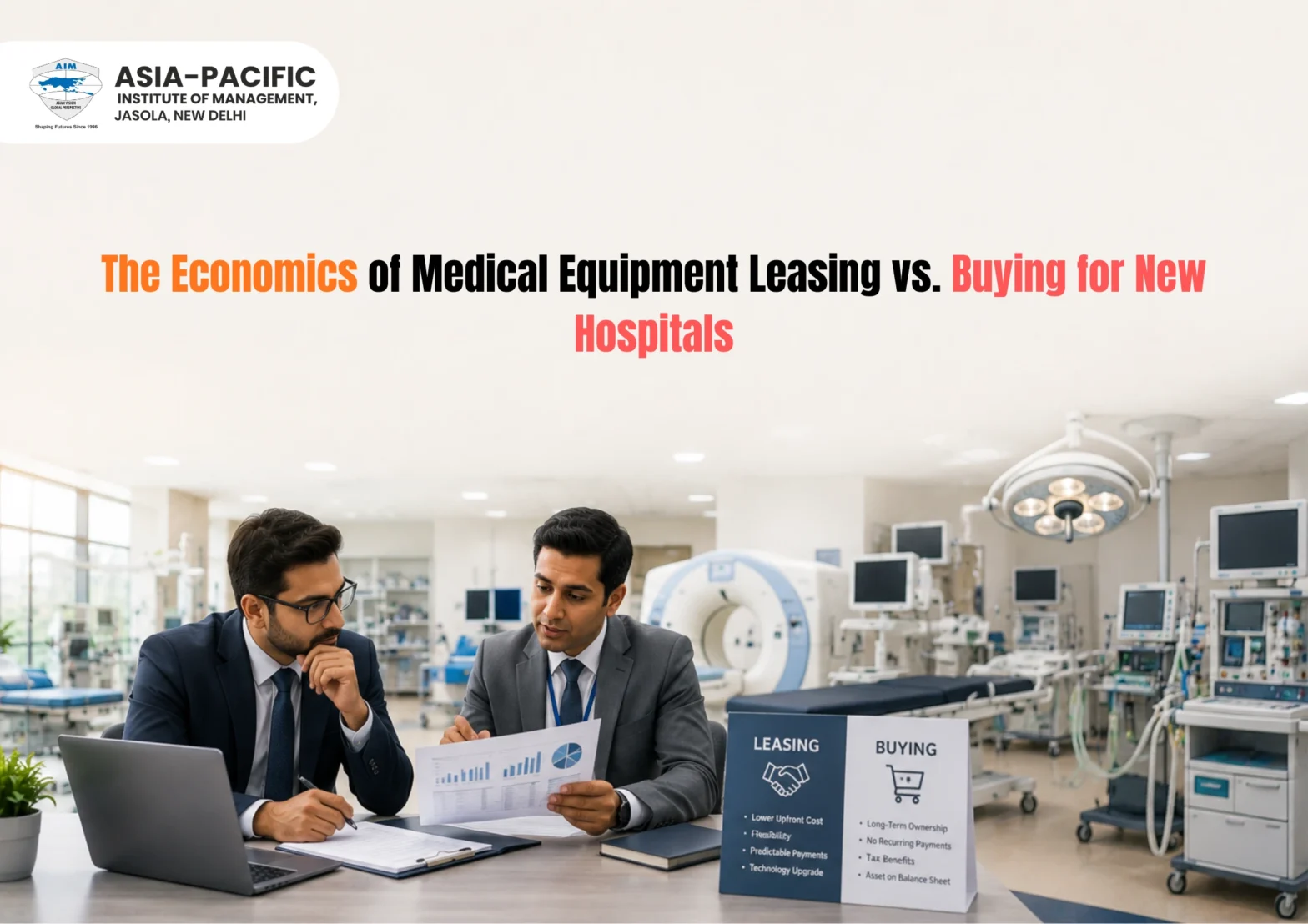
The Economics of Medical Equipment Leasing vs. Buying for New Hospitals
Posted on 29 Jun 2026
By Dr. Vikas Gupta
Introduction
Hospital asset management is one of the most important financial decisions for a new hospital. A hospital may have good doctors, a strong location, and patient demand. However, poor decisions on medical equipment can create cash-flow pressure, underused machines, high maintenance costs, and weak return on investment.
For new hospitals, the biggest question is often simple: Should we lease medical equipment or buy it?
This question becomes even more important for high-cost equipment such as MRI machines, CT scanners, ultrasound systems, ventilators, cath lab equipment, modular OT systems, and diagnostic machinery.
India’s medical devices market is also expanding fast. IBEF projects India’s medical devices market to grow from US$15.2 billion in 2025 to US$50.1 billion by 2030. This growth makes hospital equipment planning a critical management skill.
Master Asset Planning
Build practical skills in hospital asset planning, procurement, and ROI analysis for smarter healthcare operations leadership and career growth.
Hospital asset management is the process of planning, purchasing, leasing, maintaining, tracking, and optimising hospital equipment and infrastructure.
It includes decisions related to:
Medical equipment purchase
Equipment leasing
Maintenance contracts
Depreciation planning
Vendor selection
Equipment utilisation
Downtime control
Replacement planning
Compliance documentation
Return on investment
For new hospitals, asset management is not only an operations function. It is also a financial strategy.
A hospital that buys too much equipment too early may face cash-flow stress. However, a hospital that leases everything without planning may pay higher long-term costs.
Why Leasing vs Buying Matters for New Hospitals
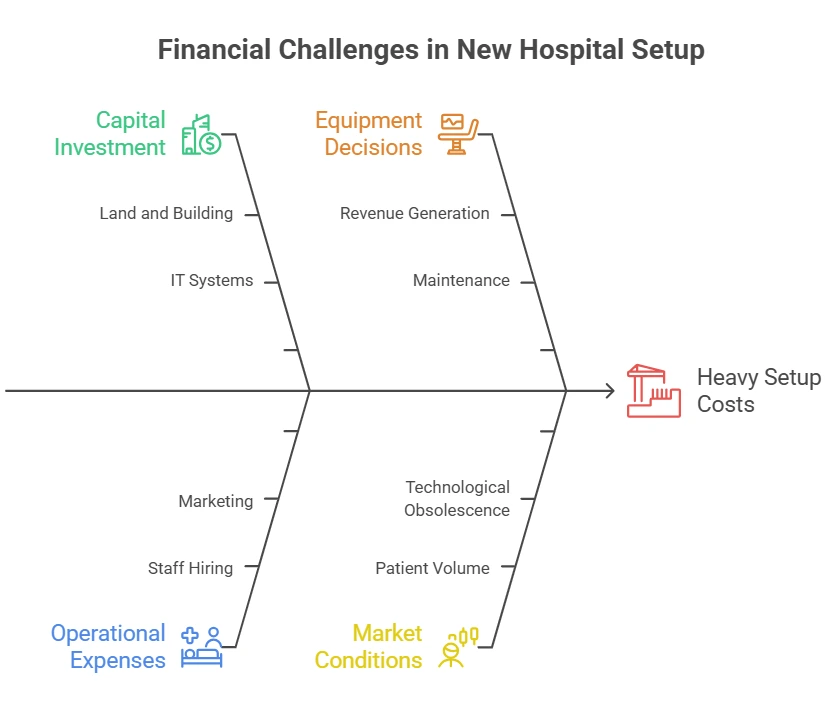
New hospitals usually face heavy setup costs. They must invest in land, building, interiors, beds, IT systems, staff hiring, licenses, medical equipment, marketing, and working capital.
Therefore, every equipment decision affects the hospital’s financial health.
A new hospital must ask:
Will the equipment generate enough revenue?
How many patients will use it daily?
Can the hospital afford the upfront cost?
Will the machine become outdated quickly?
Who will maintain the machine?
What happens if patient volume is lower than expected?
Is leasing cheaper in the short term?
Is buying better in the long term?
Good hospital asset management answers these questions before money is spent.
Buying Medical Equipment: What It Means
Buying means the hospital owns the equipment. The hospital pays upfront or through a loan. It also becomes responsible for installation, maintenance, insurance, downtime, upgrades, and replacement.
Buying is useful when the equipment is essential, frequently used, and financially viable.
For example, a hospital may buy basic equipment such as monitors, beds, oxygen systems, ultrasound machines, sterilisation units, and lab equipment if daily usage is predictable.
However, buying high-end machinery can be risky for new hospitals if patient volume is uncertain.
Leasing Medical Equipment: What It Means
Leasing means the hospital uses the equipment for a fixed period by paying monthly, quarterly, or usage-based charges. The vendor or leasing partner may own the asset.
Leasing may include:
Fixed monthly lease
Pay-per-use model
Revenue-sharing model
Operating lease
Finance lease
Managed equipment service
Rental model for short-term use
Leasing is useful when the hospital wants access to expensive technology without heavy upfront investment.
However, lease contracts must be studied carefully. The total cost over time may become higher than buying.
This process helps hospital managers decide if a medical device will generate enough value.
A good capital budgeting process should include:
Equipment cost Include purchase price, installation, site preparation, software, accessories, and taxes.
Expected patient volume Estimate daily, monthly, and yearly usage.
Revenue per procedure Calculate expected billing per scan, test, surgery, or procedure.
Operating cost Include staff, consumables, electricity, maintenance, reporting, and downtime.
Financing cost Include loan interest or lease payments.
Depreciation and useful life Consider how long the equipment will remain useful.
Replacement risk Some technologies become outdated faster than others.
Regulatory and quality requirements Include calibration, safety checks, and documentation.
Research on healthcare budgeting notes that capital budgeting in hospitals is complex because physicians and clinical teams influence investment decisions, while the financial responsibility often sits with hospital management.
MRI Machine Leasing Cost: What New Hospitals Should Know
Many hospital planners search for mri machine leasing cost because MRI machines require high capital investment.
Public vendor estimates suggest that a new 1.5T MRI system in India may cost several crores. One 2025 estimate places a new 1.5 Tesla MRI machine around ₹4.5 crore to ₹6.5 crore, depending on specifications and condition. Another industry estimate places new 1.5T MRI systems around ₹5 crore to ₹10 crore, depending on make, model, configuration, and features.
However, the lease cost is usually quote-based. It depends on:
Machine type
Magnet strength
Brand and model
New or refurbished status
Lease tenure
Monthly scan volume
Maintenance inclusion
Uptime guarantee
Software package
Coils and accessories
Installation requirements
Revenue-sharing terms
Therefore, new hospitals should not compare only monthly lease rentals. They should compare total cost of ownership and total cost of usage.
Buying vs Leasing: Key Financial Comparison
Factor
Buying Equipment
Leasing Equipment
Upfront cost
High
Lower
Ownership
Hospital owns asset
Vendor or lessor owns asset
Cash flow impact
Heavy initial pressure
Spread over time
Maintenance
Hospital responsibility unless AMC included
Often included in contract
Technology upgrade
Hospital bears upgrade cost
Easier if contract allows upgrade
Long-term cost
May be lower if utilisation is high
May be higher over long period
Risk if volume is low
Higher
Lower
Flexibility
Lower
Higher
Best for
High-use essential equipment
Expensive or uncertain-volume equipment
For new hospitals, leasing may reduce early financial pressure. However, buying may be better when demand is stable and the machine will be used heavily.
ROI on Medical Machinery
ROI on medical machinery helps hospital managers understand whether equipment is financially justified.
A simple ROI formula is:
ROI = Net Profit from Equipment ÷ Total Investment × 100
For example, assume a hospital buys a diagnostic machine.
It should estimate:
Number of procedures per month
Average revenue per procedure
Consumable cost
Staff cost
Maintenance cost
Electricity cost
Financing cost
Downtime loss
Referral revenue impact
A machine may look profitable based on billing alone. However, true ROI comes after deducting operating costs.
For high-end devices, the hospital should also calculate payback period.
Payback Period = Total Investment ÷ Annual Net Cash Flow
If a machine costs ₹5 crore and generates ₹1 crore net cash flow per year, the payback period is five years.
However, this calculation must include realistic patient volume. Overestimating volume is one of the biggest mistakes in hospital asset planning.
New hospitals should follow a structured procurement process.
1. Classify Equipment by Priority
Equipment can be divided into:
Must-have equipment
Revenue-generating equipment
Support equipment
Luxury or brand-building equipment
Future-expansion equipment
This helps management avoid buying expensive machines before demand exists.
2. Prepare a Utilisation Forecast
Hospitals should estimate expected usage for each machine.
For example, a new hospital should not buy an MRI only because competitors have one. It should check referral demand, doctor availability, radiologist support, local pricing, and patient affordability.
3. Compare Buy, Lease, and Outsource Models
Some services can be outsourced initially. Others can be leased. Core equipment may be purchased.
This blended strategy protects cash flow.
4. Include Maintenance in Procurement Planning
Maintenance cost can be significant. Therefore, the hospital should compare warranty, AMC, CMC, spare parts, uptime, and service response time.
5. Involve Clinical and Finance Teams
Doctors may focus on clinical features. Finance teams may focus on cost. Operations teams may focus on utilisation.
Good procurement decisions need all three perspectives.
Medical Vendor Negotiation: What Hospitals Should Ask
Buying looks simple when hospitals compare only purchase price. However, hidden costs can change the economics.
Common hidden costs include:
Site preparation
Shielding and civil work
Power backup
HVAC requirements
Calibration
Accessories
Software licenses
Staff training
AMC after warranty
Insurance
Spare parts
Downtime loss
Disposal cost
For example, high-end diagnostic equipment may need special room design, radiation safety approvals, power conditioning, and trained staff.
Therefore, hospitals should calculate total project cost, not just equipment price.
Hidden Costs in Leasing Medical Equipment
Leasing also has hidden costs.
Hospitals should check:
Security deposit
Lock-in period
Minimum usage commitment
Early termination penalty
Consumable tie-in
Maintenance exclusions
Software update charges
Transport and installation cost
Insurance responsibility
Damage liability
Uptime clauses
End-of-lease return conditions
A lease may look affordable at first. However, a restrictive contract can reduce flexibility.
This is why hospital managers must read the complete agreement with finance, operations, legal, and clinical teams.
Accounting and Depreciation Considerations
Asset decisions also affect accounting and tax planning.
The Indian Income Tax Department’s depreciation table includes medical and diagnostic equipment such as CT scan, ultrasound machines, and ECG monitors under plant and machinery used in medical and surgical operations. It lists useful life details for these assets under the applicable depreciation framework.
Lease accounting may also matter for hospitals following Ind AS. Ind AS 116 sets principles for recognition, measurement, presentation, and disclosure of leases. It aims to help users assess the impact of leases on financial position, performance, and cash flows.
Therefore, hospitals should consult finance and accounting professionals before finalising large lease or purchase contracts.
When Buying Makes More Sense
Buying may be better when:
Patient volume is predictable
Equipment is used daily
Technology is stable
The hospital has enough capital
Long-term cost is lower than leasing
The machine is central to hospital positioning
The hospital wants full control
Maintenance support is reliable
For example, a high-volume hospital with strong radiology demand may benefit from buying diagnostic equipment if utilisation is high.
Buying can also improve long-term margins after the payback period.
For example, a new hospital may lease high-end diagnostic equipment until patient demand becomes stable.
Leasing can also help hospitals offer advanced services without blocking large capital.
Buy, Lease, or Outsource: A Practical Decision Matrix
Situation
Better Option
High volume and stable demand
Buy
Low volume and uncertain demand
Lease or outsource
Technology changes quickly
Lease
Strong cash reserves
Buy
Limited cash flow
Lease
Need service quickly
Lease
Need full control
Buy
Testing a new department
Lease or outsource
Core hospital service
Buy or long-term managed model
This matrix helps new hospitals avoid emotional purchases.
The best decision depends on demand, cost, technology, risk, and strategy.
How Hospital Asset Management Improves Profitability
Good hospital asset management improves profitability in several ways.
It helps hospitals:
Avoid unnecessary purchases
Improve equipment utilisation
Reduce downtime
Control maintenance costs
Improve patient service availability
Plan replacement cycles
Track asset performance
Reduce theft or misuse
Improve compliance
Strengthen financial planning
Additionally, asset management helps hospitals decide when to upgrade, replace, lease, or retire equipment.
This becomes important because India remains dependent on several imported high-end medical devices. The government reported that production has started for 57 products under a medical devices manufacturing scheme, including MRI, ultrasound, CT scans, mammograms, C-arm, and X-ray machines.
Skills Healthcare Managers Need for Equipment Decisions
Students who want to work in hospital operations or healthcare management should build financial and procurement skills.
Important skills include:
Hospital asset management
Capital budgeting
Procurement planning
Vendor negotiation
Financial analysis
ROI calculation
Contract review
Equipment utilisation tracking
Maintenance planning
Compliance awareness
Data analysis
Cross-functional coordination
At Asia Pacific Institute of Management, students gain industry-oriented learning, practical exposure, experienced faculty guidance, and placement support. These elements help students prepare for healthcare operations, hospital administration, and healthcare business management roles.
Career Opportunities in Hospital Asset Management
Hospital asset management opens career paths in healthcare operations and administration.
Students can explore roles such as:
Hospital Operations Executive
Biomedical Equipment Coordinator
Procurement Executive
Healthcare Finance Analyst
Hospital Administrator
Vendor Management Executive
Medical Equipment Planning Executive
Asset Management Executive
Healthcare Operations Analyst
Facility Management Coordinator
With experience, professionals can grow into:
Hospital Operations Manager
Procurement Manager
Asset Management Head
Biomedical Services Manager
Healthcare Project Manager
Hospital Administrator
Chief Operating Officer
This field is ideal for students who enjoy finance, healthcare, operations, technology, and negotiation.
Hospital asset management is a critical success factor for new hospitals. The decision to lease or buy medical equipment affects cash flow, patient services, profitability, and long-term growth.
Buying may be better for high-use, essential equipment. Leasing may be better for expensive machines, uncertain demand, and fast-changing technology. However, the right decision depends on utilisation, ROI, maintenance, vendor terms, and hospital strategy.
For healthcare management students, this topic offers valuable career learning. Hospitals need managers who can combine financial thinking, procurement strategy, operations planning, and patient-service goals.
Asia Pacific Institute of Management helps students build practical management skills for healthcare operations, hospital administration, procurement, and healthcare business leadership.
Build Finance Edge
Prepare for hospital administration roles with asset management, capital budgeting, procurement strategy, and healthcare finance skills for career growth.
Dr. Vikas Gupta is a distinguished academic in the education and research domain, specializing in finance and related interdisciplinary studies. He is known for his...
Hospital asset management is the process of planning, purchasing, leasing, maintaining, tracking, and optimising medical equipment and hospital assets for better utilisation and financial performance.
02.
Is leasing medical equipment better than buying?
Leasing is better when patient volume is uncertain, equipment is expensive, or cash flow is limited. Buying is better when usage is high and long-term ownership reduces cost.
03.
What is capital budgeting for medical devices?
Capital budgeting for medical devices is the financial process of evaluating whether a hospital should invest in expensive equipment based on cost, revenue, risk, and return.
05.
How do hospitals calculate ROI on medical machinery?
Hospitals calculate ROI by comparing net profit from the machine with total investment. They also calculate payback period, utilisation, downtime, and maintenance costs.
06.
Why is hospital procurement strategy important?
Hospital procurement strategy helps hospitals avoid wasteful purchases, negotiate better vendor terms, control costs, and choose between buying, leasing, or outsourcing.
07.
What should hospitals negotiate with medical vendors?
Hospitals should negotiate price, warranty, AMC, uptime, training, software updates, spare parts, consumables, payment terms, buyback, and upgrade options.

















.webp) Call Us
Call Us