The marketing industry has undergone a dramatic transformation over the last decade. Traditional advertising channels are no longer the sole drivers of consumer engagement. Today, businesses rely on digital platforms, data analytics, artificial intelligence, and e-commerce ecosystems to attract, engage, and retain customers.
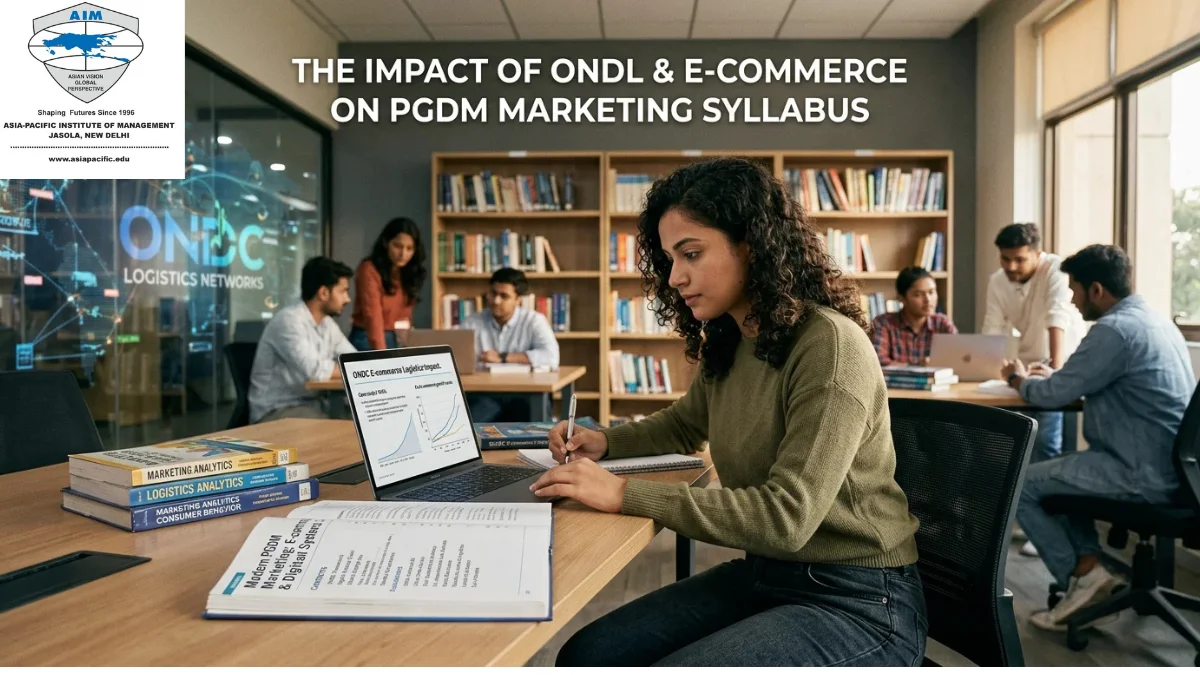
One of the most significant developments in India’s digital economy is the rise of the Open Network for Digital Commerce (ONDC). Combined with the rapid growth of e-commerce, ONDC is reshaping how businesses operate and how marketers approach customer acquisition and brand building.
As a result, management education is evolving to meet industry demands. The future of marketing management now depends on a combination of strategic thinking, digital expertise, data literacy, and technology-driven decision-making.
This shift is influencing how PGDM marketing programs are designed, taught, and delivered across leading management institutions.
Bonus: PGDM in Marketing: Career Scope and Opportunities
Master Modern Marketing
Build in-demand marketing skills through industry-focused PGDM learning designed for evolving digital commerce and leadership opportunities.
Apply Now
→
Understanding ONDC and Its Growing Influence on Indian Commerce
What is ONDC?
The Open Network for Digital Commerce (ONDC) is an initiative aimed at creating an open and interoperable digital commerce ecosystem. Unlike closed marketplace models, ONDC enables buyers and sellers to connect across different digital platforms, making online commerce more accessible and competitive.
The initiative seeks to democratize digital commerce by reducing barriers for businesses, particularly small and medium enterprises.
How ONDC Differs from Traditional E-commerce Platforms
Traditional e-commerce platforms typically operate within their own ecosystems. Businesses often depend on a single platform for visibility and customer acquisition.
ONDC introduces a network-based approach where buyers and sellers can interact across multiple participating platforms.
This shift encourages:
- Greater market access
- Increased competition
- Improved consumer choice
- Broader business participation
Why Businesses Are Paying Attention
Organizations recognize that ONDC has the potential to redefine customer discovery, digital transactions, and online marketing strategies.
As digital commerce expands, marketers must understand these evolving ecosystems to remain competitive.
How E-commerce Has Changed Modern Marketing
The growth of e-commerce has transformed nearly every aspect of marketing.
Shift from Traditional to Digital Channels
Consumers increasingly research products, compare alternatives, and make purchasing decisions online.
Businesses have therefore shifted significant marketing investments toward digital channels.
Rise of Data-Driven Marketing
Marketing decisions are no longer based solely on intuition.
Organizations now rely on:
- Customer data
- Behavioral insights
- Campaign analytics
- Performance metrics
to optimize marketing outcomes.
Personalized Customer Experiences
Consumers expect relevant and personalized interactions.
Modern marketing strategies increasingly focus on delivering customized experiences across multiple touchpoints.
Omnichannel Consumer Journeys
Today's customers interact with brands through websites, mobile applications, social media platforms, marketplaces, and physical stores.
Marketers must manage seamless experiences across all channels.
Performance Marketing Growth
Businesses now expect measurable outcomes from marketing investments.
As a result, performance-driven approaches continue to gain importance.
The Future of Marketing Management in a Digital-First Economy
The future of marketing management is closely tied to technology and consumer intelligence.
Customer-Centric Marketing
Organizations increasingly place customer needs at the center of marketing strategy.
Marketing Automation
Automation tools help businesses manage communication, lead nurturing, and customer engagement more efficiently.
AI-Driven Campaign Management
Artificial intelligence enables marketers to improve targeting, optimize content, and predict customer behavior.
Predictive Analytics
Predictive models help organizations anticipate future customer actions and market trends.
Real-Time Consumer Insights
Access to real-time data allows marketers to respond quickly to changing customer preferences.
Future marketing leaders must therefore combine traditional management knowledge with technological capabilities.
How PGDM Marketing Syllabi Are Evolving
Management institutions are adapting their curricula to reflect changing industry requirements.
Traditional Marketing Foundations Still Matter
Core concepts remain essential, including:
- Consumer behavior
- Marketing strategy
- Brand management
- Market research
These fundamentals continue to provide the foundation for effective marketing leadership.
Integration of Digital Marketing
Modern curricula increasingly incorporate digital marketing concepts and tools.
E-commerce Strategy Modules
Students learn how online marketplaces, digital commerce ecosystems, and customer acquisition strategies influence business growth.
Marketing Analytics
Data interpretation has become a critical component of marketing education.
Consumer Data Interpretation
Understanding customer behavior through analytics is now a key managerial skill.
Digital Brand Management
Students learn how brands build visibility and engagement across digital channels.
Marketing Technology Platforms
Exposure to marketing technologies helps students understand modern campaign management systems.
Bonus: PGDM in Digital Marketing: Future Career Trends
New Skills Marketing Students Must Develop
To succeed in a rapidly evolving business environment, students must develop diverse competencies.
Data Analysis Skills
The ability to interpret marketing data supports better decision-making.
Digital Marketing Expertise
Students should understand:
- Search marketing
- Social media marketing
- Content strategy
- Performance marketing
Consumer Behavior Analysis
Understanding customer motivations remains central to marketing success.
Content Strategy
Content continues to play a vital role in customer engagement.
Performance Marketing
Organizations increasingly prioritize measurable business outcomes.
Business Communication
Strong communication skills support leadership and stakeholder management.
Strategic Thinking
Future marketing leaders must connect customer insights with business objectives.
Shape Commerce Future
Gain strategic business insights and marketing expertise to thrive in India's rapidly transforming digital marketplace landscape.
Apply Now
→
Why Analytics Is Becoming Essential for Marketing Professionals
Marketing and analytics are becoming increasingly interconnected.
Organizations rely on analytics to understand customers, optimize campaigns, and improve business performance.
Marketing Analytics and Business Growth
Analytics helps organizations:
- Identify customer trends
- Improve campaign performance
- Enhance targeting strategies
- Support strategic planning
Growing Importance of Big Data
Modern marketers frequently work with large volumes of customer and business information.
As a result, concepts related to Big Data Analytics, Big Data Analytics Courses, Big Data Analytics in Cloud Computing, Big Data, BDA, BDA Courses, and Big Data Courses are becoming increasingly relevant.
Integration of Analytics into Management Education
Students interested in data-driven decision-making often explore:
- PGDM in Data Analytics
- Diploma in Data Analytics
- Programs offered by an Institute of Analytics
Many prospective students researching a Data Analyst Course Fee in Delhi also evaluate management programs that integrate analytics with business education.
This interdisciplinary approach reflects the evolving demands of the marketing profession.
Career Opportunities Emerging from E-commerce and ONDC Growth
The expansion of digital commerce is creating new career opportunities for management graduates.
Digital Marketing Manager
Professionals oversee digital campaigns, customer engagement, and online growth initiatives.
E-commerce Manager
These professionals manage online sales channels and marketplace strategies.
Brand Strategist
Brand strategists develop positioning and communication plans.
Marketing Analyst
Analysts use data to support marketing decision-making.
Performance Marketing Specialist
Specialists focus on measurable marketing outcomes and campaign optimization.
Consumer Insights Manager
These professionals translate customer data into actionable business strategies.
Product Marketing Professional
Product marketers help organizations launch and position products effectively.
Why Marketing Students Should Consider Dual-Specialization Learning
The complexity of modern business environments has increased demand for multidisciplinary professionals.
Marketing + Analytics
Combining marketing with analytics improves decision-making capabilities.
Marketing + Finance
Financial understanding helps marketers evaluate profitability and investment outcomes.
Marketing + Digital Business
Knowledge of digital commerce ecosystems supports long-term career growth.
A Dual Specialization in PGDM can help students build a broader skill set and improve career flexibility.
Choosing the Right PGDM Program for Future Marketing Careers
Selecting the right institution is an important career decision.
Students researching a PGDM in Delhi, PGDM Program, PGDM Course, Post Graduate Diploma in Management, Post Graduate Diploma in Management PGDM, PGDM Courses in Delhi NCR, PGDM Course in Delhi, PGDM Institute in Delhi, or PGDM Colleges in Delhi NCR should evaluate programs carefully.
Industry-Oriented Curriculum
The curriculum should align with current marketing and business trends.
Marketing Technology Exposure
Students should gain exposure to modern marketing tools and platforms.
Corporate Projects
Industry-linked projects improve practical learning.
Internship Opportunities
Internships provide valuable workplace experience.
Placement Support
Career development initiatives contribute to professional readiness.
Students exploring a PGDM in Marketing, Post Graduate Diploma in Marketing, PGDM in Digital Marketing, Marketing Program, PGDM in Marketing Management, PGD in Marketing Management, or related Marketing Diploma Courses should prioritize programs that balance theory and practical application.
Bonus: PGDM in Data Analytics: Skills for Future Managers
Why Students Consider Asia Pacific Institute of Management for Marketing Education
Students seeking future-ready management education often evaluate institutions based on industry relevance and practical learning opportunities.
Industry-Aligned Curriculum
Asia Pacific Institute of Management emphasizes contemporary business education aligned with evolving market requirements.
Marketing and Analytics Exposure
Students gain exposure to both traditional marketing concepts and emerging business trends.
Corporate Engagement
Industry interactions provide valuable professional insights.
Experienced Faculty
Faculty members bring academic expertise and industry perspectives to the classroom.
Placement Support
Career development initiatives help students prepare for internships and professional opportunities.
Practical Learning Environment
Projects, case studies, and experiential learning activities encourage application-oriented learning.
What the Next Decade Means for Marketing Professionals
The coming decade is expected to bring even greater transformation.
Growth of Digital Commerce
Digital transactions and online business ecosystems will continue expanding.
AI-Powered Marketing
Artificial intelligence will increasingly support personalization and decision-making.
Data-Centric Decision Making
Organizations will continue investing in analytics-driven strategies.
Consumer Experience Management
Customer experience will remain a key competitive differentiator.
Increased Demand for Marketing Leaders
Organizations will seek professionals who can combine strategic thinking, technology awareness, and customer understanding.
The future belongs to marketers who embrace continuous learning and adapt to changing business environments.
Conclusion
The rise of ONDC and e-commerce is transforming not only how businesses operate but also how future marketers are educated. The future of marketing management requires professionals who understand both traditional business principles and emerging digital ecosystems.
As customer behavior becomes increasingly data-driven and technology-enabled, management education must evolve to equip students with relevant skills in analytics, digital commerce, performance marketing, and strategic decision-making.
For aspiring marketing professionals, choosing a PGDM program that combines industry exposure, practical learning, analytics capabilities, and modern marketing education can provide a strong foundation for success in the rapidly changing world of business.
Become Marketing Leader
Prepare for high-growth marketing careers with practical exposure, expert mentorship, and industry-relevant management education experiences.
Apply Now
→
About the Author
Dr. Vikas Gupta
Dr. Vikas Gupta is a distinguished academic in the education and research domain, specializing in finance and related interdisciplinary studies. He is known for his...
Read Full Bio →













.webp) Call Us
Call Us




