Top 25 Hospital Administrator Interview Questions and Answers (With Expert Sample Answers)
Posted on 16 Jul 2026
By Dr. Vikas Gupta
Hospital administration is one of the fastest-growing career paths in the healthcare industry. As hospitals continue to adopt advanced technologies and focus on delivering quality patient care, the demand for skilled administrators has increased significantly. Whether you're a healthcare graduate, an MHA student, or a clinical professional transitioning into an administrative role, preparing for your interview is the key to success.
This guide covers the top hospital administrator interview questions and answers that hiring managers commonly ask. By practicing these questions, you can improve your communication skills, demonstrate your leadership abilities, and confidently handle administrative interview rounds.
Ace Your Interview
Master medical management processes by learning structured responses to core leadership queries. Secure top hospital executive positions with a premium MBA.
A hospital administrator is responsible for managing the daily operations of a healthcare facility. The role involves supervising staff, overseeing budgets, maintaining compliance with healthcare regulations, improving patient satisfaction, and ensuring that hospital services run efficiently. Successful administrators balance operational efficiency with high-quality patient care while supporting both medical and non-medical teams.
How to Prepare for a Hospital Administration Interview
Preparation can make a significant difference in your interview performance. Follow these practical tips before attending your interview:
Research the hospital's mission, services, and values.
Understand healthcare regulations and quality standards.
Review budgeting and hospital operations basics.
Prepare leadership and conflict-resolution examples.
Practice answering behavioral interview questions using the STAR method.
Stay informed about current healthcare trends and challenges.
Top 25 Hospital Administrator Interview Questions and Answers
1. Tell me about yourself.
Why Interviewers Ask This: This question helps interviewers understand your background and determine whether your experience aligns with the role.
Sample Answer: "I have a background in healthcare management with experience in hospital operations, team coordination, and administrative support. My strengths include leadership, communication, and problem-solving. I enjoy improving operational efficiency while ensuring patients receive high-quality care."
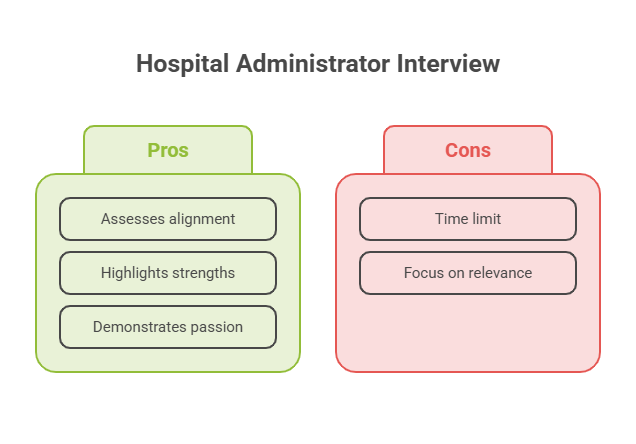
Pro Tip: Keep your answer under two minutes and focus on relevant experience.
2. Why do you want to work in hospital administration?
Why Interviewers Ask This: Interviewers want to understand your motivation and long-term career goals.
Sample Answer: "I am passionate about improving healthcare delivery through effective management. Hospital administration allows me to combine leadership, strategic planning, and patient-focused decision-making while contributing to organizational success."
Pro Tip: Connect your answer to improving patient care rather than simply managing operations.
3. What qualities make an effective hospital administrator?
Why Interviewers Ask This: They want to assess your understanding of the responsibilities associated with the role.
Sample Answer: "An effective hospital administrator demonstrates leadership, communication, financial management, analytical thinking, adaptability, and a strong understanding of healthcare regulations. These qualities help maintain operational efficiency and deliver quality patient care."
Pro Tip: Mention both technical and interpersonal skills.
4. How do you handle conflicts between hospital staff?
Why Interviewers Ask This: Conflict resolution is essential in a multidisciplinary healthcare environment.
Sample Answer: "I encourage open communication, listen to each person's concerns without bias, identify the root cause of the conflict, and work collaboratively toward a solution that benefits both the team and patient care."
Pro Tip: Emphasize fairness and professionalism.
5. Describe your leadership style.
Why Interviewers Ask This: Employers want to understand how you motivate and manage teams.
Sample Answer: "My leadership style is collaborative and supportive. I encourage open communication, delegate responsibilities effectively, and empower team members to contribute ideas while maintaining accountability."
Pro Tip: Support your answer with a real leadership example whenever possible.
6. How do you prioritize multiple responsibilities?
Why Interviewers Ask This: Hospital administrators often manage several priorities simultaneously.
Sample Answer: "I prioritize tasks based on urgency, patient impact, and organizational goals. I use planning tools, delegate responsibilities when appropriate, and regularly review progress to ensure deadlines are met."
Pro Tip: Demonstrate strong organizational skills.
7. How would you improve patient satisfaction?
Why Interviewers Ask This: Patient experience is a critical performance indicator for hospitals.
Sample Answer: "I would regularly analyze patient feedback, reduce waiting times, improve communication between staff and patients, and implement continuous quality improvement initiatives to enhance the overall patient experience."
Pro Tip: Mention measurable outcomes whenever possible.
8. What healthcare regulations are you familiar with?
Why Interviewers Ask This: Compliance is a major responsibility for hospital administrators.
Sample Answer: "I am familiar with healthcare compliance standards, patient confidentiality requirements, accreditation guidelines, workplace safety regulations, and quality assurance processes that support safe and ethical healthcare delivery."
Pro Tip: Mention regulations relevant to your country or healthcare system.
9. How do you manage hospital budgets?
Why Interviewers Ask This: Financial management is an important administrative responsibility.
Sample Answer: "I monitor expenses, review financial reports, identify opportunities for cost optimization, allocate resources efficiently, and ensure financial decisions support both operational needs and quality patient care."
Pro Tip: Show that you can balance cost control with patient outcomes.
Sample Answer: "I motivate employees by recognizing achievements, providing constructive feedback, encouraging professional development, and creating a positive work environment built on trust and collaboration."
Pro Tip: Focus on long-term employee engagement rather than financial rewards alone.
11. How do you ensure hospital compliance?
Why Interviewers Ask This: Hospitals must consistently meet regulatory and accreditation requirements.
Sample Answer: "I ensure compliance through regular internal audits, staff training, policy updates, documentation reviews, and continuous monitoring of healthcare standards."
Pro Tip: Mention preventive measures instead of corrective actions alone.
12. What would you do during a hospital emergency?
Why Interviewers Ask This: This question evaluates your crisis management and decision-making abilities.
Sample Answer: "I would follow established emergency protocols, coordinate departments, communicate clearly with stakeholders, allocate resources efficiently, and prioritize patient and staff safety throughout the emergency."
Pro Tip: Stay calm and highlight structured decision-making.
13. How do you improve hospital efficiency?
Why Interviewers Ask This: Hospitals continuously seek leaders who can improve productivity without compromising quality.
Sample Answer: "I analyze workflows, identify operational bottlenecks, implement technology where appropriate, monitor performance indicators, and encourage continuous improvement across departments."
Pro Tip: Mention data-driven decision-making and measurable improvements whenever possible. 14. Describe a difficult management decision you have made.
Why Interviewers Ask This: They want to evaluate your decision-making skills under pressure.
Sample Answer: "In a previous role, I had to reorganize staff schedules to address a staffing shortage. I analyzed workload data, consulted department heads, and communicated the changes transparently. The new schedule improved productivity while maintaining quality patient care."
Pro Tip: Use the STAR (Situation, Task, Action, Result) method to structure your response.
15. How do you handle patient complaints?
Why Interviewers Ask This: Patient satisfaction plays a crucial role in a hospital's reputation.
Sample Answer: "I listen carefully to the patient's concerns, acknowledge their experience, investigate the issue promptly, and communicate the resolution clearly. I also identify opportunities to prevent similar issues in the future."
Pro Tip: Show empathy while demonstrating your problem-solving skills.
16. Which Key Performance Indicators (KPIs) should a hospital administrator monitor?
Why Interviewers Ask This: Interviewers want to assess your understanding of hospital performance metrics.
Sample Answer: "I would monitor patient satisfaction scores, bed occupancy rates, average length of stay, readmission rates, staff productivity, financial performance, infection rates, and compliance indicators."
Pro Tip: Mention both operational and patient-care metrics.
17. How do you manage organizational change?
Why Interviewers Ask This: Healthcare organizations regularly implement new technologies, policies, and procedures.
Sample Answer: "I communicate the purpose of the change clearly, involve stakeholders early, provide training, address concerns, and monitor progress to ensure a smooth transition."
Pro Tip: Highlight communication and employee engagement.
18. What hospital management software have you used?
Why Interviewers Ask This: They want to understand your technical proficiency.
Sample Answer: "I have experience with Hospital Information Systems (HIS), Electronic Medical Records (EMR), scheduling software, billing systems, and reporting tools. I can quickly adapt to new healthcare technologies."
Pro Tip: Mention the systems you've actually used rather than listing unfamiliar software.
19. How do you ensure patient confidentiality?
Why Interviewers Ask This: Protecting patient information is a critical responsibility.
Sample Answer: "I ensure patient confidentiality by following data privacy policies, restricting access to sensitive information, conducting staff training, and promoting secure documentation practices."
Pro Tip: Emphasize ethics as well as compliance.
20. How do you reduce hospital costs without affecting quality?
Why Interviewers Ask This: Hospitals seek administrators who can improve financial performance while maintaining excellent patient care.
Sample Answer: "I focus on reducing waste, improving resource utilization, optimizing procurement processes, and implementing efficient workflows without compromising patient safety or service quality."
Pro Tip: Show that quality care remains your top priority.
21. Why should we hire you?
Why Interviewers Ask This: This question helps interviewers understand your unique value.
Sample Answer: "My combination of healthcare knowledge, leadership skills, organizational abilities, and commitment to patient-centered care enables me to contribute effectively to hospital operations while supporting continuous improvement."
Pro Tip: Tailor your answer to the organization's specific needs.
22. Where do you see yourself in five years?
Why Interviewers Ask This: They want to assess your career goals and long-term commitment.
Sample Answer: "I aim to grow into a senior hospital leadership role where I can contribute to strategic planning, operational excellence, and continuous improvements in healthcare delivery."
Pro Tip: Demonstrate ambition while showing commitment to the organization.
23. How do you stay updated with healthcare trends?
Why Interviewers Ask This: Healthcare regulations and technologies evolve constantly.
Sample Answer: "I regularly read healthcare publications, attend webinars, participate in professional development programs, and follow industry updates to stay informed about emerging trends and best practices."
Pro Tip: Mention credible learning sources and continuous education.
24. What is your greatest strength?
Why Interviewers Ask This: They want to understand what sets you apart from other candidates.
Sample Answer: "My greatest strength is problem-solving. I enjoy analyzing challenges, collaborating with teams, and implementing practical solutions that improve hospital operations and patient experiences."
Pro Tip: Support your answer with a real example.
25. Do you have any questions for us?
Why Interviewers Ask This: Employers value candidates who show genuine interest in the role and organization.
Questions You Can Ask:
What are the hospital's current priorities?
How is success measured in this position?
What opportunities are available for professional development?
What are the biggest challenges facing the administration team?
Pro Tip: Avoid asking about salary or benefits during the first interview unless the interviewer raises the topic.
Common Mistakes to Avoid During a Hospital Administration Interview
Even qualified candidates can make mistakes that affect their chances of success. Avoid these common pitfalls:
Giving generic answers without real examples.
Failing to research the hospital before the interview.
Ignoring questions related to compliance and healthcare regulations.
Speaking negatively about previous employers or colleagues.
Overlooking leadership and communication skills.
Forgetting to ask thoughtful questions at the end of the interview.
Conclusion
Hospital administration interviews evaluate much more than technical knowledge. Employers look for candidates who can lead teams, solve operational challenges, ensure compliance, manage resources efficiently, and contribute to better patient outcomes.
By practicing these hospital administration interview questions and answers, preparing real-life examples, and researching the organization beforehand, you can approach your interview with greater confidence. Focus on communicating your leadership abilities, decision-making skills, and commitment to quality healthcare, and you'll be well-positioned to make a strong impression during the selection process.
Lead Health Systems
Learn specialized administrative skills to guide modern clinical operations successfully. Gain strategic insights from our industry-recognized MBA program today.
Dr. Vikas Gupta is a distinguished academic in the education and research domain, specializing in finance and related interdisciplinary studies. He is known for his...
01.
What are the most common hospital administration interview questions?
Most interviews focus on leadership, budgeting, compliance, conflict resolution, patient satisfaction, hospital operations, and strategic decision-making.
02.
How do I prepare for a hospital administrator interview?
Research the hospital, understand healthcare regulations, practice behavioral interview questions, and prepare examples using the STAR method.
03.
What skills are required for hospital administrators?
Key skills include leadership, communication, financial management, problem-solving, organizational abilities, healthcare compliance knowledge, and strategic planning.
04.
Are behavioral interview questions common in hospital administration interviews?
Yes. Employers frequently ask behavioral questions to evaluate leadership, teamwork, decision-making, and conflict-resolution skills.
05.
Can fresh graduates apply for hospital administration jobs?
Yes. Healthcare graduates and MHA students can apply for entry-level administrative positions by demonstrating strong communication, leadership potential, and an understanding of healthcare operations.

















.webp) Call Us
Call Us