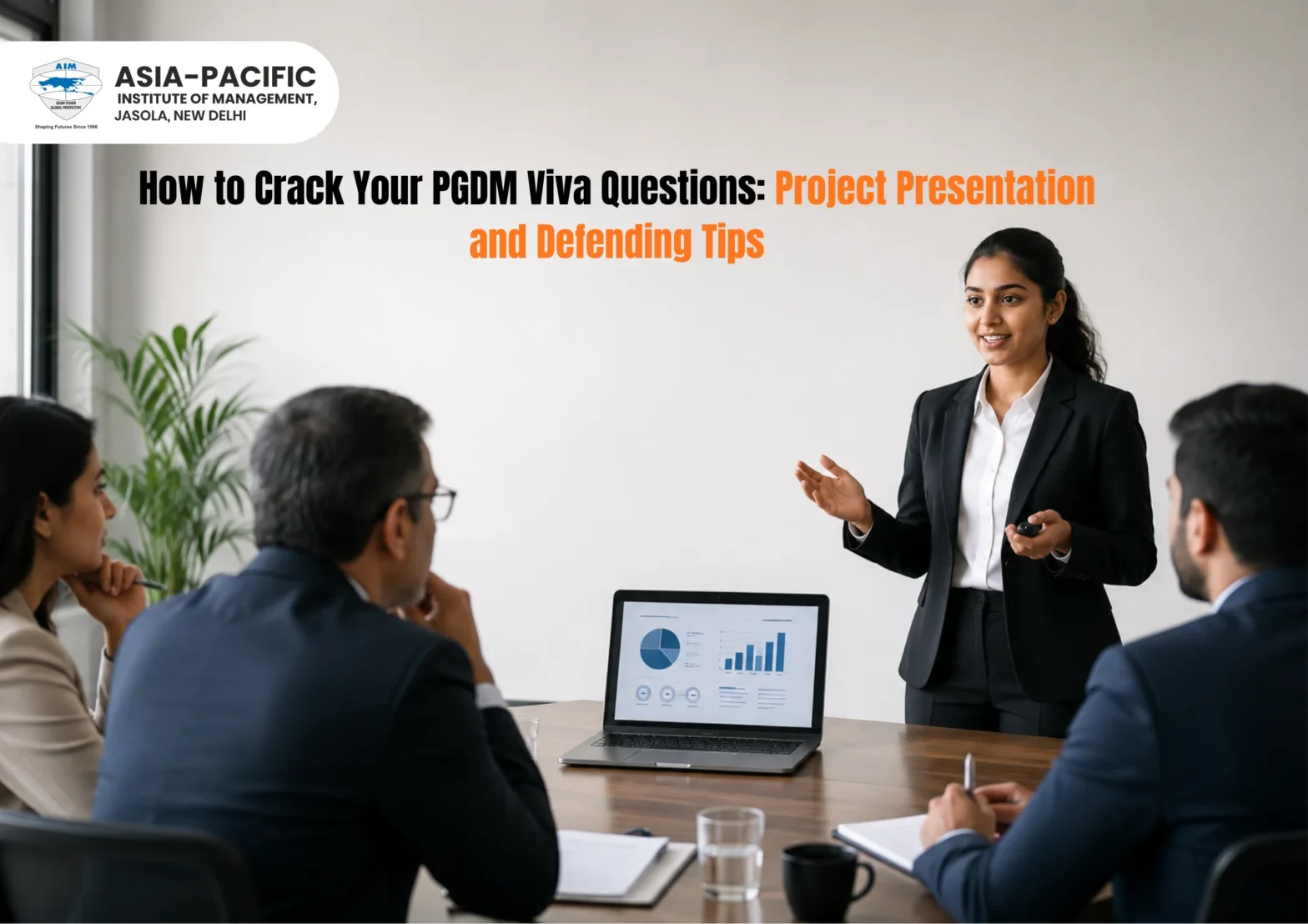
Completing your project is only half the battle. The final hurdle is the viva voce, where external examiners assess not only your research but also your understanding, confidence, and ability to defend your work. Many students spend weeks perfecting their report but underestimate the importance of preparing for PGDM Viva Questions.
Whether you've worked on finance, marketing, human resources, operations, or business analytics, your viva is an opportunity to demonstrate your knowledge and problem-solving skills. With the right preparation strategy, you can confidently answer examiner questions and make a strong impression.
This guide covers the most commonly asked PGDM Viva Questions, practical presentation tips, and a tactical checklist to help you perform well during your final project evaluation.
Ace Your PGDM Viva
Learn core answers to difficult viva board panels. Prepare strategically for defense evaluations and land your ultimate corporate management job role today.
Apply Now
Why Is the PGDM Viva Important?
A viva is more than a question-and-answer session. It evaluates whether you genuinely understand your project and can justify your decisions using logical reasoning and business concepts.
Examiners generally assess:
- Subject knowledge
- Research methodology
- Data interpretation
- Problem-solving ability
- Presentation skills
- Confidence and communication
- Practical application of concepts
Your ability to explain why you made certain choices often matters more than memorizing textbook definitions.
Bonus: PGDM Admission Process
Tactical Preparation Checklist Before Your Viva
Use this checklist a few days before your presentation.
Read your complete project report at least twice.
Memorize your project objectives and problem statement.
Understand every chart, table, and graph.
Revise important concepts related to your specialization.
Prepare answers for possible limitations of your study.
Practice your presentation within the allotted time.
Carry both printed and digital copies of your project.
Dress professionally and arrive early.
Practice speaking confidently without reading from slides.
Structure Your Project Presentation
A well-organized presentation keeps examiners engaged and demonstrates professionalism.
Follow this sequence:
- Introduction
- Problem Statement
- Research Objectives
- Literature Review
- Research Methodology
- Data Collection
- Analysis and Findings
- Recommendations
- Limitations
- Conclusion
Keep slides clean and avoid overcrowding them with text. Use charts and visuals to explain findings wherever possible.
Master Top Answers
Tackle tough project defense panels with absolute ease. Review advanced business frameworks and claim an elite leadership pathway in global industries now.
Apply Now
Top 15 PGDM Viva Questions with Sample Answers
1. Why did you choose this project topic?
Explain how the topic addresses a practical business problem and why it aligns with your career interests.
2. What is the objective of your project?
Clearly state your research objectives in simple language without reading directly from the report.
3. Why did you choose this research methodology?
Explain whether your study required qualitative, quantitative, or mixed research methods and justify your choice.
4. How did you collect your data?
Describe your primary and secondary data sources, sample size, and data collection techniques.
5. What challenges did you face during the project?
Be honest about practical limitations such as limited respondents, time constraints, or data availability, and explain how you managed them.
6. What are the key findings of your research?
Summarize your three or four most important findings instead of discussing every detail.
Bonus: PGDM Specializations Guide
7. What recommendations would you give to the organization?
Provide realistic and actionable recommendations based on your findings.
8. What are the limitations of your study?
Every research project has limitations. Explain them confidently without undermining your work.
9. How is your project relevant to industry?
Connect your findings with current business practices and industry trends.
10. If you had more time, what would you improve?
Discuss expanding the sample size, collecting additional data, or exploring new variables.
11. Which management concepts did you apply?
Mention theories, frameworks, or analytical tools that supported your research.
12. Why should someone trust your conclusions?
Explain how your methodology, data analysis, and findings support your conclusions.
13. What surprised you during the research?
Share one meaningful insight that challenged your expectations.
14. How would you implement your recommendations?
Describe practical steps that organizations can take to apply your suggestions.
15. What did you learn from this project?
Focus on analytical thinking, research skills, teamwork, communication, and business problem-solving.
How to Handle Tricky Examiner Questions
Sometimes examiners ask unexpected questions to test your understanding.
When this happens:
- Listen carefully before answering.
- Take a few seconds to organize your thoughts.
- Admit honestly if you don't know the exact answer.
- Explain your reasoning instead of guessing.
- Stay calm even if challenged.
Remember, examiners often evaluate your confidence and logical thinking more than perfect answers.
Common Mistakes Students Make During PGDM Viva
Avoid these mistakes:
- Reading directly from presentation slides.
- Memorizing answers without understanding concepts.
- Giving very long explanations.
- Interrupting the examiner.
- Ignoring project limitations.
- Providing unsupported conclusions.
- Appearing overconfident or defensive.
Professionalism and clarity leave a stronger impression than attempting to impress with complex terminology.
How to Prepare Using Existing Study Resources
Preparation becomes easier when you combine multiple learning resources.
PGDM Project Topics
Review different PGDM Project Topics to understand how various industries approach business problems. This also helps you answer comparative questions during the viva.
PGDM Notes
Revise important theories, frameworks, and management concepts using your PGDM Notes. These fundamentals are often tested during project discussions.
PGDM Previous Year Question Papers
Practicing PGDM Previous Year Question Papers helps you identify recurring concepts and understand the style of questions commonly asked during final evaluations.
MBA Case Study Examples
Reading MBA Case Study Examples improves your ability to apply theoretical concepts to practical business situations. Examiners appreciate answers supported by real-world examples.
Last-Minute Viva Tips
The day before your viva:
- Revise your executive summary.
- Review important charts and tables.
- Practice your opening introduction.
- Sleep well before the examination.
- Keep your presentation backed up on multiple devices.
- Carry necessary documents and stationery.
- Maintain a positive mindset.
Confidence comes from preparation, not memorization.
Bonus: MBA vs PGDM: Which One Should You Choose?
Frequently Asked Questions
How long does a PGDM viva usually last?
Most viva sessions last between 15 and 30 minutes, depending on the project and the number of questions asked.
Do examiners ask questions outside the project?
Yes. They may ask subject-related questions to evaluate your conceptual understanding.
What should I do if I don't know an answer?
Be honest, explain your thought process, and avoid guessing randomly.
Is presentation design important?
Yes. A clean, professional presentation improves readability and helps communicate your findings effectively.
Can I refer to my project report during the viva?
You may refer to it if required, but you should avoid relying on it for every answer.
How can I reduce viva anxiety?
Practice mock presentations, revise your project thoroughly, and prepare answers to commonly asked PGDM Viva Questions.
Conclusion
A successful project viva is not about giving perfect answers—it's about demonstrating your understanding, confidence, and ability to think critically. By preparing for common PGDM Viva Questions, revising your research thoroughly, and practicing your presentation, you can approach your final evaluation with greater confidence.
Remember that your project reflects months of hard work. Trust your preparation, communicate your ideas clearly, and support your answers with logical reasoning and evidence from your research. Every question is an opportunity to showcase your analytical skills and professional readiness.
For students pursuing management education, practical learning experiences such as live projects, case studies, and industry interactions play an important role in developing presentation and problem-solving abilities. Asia Pacific Institute of Management emphasizes industry-oriented learning that helps students build these skills throughout their academic journey, preparing them for both academic evaluations and future managerial roles.
Lead Board Defense
Step beyond basic guides. Build robust public speaking confidence and unlock high-paying corporate marketing and executive recruitment networks immediately.
Apply Now
About the Author
Dr. Vikas Gupta
Dr. Vikas Gupta is a distinguished academic in the education and research domain, specializing in finance and related interdisciplinary studies. He is known for his...
Read Full Bio →
















.webp) Call Us
Call Us