Why IIMs and Top B-Schools Are Increasing Seats for Healthcare Management
Posted on 20 Jul 2026
By Dr. Vikas Gupta
Introduction
Healthcare is no longer viewed only as a clinical profession. Today, it is one of India's fastest-growing business sectors, requiring professionals who can manage hospitals, healthcare technology, insurance, pharmaceuticals, diagnostics, medical devices, and public health systems.
This shift explains why interest in an iim healthcare management program and other specialized healthcare management programmes has increased significantly in recent years. Business schools across India are responding to changing industry needs by expanding healthcare-focused management education, introducing specialized electives, executive programmes, and industry collaborations.
For students considering an MBA or PGDM, healthcare management has emerged as a future-ready specialization that combines business strategy with one of the country's most essential industries.
Explore Healthcare MBA
Build future-ready healthcare management skills for hospitals, health-tech, consulting, insurance, and leadership roles through industry-focused MBA learning today.
Healthcare organizations today require more than doctors and clinical staff. They also need managers who can improve operational efficiency, enhance patient experience, manage digital transformation, oversee finances, and lead multidisciplinary teams.
Growing demand is driven by:
Expansion of multi-specialty hospitals
Growth of health-tech companies
Rising health insurance penetration
Digital healthcare adoption
Medical device manufacturing
Diagnostic chains
Home healthcare services
Corporate wellness programmes
Healthcare consulting
As the industry grows, demand for professionally trained healthcare managers continues to increase.
Healthcare Sector Growth Is Driving Management Careers
One of the biggest reasons behind increasing interest in healthcare management is rapid healthcare sector growth.
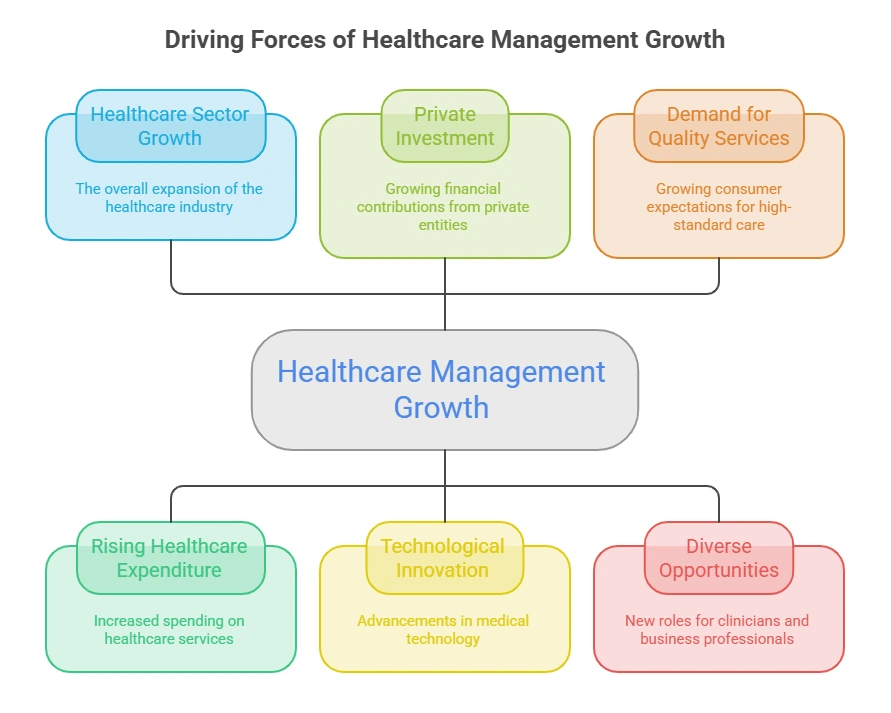
According to the India Brand Equity Foundation (IBEF), India's healthcare industry continues to expand because of rising healthcare expenditure, increasing private investment, technological innovation, and growing demand for quality healthcare services.
Growth is visible across:
Hospitals
Diagnostics
Telemedicine
Health insurance
Medical devices
Pharmaceuticals
Digital health
Preventive healthcare
Home healthcare
This expansion creates opportunities not only for clinicians but also for business and management professionals.
Why Business Schools Are Focusing on Healthcare
Business education continuously evolves according to industry demand.
Healthcare has become a strategic management discipline because organizations require professionals who understand:
Hospital operations
Healthcare finance
Strategic planning
Healthcare marketing
Quality management
Digital transformation
Supply chain management
Healthcare analytics
Patient experience
Regulatory compliance
As industries become more specialized, management education also becomes more focused.
Students increasingly prefer programmes aligned with specific industries rather than only general management.
Healthcare management stands alongside other specialized management fields because it combines:
Business knowledge
Healthcare operations
Technology
Data analytics
Leadership
Strategy
Industry-focused education often helps students understand sector-specific challenges more effectively.
Understanding an IIM Healthcare Management Program
An iim healthcare management program generally refers to healthcare-focused management education offered by certain Indian Institutes of Management or executive education initiatives related to healthcare leadership. The structure, eligibility, duration, and curriculum vary by institution.
These programmes typically emphasize areas such as:
Healthcare strategy
Hospital administration
Healthcare economics
Public health policy
Digital health
Leadership
Operations management
Healthcare innovation
Students should always review the latest programme details, eligibility criteria, and admission requirements on the official website of the respective institution before applying.
Executive MBA in Healthcare: Who Should Consider It?
Interest in executive mba in healthcare programmes is increasing among working professionals who want to advance into leadership positions without leaving their careers.
These programmes are generally suitable for professionals such as:
Hospital administrators
Doctors
Nurses
Healthcare entrepreneurs
Pharmacists
Healthcare consultants
Operations managers
Health insurance professionals
Medical device professionals
Executive programmes typically focus on leadership, strategy, operations, finance, and organizational management.
Business schools increasingly emphasize practical exposure through live projects, internships, industry visits, and case studies.
Digital Healthcare
Students learn about:
Artificial Intelligence
Telemedicine
Electronic Health Records
Healthcare analytics
Digital transformation
Interdisciplinary Education
Healthcare management combines business, technology, operations, and healthcare delivery.
Skill-Based Learning
Employers increasingly value:
Leadership
Communication
Business analytics
Problem-solving
Strategic thinking
Experiential Learning
Students gain practical understanding through simulations, research projects, and industry interactions.
Lead Healthcare Growth
Prepare for specialized healthcare careers with practical management education, corporate exposure, internships, and placement support from experienced mentors.
Compensation depends on several factors, including:
Educational qualifications
Internship experience
Skills
Communication ability
Employer
Job role
Location
Industry segment
Healthcare management graduates may work across hospitals, health-tech companies, consulting firms, insurance organizations, diagnostics, pharmaceuticals, and medical device companies. Leadership roles generally offer higher compensation as professionals gain experience and demonstrate strong performance.
Rather than focusing only on starting salary, students should evaluate long-term career growth, learning opportunities, and leadership potential.
Skills Healthcare Employers Value
Healthcare organizations seek graduates who demonstrate:
Leadership
Communication
Business analysis
Data interpretation
Strategic planning
Financial understanding
Team management
Problem-solving
Digital literacy
Ethical decision-making
Developing these competencies significantly improves employability.
Career Opportunities After Healthcare Management
Healthcare management graduates can pursue careers in:
Hospital Administration
Healthcare Operations
Healthcare Consulting
Health-Tech Companies
Medical Device Organizations
Health Insurance
Pharmaceutical Management
Patient Experience
Quality Management
Healthcare Analytics
Business Development
Corporate Healthcare
These opportunities continue to expand alongside India's healthcare ecosystem.
How Healthcare Management Programmes Prepare Students
A well-designed healthcare management programme develops both managerial and industry-specific capabilities.
Students typically study:
Hospital Administration
Healthcare Operations
Healthcare Finance
Healthcare Marketing
Human Resource Management
Healthcare Quality
Business Analytics
Strategic Management
Supply Chain Management
Digital Healthcare
Additionally, internships, live projects, industry interactions, and case studies help students connect theory with real-world practice.
At Asia Pacific Institute of Management, students benefit from an industry-oriented curriculum, experienced faculty, practical learning, corporate exposure, internships, and placement support. The programme focuses on preparing future healthcare leaders through experiential learning and industry engagement.
Why Students Should Consider Healthcare Management
Healthcare management may be suitable for students who:
Want industry-focused management education
Enjoy solving business problems
Are interested in healthcare
Prefer leadership roles
Want long-term career growth
Like working with technology and people
Seek opportunities across multiple healthcare sectors
The specialization offers diverse career pathways while contributing to improvements in healthcare delivery.
Growing interest in an iim healthcare management program reflects a broader transformation in management education. As India's healthcare ecosystem expands, organizations require professionals who can lead hospitals, health-tech companies, diagnostics, insurance businesses, and healthcare service organizations with strong business and operational expertise.
This trend also highlights the increasing importance of specialized management education. Students who combine business knowledge with healthcare industry understanding are well positioned for leadership opportunities in one of India's fastest-growing sectors.
At Asia Pacific Institute of Management, students receive industry-oriented education, practical exposure, experienced faculty guidance, corporate interactions, internships, and placement support that prepare them for successful careers across the healthcare industry.
Choose Future Leadership
Turn healthcare sector growth into career opportunity with MBA training in strategy, analytics, operations, and digital transformation skills.
Dr. Vikas Gupta is a distinguished academic in the education and research domain, specializing in finance and related interdisciplinary studies. He is known for his...
It generally refers to healthcare-focused management education offered by certain Indian Institutes of Management or related executive programmes. Programme structure varies by institution.
02.
Why is healthcare management becoming popular?
Rapid healthcare sector growth, digital transformation, and increasing demand for professional managers have made healthcare management a sought-after specialization.
03.
Who should pursue an executive MBA in healthcare?
Working professionals such as doctors, nurses, hospital administrators, pharmacists, and healthcare managers who want leadership roles may consider executive programmes.
04.
What is driving specialized MBA demand?
Industries increasingly require professionals with sector-specific business knowledge, making specialized management programmes more attractive.
05.
Does healthcare management offer good career opportunities?
Yes. Graduates can work across hospitals, diagnostics, health-tech, insurance, pharmaceuticals, medical devices, consulting, and healthcare services.
06.
What skills are important for healthcare managers?
Leadership, communication, financial understanding, analytics, strategic thinking, operations management, and digital literacy are highly valued.
07.
How does healthcare management prepare students for leadership?
Healthcare management programmes combine business education with healthcare industry knowledge, practical projects, internships, and leadership development.













.webp) Call Us
Call Us