The Role of a Medical Superintendent vs. Hospital Administrator: Understanding the Matrix Structure
Posted on 12 Aug 2026
By Dr. Vikas Gupta
Introduction
Hospitals are complex organizations. Clinical care, finance, human resources, quality, nursing, operations, diagnostics, and patient services must work together every day.
Both roles can hold significant authority. Both may influence patient safety, hospital efficiency, staffing, and compliance. However, their primary responsibilities are different.
A medical superintendent generally provides senior medical and clinical leadership. A hospital administrator usually manages operational, administrative, and non-clinical functions.
In large hospitals, these responsibilities often overlap. This creates a matrix structure where clinical and administrative leaders work together instead of operating through a single straight reporting line.
This guide explains the difference between these roles, their reporting relationships, responsibilities, skills, and career pathways.
Transform Your Healthcare Career
Combine your clinical foundation with practical management skills to explore leadership opportunities across healthcare, rehabilitation, operations, and administration.
Medical Superintendent vs Hospital Administrator: What Is the Difference?
A medical superintendent vs hospital administrator comparison is best understood through their primary areas of responsibility.
A medical superintendent usually focuses on clinical governance, medical staff coordination, patient safety, and medical service delivery.
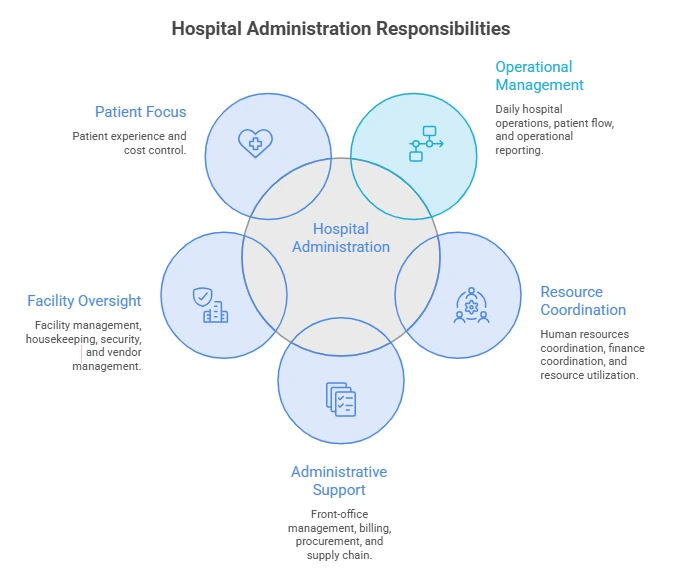
A hospital administrator usually focuses on operations, resources, staffing, finance, facilities, patient experience, and administrative efficiency.
In simple terms:
The medical superintendent represents the clinical leadership side.
The hospital administrator represents the operational and management side.
Both must collaborate for effective hospital functioning.
However, titles and authority can differ between hospitals.
A small hospital may combine several responsibilities under one senior leader. Meanwhile, a large corporate hospital may have separate medical, operations, finance, nursing, and quality leadership teams.
Why Hospitals Need Both Clinical and Administrative Leadership
Hospitals cannot be managed like ordinary businesses.
Every operational decision may affect patient care.
For example, reducing manpower may lower costs. However, it may also increase waiting time or workload.
Similarly, buying a new diagnostic machine involves more than procurement.
The hospital must consider:
Clinical need
Equipment specifications
Cost
Space
Staff training
Maintenance
Utilization
Patient demand
Therefore, hospital leadership requires different areas of expertise.
The medical superintendent brings clinical understanding.
The hospital administrator brings management and operational expertise.
Together, these perspectives help hospitals balance patient care with organizational efficiency.
Clinical vs Non Clinical Head: Understanding the Difference
Clinical leaders generally focus on medical and patient-care responsibilities.
Their areas may include:
Medical departments
Clinical quality
Doctors and consultants
Patient-safety practices
Clinical protocols
Medical documentation
Clinical audits
Medical ethics
Emergency medical services
Clinical governance
The medical superintendent often plays an important role across these areas.
What Does a Non-Clinical Head Manage?
Non-clinical leaders generally focus on administrative and operational services.
Their responsibilities may include:
Hospital operations
Finance
Human resources
Procurement
Front office
Billing
Facilities
Housekeeping
Security
Marketing
Patient experience
Vendor management
Information systems
The hospital administrator usually has stronger responsibility in these areas.
However, some departments cannot be classified entirely as clinical or non-clinical.
Quality management, infection control, biomedical services, patient experience, and healthcare information systems often require both sides to work together.
What Is a Matrix Structure in a Hospital?
A matrix structure is an organizational system where employees or departments may work under more than one reporting relationship.
Instead of having only one vertical boss, a person may report:
Administratively to one leader
Functionally to another
Clinically to a medical leader
Operationally to an administrator
Professionally to a corporate department
For example, a quality manager may report administratively to the hospital administrator.
However, the same quality manager may work directly with the medical superintendent for clinical audits and patient-safety initiatives.
Similarly, a nursing manager may report through nursing leadership while coordinating daily operations with the administrator.
For example, a medical superintendent may report to:
Hospital CEO
Unit head
Medical director
Regional medical head
Corporate medical leadership
Meanwhile, a hospital administrator may report to:
Chief operating officer
Unit head
Regional operations head
Corporate operations team
Some departmental heads may have dual reporting.
For example, an HR manager may report locally to the hospital head and functionally to corporate HR.
Similarly, a quality manager may report locally while also following systems defined by a central quality team.
This allows the organization to maintain consistent standards across hospitals.
Benefits of Matrix Reporting in Corporate Hospitals
A matrix reporting structure can provide several advantages.
Better Expertise
Employees can receive guidance from functional specialists.
Standardization
Corporate teams can establish common policies across several hospital units.
Faster Collaboration
Clinical and administrative departments can coordinate on shared problems.
Stronger Accountability
Responsibilities can be distributed according to expertise.
Better Strategic Alignment
Hospital-level activities can remain connected with corporate goals.
However, the matrix works only when responsibilities are clearly defined.
Challenges of Matrix Reporting
Matrix structures can also create confusion.
Common problems include:
Unclear authority
Conflicting instructions
Multiple approvals
Slow decision-making
Responsibility shifting
Departmental disagreements
Duplicate reporting
Suppose an administrator wants to reduce overtime.
However, the medical superintendent believes additional clinical coverage is necessary.
Both concerns may be legitimate.
Therefore, leaders need data.
They should evaluate patient volume, clinical risk, manpower utilization, workload, and financial implications before making the decision.
Move Beyond Clinical Practice
Develop business, leadership, and operational expertise to confidently pursue rewarding management careers within hospitals and evolving healthcare organizations.
The issue requires both clinical and operational action.
Scenario 2: Purchasing New Medical Equipment
Clinical leaders define requirements.
Biomedical teams assess specifications.
Finance evaluates budget impact.
Procurement handles vendors.
Administration coordinates implementation.
Therefore, the final decision involves several departments.
Scenario 3: Patient Complaint
A clinical complaint may require medical review.
A service complaint may require administrative investigation.
Some cases involve both.
Clear escalation systems are therefore important.
Scenario 4: Infection Control Issue
Clinical and infection-control teams assess patient risk.
Administration ensures isolation capacity, supplies, cleaning, manpower, and operational support.
Scenario 5: Launching a New Department
Suppose a hospital plans to open a rehabilitation unit.
The medical superintendent evaluates clinical requirements.
The administrator evaluates space, staffing, equipment, and patient flow.
Finance assesses investment.
HR supports recruitment.
Marketing supports awareness.
Therefore, hospital growth is a matrix activity.
Skills Required for a Medical Superintendent
A medical superintendent may need:
Clinical expertise
Medical leadership
Clinical governance knowledge
Communication
Conflict management
Patient-safety understanding
Healthcare regulation awareness
Quality-management knowledge
Decision-making ability
Team coordination
Senior medical leadership becomes increasingly managerial.
Therefore, doctors interested in these roles may benefit from developing formal business and leadership skills.
Skills Required for a Hospital Administrator
Hospital administrators need a broader business-management skill set.
Important capabilities include:
Operations management
Financial understanding
Human resources management
Data analysis
Quality management
Supply-chain understanding
Negotiation
Process improvement
Communication
Leadership
Patient-service management
Healthcare administrators also need stakeholder-management skills.
They work with highly specialized clinical professionals.
Therefore, effective administrators influence through coordination and expertise rather than relying only on hierarchy.
Why Healthcare Management Students Should Understand Hospital Matrix Structures
Students sometimes assume that a hospital administrator controls every department.
In reality, healthcare organizations operate through shared authority.
Clinical leadership remains essential.
Therefore, management students must learn how to work effectively with:
Doctors
Nurses
Pharmacists
Technicians
Quality professionals
Finance teams
HR teams
IT professionals
Vendors
Patients
Future managers should understand where their authority begins and where clinical authority takes priority.
This is a critical leadership skill.
Building a Career in Hospital Administration
Students interested in healthcare administration can build their careers gradually.
A practical approach includes:
Learn hospital departments and workflows.
Understand patient-flow systems.
Build knowledge of healthcare quality.
Learn hospital accreditation concepts.
Develop data-analysis skills.
Gain operational experience.
Manage small teams or projects.
Develop financial awareness.
Learn stakeholder management.
Prepare for wider leadership responsibility.
Management education can support this development.
At Asia Pacific Institute of Management, an industry-oriented curriculum, experienced faculty, practical learning, corporate exposure, and placement support can help students develop broader management capabilities.
For students interested in healthcare leadership, such capabilities can support careers across hospital operations, quality, administration, analytics, and related functions.
Conclusion
Understanding the medical superintendent vs hospital administrator distinction is essential for anyone considering a healthcare management career.
The medical superintendent generally provides clinical and medical leadership.
The hospital administrator generally focuses on operations, resources, administration, and organizational performance.
However, modern hospitals cannot separate these responsibilities completely.
Clinical decisions affect costs, staffing, workflows, and patient experience.
Similarly, administrative decisions can affect clinical safety and service quality.
Therefore, hospitals increasingly depend on matrix leadership.
Doctors, administrators, nurses, quality teams, finance professionals, and department heads must work within clearly defined responsibilities while collaborating on shared outcomes.
For aspiring managers, success does not come from competing with clinical leaders.
It comes from understanding how management expertise can complement clinical judgement.
That combination can help hospitals achieve better coordination, stronger quality systems, efficient operations, and improved patient experiences.
Build Your Management Future
Turn healthcare knowledge into strategic business capabilities and prepare for opportunities in administration, operations, wellness, and healthcare entrepreneurship.
Dr. Vikas Gupta is a distinguished academic in the education and research domain, specializing in finance and related interdisciplinary studies. He is known for his...
01.
What is the main difference between a medical superintendent and hospital administrator?
A medical superintendent generally leads clinical and medical functions. A hospital administrator usually manages operational and non-clinical functions. However, responsibilities can overlap depending on the hospital structure.
02.
Is a medical superintendent always a doctor?
The role is generally associated with medical leadership and is commonly held by a qualified doctor. However, exact eligibility and appointment requirements depend on the organization and applicable rules.
03.
Can an MBA graduate become a hospital administrator?
Yes. MBA graduates with relevant healthcare knowledge, management skills, and experience can explore roles in hospital operations, quality, finance, HR, analytics, and administration.
04.
Who has more authority: medical superintendent or hospital administrator?
There is no universal hierarchy between the two. Authority depends on the decision being made, the hospital’s organization chart, and delegated responsibilities.
05.
What is the hospital hierarchy structure?
A hospital hierarchy may include governing leadership, executive management, medical leadership, administrative leadership, nursing leadership, department heads, managers, supervisors, and frontline teams.
06.
What does matrix reporting in corporate hospitals mean?
Matrix reporting means an employee may have more than one reporting relationship. For example, a manager may report administratively to hospital leadership and functionally to a corporate department.
07.
What are common roles in administrative rank in hospitals?
Roles may include administrative executive, assistant manager, operations manager, quality manager, HR manager, hospital administrator, general manager, and chief operating officer.
08.
Doctor vs MBA manager: which is better for hospital leadership?
Neither qualification is automatically better. Doctors bring clinical expertise, while MBA managers bring business and operational skills. Large hospitals usually need both perspectives.


















.webp) Call Us
Call Us