PGDM Admission in Delhi 2027: Complete Application Guide for Students
Posted on 03 Sep 2026
By Dr. Vikas Gupta
Introduction
Planning for PGDM admission in Delhi in 2027 requires more than simply choosing a management institute and submitting an application form. Aspirants need to understand eligibility requirements, accepted entrance exams, application timelines, selection rounds, documents and the factors that distinguish one PGDM programme from another. Delhi and the wider NCR region give management students access to a large corporate and professional ecosystem, making location an important consideration while shortlisting institutes. This practical guide is designed for graduates, final-year students and PGDM aspirants who want to understand the 2027 admission journey clearly. It explains how to shortlist a PGDM college in Delhi, prepare for entrance examinations, complete applications and approach selection rounds without overlooking important admission requirements.
PGDM admission typically involves checking eligibility, taking an accepted entrance exam, submitting institute applications and completing selection rounds.
CAT, XAT, CMAT, ATMA, MAT and GMAT are among the major tests recognised under the current AICTE framework for PGDM admissions.
Admission requirements, accepted examinations, cut-offs and selection criteria can differ between institutes.
Delhi NCR offers access to a broad corporate ecosystem across Delhi, Gurugram and Noida, which can support internships, networking and industry exposure.
Applicants should verify AICTE approval, curriculum, specialisations, faculty, fees and placement information before finalising a PGDM programme.
PGDM admission in Delhi is the application and selection process for students seeking entry into Post Graduate Diploma in Management programmes offered by management institutes in Delhi. The process commonly includes graduation eligibility, an accepted management entrance test, an institute application, shortlisting and institute-specific assessment before the final admission decision.
PGDM stands for Post Graduate Diploma in Management. Under the current AICTE Approval Process Handbook, the standard PGDM programme has a duration of two years.
Students should understand that admission rules are not identical across every institution. One PGDM college in Delhi may accept several management entrance examinations, while another may use different shortlisting or selection criteria.
For 2027, applicants should therefore build their admission strategy around individual institutes rather than assuming that one application process applies everywhere.
Why Consider a PGDM Course in Delhi in 2027?
A PGDM course in Delhi can place students within one of India's major education, business and professional regions. Delhi's proximity to corporate centres in Gurugram and Noida can provide useful opportunities for internships, guest sessions, networking and exposure to different industries, although actual opportunities depend on the institute and programme.
Location matters in management education because learning does not happen only inside classrooms. Students may benefit from interaction with companies, professionals, entrepreneurs and business events.
Delhi NCR has activity across sectors such as:
Consulting and professional services
Banking and financial services
Information technology
E-commerce and digital businesses
Retail and consumer businesses
Manufacturing
Media and communications
Start-ups and entrepreneurship
However, choosing Delhi alone does not guarantee strong career outcomes. Students should investigate how effectively an institute uses its location through internships, live projects, industry interaction and recruiter engagement.
What Are the Eligibility Requirements for PGDM Admission Delhi NCR?
Eligibility for PGDM admission Delhi NCR generally begins with an eligible bachelor's degree, but minimum marks and other requirements can vary by institution. Final-year graduation students may also be considered by some institutes subject to completing their degree and submitting the required documents within the prescribed timeline.
Before applying, candidates should check:
Required bachelor's qualification
Minimum graduation marks, if specified
Conditions applicable to final-year students
Accepted management entrance examinations
Institute-specific selection requirements
Document submission deadlines
Students from different academic streams can consider PGDM programmes when they meet the eligibility conditions of the institute. A previous degree in business or commerce is not necessarily required.
A BA, BSc, BCom, BBA, BTech, BCA or graduate from another eligible discipline should still check the exact requirements of each shortlisted programme rather than assuming eligibility. Bonus:How to Apply for PGDM
Which Entrance Exams Are Accepted for PGDM Admission in Delhi?
PGDM institutes can consider national-level management aptitude tests and applicable government entrance examinations under the current regulatory framework. CAT, XAT, CMAT, ATMA, MAT and GMAT are among the six all-India tests identified in the AICTE Approval Process Handbook, but individual institutes determine which examinations they accept.
CAT
The Common Admission Test is conducted by the Indian Institutes of Management and is accepted by various management institutions beyond the IIMs.
XAT
The Xavier Aptitude Test is another management entrance examination considered by participating business schools.
CMAT
The Common Management Admission Test is conducted by the National Testing Agency and is considered by participating management institutions.
MAT
The Management Aptitude Test is conducted by the All India Management Association and is offered across multiple sessions.
ATMA and GMAT
ATMA is accepted by participating management institutes, while some PGDM institutions also consider GMAT scores.
The most efficient strategy is to shortlist institutes first and then create a college-to-exam map. This prevents students from registering for examinations that do not support their preferred applications.
How Does the PGDM Admission Process in Delhi Work?
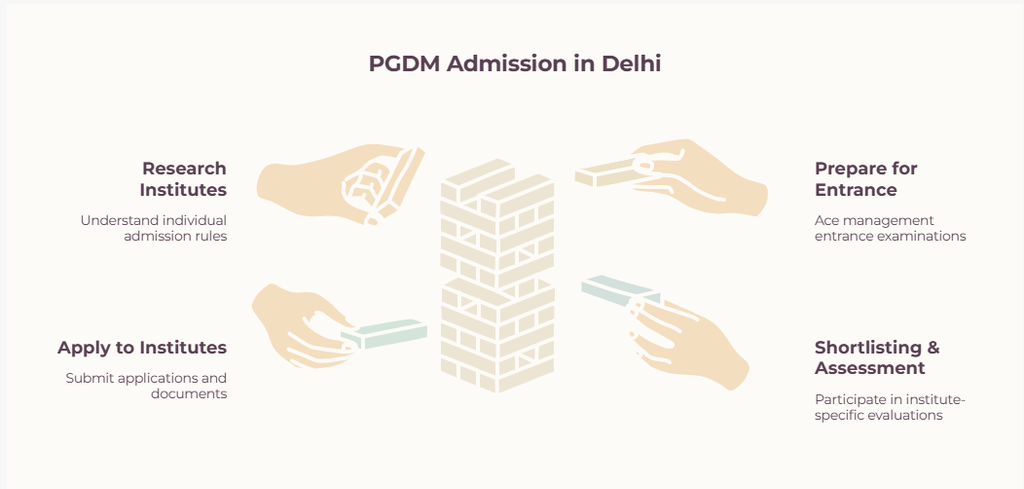
The PGDM admission process Delhi applicants follow generally includes programme research, eligibility verification, entrance testing, individual college applications, shortlisting and selection assessments. The exact stages vary between institutions, so students should maintain a separate checklist for every college instead of treating entrance-test registration as the complete admission application.
A practical process looks like this:
1. Shortlist PGDM Institutes
Start by identifying programmes that match your career interests, budget, preferred specialisation and location.
Do not shortlist solely on advertisements or a single placement number. Compare academic and career-related factors together.
2. Verify Approval and Programme Details
Check the current approval status of the specific PGDM programme through appropriate official sources. Applicants should also review programme duration, curriculum and other academic details.
3. Identify Accepted Entrance Exams
Check which examinations each shortlisted institute accepts. Your target colleges should determine whether you prepare for CAT, XAT, CMAT, MAT, ATMA, GMAT or another applicable test.
4. Complete Institute Applications
Entrance-exam registration and college applications can be separate processes. Students may need to complete individual institute forms even after registering for an entrance test.
5. Attend Selection Rounds
Shortlisted applicants may be assessed through a Personal Interview, Group Discussion, Written Ability Test or another institute-specific process.
6. Review the Admission Offer
Before accepting an offer, review the programme, applicable fees, payment schedule, refund policy and required admission documents carefully.
What Documents Should You Prepare for PGDM Admission 2027?
PGDM applicants should prepare their academic, identity and entrance-examination documents before beginning college applications. Exact documentation varies by institution and candidate category, but keeping clear digital copies ready can reduce errors and delays when multiple application forms or selection rounds have to be completed within short timelines.
A typical application folder may include:
Document
Why You May Need It
Class 10 certificate/marksheet
Academic and date-of-birth verification
Class 12 certificate/marksheet
Academic record
Graduation marksheets
Eligibility and academic assessment
Degree/provisional certificate
Graduation verification, where available
Entrance exam scorecard
Admission and shortlisting
Government ID
Identity verification
Photograph and signature
Application requirements
Category certificate
Where applicable
Work experience documents
Where relevant
Updated resume
Interviews or profile evaluation, if requested
Final-year students may have different requirements because their complete graduation results may not be available during the initial application stage.
How Should You Shortlist a PGDM College in Delhi?
A PGDM college in Delhi should be evaluated on academic credibility, programme recognition, curriculum, faculty, industry exposure, internships, career support, total cost and student outcomes. Applicants should compare verifiable information across multiple institutes instead of choosing solely because a college uses terms such as "industry-ready," "best" or "top."
Create a shortlist using these criteria:
Current programme approval
Curriculum and elective options
Faculty profiles
Teaching methodology
Internship structure
Live projects and corporate interaction
Specialisations available
Placement process and recruiter profiles
Alumni career paths
Total programme cost
Campus location and accessibility
Student support and learning resources
Students should also distinguish between a high salary figure achieved by a small number of graduates and outcomes representative of the wider batch. Placement information is most useful when it provides enough context to evaluate job roles, sectors and overall outcomes. Bonus:PGDM Eligibility Criteria
How Should You Prepare for GD, WAT and Personal Interviews?
Selection-round preparation should focus on communication, structured thinking, business awareness, academic background and career clarity. Candidates should be ready to explain why they want to pursue PGDM, why they selected particular institutes and how their previous education, internships or work experience connects with their future management goals.
Prepare Your Personal Story
Be ready to discuss:
Your academic background
Why you want to study management
Your strengths and development areas
Relevant projects or internships
Career interests
Why you selected the particular PGDM programme
Build Business Awareness
Follow major business and economic developments from reliable news and official sources. Instead of memorising headlines, understand the business implications of important developments.
Practise Structured Communication
For GD, WAT or interviews, clarity matters more than complicated vocabulary. Practise presenting an argument with a clear opening, supporting reasoning and conclusion.
What Is a Practical PGDM Admission Timeline for 2027?
The 2027 admission journey should be planned around official entrance-exam notifications and individual institute deadlines rather than assumed dates from previous years. Different exams and colleges follow separate calendars, so aspirants should track exam registration, test dates, results, college applications, selection rounds and offer deadlines independently.
A practical planning framework is:
Stage
What to Do
Research
Identify suitable Delhi and Delhi NCR PGDM institutes
Exam planning
Map colleges against accepted entrance exams
Preparation
Prepare for aptitude tests and strengthen your profile
Registration
Follow official notifications for selected exams
Applications
Complete individual institute forms on time
Selection preparation
Practise GD, WAT and PI where applicable
Final comparison
Compare offers, fees, curriculum and career opportunities
Admission
Complete required formalities within the institute's deadline
Under AICTE's current 2024–2027 Approval Process Handbook, the stated PGDM admission period runs from March 1 to June 30, subject to the prescribed conditions. Applicants for the 2027 cycle should nevertheless confirm the applicable schedule from current official notifications before making decisions.
What Mistakes Should You Avoid During PGDM Admission?
Applicants should avoid treating PGDM admission as a single-form process. Missing separate college applications, relying on outdated deadlines, choosing colleges without checking approval, ignoring total programme costs or selecting an institute solely because of advertised placement figures can lead to poor decisions even when entrance-exam preparation is strong.
Common mistakes include:
Applying without checking programme approval.
Assuming entrance-test registration automatically applies to colleges.
Waiting until the final deadline to submit forms.
Entering academic information incorrectly.
Ignoring programme curriculum and specialisations.
Focusing only on the highest placement package.
Not preparing for interviews until shortlisting.
Choosing a college solely because it is located in Delhi.
Failing to compare total programme expenses.
Using previous admission cycles as confirmation of 2027 dates.
A simple spreadsheet containing college names, exams, deadlines, documents and application status can make the process much easier to manage.
How Can You Make a Better Final Admission Decision?
The final decision should balance academic quality, career fit, financial commitment and verified programme information. When you receive admission offers, compare the actual curriculum, specialisations, faculty, internships, recruiter profiles, placement information, fees and location advantages rather than allowing one factor—such as entrance cut-off, campus appearance or advertised salary—to determine your choice.
Ask yourself:
Does the curriculum match my career interests?
Is the programme appropriately approved?
Are the specialisations relevant to my goals?
What types of internships are available?
Which roles and sectors recruit graduates?
Is the total cost manageable?
Does Delhi NCR's location add practical value for this programme?
Can I verify important claims through official information?
This approach turns college selection from a ranking exercise into a career-fit decision.
Conclusion
PGDM admission in Delhi for 2027 becomes easier to manage when students approach it as a planned process rather than a last-minute application. Begin by shortlisting suitable programmes, checking current approval and eligibility requirements, and identifying the entrance exams accepted by each institute. Keep college applications separate from entrance-test registrations, prepare documents early and practise seriously for selection rounds. While Delhi NCR can offer valuable corporate and professional exposure, institute quality, curriculum, internships, career support and affordability remain equally important. Always confirm 2027 deadlines and admission requirements through current official information before submitting applications or accepting an admission offer.
Dr. Vikas Gupta is a distinguished academic in the education and research domain, specializing in finance and related interdisciplinary studies. He is known for his...
These FAQs address practical concerns about PGDM applications, Delhi NCR colleges, entrance exams, selection rounds and admission planning for 2027.
01.
Can final-year students apply for PGDM admission in Delhi in 2027?
Yes, final-year students may apply to PGDM programmes where the institution permits provisional applicants. They generally need to complete their bachelor’s degree and provide required academic documents within the institute’s prescribed timeline. Because conditions can vary between colleges, applicants should verify final-year eligibility and document deadlines before submitting an application.
02.
Is CAT compulsory for PGDM admission in Delhi?
No, CAT is not the only management entrance examination available for PGDM applicants. Under the current AICTE framework, CAT, XAT, CMAT, ATMA, MAT and GMAT are among the recognised all-India tests. Individual institutes decide which examinations they accept, so applicants should verify each shortlisted programme’s admission requirements.
03.
Can students from non-commerce backgrounds pursue PGDM in Delhi?
Yes, students from non-commerce backgrounds can pursue PGDM when they meet the chosen institute’s eligibility requirements. Graduates from engineering, science, humanities, computer applications and other disciplines can consider management education. Applicants should check programme-specific graduation requirements and prepare to explain how their academic background connects with their management career goals.
04.
Should I apply to PGDM colleges before receiving my entrance exam result?
It depends on the individual institute’s application schedule and admission policy. Some application windows may operate before entrance-exam results are announced, while other stages may occur later. Students should track exam registration and college applications separately and follow each institution’s published instructions instead of waiting automatically for every test result.
05.
Is work experience necessary for PGDM admission in Delhi NCR?
No, work experience is not universally required for regular two-year PGDM programmes. Fresh graduates can apply to programmes that accept candidates without professional experience. However, work experience may contribute to a candidate’s profile at some institutes. Always check the eligibility and selection criteria of the specific programme before applying.
06.
How many PGDM colleges should I apply to in Delhi NCR?
There is no ideal number that applies to every applicant. Build a balanced shortlist based on your entrance-exam performance, budget, career goals, preferred specialisation and each programme’s requirements. Rather than sending applications randomly, divide your shortlist by realistic admission chances and verify that every programme genuinely fits your academic and career priorities.
07.
Does studying PGDM in Delhi guarantee better placements?
No, studying in Delhi does not guarantee better placements. Location can provide access to a substantial corporate ecosystem, but employment outcomes also depend on institute quality, recruiter relationships, curriculum, internships, market conditions and individual performance. Compare verified placement information and the types of roles offered rather than assuming location alone determines career outcomes.
08.
What should I check before paying a PGDM admission fee?
Check the programme’s current approval status, admission offer, complete fee structure, payment schedule, refund policy and important academic conditions before making a payment. You should also review curriculum, specialisations, placement information and required documents. Use official institutional and regulatory information to verify important claims rather than depending entirely on advertisements or third-party listings.














.webp) Call Us
Call Us