Who Should Pursue an MBA in Healthcare Management?
Posted on 14 Sep 2026
By Dr. Vikas Gupta
Introduction
Healthcare is not managed by clinical expertise alone. Hospitals, diagnostic networks, pharmaceutical companies, health-tech businesses, insurance providers, and other healthcare organisations also need professionals who understand operations, finance, marketing, technology, people management, quality, and strategy.
An MBA in Healthcare Management can be suitable for medical and non-medical graduates who want to build careers on the business, administrative, operational, or strategic side of healthcare. It can also be relevant for healthcare professionals who want to move beyond purely technical roles and develop broader management capabilities.
However, the programme isn't automatically the right choice for everyone.
Your academic background, interests, career objectives, skills, and willingness to work within the healthcare ecosystem should all influence your decision.
This guide explains who can study healthcare management, which graduates may benefit from the programme, possible career paths, and how to decide whether an MBA in Healthcare Management fits your goals.
Find Your Healthcare Path
Transform your academic strengths into practical management capabilities and prepare for diverse opportunities across the growing healthcare business ecosystem.
An MBA in Healthcare Management is a postgraduate management programme combining general business education with healthcare-specific knowledge.
Students typically develop an understanding of core management areas such as:
Marketing
Finance
Human Resources
Operations
Business Analytics
Organisational Behaviour
Strategic Management
Leadership
These may be combined with healthcare-focused areas such as:
Hospital Administration
Healthcare Operations
Healthcare Quality
Patient Experience
Healthcare Finance
Healthcare Marketing
Digital Health
Healthcare Analytics
Health Economics
Healthcare Strategy
The objective is to prepare students to understand how healthcare organisations operate as complex service and business systems.
Who Should Pursue MBA in Healthcare Management?
An MBA in Healthcare Management can be particularly relevant for people who are interested in healthcare but want to work in management rather than exclusively clinical roles.
Potential candidates include medical and allied-health graduates, life-sciences students, pharmacy graduates, business graduates, healthcare professionals, and people interested in healthcare entrepreneurship or management.
The programme can be worth considering if you want to develop capabilities in areas such as:
Hospital management
Healthcare operations
Patient experience
Quality management
Healthcare consulting
Business development
Healthcare marketing
Health-tech
Healthcare analytics
Strategy
Healthcare entrepreneurship
Your previous degree matters, but your career objective matters even more.
Can Medical Graduates Pursue MBA in Healthcare Management?
Yes, subject to the eligibility requirements of the institution.
Medical graduates can already have valuable knowledge of healthcare delivery, patients, clinical workflows, and healthcare systems.
However, medical education generally focuses more heavily on clinical or technical knowledge than business management.
An MBA can help medical graduates develop knowledge of finance, operations, marketing, strategy, human resources, and leadership.
This combination can be particularly useful for professionals who eventually want to take on managerial responsibilities within healthcare organisations.
Is MBA Healthcare Suitable for Doctors?
Doctors can be strong candidates for healthcare management education, particularly when their careers begin to include administrative or leadership responsibilities.
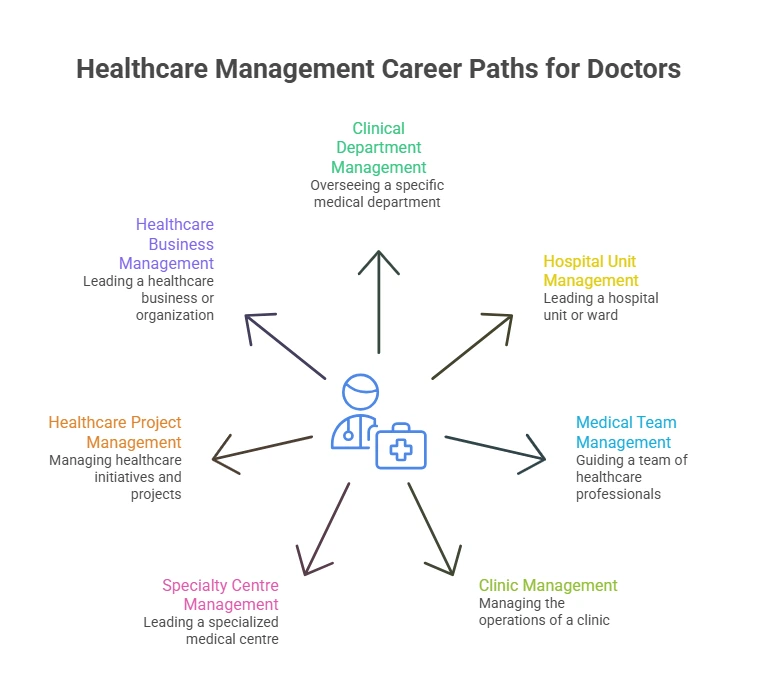
A doctor may eventually manage:
A clinical department
A hospital unit
A medical team
A clinic
A specialty centre
A healthcare project
A healthcare business
These responsibilities require more than clinical knowledge.
Doctors interested in hospital leadership, healthcare consulting, entrepreneurship, strategy, or management may therefore consider an MBA in Healthcare Management.
Experienced doctors who want to continue practicing while studying may also explore Executive MBA or other flexible management formats.
Can BDS Graduates Pursue an MBA in Healthcare Management?
BDS graduates interested in moving beyond traditional dental practice may consider healthcare management, subject to institutional eligibility.
Their understanding of patient care and healthcare delivery can be complemented by management capabilities.
Potential career directions may include healthcare administration, operations, business development, healthcare consulting, patient experience, health-tech, or entrepreneurship.
BDS graduates planning to establish or expand dental clinics may also benefit from understanding finance, marketing, operations, strategy, and people management.
Is MBA Healthcare Suitable for BAMS and BHMS Graduates?
BAMS and BHMS graduates who want to develop careers in healthcare administration, management, business, or entrepreneurship may also explore an MBA in Healthcare Management.
Their existing healthcare education can provide useful domain context, while management education can introduce them to broader organisational functions.
However, the right career path depends on individual skills, interests, programme quality, and employer requirements.
Candidates should always check the specific eligibility criteria before applying.
Can Pharmacy Graduates Pursue MBA Healthcare Management?
Pharmacy graduates can be well positioned for careers at the intersection of healthcare, pharmaceuticals, and business.
An MBA can complement pharmaceutical knowledge with capabilities in:
Marketing
Finance
Business development
Operations
Strategy
Analytics
Supply chain
Leadership
Depending on their experience and skills, graduates may explore opportunities in pharmaceutical businesses, healthcare organisations, medical devices, health-tech, consulting, or related sectors.
MBA Healthcare for Life Sciences Graduates
Life sciences graduates often understand biology, healthcare research, scientific processes, or related subjects but may have limited exposure to business management.
An MBA can provide that missing business perspective.
For students interested in moving towards healthcare businesses, pharmaceuticals, diagnostics, consulting, medical technology, or health-tech, management education can create a bridge between scientific knowledge and commercial decision-making.
This makes MBA healthcare for graduates from life sciences one possible pathway into the business side of healthcare.
Can Nursing and Allied Healthcare Professionals Pursue It?
Nurses, physiotherapists, and other allied healthcare professionals may also consider healthcare management education, depending on programme eligibility.
These professionals often have direct experience with patients and healthcare delivery.
As they move towards coordination, administration, operations, quality, or leadership responsibilities, management knowledge can become increasingly useful.
An MBA can help develop broader understanding of organisational functions beyond the candidate's existing professional specialisation.
Can Non-Medical Graduates Pursue MBA in Healthcare Management?
One of the biggest misconceptions is that healthcare management is only for doctors or medical graduates.
Depending on institutional eligibility, non-medical graduates may also pursue an MBA in Healthcare Management.
Students from backgrounds such as:
BBA
BCom
Economics
Engineering
Technology
Humanities
Science
Management
Other recognised bachelor's programmes
may be eligible for certain healthcare MBA programmes.
Non-medical students may need to spend additional time understanding healthcare terminology, hospital structures, patient journeys, healthcare stakeholders, and industry-specific challenges.
However, they can also bring valuable skills from finance, technology, marketing, analytics, operations, and other disciplines.
Healthcare management brings together professionals from different educational backgrounds because healthcare organisations themselves require multidisciplinary teams.
A hospital, for example, needs more than clinical professionals.
It also requires people who understand:
Finance
Operations
Human resources
Marketing
Technology
Data
Procurement
Quality
Strategy
Customer and patient experience
Therefore, healthcare management can appeal to both healthcare and non-healthcare graduates.
Actual admission eligibility varies by institution, so candidates should always verify programme-specific requirements.
MBA Healthcare Management Suitability: Who Is a Good Fit?
You may be a good fit if you have several of the following characteristics.
You Are Interested in Healthcare
You don't necessarily need to be a clinician, but you should have a genuine interest in the healthcare ecosystem.
You Enjoy Solving Organisational Problems
Healthcare managers deal with processes, teams, resources, costs, quality, technology, and service challenges.
Problem-solving is therefore an important capability.
You Want Management Responsibilities
If you want to manage teams, projects, departments, facilities, or businesses, management education may be relevant.
You Are Comfortable Working With People
Healthcare involves interaction with patients, doctors, employees, administrators, vendors, partners, and other stakeholders.
Communication and interpersonal capabilities are important.
You Are Interested in Business and Strategy
Healthcare organisations need to remain financially sustainable while maintaining service quality.
Understanding business decisions can therefore be valuable.
You Are Interested in Technology
Digital health, analytics, AI, telemedicine, automation, and electronic health systems are becoming increasingly relevant to healthcare management.
Who May Not Need an MBA in Healthcare Management?
The programme isn't automatically suitable for everyone interested in healthcare.
If your goal is to remain exclusively focused on clinical specialisation, a management degree may not be necessary.
Similarly, if you're unsure whether you want to work in healthcare at all, a specialised healthcare MBA could restrict your focus compared with a general MBA.
The programme may also not be the right investment if you're choosing it only because you expect an immediate high salary.
An MBA should support a clear professional direction rather than simply add another qualification to your CV.
Healthcare Needs Your Skills
Bring your medical, scientific, business, or technical background into healthcare management and develop skills for meaningful professional growth ahead.
A healthcare MBA places management concepts within the context of hospitals and the wider healthcare ecosystem.
Broader Management Skills
Students can develop knowledge across finance, operations, marketing, HR, strategy, analytics, and leadership.
Career Diversity
Healthcare management can lead to opportunities beyond traditional hospital administration.
Industry Understanding
Students can learn how different healthcare organisations, stakeholders, and business models operate.
Leadership Development
Management education can help candidates develop communication, decision-making, problem-solving, team management, and strategic thinking capabilities.
Career Transition Opportunities
Healthcare professionals may use an MBA to transition from technical or clinical roles towards management-oriented responsibilities.
Depending on educational background, experience, skills, and employer requirements, graduates may explore roles such as:
Hospital Operations
Operations professionals help coordinate processes, departments, resources, patient flow, and service delivery.
Hospital Administration
Administrators support the effective management of healthcare facilities and organisational functions.
Patient Experience
Patient experience professionals focus on communication, feedback, service quality, and different stages of the patient journey.
Healthcare Quality
Quality professionals may work on process improvement, service standards, quality systems, patient safety, and accreditation-related activities.
Healthcare Marketing
Healthcare marketers may work on branding, communication, digital marketing, market research, patient acquisition, and service positioning.
Business Development
Business development professionals help healthcare organisations identify partnerships, markets, corporate relationships, and growth opportunities.
Healthcare Consulting
Consulting professionals may work on healthcare strategy, operations, transformation, market research, and organisational improvement.
Health-Tech
Healthcare management graduates can potentially explore operations, implementation, partnerships, business development, and strategy within health-tech companies.
Healthcare Analytics
Professionals interested in data may work with healthcare KPIs, dashboards, business intelligence, performance measurement, and decision support.
Healthcare Strategy
Strategy professionals may contribute to expansion planning, market analysis, organisational transformation, partnerships, and long-term growth.
Where Can MBA Healthcare Graduates Work?
Healthcare management opportunities aren't limited to hospitals.
Graduates may explore careers across:
Hospitals: Administration, operations, quality, marketing, patient experience, and strategy.
Pharmaceutical companies: Marketing, business operations, projects, strategy, and commercial functions.
Health-tech companies: Operations, partnerships, implementation, growth, and business strategy.
Diagnostic companies: Operations, centre management, expansion, and business development.
Medical-device companies: Marketing, operations, business development, and commercial management.
Healthcare consulting: Strategy, process improvement, transformation, and research.
Insurance organisations: Healthcare operations, provider management, and related functions.
Healthcare startups: Operations, growth, partnerships, marketing, and strategy.
This diversity is one reason healthcare management can appeal to candidates from multiple academic backgrounds.
MBA Healthcare for Graduates Who Want a Career Change
An MBA healthcare for graduates can also be relevant to candidates who want to change their professional direction.
For example, a science graduate may want to move into healthcare business development.
A pharmacist may want to move towards pharmaceutical management.
A healthcare professional may want to transition from technical work into hospital operations.
A technology professional may want to explore digital health.
The MBA can provide management foundations, but successful career transitions also require relevant skills, internships, networking, and practical industry exposure.
Is MBA Healthcare Good for Working Professionals?
It can be, particularly for professionals who already work within healthcare and want broader management capabilities.
A working professional may already understand one function extremely well but have limited knowledge of finance, marketing, strategy, or organisational management.
Management education can help develop this cross-functional perspective.
Experienced professionals who cannot leave their jobs may also consider Executive MBA, weekend, part-time, online, or hybrid formats depending on their career goals and programme availability.
Skills Needed for Healthcare Management
Your academic qualification can help you enter a programme, but career success depends on capabilities beyond the degree.
Important skills can include:
Communication
Leadership
Analytical thinking
Problem-solving
Financial understanding
Data interpretation
Operations management
Project management
Negotiation
Team management
Digital awareness
Strategic thinking
Patient-centric decision-making
Healthcare managers often work with people from very different professional backgrounds, making communication and stakeholder management particularly important.
Medical vs Non-Medical Graduates: Who Has an Advantage?
Medical and healthcare graduates may have stronger understanding of clinical environments, terminology, patient care, and healthcare workflows.
Non-medical graduates may bring strengths in business, finance, technology, analytics, marketing, or operations.
A healthcare organisation needs both types of capabilities.
What matters is how effectively candidates build the skills they don't already possess.
A medical graduate may need stronger business knowledge, while a business graduate may need deeper healthcare understanding.
How to Decide Whether MBA Healthcare Is Right for You
Before applying, ask yourself several questions.
Do I genuinely want to work in healthcare?
If healthcare doesn't interest you, a specialised MBA may not be the best choice.
What role do I want after graduation?
Research actual career paths rather than choosing the programme based only on its title.
Does my academic background meet eligibility requirements?
Check directly with the institution.
Does the curriculum match my goals?
Look at individual subjects, practical projects, internships, and industry exposure.
Am I interested in management?
An MBA is fundamentally a business and management qualification.
What is the total investment?
Consider tuition fees, living expenses, additional costs, and opportunity cost.
What skills do I need to build?
Identify gaps between your current profile and your target healthcare role.
These questions can give you a much clearer picture of healthcare management MBA suitability.
How to Choose the Right MBA in Healthcare Management
Once you decide that healthcare management fits your goals, compare programmes carefully.
Evaluate:
Institutional credibility
Programme recognition
Curriculum
Healthcare specialisation
Faculty profiles
Industry exposure
Internships
Live projects
Alumni network
Career support
Programme fees
Learning format
International exposure, if relevant
Don't select a programme solely because of advertising claims or one placement number.
Look at the complete learning and career ecosystem.
Future Scope of Healthcare Management
Healthcare is evolving through digital transformation, changing patient expectations, analytics, artificial intelligence, telemedicine, automation, and new healthcare delivery models.
This means future managers may need a broader combination of business and healthcare capabilities.
Understanding traditional hospital operations may no longer be enough.
Professionals may increasingly need knowledge of technology, data, patient experience, financial sustainability, quality, innovation, and organisational change.
For candidates interested in this intersection of healthcare and business, management education can provide a relevant foundation.
So, who should pursue MBA in Healthcare Management?
The programme can be suitable for medical graduates, BDS graduates, pharmacy students, life-sciences graduates, allied healthcare professionals, business graduates, working professionals, and even candidates from non-medical backgrounds—provided they meet institutional eligibility requirements and have a genuine interest in healthcare management.
Your bachelor's degree alone shouldn't determine whether healthcare management is right for you.
Your career goal is equally important.
If you want to work in hospital administration, healthcare operations, quality, consulting, patient experience, business development, health-tech, healthcare marketing, analytics, strategy, or entrepreneurship, an MBA in Healthcare Management may provide useful business and industry knowledge.
But the degree works best when combined with practical exposure, relevant skills, networking, and a clear understanding of the healthcare function you want to enter.
Before applying, ask yourself a simple question:
Do I want to build my career where healthcare and business meet?
If the answer is yes, exploring an MBA in Healthcare Management could be a logical next step.
Where Healthcare Meets Business
Build expertise in operations, strategy, analytics, marketing, and leadership to pursue management opportunities throughout the dynamic healthcare industry.
Dr. Vikas Gupta is a distinguished academic in the education and research domain, specializing in finance and related interdisciplinary studies. He is known for his...
01.
Who should pursue MBA in Healthcare Management?
Healthcare and non-healthcare graduates interested in hospital administration, operations, healthcare business, consulting, health-tech, quality, marketing, analytics, or strategy may consider the programme, subject to institutional eligibility.
02.
Who can study Healthcare Management?
Depending on the programme, candidates may come from medicine, dentistry, pharmacy, nursing, life sciences, business, commerce, engineering, science, humanities, and other recognised undergraduate backgrounds.
03.
Can non-medical students pursue MBA in Healthcare Management?
Yes, many healthcare management programmes may accept non-medical graduates. Exact eligibility requirements vary by institution and should be verified before applying.
04.
Is MBA Healthcare Management good for medical graduates?
It can be relevant for medical graduates who want to complement their healthcare knowledge with management, finance, operations, strategy, marketing, analytics, or leadership capabilities.
05.
What are the main MBA Healthcare Management benefits?
Potential benefits include healthcare-specific business knowledge, broader management capabilities, industry exposure, career diversity, leadership development, and opportunities to move from technical roles towards management.
06.
What are the MBA Healthcare career options?
Potential areas include hospital administration, healthcare operations, quality management, patient experience, healthcare marketing, business development, consulting, health-tech, analytics, and strategy.
07.
Can BDS, BAMS, BHMS and pharmacy graduates pursue an MBA in Healthcare Management?
They may be eligible for healthcare management programmes depending on the institution’s admission criteria. Candidates should verify the specific eligibility requirements before applying.
08.
Is an MBA in Healthcare Management suitable for working professionals?
It can be suitable for professionals seeking broader management or leadership capabilities. Experienced professionals may also consider Executive, weekend, part-time, online, or hybrid healthcare management programmes.


















.webp) Call Us
Call Us