Healthcare consulting combines healthcare knowledge with business strategy, analytics, operations, and problem-solving. As healthcare systems become more complex, consultants increasingly need strong management skills alongside industry expertise.
An executive MBA for healthcare consultants can help professionals strengthen their capabilities in strategy, finance, operations, leadership, and healthcare management. It can also support professionals who want to take on larger consulting assignments or move into leadership roles.
For working professionals, an Executive MBA can offer a structured way to build management expertise without completely stepping away from their careers. However, the right program should match your experience, career goals, and preferred area of healthcare consulting.
Advance Your Consulting Career
Strengthen strategic, financial, and leadership skills to take on broader healthcare consulting responsibilities and complex client assignments confidently.
What Is an Executive MBA for Healthcare Consultants?
An Executive MBA for healthcare consultants is a management-focused program designed for professionals who want to develop advanced business and leadership skills while continuing their careers.
The curriculum may cover areas such as:
Healthcare management
Business strategy
Financial management
Healthcare operations
Marketing management
Business analytics
Organisational behaviour
Leadership
Project management
Strategic decision-making
For consultants, these subjects can complement existing skills in research, analysis, client management, and healthcare industry knowledge.
Therefore, an Executive MBA can help bridge the gap between technical consulting expertise and broader business leadership.
Why Should Healthcare Consultants Consider an Executive MBA?
Healthcare consultants often work across multiple business problems. These may include operational improvement, market analysis, process optimisation, growth strategy, and organisational transformation.
However, progressing into senior consulting roles can require broader management capabilities.
An Executive MBA can help professionals develop these capabilities through structured management education.
1. Strengthen Strategic Thinking
Healthcare consulting often involves solving complex organisational problems.
Consultants need to understand:
Business objectives
Market dynamics
Financial implications
Operational constraints
Competitive factors
Long-term growth opportunities
An Executive MBA can provide frameworks for evaluating these factors systematically.
Consequently, consultants can develop a broader perspective when analysing healthcare business problems.
2. Develop Healthcare Management Expertise
Healthcare management involves more than clinical or operational knowledge.
Professionals also need to understand business planning, resource allocation, leadership, financial management, and organisational strategy.
A healthcare consulting MBA can help consultants connect their consulting experience with management concepts.
This combination can be useful when working with hospitals, healthcare companies, insurers, health-tech organisations, and other healthcare businesses.
3. Improve Client Management Skills
Consultants regularly communicate with senior stakeholders.
They may need to present findings, explain recommendations, manage expectations, and support implementation.
An Executive MBA can strengthen skills in:
Business communication
Negotiation
Leadership
Presentation
Stakeholder management
Decision-making
These capabilities can become increasingly important as consultants take responsibility for larger projects.
How Can an Executive MBA Support a Healthcare Consultant Career?
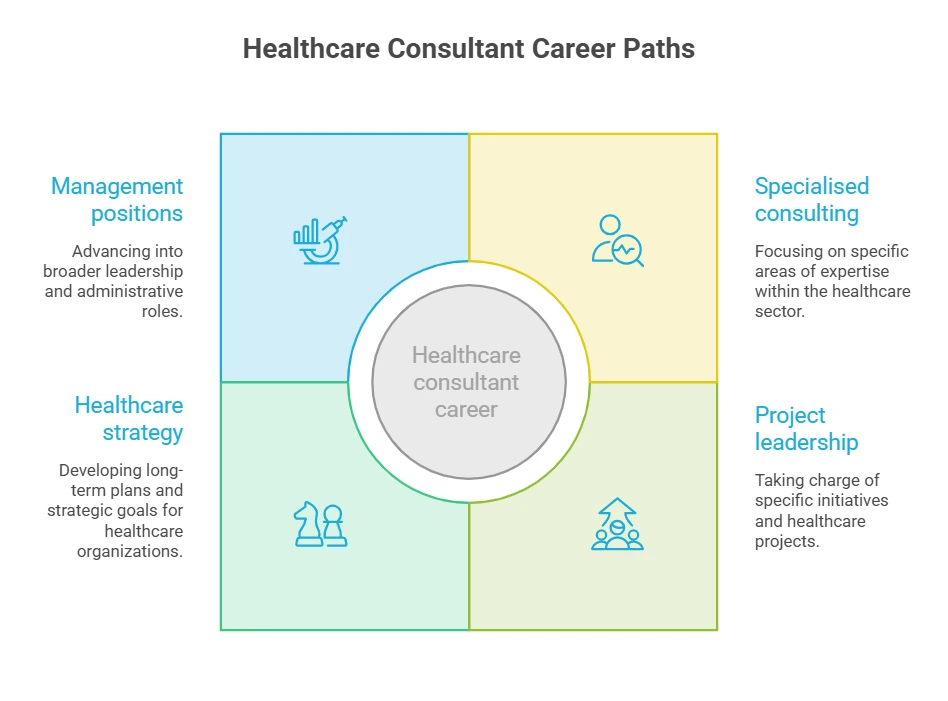
A healthcare consultant career can develop in several directions. Professionals may move towards specialised consulting, project leadership, healthcare strategy, or broader management positions.
An Executive MBA does not automatically result in career progression. However, it can provide management knowledge that complements professional experience.
Healthcare Strategy Consulting
Healthcare strategy involves helping organisations evaluate growth opportunities, operational priorities, business models, and strategic initiatives.
Consultants working in this area can benefit from knowledge of:
Corporate strategy
Financial planning
Market analysis
Business development
Organisational leadership
An Executive MBA can help professionals approach these problems from a management perspective.
Healthcare Operations Consulting
Operations consulting focuses on improving processes and organisational performance.
Consultants may work on areas such as:
Process improvement
Resource utilisation
Service delivery
Patient experience
Cost management
Operational planning
Management education can help consultants understand how operational decisions affect broader business performance.
Healthcare Transformation Consulting
Healthcare organisations are increasingly adopting technology and data-driven processes.
Consultants may therefore support digital transformation, process redesign, technology adoption, and organisational change.
Executive healthcare management education can help professionals understand both the business and organisational sides of transformation.
Healthcare Consulting MBA: What Can You Learn?
A healthcare consulting MBA should offer more than theoretical business knowledge.
Working professionals should look for a curriculum that connects management concepts with practical healthcare situations.
Healthcare Strategy
Strategy helps professionals understand how organisations create sustainable value.
Consultants can apply strategic frameworks while evaluating healthcare markets, services, business models, and growth opportunities.
Finance for Managers
Financial knowledge is important for consultants working on business cases and strategic recommendations.
Relevant areas may include:
Financial analysis
Budgeting
Cost management
Investment decisions
Business performance
This knowledge can improve the financial perspective of consulting recommendations.
An Executive MBA can support several career directions for experienced healthcare professionals.
Possible roles may include:
Healthcare Strategy Consultant
These professionals work on strategic business problems and organisational growth initiatives.
Healthcare Management Consultant
Management consultants help organisations improve business and operational performance.
Healthcare Operations Manager
Operations managers focus on process efficiency, service delivery, resource planning, and performance.
Business Development Manager
These professionals identify growth opportunities and develop strategic partnerships.
Healthcare Project Manager
Project managers coordinate teams, timelines, resources, and implementation activities.
Healthcare Strategy Manager
Strategy managers support organisational planning, market analysis, and strategic initiatives.
Healthcare Transformation Professional
These professionals may work on organisational change, digital transformation, and process improvement.
Career progression depends on experience, skills, employer requirements, performance, and the complexity of responsibilities.
How to Choose an Executive MBA for Healthcare Consultants
Choosing a program requires more than checking the course title.
Healthcare consultants should evaluate several factors.
Check the Curriculum
Look for subjects covering strategy, finance, operations, analytics, leadership, and healthcare management.
Consider Practical Learning
Case studies, projects, presentations, simulations, and industry-oriented assignments can make management education more applicable.
Evaluate Faculty Experience
Experienced faculty can bring practical business perspectives into classroom discussions.
Check Flexibility
Working professionals should consider class schedules, learning formats, attendance requirements, and workload.
Understand Admission Requirements
Eligibility requirements vary by program.
Check the latest official requirements for educational qualifications, work experience, entrance requirements, and documentation.
Evaluate Career Support
Career guidance, industry exposure, networking opportunities, and professional development support can add value.
Can Healthcare Consultants Pursue an Executive MBA Without Leaving Their Jobs?
Yes, many Executive MBA formats are designed for working professionals.
However, the workload still requires planning.
Professionals should consider:
Weekly study hours
Class schedules
Work travel
Project deadlines
Personal commitments
Assignment requirements
A practical approach is to create a weekly study schedule before joining.
Additionally, discussing workload expectations with your employer may help.
Why Practical Learning Matters for Consultants
Consulting is highly application-oriented.
Professionals often need to transform theoretical concepts into practical recommendations.
Therefore, management education becomes more valuable when students work with realistic business situations.
A practical learning approach can help consultants connect classroom concepts with real consulting challenges.
Asia Pacific Institute of Management focuses on industry-oriented management education, practical learning, experienced faculty, and corporate exposure.
These elements can help working professionals strengthen their understanding of management and business decision-making.
A Practical Career Roadmap for Healthcare Consultants
An Executive MBA journey can be planned around professional development.
Step 1: Identify Your Career Direction
Decide whether you want to focus on strategy, operations, transformation, business development, analytics, or leadership.
Step 2: Identify Skill Gaps
Assess your current strengths and determine where additional management knowledge is needed.
Step 3: Select the Right Program
Compare curriculum, learning approach, flexibility, faculty, industry exposure, and career support.
Step 4: Apply Learning at Work
Use management concepts in current consulting projects whenever possible.
Step 5: Build Leadership Experience
Take ownership of projects, teams, stakeholder relationships, and strategic assignments.
Step 6: Plan Your Next Career Move
After developing relevant experience and skills, explore roles that align with your long-term goals.
Common Mistakes Healthcare Consultants Should Avoid
An Executive MBA can be valuable, but choosing a program without proper research can create challenges.
Avoid these mistakes:
Choosing a program only because of its title
Ignoring curriculum relevance
Overlooking flexibility
Not checking eligibility
Focusing only on fees
Expecting an automatic promotion
Ignoring practical learning
Failing to define career goals
Moreover, professionals should evaluate the program against their current career stage.
An executive MBA for healthcare consultants can provide a structured pathway to strengthen business and leadership capabilities. It can complement consulting experience with knowledge of strategy, finance, operations, analytics, and healthcare management.
For professionals targeting healthcare management consulting, the right program should combine academic learning with practical business exposure.
Therefore, evaluate the curriculum, flexibility, faculty, industry orientation, and career support before making a decision.
Asia Pacific Institute of Management offers industry-oriented management education with practical learning, corporate exposure, experienced faculty, and career-focused development.
If you are planning the next stage of your healthcare consultant career, explore how an Executive MBA can fit your professional goals and management aspirations.
Elevate Healthcare Expertise
Combine consulting experience with advanced business knowledge to strengthen decision-making, client management, and healthcare leadership capabilities.
Dr. Vikas Gupta is a distinguished academic in the education and research domain, specializing in finance and related interdisciplinary studies. He is known for his...
01.
Is an Executive MBA useful for healthcare consultants?
An Executive MBA can help healthcare consultants strengthen business, leadership, finance, operations, strategy, and management skills. Its relevance depends on the consultant’s experience, career goals, and desired area of specialisation.
02.
Can consultants pursue an Executive MBA while working?
Yes. Executive MBA programs are commonly designed around the needs of working professionals. However, candidates should review the program’s schedule, attendance requirements, academic workload, and project expectations before enrolling.
03.
What can I study in a healthcare consulting MBA?
A healthcare consulting MBA may cover healthcare management, strategy, finance, operations, analytics, marketing, leadership, organisational behaviour, and project management. The exact curriculum varies by institution and program.
04.
Can an Executive MBA help with healthcare management consulting?
It can provide management frameworks that complement consulting experience. Skills in strategy, finance, operations, leadership, and analytics can support professionals working on complex healthcare business problems.
05.
What careers can healthcare consultants pursue after an Executive MBA?
Possible directions include healthcare strategy, management consulting, operations, business development, project management, healthcare transformation, and broader healthcare management roles.
06.
Is an Executive MBA suitable for experienced consultants?
It can be suitable when experienced consultants want to strengthen management knowledge, develop leadership capabilities, or prepare for broader responsibilities. However, the program should align with their specific career objectives.
07.
What should consultants check before choosing an Executive MBA?
Consultants should evaluate curriculum, eligibility, learning format, flexibility, faculty, practical learning, industry exposure, career support, and overall program relevance.
08.
Does an Executive MBA guarantee career growth?
No. Career growth depends on experience, skills, performance, employer requirements, market conditions, and responsibilities. An Executive MBA can support professional development but does not guarantee a specific career outcome.
















.webp) Call Us
Call Us