Executive MBA for Clinical Professionals: Career & Leadership Guide
Posted on 03 Oct 2026
By Dr. Vikas Gupta
Introduction
Clinical professionals build their careers around patient care, clinical expertise, and healthcare delivery. However, some eventually want to take on responsibilities beyond direct clinical practice.
They may become interested in hospital administration, healthcare operations, strategy, consulting, business development, or organisational leadership.
An executive MBA for clinical professionals can provide a structured pathway for developing business and management skills while continuing professional development.
For experienced clinicians, the transition from clinical work to management requires more than a new qualification. It also requires an understanding of finance, operations, leadership, strategy, analytics, and organisational decision-making.
An Executive MBA can help bridge this knowledge gap.
Expand Your Clinical Career
Combine clinical expertise with management skills to explore leadership opportunities across healthcare operations, administration, strategy, consulting, and technology.
What Is an Executive MBA for Clinical Professionals?
An Executive MBA for clinical professionals is a management-focused program designed for experienced working professionals who want to develop leadership and business capabilities.
The curriculum may include:
Healthcare management
Strategic management
Financial management
Operations management
Business analytics
Organisational behaviour
Leadership
Marketing
Project management
Decision-making
For clinicians, these subjects can complement existing healthcare and patient-care experience.
Therefore, the combination can help professionals understand healthcare from both clinical and management perspectives.
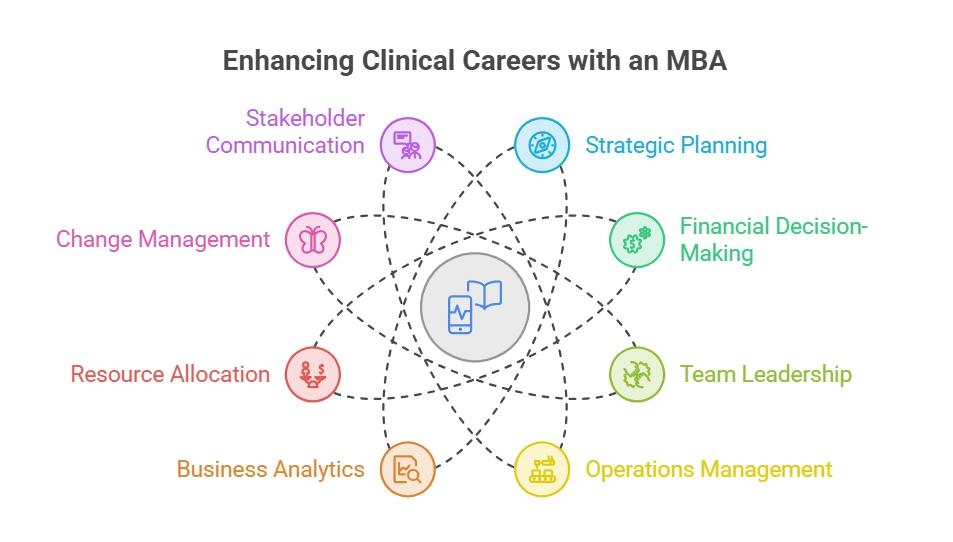
Clinical expertise provides a strong understanding of patient care and healthcare delivery. However, management roles often require additional capabilities.
These include:
Strategic planning
Financial decision-making
Team leadership
Operations management
Business analytics
Resource allocation
Change management
Stakeholder communication
An MBA can provide structured exposure to these areas.
Consequently, clinicians can develop a broader understanding of how healthcare organisations function.
Clinical to Management Career: What Does the Transition Involve?
Clinicians with management education can explore administrative responsibilities involving healthcare services, teams, and operations.
Healthcare Operations
Operations roles focus on processes, resource planning, service delivery, and organisational performance.
Clinical Program Management
Professionals may manage specific healthcare programs, services, or initiatives.
Quality Management
Quality functions focus on improving systems, processes, patient experience, and organisational performance.
Healthcare Consulting
Consulting can involve analysing healthcare organisations, business challenges, processes, and strategic opportunities.
Healthcare Strategy
Strategy professionals work on organisational planning, growth initiatives, market analysis, and transformation projects.
Health-Tech Management
Healthcare technology companies need professionals who understand healthcare environments and business operations.
Healthcare Business Development
Business development professionals identify opportunities, partnerships, services, and markets.
The suitability of each pathway depends on the individual's experience and professional interests.
Can Doctors Pursue an Executive MBA?
Doctors may consider an Executive MBA when they want to develop management and leadership capabilities.
Medical education provides extensive clinical knowledge. However, healthcare leadership often requires additional understanding of business and organisational management.
An Executive MBA can help doctors explore areas such as:
Hospital management
Healthcare strategy
Healthcare operations
Consulting
Business development
Healthcare entrepreneurship
Health-tech management
However, the program's eligibility requirements should always be checked before applying.
Can Nurses and Allied Healthcare Professionals Pursue an Executive MBA?
Nurses and other experienced healthcare professionals may also explore management education, subject to program eligibility.
Their professional experience can provide valuable knowledge of healthcare delivery.
Management education can then add skills in:
Leadership
Operations
Strategy
Finance
Project management
Organisational behaviour
This combination can support transitions into healthcare management and leadership roles.
Project management skills can therefore be useful across many leadership roles.
Healthcare Leadership for Clinicians in a Changing Industry
Healthcare is evolving through technology, changing patient expectations, digital services, data-driven decision-making, and new operating models.
These developments require leaders who can understand both healthcare delivery and organisational management.
Clinicians already understand many aspects of patient care.
However, management education can help them understand the broader business environment.
Therefore, combining clinical experience with management skills can create a broader professional toolkit.
Why Practical Learning Matters
Healthcare management cannot be understood entirely through theory.
Professionals need to understand how decisions affect patients, teams, operations, costs, and organisational outcomes.
Therefore, practical projects, case studies, corporate exposure, presentations, and industry interactions can strengthen management education.
Asia Pacific Institute of Management focuses on industry-oriented management education, practical learning, experienced faculty, and corporate exposure.
For clinical professionals, this approach can help connect management concepts with real-world organisational challenges.
Career Growth After an Executive MBA
An Executive MBA does not guarantee a promotion or specific job.
However, it can support professionals who want to develop broader management capabilities.
Career progression may involve moving from:
Clinical role → Team responsibility → Program coordination → Department management → Healthcare leadership
This progression is not automatic.
Experience, leadership performance, organisational opportunities, skills, and professional credibility also matter.
Therefore, clinicians should view an Executive MBA as one component of a broader career development strategy.
Salary Considerations After an Executive MBA
Clinical professionals should avoid evaluating an Executive MBA only through salary expectations.
Compensation can vary based on:
Professional experience
Clinical background
Management responsibilities
Organisation
Location
Industry
Role
Leadership scope
Professional performance
A management transition can also involve changes in responsibilities and career trajectory.
Therefore, evaluate the program based on skills, opportunities, learning, and long-term professional objectives.
Common Mistakes Clinical Professionals Should Avoid
Choosing an MBA Without a Career Objective
First decide what management role you want to explore.
Assuming Clinical Experience Is Enough
Clinical expertise is valuable, but management roles require additional business skills.
Ignoring Financial and Analytical Skills
Senior leaders need to understand organisational performance.
Choosing Only for the Qualification
The curriculum, faculty, flexibility, and practical exposure matter.
Expecting an Immediate Leadership Role
Career transitions take time and depend on multiple factors.
Ignoring Work-Life Balance
Working professionals should assess whether the program workload is realistic.
An executive MBA for clinical professionals can help experienced healthcare professionals expand their careers beyond direct clinical responsibilities. By combining clinical knowledge with management education, professionals can explore healthcare operations, administration, strategy, consulting, quality, health-tech, and leadership.
For clinicians considering a clinical to management career, the transition should be planned around clear career objectives and relevant skill development.
Therefore, evaluate the curriculum, practical learning approach, flexibility, faculty, corporate exposure, and career support before choosing a program.
Asia Pacific Institute of Management offers industry-oriented management education, practical learning, experienced faculty, and corporate exposure for professionals seeking broader management capabilities.
If you are a clinical professional planning your next career stage, explore how an Executive MBA can complement your healthcare experience and help you develop the skills required for management and leadership roles.
Transform Clinical Expertise
Turn healthcare experience into practical management capabilities through learning focused on strategy, finance, analytics, operations, and leadership.
Dr. Vikas Gupta is a distinguished academic in the education and research domain, specializing in finance and related interdisciplinary studies. He is known for his...
01.
Is an Executive MBA suitable for clinical professionals?
An Executive MBA can be suitable for experienced clinical professionals who want to develop management, strategy, finance, operations, and leadership skills. The program should align with their career objectives and eligibility.
02.
Can doctors pursue an MBA in healthcare?
Doctors may consider healthcare management programs that accept their academic background and experience. An MBA can help them explore management, administration, strategy, operations, consulting, and healthcare entrepreneurship.
03.
Can nurses move from clinical work to management?
Experienced nurses can explore healthcare management roles, subject to the requirements of the employer and selected program. Management education can help develop leadership, operations, finance, and organisational skills.
04.
What is a clinical to management career transition?
A clinical to management career transition involves moving from primarily patient-facing responsibilities toward roles involving healthcare operations, administration, strategy, quality, projects, or organisational leadership.
05.
What can I do after an Executive MBA in healthcare?
Potential career directions include hospital administration, healthcare operations, healthcare strategy, consulting, quality management, health-tech, business development, project management, and healthcare leadership.
06.
Does an Executive MBA guarantee a management position?
No. An Executive MBA does not guarantee a specific position or salary. Career outcomes depend on experience, skills, performance, employer requirements, market conditions, and available opportunities.
07.
What should clinicians check before choosing an Executive MBA?
Clinicians should evaluate eligibility, curriculum, flexibility, faculty, practical learning, industry exposure, career support, and how well the program aligns with their intended management pathway.
08.
Can clinical professionals continue working while pursuing an Executive MBA?
Many Executive MBA formats are designed for working professionals. However, candidates should carefully review the program’s schedule, attendance requirements, assignments, and workload.



















.webp) Call Us
Call Us