The Rise of Boutique Maternity & Childcare Hospitals: Operational Nuances
Posted on 03 Aug 2026
By Dr. Vikas Gupta
Introduction
Pregnancy and childbirth are different from many other hospital experiences.
Patients may interact with a maternity hospital for months before delivery. They attend consultations, diagnostic tests, antenatal sessions, delivery planning, childbirth, and postnatal follow-ups.
After birth, the relationship may continue through neonatology, vaccinations, paediatrics, lactation support, and child development services.
This extended patient journey has contributed to the growth of specialized mother-and-child healthcare facilities in India.
For healthcare management students, boutique hospital management provides an interesting case study. These facilities combine clinical care with hospitality, customer experience, brand management, digital engagement, and highly specialized operations.
The model is also part of a wider shift toward single-specialty healthcare.
However, managing a maternity and childcare facility requires more than attractive rooms or premium services. Administrators must balance clinical safety, emergency preparedness, patient expectations, specialist availability, occupancy, costs, and long-term family relationships.
This guide explains the operational nuances behind this growing healthcare model.
Lead Modern Healthcare
Build practical management skills for emerging careers across hospital operations, patient experience, healthcare marketing, quality, analytics, and business development.
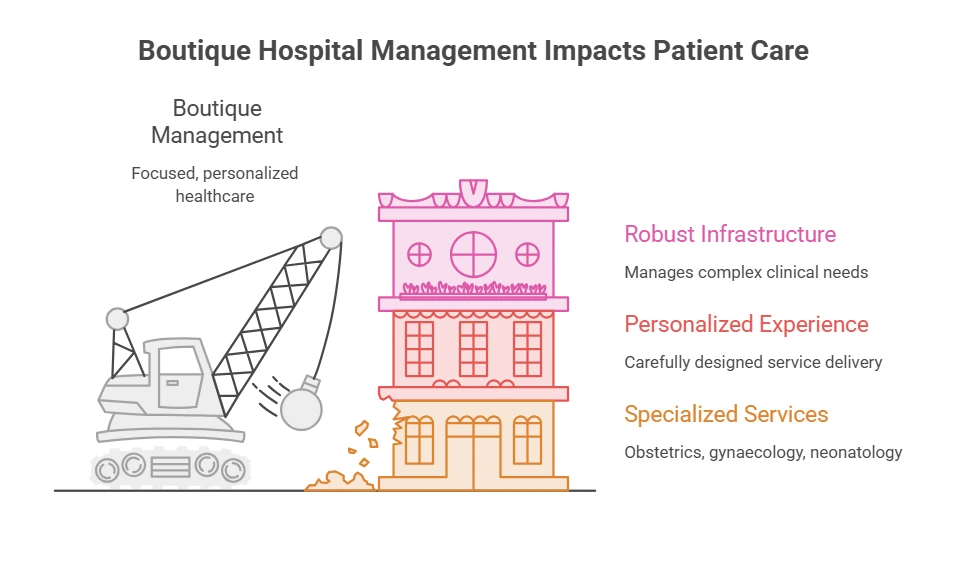
Boutique hospital management refers to operating a focused healthcare facility that combines specialized clinical services with personalized patient experience and carefully designed service delivery. In maternity and childcare, this may include obstetrics, gynaecology, neonatology, paediatrics, fertility support, diagnostics, wellness, and premium hospitality services.
The word “boutique” should not imply that clinical complexity is low.
A maternity facility may need to manage:
Normal deliveries
Caesarean sections
High-risk pregnancies
Neonatal emergencies
Obstetric emergencies
Premature babies
Surgical procedures
Therefore, the management model must combine personalized service with robust clinical infrastructure.
Why Are Single-Specialty Hospitals Growing in India?
Instead of offering dozens of unrelated specialties, these hospitals build expertise around one segment.
Mother-and-child healthcare is a strong example.
Industry reporting in 2025 estimated that India's wider single-specialty hospital market could grow from around $15 billion to $31 billion within three to four years. The same analysis projected the segment could increase its share of the healthcare market.
Several factors support this model.
Focused Clinical Expertise
Specialization allows hospitals to concentrate on selected clinical pathways.
A maternity facility can build deeper capabilities around:
Obstetrics
Gynaecology
Foetal medicine
Neonatology
Paediatrics
Fertility
Women's health
This creates operational focus.
Standardized Infrastructure
A focused hospital can design facilities around predictable patient requirements.
For example, maternity infrastructure may include:
Labour rooms
Delivery suites
Operating theatres
NICU
Ultrasound
Pharmacy
Laboratory
Lactation support
This differs from designing a large multispecialty hospital serving many unrelated specialties.
Replicable Operating Models
Once a focused operating model works, the organization may replicate processes across locations.
This can include:
Clinical protocols
Room designs
Staffing models
Technology
Branding
Patient communication
Procurement
Therefore, single-specialty chains can create standardized patient experiences across cities.
Historically, many families depended on local maternity homes, nursing homes, or multispecialty hospitals.
However, organized mother-and-child hospital networks have created another model.
These facilities attempt to provide an integrated journey from pregnancy through childbirth and paediatric care.
Current examples include Cloudnine Hospitals and Motherhood Hospitals.
Cloudnine states that its network has supported more than 250,000 births and employs more than 8,000 people alongside over 2,000 doctors.
Motherhood describes its model as an integrated women-and-child healthcare network covering obstetrics, gynaecology, fertility, neonatology, and paediatrics across multiple Indian states.
These examples demonstrate how maternity care can develop into an organized specialty platform rather than a single hospital department.
Why Maternity Hospitals Operate Differently
A maternity hospital has several operational characteristics that distinguish it from many other healthcare businesses.
The Patient Relationship Starts Before Admission
A hospital may acquire a maternity patient during early pregnancy.
The patient can then remain connected with the organization for several months.
This creates opportunities for continuity.
However, it also increases expectations.
Every interaction can influence whether the patient continues with the hospital.
Delivery Timing Is Unpredictable
An elective procedure can be scheduled.
Labour cannot always be predicted precisely.
Therefore, administrators need:
24/7 staffing
Emergency readiness
Available labour rooms
Operating theatre capacity
Neonatal support
Blood arrangements
Consultant escalation
This creates a capacity-management challenge.
Two Patients May Require Care
Childbirth involves both mother and baby.
Therefore, maternity operations require coordination between obstetrics and neonatal or paediatric teams.
This makes handovers particularly important.
Family Experience Matters
Pregnancy and childbirth are emotionally significant.
Patients may be accompanied by partners and family members.
Therefore, communication and hospitality can strongly influence overall experience.
Boutique Care Does Not Mean Hotel-Only Care
The rise of luxury healthcare services can sometimes create the impression that boutique hospitals compete mainly through interiors.
That would be an incomplete understanding.
Premium rooms may contribute to patient experience.
However, clinical readiness remains fundamental.
A maternity facility may need immediate access to:
Obstetricians
Anaesthetists
Neonatologists
Nurses
Operating theatres
Blood support
Emergency medication
NICU services
Therefore, managers should never allow hospitality metrics to overshadow clinical safety.
A beautiful room cannot compensate for an inadequate emergency response.
Digital or call-centre systems schedule the consultation.
Consultation
The patient develops a relationship with a clinician.
Pregnancy Monitoring
Regular visits create repeated interactions with the hospital.
Delivery Planning
The hospital may discuss packages, rooms, documentation, insurance, and admission procedures.
Admission and Delivery
Clinical and operational teams coordinate care.
Discharge
Billing, pharmacy, documentation, counselling, and follow-up must work together.
Paediatric Continuity
The relationship may continue after childbirth.
Therefore, maternity care offers a longer customer lifecycle than many episodic healthcare services.
Customer Acquisition in Hospitals: Why Maternity Is Different
Customer acquisition in hospitals is particularly interesting in maternity care because patients may actively research providers before selecting one.
Unlike some emergency situations, pregnancy often allows time for comparison.
Families may evaluate:
Doctor reputation
Hospital location
Clinical infrastructure
NICU availability
Patient experience
Room quality
Package transparency
Online reviews
Recommendations
Insurance acceptance
Therefore, maternity hospitals need strong patient-acquisition systems.
However, healthcare marketing must remain ethical.
Advertising should not create unrealistic expectations or compromise professional standards.
Digital Customer Acquisition
Digital discovery can play a major role.
Potential channels include:
Search engines
Hospital websites
Educational content
Social media
Online appointment systems
Doctor profiles
Patient education webinars
A prospective parent may begin with a search such as:
“maternity hospital near me”
The person may then compare doctors, facilities, reviews, services, and appointment availability.
Therefore, digital marketing and hospital operations are increasingly connected.
If marketing promises convenient appointments but the call centre fails to respond, acquisition spending is wasted.
Content Marketing in Maternity Healthcare
Educational content can support both patient awareness and brand discovery.
Topics may include:
Pregnancy nutrition
Antenatal care
Labour preparation
Breastfeeding
Newborn care
Vaccination
Postpartum recovery
This content can answer genuine patient questions while building familiarity with the healthcare brand.
However, medical content should be clinically reviewed.
Marketing teams should not independently publish medical claims simply to attract website traffic.
Lead Management and Conversion
A maternity inquiry may arrive through:
Website forms
Calls
Messaging channels
Social platforms
Referrals
Health camps
The hospital needs a structured process.
For example:
Inquiry → Contact → Appointment → Consultation → Follow-up → Registration → Continued Care
Managers may track:
Inquiry volume
Response time
Appointment conversion
Consultation attendance
Patient retention
However, healthcare conversion should not become aggressive selling.
The patient must retain freedom of choice.
Doctor Reputation and Hospital Brand
Maternity care is highly doctor-dependent.
Patients may choose a hospital because of a particular obstetrician.
This creates a management challenge.
The organization needs a strong institutional brand while respecting the importance of individual clinicians.
If the hospital depends excessively on one doctor, business continuity may become vulnerable.
Therefore, management should develop:
Strong clinical teams
Standardized care pathways
Institutional quality
Consistent service
Reliable support systems
The goal is not to reduce the doctor's importance.
It is to build organizational strength around clinical expertise.
Consultant Scheduling
Maternity hospitals frequently work with several specialist groups.
These may include:
Obstetricians
Gynaecologists
Paediatricians
Neonatologists
Anaesthetists
Radiologists
Fertility specialists
Administrators need systems for:
OPD scheduling
On-call availability
Emergency coverage
Leave planning
Operating theatre coordination
Consultant communication
Coverage gaps can become serious when emergencies occur.
Therefore, rosters require continuous monitoring.
Managing Labour Room Capacity
Labour-room management is unlike ordinary appointment scheduling.
Administrators need to balance:
Expected deliveries
Unplanned admissions
Labour duration
Emergency procedures
Staff availability
Bed capacity
Demand can fluctuate.
Therefore, hospitals need escalation plans for high-volume periods.
Managers should know:
Available labour beds
Current occupancy
Expected deliveries
OT availability
Nursing capacity
NICU capacity
Real-time operational dashboards can support decision-making.
NICU Capacity Is Strategically Important
Neonatal intensive care is an important component of specialized maternity infrastructure.
A baby may unexpectedly require intensive support after delivery.
Therefore, maternity hospitals need clear neonatal escalation pathways.
Motherhood, for example, publicly lists Level III NICU, paediatric intensive care, neonatal transport, operating theatres, laboratory, pharmacy, and delivery facilities within its mother-and-child infrastructure.
For managers, NICU planning involves:
Beds
Equipment
Specialist staffing
Infection control
Consumables
Emergency transfer
Family communication
A maternity hospital cannot evaluate delivery capacity independently from neonatal capacity.
Hospitality in Luxury Healthcare Services
Premium maternity care may borrow service concepts from hospitality.
Examples include:
Private rooms
Comfortable waiting areas
Personalized meals
Family support
Concierge-style assistance
Celebration services
These elements can improve experience.
However, healthcare hospitality has limits.
Clinical requirements must take priority.
For example, dietary preferences may need to follow medical advice.
Visitor access may be restricted for infection control.
Room preferences may change because of clinical needs.
Therefore, administrators must communicate boundaries clearly.
Patient Experience Is More Than Luxury
A common management mistake is equating patient experience with expensive interiors.
Experience also depends on basic operational performance.
Patients care about:
Waiting time
Communication
Cleanliness
Privacy
Staff behaviour
Billing transparency
Responsiveness
Pain management
Discharge coordination
A simple room with excellent service may create a better experience than a luxurious room with poor communication.
Therefore, managers should measure experience across the entire journey.
Managing Maternity Packages
Many maternity hospitals use package-based pricing.
Packages can simplify financial planning for families.
However, administrators should ensure transparency.
Patients should understand:
What is included
What is excluded
Room category
Professional fees
Investigation charges
Medication treatment
Additional procedures
Neonatal care implications
Clinical circumstances may change unexpectedly.
Therefore, managers should communicate that additional medically necessary services can affect the final bill.
Surprise billing can damage trust.
Insurance and Maternity Coverage
Insurance coordination can be complex because maternity coverage varies between policies.
Hospital teams should verify:
Eligibility
Waiting periods
Coverage limits
Room eligibility
Documentation
Preauthorization
Exclusions
Staff should avoid promising coverage before verification.
A smooth insurance process can significantly influence patient experience.
Quality Management in a Single Specialty Hospital Chain
A single specialty hospital chain has an important operational advantage.
Similar processes can potentially be standardized across facilities.
Examples include:
Admission protocols
Clinical checklists
Emergency escalation
Medication processes
Infection control
Patient identification
Discharge procedures
Complaint handling
However, standardization must be carefully implemented.
Hospitals in different cities may have different:
Patient profiles
Demand patterns
Staffing environments
Local regulations
Facility layouts
Therefore, a central SOP should provide consistency while allowing appropriate local implementation.
Clinical Quality Indicators
Boutique hospitals should track clinical performance alongside experience metrics.
Potential indicators may include:
Infection indicators
Medication incidents
Emergency response
Readmissions
Patient-safety incidents
NICU indicators
Surgical safety compliance
The exact indicators should be defined by qualified clinical and quality leadership.
Motherhood states that its network monitors dozens of internal clinical quality indicators each month.
This illustrates why specialty healthcare chains need strong data systems.
Shape Healthcare Experiences
Develop leadership, operations, marketing, and analytical capabilities to manage specialized healthcare organizations while delivering exceptional patient experiences and value.
Service quality determines whether trust continues.
Why Healthcare Management Students Should Study This Model
Boutique maternity hospitals demonstrate how modern healthcare increasingly combines multiple management disciplines.
A manager may need to understand:
Clinical workflows
Hospitality
Marketing
Finance
Technology
Quality
Capacity planning
Customer experience
This makes the model valuable for healthcare management education.
At Asia Pacific Institute of Management, an industry-oriented curriculum, practical learning, experienced faculty, corporate exposure, and placement support can help students develop wider managerial capabilities.
For learners interested in healthcare, combining business fundamentals with an understanding of specialized healthcare operations can support preparation for emerging management roles.
The Future of Boutique Hospital Management in India
Single-specialty healthcare is likely to remain an important part of India's evolving private healthcare landscape.
Recent 2026 industry analysis continues to identify specialty hospital chains as growth engines within healthcare.
For maternity and childcare operators, future growth may increasingly depend on:
Expansion into new cities
Integrated women's healthcare
Fertility services
Paediatric continuity
Digital engagement
Standardized quality
Better patient experience
Strong operational analytics
However, expansion also creates risk.
A healthcare brand cannot scale successfully if clinical quality becomes inconsistent between locations.
Therefore, the strongest networks will need to scale both experience and safety.
The growth of boutique hospital management reflects an important shift in Indian healthcare.
Patients increasingly encounter focused healthcare organizations designed around specific clinical journeys.
Maternity and childcare are particularly suited to this model because the relationship can begin early in pregnancy and continue through childbirth, neonatal care, and paediatrics.
However, specialized hospitals are operationally demanding.
They must manage unpredictable deliveries, emergency readiness, specialist rosters, NICU capacity, patient expectations, premium hospitality, marketing, quality, and financial performance simultaneously.
Therefore, successful management requires much more than creating a luxury experience.
The strongest model combines clinical excellence with efficient operations and patient trust.
For healthcare management students, this sector offers a valuable lesson in how single specialty hospital chains, luxury healthcare services, and niche healthcare operations intersect.
It also creates career opportunities across operations, patient experience, quality, marketing, analytics, supply chain, and business development.
As specialized healthcare expands, managers who can balance business performance with safety, empathy, and service quality can become increasingly valuable.
Build Healthcare Leadership
Prepare for high-impact management roles in India’s evolving healthcare sector through industry-focused learning, practical exposure, and essential business skills.
Dr. Vikas Gupta is a distinguished academic in the education and research domain, specializing in finance and related interdisciplinary studies. He is known for his...
Boutique hospital management involves operating focused healthcare facilities that combine specialized clinical expertise with personalized service and carefully managed patient experience.
02.
What is a single specialty hospital chain?
A single-specialty hospital chain operates multiple facilities focused mainly on a defined healthcare area, such as maternity and childcare, fertility, ophthalmology, or another specialized segment.
03.
Why are maternity hospitals growing in India?
Organized maternity hospitals benefit from demand for specialized clinical care, integrated mother-and-child services, stronger patient experience, digital convenience, and continuity across pregnancy and paediatric care.
04.
What are the major challenges in niche healthcare operations?
Challenges include specialist staffing, emergency preparedness, quality standardization, capacity planning, patient acquisition, supply chains, technology, and maintaining consistent service across locations.
05.
What are luxury healthcare services in maternity hospitals?
They may include private rooms, personalized hospitality, wellness support, premium dining, concierge-style assistance, and enhanced family services. However, clinical safety must remain the priority.
06.
How do maternity hospitals acquire patients?
Patient acquisition may involve doctor reputation, referrals, digital search, educational content, social media, corporate partnerships, online reviews, and patient recommendations.
07.
Can MBA graduates work in boutique maternity hospitals?
Yes, depending on employer requirements. Opportunities may exist in operations, marketing, finance, HR, quality, supply chain, analytics, patient experience, and business development.
08.
What skills are important for boutique hospital managers?
Important skills include healthcare operations, customer experience, data analysis, quality management, finance, marketing, communication, digital systems, and team leadership.

















.webp) Call Us
Call Us