Can Doctors Pursue an Executive MBA While Practicing?
Posted on 15 Sep 2026
By Dr. Vikas Gupta
Introduction
Doctors spend years developing clinical expertise, but as their careers progress, many find themselves taking on responsibilities that extend beyond patient care. Managing teams, running a clinic, handling hospital operations, making financial decisions, improving patient experience, or building a healthcare business all require skills that aren't traditionally the focus of medical education.
This leads to an important question: Can doctors pursue an Executive MBA while practicing?
In many cases, yes. An executive MBA for doctors can be a practical option for medical professionals who want to develop management and leadership capabilities while continuing their clinical careers. Executive programmes may offer weekend, online, hybrid, or other flexible formats designed around working professionals.
However, balancing medical practice with management education requires careful planning.
This guide explains how an Executive MBA can fit into a doctor's career, what you may learn, potential benefits, career opportunities, and what to consider before choosing a programme.
Lead Beyond Clinical Care
Combine your medical expertise with finance, strategy, operations, and leadership skills to expand your impact across modern healthcare organizations.
An executive MBA for doctors is not necessarily a separate degree exclusively for physicians. Rather, it generally refers to an Executive MBA or healthcare-focused management programme suitable for experienced medical professionals.
Unlike a traditional full-time MBA, executive programmes are typically designed around professionals who already have workplace experience.
For doctors, this means developing business knowledge without necessarily abandoning clinical practice.
Depending on the programme, doctors may study subjects such as:
Healthcare Management
Hospital Operations
Financial Management
Healthcare Marketing
Human Resource Management
Business Strategy
Healthcare Quality
Healthcare Analytics
Digital Health
Leadership and Organisational Behaviour
The objective is to complement medical expertise with managerial and business capabilities.
Can Doctors Really Pursue an MBA While Working?
Yes, depending on the programme format and a doctor's professional schedule.
Pursuing an MBA while working as doctor can be challenging because medical professionals often work irregular hours, manage emergencies, attend consultations, and carry significant patient responsibilities.
A traditional full-time MBA may therefore be difficult for a doctor who wants to continue practising.
Executive programmes can provide greater flexibility.
Depending on the institution, classes may be delivered through:
Weekend sessions
Evening classes
Online learning
Hybrid learning
Modular sessions
Periodic campus residencies
This can make management education more accessible to practicing doctors.
Before enrolling, however, doctors should verify the exact class schedule, attendance requirements, examinations, assignments, and compulsory campus components.
Why Would a Doctor Need an MBA?
Medical education develops clinical expertise. Management education develops a different set of capabilities.
Consider a doctor who eventually becomes responsible for an entire hospital department.
Clinical expertise remains essential, but the role may also involve budgeting, team management, resource allocation, performance measurement, patient experience, strategic planning, and coordination with other departments.
Similarly, a doctor running a clinic needs to think about staffing, finance, marketing, operations, technology, compliance, service quality, and growth.
An MBA for doctors can help provide structured exposure to these business functions.
Why Healthcare Needs Doctors With Management Skills
Healthcare organisations operate at the intersection of medicine, business, technology, operations, and human behaviour.
Decisions made by hospital leaders can affect both organisational performance and patient experience.
Doctors already understand clinical workflows and many of the practical challenges experienced by patients and medical teams.
Adding management knowledge can provide another perspective.
For example, a doctor with management training may be better equipped to understand questions such as:
How should hospital resources be allocated?
How can patient waiting times be reduced?
How should a healthcare organisation evaluate expansion opportunities?
How can multidisciplinary teams work more effectively?
How should technology investments be evaluated?
How can patient experience be improved without compromising operational sustainability?
A healthcare MBA for doctors can help medical professionals approach such questions through both clinical and managerial perspectives.
Executive MBA vs Regular MBA for Doctors
Choosing between an Executive MBA and a regular MBA depends largely on career stage.
Factor
Executive MBA
Regular MBA
Typical audience
Experienced professionals
Graduates and early-career candidates
Work experience
Usually required/preferred
May not always be required
Learning schedule
Often flexible
Usually full-time
Continue practicing
More feasible depending on format
Can be difficult with full-time study
Learning approach
Applied and leadership-oriented
Foundational + applied
Peer group
Experienced professionals
Primarily students/early-career professionals
Career objective
Leadership/career progression
Career entry or major transition
For an experienced practicing doctor, an Executive MBA may offer a more compatible structure.
A medical graduate who wants to leave clinical practice and transition completely into business or management may have different requirements and could also consider a regular MBA.
Doctors may learn about capacity planning, patient flow, process improvement, resource utilisation, service delivery, operational efficiency, and performance measurement.
Finance
Understanding finance becomes increasingly important for doctors moving into leadership positions or running their own healthcare businesses.
Management education may cover budgeting, financial statements, cost management, investment decisions, financial planning, and business performance.
Human Resource Management
Doctors in senior positions often manage multidisciplinary teams.
Leadership requires an understanding of motivation, performance management, conflict resolution, workforce planning, communication, and organisational behaviour.
Healthcare Marketing
Healthcare organisations need to understand patient expectations, communication, reputation, service positioning, and changing consumer behaviour.
Doctors running clinics or healthcare businesses may find these concepts particularly relevant.
Healthcare Quality
Quality management can include patient safety, service standards, process improvement, accreditation concepts, performance measurement, and patient experience.
Healthcare Analytics
Healthcare organisations generate significant amounts of data.
Management programmes may help doctors understand dashboards, KPIs, performance metrics, business analytics, and data-driven decision-making.
Digital Health
AI, telemedicine, digital platforms, electronic health systems, and automation are changing healthcare delivery.
Healthcare leaders increasingly need enough technological understanding to evaluate how these tools affect patients, professionals, and organisations.
Strategy and Leadership
Executive programmes often place significant emphasis on strategic decision-making.
Doctors may study organisational growth, competitive strategy, innovation, change management, leadership, negotiation, and business models.
MBA for Doctors Who Want Hospital Leadership Roles
One of the clearest reasons to consider an MBA for doctors is a desire to move towards healthcare leadership.
A doctor's career may gradually evolve from treating individual patients to managing teams, departments, facilities, or healthcare organisations.
At that level, medical expertise remains important, but management capabilities become increasingly relevant.
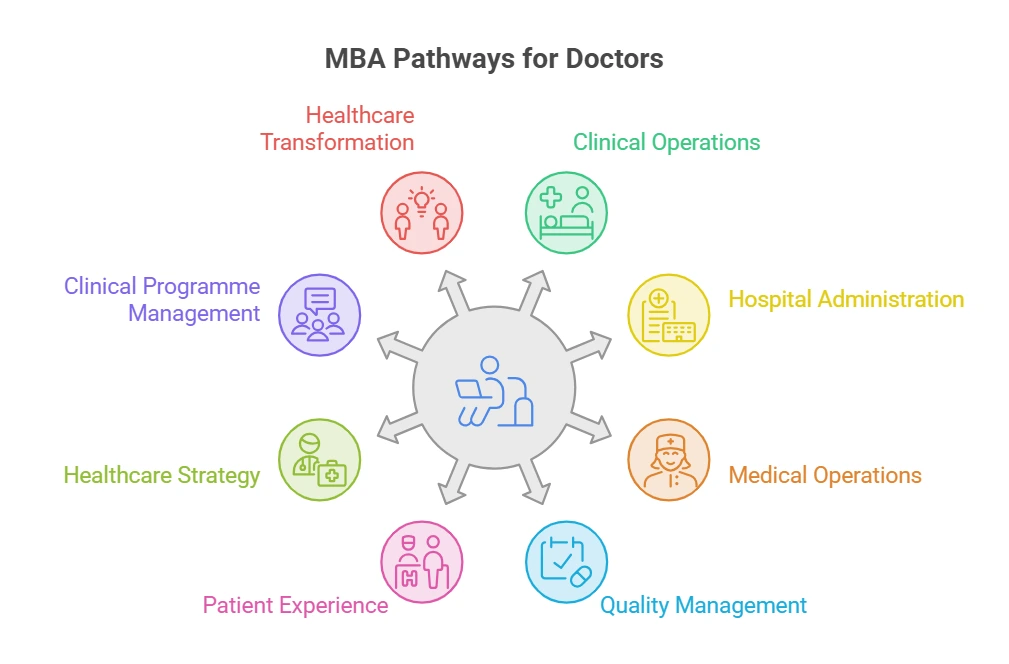
Doctors interested in leadership may explore responsibilities connected with:
Clinical operations
Hospital administration
Medical operations
Quality management
Patient experience
Healthcare strategy
Clinical programme management
Healthcare transformation
An MBA doesn't automatically qualify someone for senior leadership. Experience, organisational performance, leadership ability, and other professional credentials remain important.
MBA for Doctors Running Their Own Clinic
A doctor who owns a clinic is both a medical professional and a business operator.
Beyond patient care, clinic ownership can involve:
Hiring employees
Managing finances
Controlling costs
Marketing services
Managing appointments
Selecting technology
Improving patient experience
Negotiating with vendors
Planning expansion
A management course for doctors can help develop a more structured understanding of these business responsibilities.
This can be particularly useful for doctors planning to expand from an individual practice to a larger clinic, diagnostic centre, specialty centre, or healthcare venture.
Executive MBA for Doctors Interested in Entrepreneurship
Healthcare entrepreneurship can take many forms.
Doctors may develop clinics, specialty healthcare centres, digital health platforms, medical technology solutions, diagnostic businesses, wellness services, or other healthcare ventures.
Clinical expertise can help identify genuine healthcare problems.
Management education can complement this with knowledge of finance, business models, marketing, operations, strategy, team building, and growth.
For doctors interested in entrepreneurship, the combination of medical knowledge and business capabilities can be valuable.
Can Doctors Continue Clinical Practice During an Executive MBA?
For many doctors, this is the most important practical consideration.
Whether you can continue practising depends on both your work schedule and the structure of the programme.
A doctor working predictable consultation hours may find a weekend programme manageable.
Someone working rotating hospital shifts or frequent emergency duties may prefer an online or highly flexible programme.
Before enrolling, compare your actual weekly schedule with the programme timetable.
Don't consider only lecture hours. Account for assignments, projects, examinations, readings, group meetings, and travel as well.
Practice Medicine Lead Healthcare
Continue practicing while developing business and management capabilities for hospital leadership, clinical administration, entrepreneurship, and strategic healthcare responsibilities.
Pursuing an MBA while working as doctor requires disciplined time management.
Choose the Right Learning Format
Your work schedule should influence whether you choose weekend, online, hybrid, or another executive format.
Block Dedicated Study Time
Don't rely on finding spare time randomly.
Create fixed weekly periods for lectures, reading, assignments, and projects.
Plan Around Clinical Responsibilities
If your schedule includes predictable high-pressure periods, plan academic work in advance.
Use Your Workplace as a Learning Environment
One advantage of studying while practicing is that management concepts can potentially be connected to real healthcare situations.
Operations, patient experience, quality, leadership, and strategy can become easier to understand when you can relate them to your professional environment.
Protect Recovery Time
Combining clinical responsibilities with academic commitments can be demanding. A sustainable schedule should account for rest and personal commitments rather than filling every available hour with work or study.
Executive MBA for Medical Professionals Beyond Doctors
An executive MBA for medical professionals may also be relevant to professionals across the wider healthcare ecosystem.
Depending on programme eligibility, participants can include:
Dentists
Pharmacists
Nurses
Physiotherapists
Hospital administrators
Allied healthcare professionals
Medical-device professionals
Healthcare consultants
Health-tech professionals
Diagnostic professionals
This diversity can create interesting classroom discussions because participants bring different perspectives on healthcare delivery and management.
Career Opportunities After an Executive MBA for Doctors
Doctors don't necessarily pursue an MBA to stop practicing medicine.
Some use management education to add leadership responsibilities to their existing clinical careers.
Others may eventually explore non-clinical or hybrid roles.
Depending on professional experience and organisational requirements, potential areas can include:
Medical Administration
Doctors may contribute to the management and coordination of medical services within hospitals and healthcare organisations.
Hospital Operations
Professionals working in operations focus on improving processes, resource utilisation, patient flow, service delivery, and organisational efficiency.
Clinical Leadership
Experienced doctors may take on responsibilities involving teams, departments, clinical programmes, or service lines.
Healthcare Consulting
Doctors with business knowledge may explore consulting roles involving healthcare strategy, operations, clinical transformation, or related areas.
Healthcare Strategy
Healthcare strategy can involve expansion planning, service development, organisational transformation, partnerships, and market analysis.
Health-Tech
Doctors can bring valuable clinical perspectives to health-tech businesses developing solutions for patients and healthcare professionals.
Healthcare Entrepreneurship
Management education can support doctors interested in building or expanding their own healthcare ventures.
Healthcare MBA for Doctors vs General MBA
Doctors also need to decide whether they want a general MBA or a specialised healthcare MBA.
A general MBA provides broad business knowledge applicable across multiple industries.
A healthcare MBA for doctors places those management principles within a healthcare context.
For a doctor who intends to remain in healthcare, specialised subjects such as hospital operations, healthcare quality, patient experience, health economics, and digital healthcare may be particularly relevant.
A doctor planning to transition into a completely different industry may prefer the broader flexibility of a general MBA.
Is an Executive MBA Better Than a Short Management Course for Doctors?
It depends on what you want to achieve.
A short management course for doctors can be useful if you need focused knowledge in one specific area.
For example, you might want to learn only healthcare finance, hospital quality, leadership, entrepreneurship, or digital health.
An Executive MBA generally provides broader exposure across multiple business functions.
If your goal is comprehensive management and leadership development, an Executive MBA may be more appropriate.
If you need only one specific skill, a shorter specialised programme may be more efficient.
What Should Doctors Check Before Choosing an Executive MBA?
The programme title shouldn't be your only selection criterion.
Eligibility
Confirm whether your medical qualification and professional experience meet the programme requirements.
Recognition
Verify the institution, qualification, and applicable recognition or approvals.
Curriculum
Look for a balance between core management subjects and relevant healthcare applications.
Learning Format
Check whether classes are delivered online, on campus, on weekends, or through a hybrid format.
Schedule
Review actual class timings rather than assuming that an "Executive MBA" will automatically fit your work schedule.
Faculty
Look for faculty with relevant academic, healthcare, management, and industry experience.
Peer Group
Executive education can benefit considerably from interaction with experienced professionals.
Industry Exposure
Healthcare case studies, projects, guest sessions, and industry interaction can improve practical learning.
Total Cost
Consider tuition fees alongside travel, accommodation, technology, and other programme expenses.
Career Relevance
Most importantly, ask whether the programme supports the professional direction you actually want to pursue.
Is an Executive MBA Worth It for Doctors?
An executive MBA for doctors can be worthwhile when there is a clear reason for pursuing it.
For example, it may make sense if you want to:
Move into hospital leadership
Manage a larger clinical department
Understand healthcare business operations
Build or expand your clinic
Enter healthcare consulting
Work in health-tech
Develop a healthcare venture
Strengthen finance and strategy knowledge
Move towards non-clinical management
It may be less valuable if you're pursuing an MBA simply because you assume the qualification will automatically lead to a higher salary or senior designation.
The value comes from combining management education with your existing medical expertise and applying both effectively.
Does an Executive MBA Mean Leaving Clinical Practice?
No.
Pursuing an MBA doesn't automatically mean giving up medicine.
Some doctors may use management education to transition completely into administration, consulting, business, or entrepreneurship.
Others may maintain clinical practice while taking on leadership responsibilities.
For example, a doctor might continue seeing patients while also managing a department or healthcare business.
Your eventual career path depends on your interests, opportunities, and long-term objectives.
How Can an MBA Change a Doctor's Career?
A medical career traditionally focuses on developing deeper clinical expertise.
Management education can add another dimension.
Instead of asking only:
"How can I improve outcomes for this patient?"
A doctor in a management role may also need to ask:
"How can we improve outcomes across an entire department, hospital, or healthcare system?"
That shift—from individual clinical decisions to organisational decision-making—is one of the most important reasons doctors may consider management education.
Who Should Consider an Executive MBA for Doctors?
An Executive MBA may be particularly relevant if you are an experienced doctor who increasingly handles managerial responsibilities.
It can also make sense if you own a healthcare business, lead a medical team, want to move into hospital administration, or are interested in healthcare entrepreneurship.
Doctors early in their careers should think carefully about whether an Executive MBA is necessary immediately or whether additional clinical experience would provide greater value first.
The right timing depends on your career objective and the eligibility requirements of the programme.
So, can doctors pursue an Executive MBA while practicing?
For many medical professionals, the answer can be yes—provided they choose a programme format compatible with their clinical responsibilities.
An executive MBA for doctors can help bridge the gap between clinical expertise and business leadership by introducing professionals to finance, operations, strategy, marketing, analytics, technology, and organisational management.
The biggest advantage for practicing doctors is that executive formats may allow them to develop these capabilities without completely stepping away from medicine.
However, the decision should begin with a clear career objective.
If you want to lead healthcare teams, manage hospitals, expand a clinical practice, build a healthcare business, enter health-tech, or contribute to healthcare strategy, management education can complement your medical background.
Before choosing an MBA for doctors, compare eligibility, recognition, curriculum, schedule, faculty, learning format, healthcare exposure, cost, and career relevance.
The right programme should not force you to choose between being a doctor and understanding business. It should help you use your medical experience more effectively as your responsibilities expand beyond clinical care.
Turn Expertise Into Leadership
Strengthen your clinical experience with practical management knowledge to lead teams, improve operations, and build successful healthcare ventures confidently.
Dr. Vikas Gupta is a distinguished academic in the education and research domain, specializing in finance and related interdisciplinary studies. He is known for his...
01.
Can doctors pursue an Executive MBA while practicing?
Yes, depending on their work schedule and programme format. Weekend, online, hybrid, or other flexible Executive MBA formats may allow doctors to continue clinical practice while studying.
02.
What is an Executive MBA for doctors?
An Executive MBA for doctors generally refers to an Executive MBA or healthcare management programme suitable for experienced medical professionals who want to develop business, management, and leadership capabilities.
03.
Is an MBA useful for doctors?
An MBA can be useful for doctors interested in hospital management, leadership, healthcare strategy, consulting, health-tech, entrepreneurship, or running and expanding their own healthcare businesses.
04.
Can I pursue an MBA while working as a doctor?
It can be possible with an appropriate flexible programme. Doctors should compare class timings, attendance, assignments, examinations, travel requirements, and clinical responsibilities before enrolling.
05.
Which MBA is best for doctors?
The right MBA depends on the doctor’s career goal. A healthcare-focused MBA may suit doctors planning to remain within healthcare, while a general MBA can provide broader business exposure across industries.
06.
What can doctors do after a Healthcare MBA?
Depending on their experience and skills, doctors may explore hospital administration, medical operations, clinical leadership, healthcare consulting, strategy, health-tech, and healthcare entrepreneurship.
07.
Is an Executive MBA better for experienced doctors than a regular MBA?
It may be more suitable for experienced doctors who want to continue working because Executive MBA programmes are generally designed for professionals. Individual programme structures and eligibility requirements should still be compared.
08.
Do doctors have to stop clinical practice after an MBA?
No. Doctors can choose to continue clinical practice, combine clinical and management responsibilities, or transition towards non-clinical careers depending on their professional goals.


















.webp) Call Us
Call Us