Weekend Executive MBA in Healthcare: A Flexible Learning Option for Professionals
Posted on 14 Sep 2026
By Dr. Vikas Gupta
Introduction
Working in healthcare can be demanding. Hospital operations, patient care, administration, pharmaceuticals, diagnostics, health-tech, and other healthcare functions often involve busy schedules and significant professional responsibilities. For many professionals, leaving their jobs to pursue a full-time management degree simply isn't practical.
Designed primarily around the needs of working professionals, a weekend programme can provide an opportunity to develop management and leadership capabilities while continuing your career. Instead of attending regular weekday classes, learners typically complete a significant portion of their academic activities during weekends, although the exact schedule varies by institution.
But is a weekend MBA healthcare programme right for you? How does it work, who should consider it, and what career opportunities can it support?
This guide explains the programme format, eligibility, curriculum, benefits, challenges, career scope, and factors to consider before choosing a weekend Executive MBA in Healthcare.
Weekends That Build Careers
Turn your weekends into career progress by developing healthcare management, strategic thinking, and leadership skills while continuing your profession.
A weekend executive MBA in healthcare is a management programme generally designed for professionals who want to strengthen their business, healthcare management, and leadership capabilities without completely stepping away from employment.
Classes are commonly scheduled during weekends or other professional-friendly time slots.
The programme may combine core business areas such as:
Finance
Marketing
Human Resources
Operations
Strategy
Business Analytics
Leadership
These may be integrated with healthcare-specific subjects such as hospital operations, healthcare quality, patient experience, healthcare finance, digital health, healthcare analytics, and healthcare strategy.
The objective is to help professionals understand healthcare organisations from both operational and business perspectives.
Why Consider a Weekend MBA in Healthcare?
For professionals, one of the biggest challenges of returning to education is finding enough time.
A conventional full-time MBA may require regular weekday attendance and a significant academic commitment. This can make it difficult to continue full-time employment.
A weekend MBA healthcare programme attempts to address this challenge by offering a schedule designed around professional commitments.
Instead of choosing between your career and management education, a weekend format may allow you to pursue both simultaneously.
That makes it particularly relevant to healthcare professionals who want management education but aren't ready or able to take an extended career break.
How Does a Weekend Executive MBA Work?
The exact structure depends on the institution.
An executive MBA weekend program may include classroom sessions on Saturdays and Sundays, online learning, case discussions, projects, assignments, examinations, group activities, and industry interactions.
Some programmes may be primarily campus-based, while others can use a blended structure combining physical and online classes.
A typical learning experience may involve:
Weekend classes: Core academic sessions may be scheduled around Saturdays and Sundays.
Online learning: Digital platforms may be used for learning resources, recorded lectures, assignments, or supplementary sessions.
Case studies: Students may analyse real or simulated healthcare management problems.
Group projects: Participants may collaborate with professionals from different healthcare backgrounds.
Industry interaction: Guest lectures, workshops, projects, or discussions may provide additional exposure to healthcare organisations and leaders.
Because formats vary, applicants should verify the actual timetable before enrolling.
Who Should Consider a Weekend Executive MBA in Healthcare?
A weekend programme can be particularly relevant to professionals who already have workplace experience and want to strengthen their managerial capabilities.
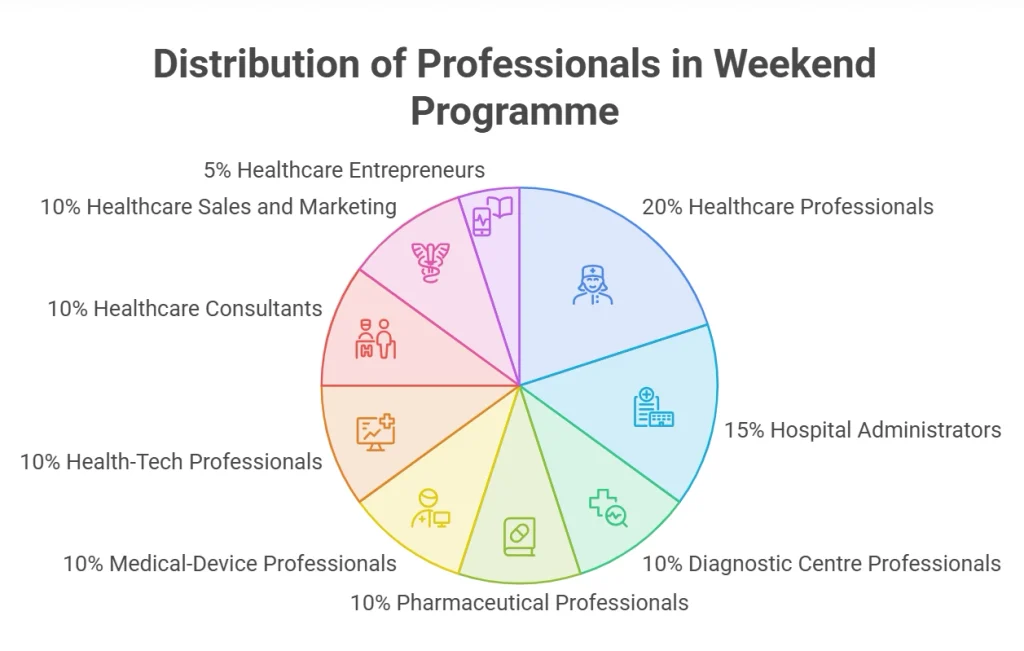
Potential participants may include:
Doctors
Dentists
Pharmacists
Nurses and allied healthcare professionals
Hospital administrators
Hospital operations professionals
Diagnostic centre professionals
Pharmaceutical professionals
Medical-device professionals
Health-tech professionals
Healthcare consultants
Healthcare sales and marketing professionals
Healthcare entrepreneurs
It can also appeal to professionals from other sectors who want to transition into healthcare management, subject to programme eligibility.
MBA for Working Professionals: Why Flexibility Matters
An MBA for working professionals needs to recognise that learners have different responsibilities from traditional full-time students.
A working professional may have office deadlines, team responsibilities, client meetings, hospital shifts, travel, or family commitments.
A flexible programme can make management education more accessible by concentrating academic activities into specific periods.
However, flexibility shouldn't be confused with a lighter academic workload.
Weekend learners may still need to complete assignments, projects, examinations, readings, presentations, and group work during the week.
The real advantage is greater control over when learning takes place.
Weekend Executive MBA vs Regular MBA in Healthcare
Both programmes can teach healthcare management, but they generally serve different audiences.
Factor
Weekend Executive MBA
Regular MBA in Healthcare
Primary audience
Working professionals
Graduates and early-career candidates
Classes
Primarily weekends/flexible
Usually weekdays
Work experience
Often required or preferred
May not always be required
Career break
Often avoidable
May be necessary for full-time study
Learning approach
Applied and experience-oriented
Foundational + applied
Peer group
Primarily professionals
Mostly students/early-career professionals
Main objective
Career development/leadership
Career entry and management foundation
Work-study balance
Designed around employment
Full-time academic commitment
These differences are general rather than universal. Candidates should compare the actual structure of individual programmes.
Weekend Executive MBA vs Part-Time MBA Healthcare
The terms weekend MBA and part time MBA healthcare are sometimes used interchangeably, but they don't necessarily mean exactly the same thing.
A part-time MBA refers broadly to a programme completed alongside professional or other responsibilities.
Classes could take place during evenings, weekends, online, or through a combination of formats.
A weekend MBA is more specifically organised around weekend learning.
An Executive MBA, meanwhile, usually targets professionals with work experience and may place greater emphasis on leadership, strategy, decision-making, and applied management.
Because institutions use programme terminology differently, candidates should evaluate the actual curriculum, eligibility, learning mode, duration, and qualification rather than relying only on the programme title.
What Do You Learn in a Weekend Healthcare MBA?
A flexible healthcare MBA may combine general management fundamentals with healthcare-specific applications.
Healthcare Operations Management
Operations are at the heart of hospitals and healthcare organisations.
Students may learn about patient flow, resource utilisation, process improvement, capacity planning, service efficiency, and operational performance.
Healthcare Finance
Healthcare managers need to understand the financial implications of business decisions.
Subjects may include budgeting, financial statements, cost management, financial planning, healthcare economics, and financial decision-making.
Healthcare Marketing
Healthcare organisations also need to understand patients, markets, communication, reputation, and service positioning.
Students may explore digital marketing, patient acquisition, healthcare branding, market research, and relationship management.
Healthcare Quality Management
Quality and patient safety are important components of healthcare administration.
Students may learn about quality systems, accreditation concepts, patient safety, process improvement, service standards, and performance measurement.
Learn Without Leaving Work
Continue your healthcare career while gaining practical expertise in finance, operations, analytics, strategy, and leadership through flexible management education.
Hospitals and healthcare businesses depend on multidisciplinary teams.
Management education can help professionals understand workforce planning, performance management, employee engagement, conflict management, organisational behaviour, and leadership.
Healthcare Analytics
Data increasingly influences healthcare decision-making.
Students may develop familiarity with healthcare KPIs, dashboards, analytics, performance measurement, and data-driven decision-making.
Digital Health
Healthcare is becoming increasingly technology-enabled.
Depending on the programme, students may explore telemedicine, digital healthcare platforms, electronic health systems, artificial intelligence, automation, and healthcare technology transformation.
Healthcare Strategy and Leadership
Executive education often places considerable emphasis on strategic thinking and leadership.
Students may study competitive strategy, organisational growth, innovation, change management, strategic decision-making, and leadership development.
Benefits of a Weekend Executive MBA in Healthcare
The value of a weekend programme goes beyond simply attending classes on Saturdays and Sundays.
Continue Working While Studying
One of the biggest potential advantages is the ability to continue your career.
Professionals can maintain workplace exposure while developing new management capabilities.
Avoid a Complete Career Break
Leaving employment for a full-time MBA can involve an opportunity cost.
A weekend format may allow professionals to continue earning and accumulating experience while studying.
Apply Learning Immediately
Professionals can potentially apply classroom concepts to workplace situations.
For example, someone studying operations management may use process-improvement concepts to analyse workflow challenges within their organisation.
Build Cross-Functional Knowledge
A professional may have significant expertise in one function but limited understanding of others.
An MBA can provide exposure to finance, marketing, operations, analytics, HR, and strategy.
Develop Leadership Capabilities
Moving into management requires more than technical expertise.
Professionals need capabilities in communication, decision-making, team management, negotiation, problem-solving, and strategic thinking.
Learn From Experienced Peers
An executive cohort may include professionals from hospitals, pharmaceuticals, health-tech, diagnostics, insurance, medical devices, and other sectors.
Their workplace experiences can contribute significantly to classroom discussions.
Eligibility for a Weekend Executive MBA in Healthcare
Eligibility varies between institutions.
Candidates typically need a recognised bachelor's degree. Executive programmes may additionally require or prefer professional work experience.
Some healthcare-focused programmes may specifically target candidates from medicine, dentistry, pharmacy, nursing, life sciences, allied health sciences, hospital administration, or related fields.
Others may accept professionals from broader academic and industry backgrounds.
Applicants should verify the latest eligibility requirements directly with the institution before applying.
How Long Does a Weekend Executive MBA Take?
There is no universal duration for a weekend Executive MBA.
Programme length depends on curriculum depth, academic structure, number of credits, delivery format, and institution.
When comparing programmes, don't assume that a shorter course automatically offers better value.
Consider:
Total learning hours
Number of subjects
Curriculum depth
Projects
Live sessions
Faculty interaction
Industry exposure
Assessment structure
The objective should be to find a programme that provides sufficient academic depth while remaining manageable alongside your professional responsibilities.
Career Opportunities After a Weekend Executive MBA in Healthcare
The value of a weekend executive MBA in healthcare can also be assessed through the career capabilities it may help professionals develop.
Depending on previous education, professional experience, skills, and employer requirements, learners may explore or progress within roles such as:
Hospital Operations Manager
Healthcare Administrator
Healthcare Project Manager
Healthcare Quality Manager
Patient Experience Manager
Healthcare Business Development Manager
Healthcare Marketing Manager
Healthcare Consultant
Health-Tech Operations Manager
Healthcare Programme Manager
Medical Operations Manager
Healthcare Strategy Professional
An Executive MBA doesn't automatically guarantee a promotion or senior management position.
Career progression depends on previous experience, performance, skills, professional network, programme quality, and organisational opportunities.
Industries Where Healthcare Management Skills Can Be Relevant
Healthcare management careers aren't limited to hospitals.
Professionals can potentially apply management capabilities across:
Hospitals: Operations, administration, quality, patient experience, and strategy.
Pharmaceuticals: Marketing, business operations, projects, strategy, and commercial functions.
Health-Tech: Operations, implementation, partnerships, growth, and business strategy.
Diagnostics: Centre operations, expansion, business development, and service quality.
Healthcare Consulting: Strategy, transformation, operational improvement, and project management.
Medical Devices: Marketing, business development, operations, and commercial management.
Insurance: Healthcare operations, provider management, customer experience, and related functions.
Healthcare Startups: Operations, partnerships, growth, strategy, and business development.
Challenges of a Weekend MBA for Working Professionals
A weekend format provides flexibility, but it isn't effortless.
Limited Free Time
After working throughout the week, spending weekends in classes can be physically and mentally demanding.
Time Management
Assignments, projects, presentations, and readings may need to be completed during weekdays.
Professionals therefore need strong time-management habits.
Work Pressure
Busy periods at work can occasionally conflict with academic deadlines or classes.
Family and Personal Commitments
Weekend study can reduce the time available for personal and family responsibilities.
Networking Requires Effort
Professionals may spend less time on campus than full-time students, so actively participating in peer discussions, projects, and networking events becomes important.
Understanding these challenges before enrolling can help you prepare more realistically.
How to Balance Work and a Weekend Executive MBA
Successful work-study balance usually requires planning.
Create a weekly schedule that includes work, classes, assignments, personal responsibilities, and rest.
Avoid leaving every academic task until the weekend because classes themselves may occupy a significant portion of that time.
Communicate with your family and, where appropriate, your employer about your academic commitments.
Use small periods during weekdays for readings, research, or assignments.
Most importantly, set realistic expectations. Trying to maintain an unsustainable schedule for months can negatively affect both work and learning.
How to Choose the Right Executive MBA Weekend Program
Not every weekend programme offers the same experience.
Before enrolling, examine several factors carefully.
Recognition: Verify the institution and qualification, including applicable approvals or recognition.
Curriculum: Check whether it combines management fundamentals with relevant healthcare subjects.
Faculty: Look at academic credentials as well as healthcare and industry experience.
Schedule: Confirm exactly when classes take place.
Learning mode: Determine whether the programme is classroom-based, online, or hybrid.
Industry exposure: Look for healthcare projects, case studies, guest sessions, and practical interactions.
Peer profile: Executive education can benefit from an experienced and diverse cohort.
Career support: Understand what career services are available specifically to executive learners.
Total cost: Calculate tuition and any additional academic, travel, or technology expenses.
These factors provide a much stronger basis for comparison than programme fees alone.
Weekend MBA vs Online MBA: Which Is Better?
Both formats can work well for professionals, but they offer different experiences.
A weekend classroom programme may provide more face-to-face interaction with faculty and peers.
An online MBA may offer greater geographical and scheduling flexibility.
A hybrid programme can combine elements of both.
If you value regular in-person discussions and live networking, a weekend format may appeal to you.
If travel and location are major constraints, online learning may be more practical.
The best format depends on how you learn and how much flexibility your job requires.
Is a Part-Time MBA Healthcare Programme Worth It?
A part time MBA healthcare programme can be worthwhile when it allows you to build relevant management capabilities without significantly disrupting your existing career.
Its value depends on several factors:
Programme quality
Curriculum relevance
Faculty expertise
Industry exposure
Recognition
Peer group
Cost
Career objective
Your existing professional experience
A flexible format alone doesn't make a programme valuable. The academic and professional quality of the programme remains essential.
Who Benefits Most From a Flexible Healthcare MBA?
A flexible healthcare MBA can be particularly useful for professionals who already have industry experience but need broader business knowledge to progress.
For example, a healthcare professional may understand clinical or operational processes well but have limited exposure to finance, strategy, marketing, analytics, or organisational leadership.
Management education can help fill these gaps.
Similarly, professionals who already manage teams or departments may use an Executive MBA to strengthen strategic decision-making and leadership capabilities.
Is a Weekend Executive MBA Right for You?
Before applying, ask yourself a few practical questions.
Do you already have professional experience?
Can you commit a significant portion of your weekends to learning?
Will you realistically have enough time for assignments during the week?
Does the curriculum support your career objective?
Are you looking for career progression rather than simply another qualification?
Does the programme offer sufficient interaction with faculty, peers, and the healthcare industry?
Can you manage the financial investment without creating excessive pressure?
If your answers align with the structure and purpose of the programme, a weekend Executive MBA may be a practical route to management education.
Future Scope of Healthcare Management
Healthcare continues to evolve through digital transformation, new service-delivery models, increasing patient expectations, analytics, artificial intelligence, telemedicine, quality requirements, and operational pressures.
Managers therefore need more than traditional administrative capabilities.
Future healthcare professionals may increasingly need to combine:
Business understanding
Healthcare knowledge
Digital awareness
Data-driven decision-making
Leadership
Strategic thinking
Patient-centric management
Professionals who develop this combination can potentially contribute across different areas of the healthcare ecosystem.
A weekend executive MBA in healthcare can provide a practical learning route for professionals who want to develop management and leadership capabilities without completely stepping away from their careers.
Its biggest advantage is flexibility, but flexibility should not be the only criterion used to choose a programme.
A strong executive MBA weekend program should provide relevant management education, healthcare industry context, experienced faculty, practical learning, meaningful peer interaction, and a structure that professionals can realistically manage.
Before enrolling, compare curriculum, recognition, schedule, faculty, industry exposure, cost, learning format, peer profile, and career relevance.
For professionals who can balance work and study effectively, a weekend MBA healthcare programme can offer an opportunity to continue gaining workplace experience while simultaneously developing broader business and leadership capabilities.
Ultimately, the right programme should fit not only your weekend schedule but also your long-term healthcare career goals.
Balance Work And Growth
Build broader business and healthcare leadership capabilities with professional learning designed to complement your experience and demanding work schedule.
Dr. Vikas Gupta is a distinguished academic in the education and research domain, specializing in finance and related interdisciplinary studies. He is known for his...
01.
What is a weekend Executive MBA in Healthcare?
A weekend Executive MBA in Healthcare is a management programme generally designed for professionals, with academic sessions scheduled primarily during weekends or other flexible periods. Exact formats vary by institution.
02.
Is a weekend MBA Healthcare programme suitable for working professionals?
It can be particularly suitable for working professionals who cannot leave their jobs for full-time study and can manage classes and academic work alongside employment.
03.
Can I continue my job while pursuing a weekend Executive MBA?
Many weekend Executive MBA programmes are structured with working professionals in mind. However, candidates should check class timings, attendance requirements, examinations, and workload before enrolling.
04.
What is the difference between a weekend MBA and a part-time MBA in Healthcare?
A part-time MBA broadly refers to a programme pursued alongside other commitments. A weekend MBA is a type of flexible programme where classes are primarily concentrated on weekends.
05.
Is work experience required for a weekend Executive MBA?
Many Executive MBA programmes require or prefer professional experience, although exact eligibility requirements differ between institutions.
06.
What can I study in a flexible Healthcare MBA?
Depending on the programme, subjects may include healthcare operations, finance, marketing, HR, quality management, analytics, digital health, strategy, and leadership.
07.
What career opportunities are available after a weekend Executive MBA in Healthcare?
Depending on prior experience and skills, professionals may explore opportunities across hospital administration, operations, quality, consulting, business development, healthcare marketing, health-tech, projects, and strategy.
08.
Is a weekend Executive MBA better than an online Healthcare MBA?
Neither is universally better. Weekend programmes can provide greater face-to-face interaction, while online programmes may provide more geographical flexibility. The right option depends on your schedule, location, learning preferences, and career goals.


















.webp) Call Us
Call Us