How to Track Your Academic Progress Throughout a PGDM Program: Performance Guide
Posted on 31 Aug 2026
By Dr. Vikas Gupta
Introduction
Starting a PGDM can feel academically demanding because students must manage classroom learning, assignments, case studies, presentations, projects, examinations, and practical activities simultaneously. A structured Performance Guide helps PGDM students and parents understand whether academic development is moving in the right direction throughout the program. Instead of judging performance only by examination results, students can monitor grades, credits, faculty feedback, project quality, subject-level strengths, and skill development. This approach makes it easier to identify learning gaps before they become larger academic problems. This guide explains practical ways to track progress during a PGDM program, review performance after each assessment and term, use feedback effectively, and create measurable improvement goals for consistent academic development.
PGDM Lab Edge Today
Master real-world business analytics tools in modern management labs. Upgrade your corporate skill!
Track grades, credits, assignments, projects, presentations, and feedback rather than relying on examination marks alone.
Review academic performance after every major assessment and at the end of each term.
Compare subject-level performance to identify consistent strengths and learning gaps.
Convert faculty feedback into specific improvement actions for future assignments and presentations.
Maintain a simple academic dashboard to give students and parents a clearer long-term view of progress.
What Is a Performance Guide?
A Performance Guide is a structured approach to monitoring academic achievement, learning progress, feedback, and improvement over time. During a PGDM program, it can help students review grades, credits, assignments, projects, presentations, and skill development while identifying areas that require additional attention before the next academic evaluation.
Rather than treating every grade as an isolated result, students can look for patterns. For example, consistently strong case analysis but weaker presentation scores may indicate that conceptual understanding is developing faster than communication skills.
This broader view is particularly useful in a post graduate diploma in management because management education can involve different forms of assessment. The exact assessment methods, grade calculations, credit requirements, and passing standards vary by institution, so students should always use their institute's current academic regulations as the primary reference. Bonus:PGDM grading system
What Should PGDM Students Track Throughout the Program?
PGDM students should track both academic results and the learning activities behind those results. Useful indicators include course grades, earned credits, assessment scores, assignment completion, project performance, presentation feedback, attendance where applicable, recurring faculty comments, and personal skill development. Together, these measures provide more context than a cumulative grade alone.
Students should modify this framework according to their institute's actual PGDM course structure.
How Can You Build a PGDM Academic Performance Tracker?
A PGDM academic performance tracker can be created using a spreadsheet, notebook, calendar, or another reliable system that students update regularly. Record every assessed activity, its result, relevant feedback, and the next improvement action. The objective is not complicated data collection but creating a consistent record that supports better academic decisions.
Create separate sections for each subject in the PGDM program. Record assessment dates, results, project milestones, feedback, and pending work.
A useful monthly review can answer four questions:
Which subjects are improving?
Which subjects are declining or remaining weak?
What feedback is appearing repeatedly?
What specific action should be completed before the next assessment?
For example, a student receiving repeated feedback about insufficient evidence in case-study answers can set a goal to support recommendations with clearer reasoning in the next assignment.
Students in a marketing program may monitor case analysis, consumer insights, presentations, and strategic recommendations. Someone pursuing PGDM in data analytics may pay closer attention to quantitative interpretation, analytical reasoning, data visualization, and the ability to communicate findings.
Why Should You Review Grades and Credits Separately?
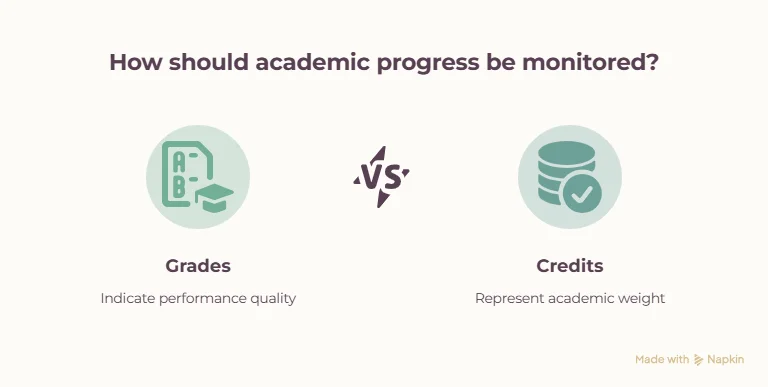
Grades and credits represent different aspects of academic progress and should therefore be monitored separately. Grades generally indicate the quality of performance in an assessed course, while credits indicate the academic weight associated with courses or other learning components. Exact definitions, calculations, and completion requirements depend on the individual institution's academic rules.
Students sometimes focus heavily on their cumulative result without examining what produced it. A better Performance Guide considers the individual subjects behind the overall academic record.
Look for patterns such as:
Consistently strong performance across related subjects
One subject repeatedly falling below personal targets
Better project performance than examination performance
Improvement after acting on faculty feedback
Required credit-bearing components that remain incomplete
Students pursuing a post graduate diploma in management PGDM should check their official handbook for exact grading, credit, progression, and completion rules rather than applying another institute's system. Bonus:PGDM credit system
How Often Should PGDM Students Review Their Performance?
PGDM students should review progress at multiple intervals rather than waiting for final examinations or term results. A brief weekly check helps monitor tasks and deadlines, a monthly review reveals performance patterns, and a detailed term-end review helps students evaluate academic outcomes and establish priorities for the next stage of the program.
A practical review cycle is:
Weekly: Check assignments, readings, presentations, project milestones, and deadlines.
After major assessments: Compare results with preparation methods and identify what worked.
Term-end: Review grades, credits, strengths, weaknesses, and learning goals comprehensively.
Regular reviews reduce the risk of discovering a problem too late. They also make improvement more measurable because students can compare current performance with their previous academic record rather than with classmates alone.
How Can Faculty Feedback Improve PGDM Academic Performance?
Faculty feedback becomes valuable when students translate comments into specific actions for the next academic task. Instead of simply reading a grade or remark, identify recurring feedback about analysis, structure, research, calculations, presentations, participation, or conceptual understanding. Then create one or two measurable improvement priorities and review whether subsequent performance changes.
Suppose a faculty member indicates that a student's presentation contains useful information but lacks a clear recommendation. The next goal should not simply be "improve presentations." A more useful goal would be to end the next case presentation with a concise recommendation supported by evidence.
Feedback can also reveal patterns across subjects. Comments about unclear reasoning appearing in finance, marketing, and strategy assignments may point to a broader analytical communication issue.
Students can also discuss persistent academic difficulties with appropriate faculty members or mentors. Such conversations are most productive when students arrive with specific questions, previous feedback, and evidence of the steps they have already taken.
How Can Students Track Skills Beyond Academic Grades?
PGDM students can track skills by connecting classroom activities with observable improvements in communication, analysis, teamwork, problem-solving, leadership, research, and decision-making. Students should record specific evidence of development, such as stronger presentations or better case analysis, rather than giving themselves vague ratings that cannot be supported by actual academic work.
A PGDM course develops management capabilities through multiple learning formats, so grades provide only one perspective.
For example, students can periodically ask:
Can I explain a complex business problem more clearly than last term?
Have my case recommendations become more evidence-based?
Am I contributing more effectively to group projects?
Can I interpret quantitative information with greater confidence?
Have my presentations become better structured?
The skills students monitor may also differ by specialization. PGDM in marketing management may place greater personal emphasis on consumer understanding and strategic communication, while PGDM in data analytics may involve greater attention to analytical interpretation and data-driven decision-making.
What Should You Do When Academic Performance Starts Declining?
When PGDM performance declines, students should first identify the specific cause rather than reacting only to the final score. Compare recent results, preparation habits, deadlines, faculty feedback, attendance requirements where relevant, and workload. Once the likely problem becomes clearer, choose a small number of corrective actions and monitor the next assessment carefully.
A decline in performance does not always have one cause. Several assignments may have accumulated simultaneously, a particular subject may require stronger foundational knowledge, or preparation methods may not match the assessment format.
Start by identifying where the decline appears. If only one subject is affected, subject-specific support may be appropriate. If performance is declining across several courses, workload planning and study routines may deserve attention.
Create a short improvement plan with measurable actions such as completing weekly revision, starting assignments earlier, seeking clarification on difficult concepts, or practising presentations before evaluation.
How Can Parents Understand a Student's PGDM Progress?
Parents can understand PGDM progress better by looking at overall learning patterns rather than reacting to individual marks. Useful discussions can cover term performance, completed credits, project experiences, recurring academic challenges, faculty feedback, workload management, and developing skills. The institution's official academic rules should remain the reference for formal progression and completion requirements.
Constructive conversations can focus on questions such as, "Which subject has improved most this term?" or "What feedback are you working on currently?"
This encourages students to explain their development rather than reporting only a number.
For families comparing PGDM colleges in Delhi NCR or a PGDM institute in Delhi, understanding how an institution evaluates academic work can also be useful. Assessment systems vary, so students and parents should examine the current academic information provided by the institution they are considering. Bonus:Managing PGDM academic workload
Conclusion
Tracking academic progress throughout a PGDM requires more than checking examination marks at the end of each term. Students gain a clearer Performance Guide when they monitor grades, credits, assignments, projects, presentations, feedback, deadlines, and skill development together. Regular weekly, monthly, and term-end reviews can reveal patterns that individual scores may hide. When a weakness appears, students should identify its cause, seek appropriate guidance, and create a measurable improvement action. Parents can support this process by discussing learning patterns rather than focusing on isolated results. Consistent tracking ultimately helps students take greater ownership of their academic development throughout the program.
Top PGDM Skill Labs
Gain practical executive exposure with interactive business simulations. Secure admission with us!
Dr. Vikas Gupta is a distinguished academic in the education and research domain, specializing in finance and related interdisciplinary studies. He is known for his...
PGDM student reviewing academic grades, project notes and progress charts on a laptop in a modern management classroom.
01.
Should PGDM students compare their performance with classmates?
Students should primarily compare current performance with their own previous results, learning goals, and institutional academic requirements. Peer comparison may provide limited context, but it does not explain individual strengths or learning gaps. Tracking personal improvement across assessments, subjects, projects, and skills usually provides a more useful basis for deciding what needs attention next.
02.
Can a spreadsheet be used to track PGDM academic progress?
Yes, a spreadsheet can provide a simple way to organize academic information in one place. Students can create columns for subjects, assessments, dates, results, credits, feedback, improvement goals, and completion status. The tracker should remain easy to update; an overly complicated system may become another administrative task instead of supporting academic planning.
03.
What should students record after receiving an assignment grade?
Students should record the result, faculty feedback, mistakes, strengths, and one or two actions for the next similar assignment. This converts an assessment from a historical score into a learning tool. If comments are unclear, students can seek clarification through the academic process available at their institution rather than guessing what the evaluator intended.
04.
How can PGDM students know whether their study strategy is working?
Students can evaluate a study strategy by looking for consistent improvement across relevant assessments and understanding. Compare preparation methods with subsequent results, recall of concepts, assignment quality, and feedback. If additional study time produces little improvement, the issue may involve study technique, conceptual gaps, task interpretation, or another factor requiring a different approach.
05.
Should internship learning be included in a PGDM performance tracker?
Yes, when an internship forms part of the student’s PGDM learning experience, its academic and developmental outcomes can be tracked alongside classroom progress. Students can record responsibilities, feedback, problems solved, skills practised, and connections between workplace experience and management concepts. Formal assessment and credit treatment, however, depend on the specific institution’s curriculum and regulations.
06.
How can students measure improvement in PGDM presentations?
Students can measure presentation improvement by tracking recurring evaluation criteria and feedback over time. Useful areas may include structure, subject understanding, evidence, delivery, visual clarity, response to questions, and recommendations. Instead of simply recording a presentation score, students should identify which elements improved and which still require deliberate practice before the next evaluated presentation.
07.
What is the best time to seek academic support during a PGDM?
Students should seek appropriate academic support as soon as a recurring difficulty becomes visible rather than waiting for several poor results. Warning signs can include repeated conceptual confusion, declining assessment performance, difficulty completing work, or recurring negative feedback. Faculty members, academic mentors, or other designated institutional support channels may help students identify suitable next steps.
08.
Can one poor assessment indicate weak overall PGDM performance?
No, one poor assessment should not automatically be treated as evidence of weak overall academic performance. Students should examine the assessment’s context, its academic weight, previous results, feedback, and performance across other components. A pattern across multiple assessments is generally more informative for personal progress tracking than an isolated result, although formal academic consequences depend on institutional rules.


















.webp) Call Us
Call Us