The Business of Diagnostic Labs: Managing Operations at Dr. Lal PathLabs, Metropolis & SRL
Posted on 26 Jun 2026
By Dr. Vikas Gupta
Introduction
Diagnostic network management is one of the most important functions in modern healthcare operations. Diagnostic labs are no longer limited to blood tests and printed reports. Today, large diagnostic businesses manage patient service centres, home sample collection teams, franchise partners, logistics networks, lab quality systems, digital booking platforms, and fast report delivery.
India’s diagnostic industry is growing quickly. ResearchAndMarkets estimates that India’s diagnostic laboratories market may grow from INR 1.54 trillion in FY 2024 to INR 2.98 trillion by FY 2030, at around 11.70% CAGR. This growth is driven by healthcare awareness, chronic disease testing, preventive health checkups, and technology adoption.
Large networks like Dr. Lal PathLabs, Metropolis Healthcare, and SRL Diagnostics, now known as Agilus Diagnostics, show how complex this business has become. SRL Diagnostics announced its rebranding as Agilus Diagnostics in 2023.
For management students, this industry offers strong career opportunities in healthcare operations, logistics, lab administration, quality control, franchise management, and business analytics.
Scale Diagnostic Operations
Build healthcare operations skills to manage diagnostic networks, sample logistics, quality systems, and patient service growth confidently and professionally.
Diagnostic network management is the process of managing labs, collection centres, sample logistics, home collection teams, franchise outlets, quality systems, reporting platforms, and patient service operations in a diagnostic business.
The main goal is simple: every sample must be collected safely, transported correctly, tested accurately, and reported on time.
However, this is not easy. A diagnostic network may process thousands of samples daily. Each sample needs correct labelling, barcode tracking, temperature control, timely movement, accurate testing, and secure report delivery.
Why Diagnostic Labs Are a Serious Healthcare Business
Diagnostic labs play a critical role in patient care. Doctors depend on accurate reports before prescribing treatment. Patients depend on timely results before making healthcare decisions.
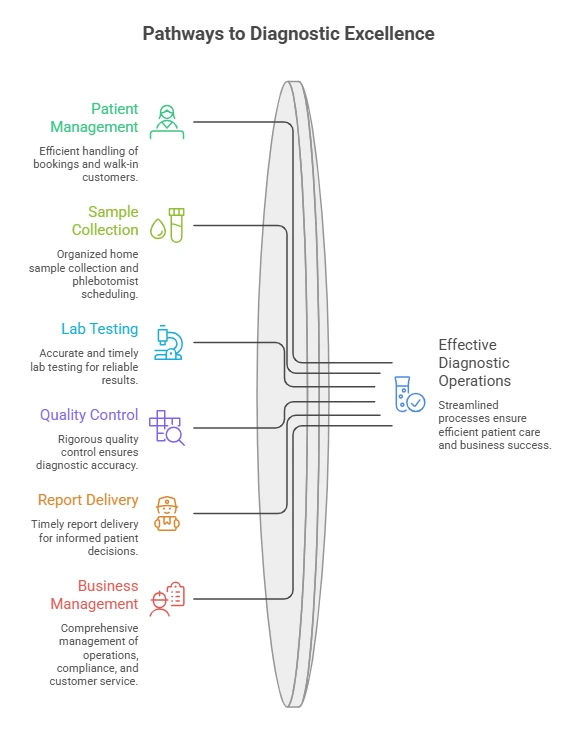
A diagnostic business must manage:
Patient bookings
Walk-in customers
Home sample collection
Phlebotomist scheduling
Sample labelling
Route planning
Lab testing
Quality control
Report delivery
Franchise operations
Customer complaints
Inventory and reagents
Compliance and accreditation
Dr. Lal PathLabs reports 6,600+ patient service centres, 290+ labs, 12,300+ pick-up points, and 85.6 million samples collected, which shows the operational scale of large diagnostic networks.
Similarly, Metropolis Healthcare reported 210 clinical labs, a 4,500+ service network, over 4,100 tests and profiles, and 12.67 million patient volumes in FY25.
These numbers show why diagnostic labs need trained managers, not just medical experts.
How Large Diagnostic Networks Operate
Large diagnostic companies usually follow a hub-and-spoke model. In this model, smaller collection centres collect samples and send them to satellite, regional, or reference laboratories.
This helps companies expand faster while maintaining testing quality.
Network Layer
Main Function
Patient service centre
Handles walk-ins and sample collection
Home collection team
Collects samples from patient homes
Pick-up point
Aggregates samples from nearby centres
Satellite lab
Handles routine tests
Regional lab
Processes higher test volumes
Reference lab
Handles specialised and advanced tests
Logistics team
Moves samples safely
Quality team
Maintains testing accuracy
Digital platform
Supports booking, tracking, and reports
This structure allows diagnostic brands to serve more locations without building full laboratories everywhere.
However, it also increases operational complexity. Every centre must follow the same process. Every sample must remain traceable. Every report must be accurate.
Franchise Model Healthcare in Diagnostic Labs
The franchise model healthcare approach is common in diagnostics because it helps brands expand reach without owning every centre.
In this model, a local partner may operate a collection centre under the diagnostic brand’s guidelines. The brand provides technology, processes, test support, reporting systems, logistics support, and quality standards.
This model helps companies:
Expand into new locations
Serve Tier 2 and Tier 3 cities
Increase sample volume
Reduce capital investment
Build local patient access
Improve brand visibility
However, franchise operations also create risks.
A franchise centre must follow strict rules for sample collection, hygiene, patient communication, billing, labelling, and sample storage. If one centre fails, the entire brand reputation can suffer.
Therefore, franchise management is not only a sales function. It is a quality, operations, and training function.
A small error can create a serious problem. Wrong labelling, delayed transport, poor temperature control, or damaged packaging can affect test accuracy.
Therefore, diagnostic networks use barcodes, sealed collection kits, mobile apps, route planning, and tracking systems.
In home collection, trained phlebotomists are especially important. They must collect samples safely, explain the process to patients, follow hygiene protocols, and ensure correct documentation.
Lab Quality Control NABL: Why It Matters
Lab quality control NABL is essential because diagnostic reports directly influence treatment decisions.
ISO 15189:2022 specifies requirements for quality and competence in medical laboratories. It applies to medical laboratories that want to develop quality management systems and demonstrate competence.
In India, NABL provides accreditation for medical laboratories under ISO 15189. NABL also publishes specific criteria for accreditation of medical laboratories.
Quality control in diagnostic labs includes:
Internal quality checks
External quality assessment
Equipment calibration
Reagent validation
Sample traceability
Barcode-based identification
Temperature monitoring
Staff training
Standard operating procedures
Corrective and preventive action
Audit readiness
Report review systems
For diagnostic managers, quality is non-negotiable. It affects patient safety, doctor trust, brand credibility, and regulatory confidence.
Warehouse and Inventory Management in Diagnostic Labs
Diagnostic labs require careful inventory management. They need reagents, test kits, vacutainers, swabs, chemicals, consumables, PPE, sample containers, and cold storage items.
Poor inventory control can delay testing and increase costs.
Common inventory challenges include:
Reagent stockouts
Expired test kits
Poor storage conditions
High wastage
Manual stock errors
Delayed procurement
Weak vendor coordination
Lack of real-time visibility
A strong diagnostic network needs digital inventory tracking, expiry alerts, vendor planning, and standard operating procedures.
Moreover, diagnostic lab inventory is linked with patient service. If a test kit is unavailable, the patient may need to visit another lab. Therefore, inventory management directly affects customer experience.
Diagnostics Industry Trends 2026
The diagnostics industry trends 2026 show a clear shift toward convenience, scale, quality, and digital healthcare.
1. Preventive Health Checkups Are Growing
More people are choosing regular health packages. This trend is driven by lifestyle diseases, awareness, corporate wellness, and early detection.
2. Home Sample Collection Is Becoming Standard
Patients now expect convenience. Therefore, home collection has become a major business channel.
3. Tier 2 and Tier 3 Expansion Is Rising
Diagnostic companies are expanding beyond metro cities. Smaller cities offer strong growth potential because of rising healthcare awareness and better access.
4. Digital Booking and Reports Are Expected
Patients want app-based booking, online payments, WhatsApp updates, and digital reports.
5. AI and Automation Are Entering Lab Operations
Automation can support sample processing, workflow management, report formatting, and customer service.
6. Accreditation Is Becoming More Important
Patients and doctors increasingly prefer reliable, accredited labs. Therefore, NABL and ISO-based quality systems are becoming a business advantage.
7. Specialty Testing Is Growing
Specialised diagnostics, molecular testing, genomics, preventive panels, and chronic disease monitoring are gaining importance.
A recent market update also reported strong performance for Metropolis Healthcare, supported by growth in specialty and preventive healthcare diagnostics.
Public salary platforms show wide variation. Glassdoor reports the average lab manager salary in India at around ₹10.5 lakh per year, based on a small salary sample. Indeed reports an estimated laboratory manager salary of about ₹40,779 per month in Delhi.
A practical salary range may look like this:
Role
Indicative Salary Range
Lab Operations Executive
₹3 LPA – ₹5 LPA
Senior Lab Coordinator
₹4 LPA – ₹7 LPA
Pathology Lab Manager
₹5 LPA – ₹12 LPA
Quality Manager
₹6 LPA – ₹14 LPA
Regional Operations Manager
₹10 LPA – ₹20 LPA+
These figures are indicative. Actual salary depends on city, company, qualification, experience, lab size, and responsibility level.
Skills Needed for Diagnostic Network Management
Diagnostic network management needs both healthcare knowledge and business skills.
Important skills include:
Healthcare operations understanding
Lab workflow knowledge
Sample logistics planning
Franchise coordination
Quality control awareness
Patient service management
Vendor management
Inventory planning
Data analysis
Excel and dashboarding
Team coordination
Communication skills
Problem-solving ability
Additionally, managers must understand patient sensitivity. A delayed or inaccurate report can affect medical decisions. Therefore, responsibility and attention to detail are essential.
Career Opportunities in Diagnostic Lab Operations
Diagnostic network management offers several career paths for management students.
Common entry-level roles include:
Lab Operations Executive
Diagnostic Centre Coordinator
Sample Logistics Coordinator
Franchise Operations Executive
Patient Service Executive
Quality Executive
Inventory Coordinator
Healthcare Operations Analyst
Home Collection Coordinator
Customer Experience Executive
With experience, professionals can grow into:
Pathology Lab Manager
Diagnostic Centre Manager
Cluster Manager
Regional Operations Manager
Quality Manager
Network Operations Head
Business Development Manager
Healthcare Business Manager
This field is ideal for students who enjoy healthcare, operations, service quality, logistics, and process improvement.
Why Diagnostic Lab Operations Are Difficult
Diagnostic lab operations look simple from the outside. A patient gives a sample and receives a report. However, the backend process is complex.
Managers must handle:
High patient volume
Sample accuracy
Time-sensitive logistics
Quality control
Franchise compliance
Phlebotomist training
Technology systems
Report turnaround time
Inventory availability
Patient complaints
Doctor expectations
Moreover, every sample has medical importance. Therefore, diagnostic operations require discipline, speed, accuracy, and empathy.
This makes diagnostic network management a serious healthcare leadership role.
How Management Education Helps
Diagnostic businesses need professionals who understand healthcare and management together.
A strong management programme helps students learn:
Operations management
Healthcare systems
Supply chain planning
Service quality
Business analytics
Marketing and customer behaviour
Financial decision-making
Team leadership
At Asia Pacific Institute of Management, students gain industry-oriented learning, corporate exposure, experienced faculty guidance, practical learning, and placement support. These elements help students prepare for roles in healthcare operations, diagnostics, hospital administration, and healthcare business management.
Diagnostic network management is the backbone of large diagnostic lab businesses. Companies such as Dr. Lal PathLabs, Metropolis Healthcare, and SRL/Agilus show how scale, technology, logistics, quality, and patient service come together.
The diagnostics industry in India is growing rapidly. However, growth also brings operational pressure. Labs must manage sample collection, franchise partners, quality control, inventory, reports, and patient experience with precision.
For students interested in healthcare management, diagnostic operations offer a strong and practical career path. It combines service delivery, logistics, data, quality, and business growth.
Asia Pacific Institute of Management helps students build industry-ready management skills through practical learning, corporate exposure, experienced faculty, and placement support.
Build Healthcare Edge
Turn interest in diagnostics into career-ready management expertise for lab operations, patient service, and healthcare business leadership roles.
Dr. Vikas Gupta is a distinguished academic in the education and research domain, specializing in finance and related interdisciplinary studies. He is known for his...
Diagnostic network management means managing labs, collection centres, sample logistics, franchise partners, quality systems, reporting platforms, and patient service operations in a diagnostic business.
02.
Why is diagnostic network management important?
It is important because diagnostic reports affect patient treatment. A strong network ensures safe collection, timely transport, accurate testing, and smooth report delivery.
03.
What is the franchise model healthcare approach in diagnostics?
The franchise model healthcare approach allows diagnostic brands to expand through local partners. These partners operate collection centres while following brand standards, technology systems, and quality guidelines.
04.
What is the logistics of blood sample collection?
The logistics of blood sample collection includes phlebotomist assignment, sample labelling, barcode tracking, packaging, route planning, temperature-safe transport, and lab delivery.
05.
Why is lab quality control NABL important?
Lab quality control NABL is important because accreditation supports testing accuracy, traceability, audit readiness, and patient trust.
06.
What is the average pathology lab manager salary in India?
The pathology lab manager salary varies by city, experience, and lab size. Public salary sources suggest broad ranges from around ₹5 LPA to ₹12 LPA for many lab manager roles.
07.
Is diagnostic lab management a good career?
Yes, diagnostic lab management is a strong career option. India’s diagnostics industry is growing through preventive testing, home collection, digital reports, specialty testing, and wider city expansion.


















.webp) Call Us
Call Us




