Understanding NABH Chapter 1: Access, Assessment and Continuity of Care (AAC) for Managers
Posted on 04 Aug 2026
By Dr. Vikas Gupta
Introduction
Hospital quality begins before a patient receives treatment. It starts when the patient first approaches the hospital, requests information, enters the facility, or seeks emergency support.
Every step must be organized, timely, safe, and appropriate to the hospital’s capabilities.
This is why Access, Assessment and Continuity of Care, commonly called AAC, holds an important position within the NABH guidelines for hospitals.
AAC covers the patient journey across access, registration, admission, assessment, reassessment, transfer, referral, discharge, and follow-up coordination. For managers, it connects clinical care with hospital operations.
Understanding AAC is therefore essential for quality managers, administrators, department heads, nursing leaders, and healthcare management professionals.
This guide explains AAC from a managerial perspective. It also offers practical guidance for documentation, audits, patient admission protocols, and continuous compliance.
Important note: This article is an educational overview. Hospitals should consult the complete NABH Hospital Accreditation Standards, 6th Edition, and current official guidance before creating or revising compliance systems.
Master Healthcare Leadership
Develop practical management expertise to improve hospital quality, streamline operations, and confidently lead modern healthcare organizations with strategic decision-making.
What Is AAC Under the NABH Guidelines for Hospitals?
Access, Assessment and Continuity of Care is the NABH chapter concerned with how patients access appropriate services, receive timely clinical assessments, and experience coordinated care across admission, treatment, transfer, referral, and discharge. It helps hospitals create a safe and consistent patient journey.
AAC is not limited to the admission desk.
It involves several hospital functions, including:
Registration
Emergency services
Outpatient departments
Inpatient services
Nursing
Diagnostics
Medical records
Billing coordination
Ambulance services
Discharge planning
Referral and transfer processes
Therefore, AAC compliance requires teamwork.
A hospital may have strong clinical professionals. However, gaps in communication or documentation can still affect patient safety.
Managers must ensure that systems work together across departments.
Why AAC Matters in the Hospital Accreditation Process
The hospital accreditation process evaluates whether a healthcare organization follows defined systems for quality and patient safety.
Accreditation is not simply a document review. It examines whether approved processes are understood and followed in daily practice.
NABH describes hospital accreditation as a framework that supports patient safety, service quality, operational standardization, public trust, and continuous improvement.
AAC matters because it covers the beginning, movement, and closure of the patient-care journey.
Weaknesses at these stages can cause:
Delays in treatment
Incorrect admissions
Incomplete patient assessments
Poor communication between teams
Unsafe transfers
Confusing discharge instructions
Loss of continuity after discharge
Patient dissatisfaction
Compliance failures
Consequently, managers should treat AAC as an operational framework rather than an audit-only requirement.
The Managerial Meaning of Access to Care
Access means more than allowing a patient to enter the hospital.
The hospital must communicate its scope of services clearly. It must also determine whether the patient’s needs can be managed safely within that scope.
For managers, this creates several responsibilities.
Define the Hospital’s Scope of Services
The hospital should clearly identify the services it provides.
This may include specialties, diagnostic facilities, emergency services, critical care, surgical services, rehabilitation, pharmacy, and other support functions.
The communicated scope should match actual capability.
For example, a hospital should not routinely accept cases requiring services it cannot provide safely.
Managers must therefore align:
Public information
Departmental capabilities
Available infrastructure
Clinical privileges
Staffing
Equipment
Referral arrangements
A mismatch between communicated services and actual capacity can create operational and patient-safety risks.
Make Service Information Accessible
Patients should receive clear information about available services and how to access them.
This information may be communicated through:
Hospital websites
Signage
Help desks
Registration teams
Call centres
Patient information material
Emergency guidance
Additionally, staff should know how to guide patients when the requested service is unavailable.
Establish Prioritization Systems
Patients should not always be managed only by arrival order.
Emergency and urgent cases require appropriate prioritization.
Therefore, managers should ensure that triage and prioritization processes are clearly defined, staffed, monitored, and documented.
Front-office teams must also know how to escalate visibly unwell patients without avoidable delays.
Patient Admission Protocols: What Managers Must Control
Clear patient admission protocols help hospitals reduce delays, prevent errors, and create a consistent experience.
Protocols should explain who can authorize admission, what information must be collected, and how patients enter different care pathways.
Patient Identification
Accurate identification is essential from the first interaction.
Hospitals need a consistent method for recording and verifying patient identity.
Managers should review whether registration teams:
Collect the required patient details
Check existing records before creating duplicates
Use approved patient identifiers
Manage unidentified patients safely
Handle name similarities carefully
Follow applicable privacy requirements
Patient identification practices should remain consistent across registration, sample collection, medication, procedures, transfers, and discharge.
Admission Criteria
Departments should understand the criteria used for admission.
These criteria may vary according to the service, specialty, care setting, and patient condition.
For example, admission processes may differ for:
Planned procedures
Emergency cases
Intensive care
Day-care services
Maternity services
Isolation requirements
Medico-legal cases
However, differences should be intentional and documented.
Initial Screening
The hospital should identify immediate patient needs early.
Screening can help determine urgency, required precautions, infection risks, mobility needs, pain, or other immediate concerns.
Therefore, managers should verify that screening processes are practical and consistently followed.
Informed Communication
Patients and families should understand the admission process, expected next steps, and relevant responsibilities.
Confusing instructions can increase anxiety and complaints.
Moreover, poor communication can delay investigations, procedures, payments, transfers, and discharge.
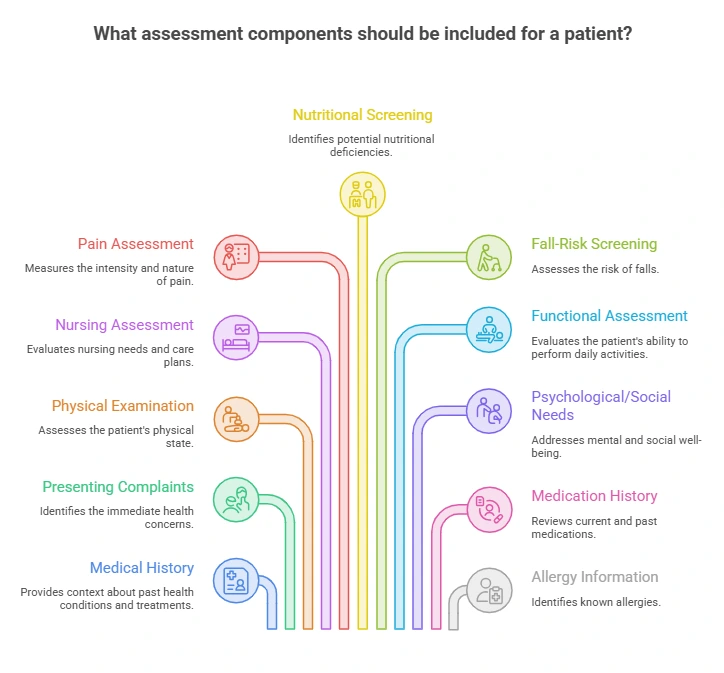
Patient Assessment: The Foundation of Care Planning
Patient assessment collects the information needed to understand the patient’s condition and plan appropriate care.
Assessment is not a one-time form-filling exercise.
It should support clinical decision-making.
Depending on the patient and service, assessment may include:
Medical history
Presenting complaints
Physical examination
Nursing assessment
Pain assessment
Nutritional screening
Fall-risk screening
Functional assessment
Psychological or social needs
Medication history
Allergy information
Managers should ensure that assessment requirements are defined for each relevant patient category.
Set Clear Assessment Timelines
Hospital policies should specify when different assessments must be completed.
The timeline should reflect the urgency and nature of care.
For example, an emergency patient requires immediate evaluation. Meanwhile, a planned admission may follow a different workflow.
Managers should not rely only on written timelines.
They should also monitor actual completion through records, audits, and performance data.
Define Who Can Perform Assessments
Only appropriately qualified and authorized professionals should conduct clinical assessments.
Therefore, hospital managers must connect AAC requirements with:
Job descriptions
Credentialing
Clinical privileges
Staff competency
Training
Scope of practice
This connection is important during audits.
An assessor may examine not only whether an assessment exists, but also whether the person completing it was authorized and competent.
Connect Assessment With the Care Plan
A completed assessment should lead to an appropriate care plan.
If information is collected but does not influence treatment, the process becomes administrative rather than clinical.
Managers should therefore check whether care plans reflect:
It may be required after treatment, medication, procedures, transfer, deterioration, or changes in symptoms.
Managers should ensure that reassessment processes explain:
When reassessment is required
Who performs it
What must be documented
How changes are escalated
How the care plan is updated
For example, pain should not only be recorded once. It may need reassessment after pain-management measures.
Similarly, a patient’s fall risk may change after surgery, sedation, or a change in mobility.
A strong system captures these changes and responds appropriately.
Continuity of Care Across Departments
Continuity means that care remains coordinated when the patient moves between professionals, departments, facilities, or stages of treatment.
Failures often occur at handover points.
These include:
Emergency to inpatient transfer
Operation theatre to recovery
Recovery to ward
Intensive care to ward
One clinical team to another
Hospital to another facility
Hospital to home care
Managers should identify these transition points and control the associated risks.
Standardize Clinical Handovers
Handovers should communicate the information required for safe ongoing care.
Depending on the situation, this may include:
Patient identity
Diagnosis or working diagnosis
Current condition
Treatment given
Medication details
Allergies
Pending investigations
Risks
Devices or lines
Follow-up actions
Hospitals may use structured formats to improve consistency.
However, a form alone does not create a safe handover.
Managers should observe practice, review records, and speak with employees.
Build Hospital Expertise
Gain industry-focused business knowledge to strengthen hospital administration, quality compliance, patient care coordination, and operational excellence for future leadership.
Quality managers should not become the only people responsible for compliance.
Department heads and frontline teams must own their processes.
The quality manager can support them through the following activities.
Policy Coordination
Policies should reflect the hospital’s scope, staffing, services, risks, and workflows.
Copying a generic policy may create gaps between documentation and actual practice.
Therefore, quality managers should involve relevant clinical and administrative stakeholders.
Process Mapping
A process map can show how the patient moves from enquiry to discharge.
It can reveal delays, duplication, unclear handovers, and missing controls.
Moreover, process mapping helps teams understand how their work affects other departments.
Staff Training
Training should focus on practical responsibilities.
Employees should know:
What they must do
Why it matters
Which records they must complete
When to escalate
Who owns the next step
Training effectiveness should also be evaluated.
Attendance records alone do not prove understanding.
Internal Audits
Internal audits should compare policy, documentation, staff knowledge, and actual practice.
A strong audit does not only ask, “Is the form available?”
It also asks:
Is the form used consistently?
Is it completed on time?
Does it support care?
Do employees understand the process?
Are deviations identified and corrected?
Performance Monitoring
Quality managers should work with departments to monitor useful indicators.
These may include:
Assessment completion within defined timelines
Discharge-summary completion
Waiting time
Transfer-document completeness
Unplanned return visits
Delayed discharges
Duplicate registrations
Patient complaints related to access
Handover compliance
Indicators should lead to action.
Collecting data without reviewing or improving the process adds little value.
A Practical NABH Audit Checklist for AAC
A NABH audit checklist should reflect the hospital’s approved processes and the applicable edition of the official standards.
Managers can use the following areas as a practical starting point:
Access and Registration
Is the scope of services clearly defined?
Is service information accurately communicated?
Are registration and identification practices consistent?
Are emergency patients appropriately prioritized?
Are patients guided when required services are unavailable?
Admission
Are admission criteria defined?
Are different admission pathways documented?
Are immediate patient needs identified?
Are relevant risks screened?
Are patients and families informed appropriately?
Assessment and Reassessment
Are assessment requirements defined by patient type?
Are timelines established and monitored?
Are assessments completed by authorized professionals?
Do assessment findings influence care plans?
Are reassessments documented after clinical changes?
Continuity and Handover
Are handover processes standardized?
Is important information transferred accurately?
Are multidisciplinary needs coordinated?
Are pending tests and actions communicated?
Is responsibility clear after each transfer?
Referral and Transfer
Are transfer decisions documented?
Is the patient stabilized where required?
Is the receiving facility contacted?
Does the transfer note contain relevant information?
Are escort and transport needs assessed?
Discharge
Does discharge planning begin at an appropriate stage?
Are instructions clear and understandable?
Are medication and follow-up details provided?
Are pending reports addressed?
Are discharge delays analyzed?
This checklist should not replace the official standards.
Instead, it should help managers translate requirements into daily operational questions.
Common AAC Non-Compliance Risks
AAC gaps often arise when written policies do not match practice.
Common risks include:
Incomplete initial assessments
Delayed assessments
Missing reassessments
Duplicate patient records
Unclear triage documentation
Weak handovers
Incomplete transfer notes
Discharge instructions without warning signs
Missing follow-up information
Policies unknown to employees
Inconsistent forms across departments
Data collected without improvement action
Managers should look for repeated patterns rather than isolated errors alone.
A recurring documentation gap may indicate workload issues, poor form design, unclear responsibility, or inadequate training.
Therefore, corrective action should address the root cause.
Building a Sustainable Hospital Compliance Standard
A hospital compliance standard becomes sustainable when employees follow it during routine work, not only before an external assessment.
Managers can support this culture through five actions:
Simplify processes: Remove unnecessary steps and duplication.
Clarify ownership: Assign responsibility for every critical activity.
Train through examples: Use actual patient scenarios and process failures.
Measure performance: Select indicators linked to patient safety and flow.
Review effectiveness: Confirm that corrective actions produce improvement.
Additionally, leaders should encourage employees to report gaps without fear.
Early reporting helps the hospital correct weaknesses before they cause harm.
Why Future Healthcare Managers Should Understand NABH
Quality and accreditation knowledge is increasingly relevant for hospital administrators.
Managers need to understand how policies, people, data, documentation, and clinical processes work together.
AAC provides a strong example.
It connects patient experience with operational efficiency and clinical safety.
Students preparing for healthcare management careers should therefore develop skills in:
Process mapping
Quality improvement
Healthcare operations
Patient-flow management
Compliance monitoring
Data analysis
Team coordination
Documentation control
Risk identification
At Asia Pacific Institute of Management, an industry-oriented curriculum, experienced faculty, practical learning, corporate exposure, and placement support can help students develop broader management capabilities.
Such management education can support professionals who want to understand healthcare systems, quality practices, and data-driven operations.
Understanding AAC is essential for managers implementing the NABH guidelines for hospitals.
The chapter follows the patient journey from access and admission to assessment, treatment transitions, referral, transfer, and discharge.
Therefore, AAC compliance cannot remain the responsibility of one quality department.
It requires coordination between clinical teams, nursing, registration, administration, diagnostics, medical records, and support services.
Managers should focus on practical implementation.
Policies must match hospital capabilities. Employees must understand their responsibilities. Records must support patient care. Moreover, audits should lead to measurable improvement.
When AAC becomes part of everyday operations, it can support safer patient journeys, clearer communication, and more reliable hospital systems.
Advance Management Skills
Prepare for leadership roles by combining healthcare knowledge with modern business strategies, operational insights, and data-driven management capabilities effectively.
Dr. Vikas Gupta is a distinguished academic in the education and research domain, specializing in finance and related interdisciplinary studies. He is known for his...
AAC stands for Access, Assessment and Continuity of Care. It addresses how patients access hospital services, receive appropriate assessments, and experience coordinated care across admission, treatment, transfer, referral, and discharge.
02.
Why is AAC important for hospital managers?
AAC connects multiple operational and clinical departments. Managers use it to improve patient flow, standardize admissions, reduce communication gaps, monitor assessments, coordinate transfers, and strengthen discharge processes.
03.
What are patient admission protocols?
Patient admission protocols are approved procedures that explain how patients are identified, registered, assessed, authorized for admission, informed, and moved into the appropriate care setting.
04.
What does a quality manager do during an NABH audit?
A quality manager coordinates documentation, supports departments, reviews compliance, conducts internal audits, analyzes gaps, and tracks corrective actions. However, every department remains responsible for implementing its applicable processes.
05.
What documents are commonly reviewed under AAC?
Records may include registration documents, assessment forms, reassessment notes, care plans, handover records, transfer notes, referral documents, discharge summaries, policies, training records, and performance-monitoring data.
06.
How can hospitals prepare an NABH audit checklist?
Hospitals should convert the applicable official requirements and their approved policies into verifiable questions. The checklist should examine documents, staff knowledge, actual practice, timelines, records, indicators, and corrective actions.
07.
How can hospitals improve continuity of care?
Hospitals can standardize handovers, clarify responsibility, coordinate multidisciplinary teams, document pending actions, begin discharge planning early, and provide complete referral or discharge information.
08.
Is following an AAC checklist enough for NABH accreditation?
No. A checklist supports review, but accreditation requires consistent implementation. Hospitals need approved processes, trained employees, complete records, monitored outcomes, and evidence of continuous improvement.



















.webp) Call Us
Call Us




