Generative AI tools such as ChatGPT can help healthcare administrators structure reports, improve language, summarize approved information, create tables, generate management questions, and convert complex data into readable explanations.
However, healthcare information can be sensitive. AI outputs can also contain errors, unsupported conclusions, or invented details.
Therefore, hospital managers must use AI within approved privacy, security, compliance, and human-review systems.
This guide explains how healthcare managers can use ChatGPT and other AI tools responsibly for hospital report writing.
Expand Your Career
Turn your healthcare expertise into management excellence through industry-focused learning, practical exposure, and leadership skills for future healthcare careers.
AI tools for healthcare management are digital systems that help administrators organize information, draft reports, summarize approved records, analyze operational data, identify patterns, and improve communication. These tools should support managerial decisions rather than replace professional judgement, clinical accountability, or established hospital controls.
Healthcare managers can use different categories of AI-enabled tools.
These may include:
Generative writing assistants
Spreadsheet analysis tools
Business intelligence platforms
Dashboard applications
Transcription tools
Document-management systems
Workflow automation platforms
Data-visualization tools
Predictive analytics systems
ChatGPT belongs mainly to the generative AI category.
It can interpret instructions and produce written responses. Therefore, it can help managers draft or improve reports when appropriate information and clear directions are provided.
OpenAI states that its managed business products provide organizational controls over business data. It also states that business inputs and outputs are not used for model training by default. However, hospitals must still evaluate the exact product, contract, retention settings, access controls, and applicable regulations before using it with organizational information.
Why Hospital Report Writing Is Difficult
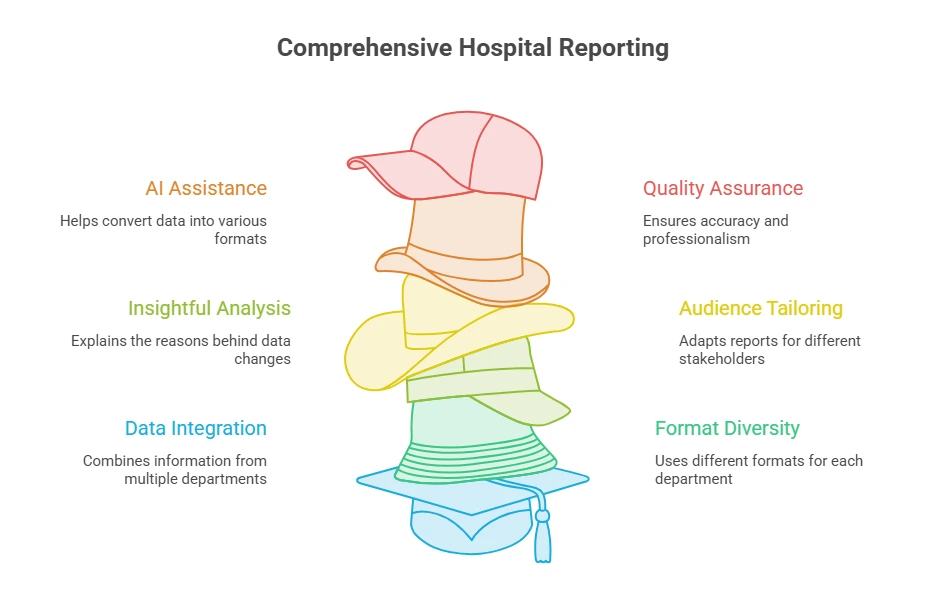
Hospital reports often combine information from several departments.
For example, a monthly operations report may require data from:
Registration
Outpatient services
Emergency services
Inpatient units
Nursing
Pharmacy
Diagnostics
Human resources
Finance
Quality
Patient feedback
Facility management
Each department may use different formats.
Moreover, the data may not automatically explain what happened.
A manager may know that waiting time increased by 18%. However, the report must explain whether the increase was linked to patient volume, staffing, registration delays, diagnostics, or another factor.
Hospital reports must also serve different audiences.
A department head may need detailed operational findings. Senior leadership may need a concise summary. Meanwhile, an accreditation team may need evidence, records, and corrective actions.
AI can help managers convert the same approved information into different reporting formats.
However, the final report must remain accurate, traceable, and professionally reviewed.
A strong prompt explains the task, audience, source information, format, limitations, and required output.
A useful prompt framework is:
Role + Objective + Context + Data + Format + Constraints + Review requirement
For example:
Act as a hospital operations reporting assistant. Draft a monthly bed-utilization report for senior management using only the anonymized data provided. Include an executive summary, three important trends, possible operational questions, and an action table. Do not add causes that are not supported by the data. Mark any missing information clearly.
This prompt controls the output more effectively than simply asking, “Write a hospital report.”
Practical Prompts for Hospital Report Writing
The following templates can help managers create safer and more useful outputs.
Prompt for a Monthly Operations Report
Organize the approved hospital performance data below into a monthly operations report. Include an executive summary, KPI table, significant variances, operational risks, actions, owners, and deadlines. Use only the provided data. Do not invent explanations.
Prompt for an Audit Summary
Convert these anonymized audit observations into a professional internal audit summary. Group findings by department and risk level. Separate evidence, non-compliance, corrective action, responsible owner, and target date.
Prompt for Patient-Feedback Analysis
Analyze the de-identified patient-feedback themes below. Group them into service categories, identify repeated concerns, summarize positive feedback, and suggest questions management should investigate. Do not make unsupported claims.
Prompt for Meeting Minutes
Convert these approved meeting notes into formal minutes. Include attendees, agenda, key discussion points, decisions, action owners, and deadlines. Mark any unclear information as “confirmation required.”
Prompt for KPI Commentary
Write concise management commentary for each KPI. Compare current performance with the target and previous month. Describe the variance without assuming its cause. Add one investigation question for each negative variance.
Prompt for Report Editing
Edit this hospital report for clarity, grammar, professional tone, and concise language. Preserve all facts, numbers, dates, names, and conclusions exactly. Highlight any statement that appears unsupported or ambiguous.
However, it is much more sensitive than drafting a general administrative report.
Clinical summaries may affect diagnosis, treatment, handovers, referrals, discharge, or follow-up care.
An incorrect omission or invented statement can create patient-safety risks.
The World Health Organization advises that generative AI in health requires appropriate governance, transparency, accountability, risk management, and protection of autonomy. WHO also warns that large multimodal models can produce inaccurate, biased, incomplete, or false outputs.
Therefore, hospitals should not allow employees to generate clinical summaries through unapproved public tools.
Where an organization adopts an approved healthcare AI system, it should define:
Permitted use cases
Authorized users
Approved data sources
Human-review responsibilities
Clinical sign-off
Error-reporting procedures
Audit trails
Data retention
Access controls
Escalation processes
An AI-generated clinical summary should remain a draft until an authorized professional verifies it.
AI must never be treated as the responsible clinician.
Lead Healthcare Success
Build strategic business capabilities to confidently manage healthcare operations, rehabilitation services, and patient-focused organizations with professional leadership.
Managers should not enter identifiable patient information, protected health information, employee records, financial information, passwords, confidential contracts, or internal security details into an unapproved AI platform.
The US Department of Health and Human Services has itself established restrictions that prohibit users of certain internal ChatGPT arrangements from entering personally identifiable information and protected health information. This illustrates the importance of clear organizational rules, even when AI is being used for administrative support.
Hospitals should create an approved-data classification system.
For example:
Low-Risk Information
Publicly available hospital information
Generic report formats
Blank templates
Non-confidential training examples
Artificial sample data
Restricted Information
Patient identifiers
Clinical records
Employee information
Financial records
Internal audit findings
Contracts
Security information
Non-public performance data
Restricted information should be used only within systems approved by the hospital’s legal, information security, privacy, clinical, and management teams.
Removing a patient’s name alone may not be enough.
Dates, locations, rare diagnoses, identification numbers, or unusual events may still reveal identity.
AI can support first drafts and language improvements.
For example, a manager may ask AI to convert a detailed policy into a staff-friendly checklist.
Similarly, a hospital may create a patient-information leaflet from approved clinical content.
However, AI should not determine policy independently.
Every document needs an appropriate review process.
A policy may require approval from clinical leaders, quality teams, legal advisers, infection-control teams, or senior management.
Therefore, hospitals should maintain version control, approval records, review dates, and document ownership.
AI can help create content. It should not bypass document governance.
A Safe AI Workflow for Hospital Reports
Healthcare managers can follow a structured process.
Step 1: Define the Reporting Purpose
Identify the decision the report should support.
Is the report for operational review, quality improvement, finance, staffing, patient experience, or compliance?
A clear purpose prevents unnecessary data use.
Step 2: Confirm Tool Approval
Use only tools approved by the hospital.
Confirm privacy terms, contractual protections, access controls, retention settings, and permitted data categories.
OpenAI offers managed products designed for organizational use, including healthcare-specific options with role-based access, audit logs, data controls, and other enterprise safeguards. However, adopting such a product does not remove the hospital’s responsibility to configure and govern it correctly.
Step 3: Minimize the Data
Provide only the information needed for the task.
Where possible, use aggregated or de-identified information.
Do not upload an entire record when a small approved extract is sufficient.
Step 4: Write a Controlled Prompt
Tell the tool to use only the provided facts.
Ask it to mark uncertainty and avoid unsupported conclusions.
Step 5: Validate Every Output
Check:
Names
Dates
Numbers
Calculations
Comparisons
Clinical terms
Conclusions
Recommended actions
References
Missing information
AI can produce confident-sounding errors.
Therefore, fluent writing must not be mistaken for accurate analysis.
Step 6: Obtain Required Approval
Reports should follow the hospital’s existing approval hierarchy.
AI does not replace departmental, financial, quality, legal, or clinical approval.
Step 7: Maintain an Audit Trail
Record how the report was prepared when required.
The organization may need to document the tool used, reviewer, approval date, source data, and important edits.
Step 8: Monitor Outcomes
Review whether AI actually improves reporting quality, accuracy, turnaround time, and decision-making.
A tool that creates more correction work may not be suitable.
One common mistake is entering sensitive information into an unapproved platform.
Another is assuming that a well-written response must be factually correct.
Managers should also avoid using AI to:
Make independent clinical decisions
Approve policies
Sign off financial reports
Determine disciplinary action
Replace incident investigations
Produce unsupported root-cause conclusions
Generate false references
Hide incomplete data
Create misleading performance narratives
Additionally, managers should not accept every AI recommendation.
A suggested action may sound reasonable but fail to match hospital resources, policy, regulation, or clinical reality.
Human review is essential.
Creating an AI Governance Policy for Hospitals
Hospitals need clear governance before using AI at scale.
A practical policy should define:
Approved AI tools
Prohibited information
Permitted use cases
High-risk activities
Human-review requirements
Access controls
Data-retention rules
Vendor assessment
Incident reporting
Audit requirements
Staff training
Accountability
Governance should involve multiple functions.
These may include hospital administration, information technology, information security, quality, legal, privacy, finance, human resources, and clinical leadership.
WHO’s AI guidance emphasizes protecting autonomy, promoting safety, ensuring transparency, establishing accountability, supporting equity, and developing sustainable systems. These principles provide a useful foundation for hospital AI governance.
Measuring the Value of AI-Assisted Report Writing
Hospitals should evaluate AI based on measurable outcomes.
Useful indicators may include:
Report preparation time
Error rate
Revision frequency
On-time report completion
User satisfaction
Missing-data frequency
Management readability
Action completion
Privacy incidents
Unsupported-output rate
The goal should not be to produce more reports.
The goal should be to produce clearer, faster, and more useful reports without weakening safety or compliance.
For example, reducing report-writing time is valuable only when accuracy remains high.
Similarly, a polished executive summary is useful only when it represents the underlying data fairly.
Tech in B-School: Why Future Managers Need AI Literacy
The growing use of tech in B-school reflects a wider change in management careers.
Future healthcare managers will need more than traditional administrative knowledge.
They should understand how to use digital tools, interpret dashboards, frame analytical questions, review AI outputs, protect data, and lead technology-enabled teams.
Important capabilities include:
Prompt writing
Data interpretation
AI-output validation
Process automation
Privacy awareness
Risk assessment
Digital communication
Change management
Responsible technology adoption
However, AI literacy does not mean accepting every new tool.
A capable manager knows when AI can help and when human expertise must take priority.
At Asia Pacific Institute of Management, an industry-oriented curriculum, experienced faculty, practical learning, corporate exposure, and placement support can help students develop broader management capabilities.
Exposure to technology-enabled decision-making can also prepare learners for changing roles across healthcare and other service industries.
Conclusion
AI tools for healthcare management can improve how hospital administrators prepare reports, summarize findings, analyze data, and communicate decisions.
ChatGPT can help structure documents, improve readability, convert notes into formal reports, create KPI commentary, and organize management actions.
However, healthcare use requires strong safeguards.
Managers must protect patient information, use approved systems, minimize data, verify every output, maintain human accountability, and follow established hospital governance.
The most effective approach is not to ask AI to “write everything.”
Instead, managers should use it as a controlled assistant.
The hospital provides the approved data. The manager provides the context. AI supports the drafting process. Finally, responsible professionals verify and approve the result.
Healthcare managers who combine operational expertise with AI literacy can improve reporting efficiency while protecting accuracy, privacy, and patient trust.
Shape Future Leaders
Gain modern management knowledge that complements clinical experience and prepares you for impactful leadership across the evolving healthcare industry.
Dr. Vikas Gupta is a distinguished academic in the education and research domain, specializing in finance and related interdisciplinary studies. He is known for his...
ChatGPT can help managers structure reports, summarize approved information, improve language, create tables, draft meeting minutes, organize audit observations, and generate analytical questions. Every output should be verified before use.
02.
Can hospital managers enter patient data into ChatGPT?
Patient data should not be entered into an unapproved AI tool. Hospitals must use approved systems, appropriate contractual and technical protections, access controls, data-minimization measures, and clear privacy policies.
03.
Can AI write clinical summaries?
AI can assist with draft clinical summaries in properly approved and governed environments. However, an authorized healthcare professional must review the content for accuracy, completeness, context, and patient safety.
04.
What is prompt engineering for hospital administrators?
Prompt engineering is the practice of giving an AI tool clear instructions about the task, audience, source information, output format, limitations, and review requirements.
05.
How can AI support healthcare data analysis?
AI can organize data, compare performance periods, identify patterns, calculate changes, create chart suggestions, and draft variance commentary. Managers must verify calculations and investigate the operational causes.
06.
What are the risks of using AI for hospital reports?
Risks include privacy breaches, inaccurate summaries, invented facts, biased outputs, incorrect calculations, false references, overreliance, and unclear accountability.
07.
Does AI replace healthcare managers?
No. AI can support writing and analysis, but managers remain responsible for interpretation, decisions, approvals, communication, compliance, and outcomes.
08.
What skills do healthcare managers need for AI adoption?
They need data literacy, prompt-writing ability, privacy awareness, analytical thinking, output-validation skills, process knowledge, communication, change management, and responsible leadership.
















.webp) Call Us
Call Us




