Managing a Large-Scale Vaccination Drive: Operational Logistics and Cold Chain Protocols
Posted on 10 Aug 2026
By Dr. Vikas Gupta
Introduction
A vaccination drive can involve thousands or even millions of individual healthcare interactions.
Each dose must reach the correct location, remain within its approved storage conditions, and be administered to an eligible person. Moreover, every transaction must be recorded accurately.
A failure at any stage can cause shortages, delays, wastage, safety concerns, or loss of public trust.
Therefore, successful vaccine logistics management requires much more than transporting vaccine boxes. It involves demand forecasting, procurement coordination, cold-chain capacity, workforce planning, session-site design, temperature monitoring, waste disposal, data management, and emergency response.
Healthcare managers must coordinate these functions as one connected system.
This guide explains how managers can plan a large-scale immunization campaign while protecting vaccine quality and ensuring efficient service delivery.
Important note: Storage conditions vary by vaccine and manufacturer. Managers must follow the approved product information and current national or programme-specific guidance. This article provides general operational guidance, not product-specific instructions.
Elevate Your Career
Gain industry-ready management expertise that complements your healthcare background and prepares you for leadership roles across modern healthcare organizations.
Vaccine logistics management is the coordinated planning, storage, transportation, monitoring, allocation, and control of vaccines and related supplies. Its objective is to deliver usable doses to vaccination sites at the right time, in the correct quantity, and under approved temperature conditions.
The process begins before vaccines arrive at a storage facility.
It includes:
Population estimation
Demand forecasting
Procurement planning
Storage-capacity assessment
Transport scheduling
Stock management
Temperature monitoring
Session-site distribution
Reverse logistics
Waste management
Performance reporting
The World Health Organization’s vaccine-management resources address supply-chain planning, cold-chain equipment, temperature monitoring, stock management, vaccine forecasting, and wastage. Therefore, managers should view these activities as connected parts of one operational system.
Why Large-Scale Vaccination Drives Are Operationally Complex
Routine immunization programmes often use established delivery channels.
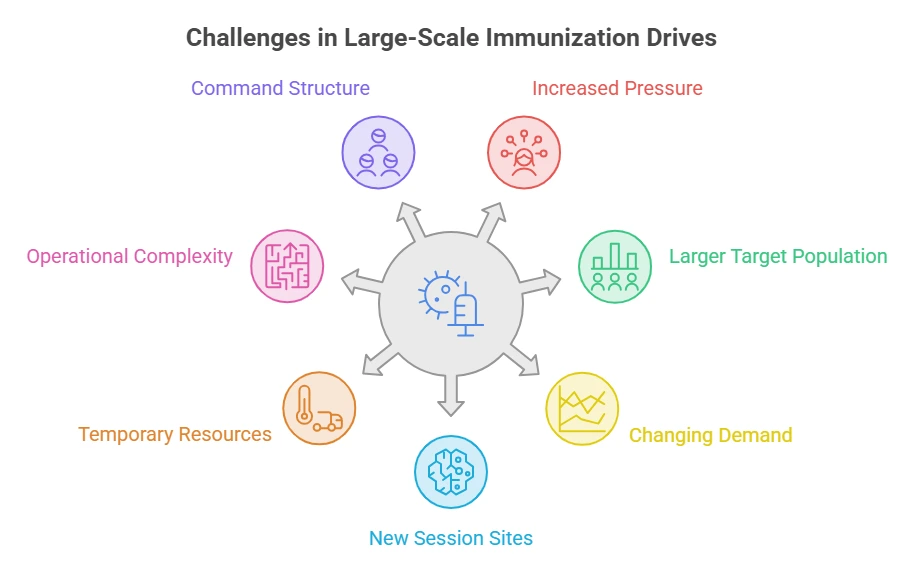
A large-scale drive may create additional pressure.
The target population can be much larger. Demand may change quickly, and new session sites may be required. Furthermore, managers may need to mobilize temporary employees, vehicles, storage units, digital systems, and public communication channels.
Operational complexity can increase because of:
Geographic dispersion
Uneven population density
Limited cold-chain capacity
Staff shortages
Remote delivery locations
Power interruptions
Transport delays
Public hesitancy
Unexpected demand
Vaccine-specific handling conditions
Data-entry backlogs
Adverse-event preparedness
Therefore, managers need a command structure that connects public health objectives with daily field operations.
For example, a school-based campaign requires coordination with educational institutions. Meanwhile, an epidemic response may require rapid deployment to affected areas.
Managers should also separate strategic goals from operating targets.
A strategic goal may be to protect a vulnerable population. An operating target may be to administer a defined number of doses per site each day.
Step 2: Estimate the Target Population and Demand
Demand forecasting prevents both stock-outs and excessive allocation.
Managers should estimate the eligible population using reliable and current information.
Potential data sources may include:
Census or population estimates
Health-facility records
Local administrative records
Disease-surveillance information
School or workplace data
Previous campaign performance
Community health-worker records
However, the eligible population does not automatically equal expected attendance.
Managers should account for factors such as:
Public awareness
Vaccine acceptance
Accessibility
Previous vaccination
Migration
Seasonal movement
Campaign duration
Dose schedules
Forecasts should also include expected wastage according to applicable programme rules.
WHO provides guidance for calculating vaccine volumes and assessing cold-chain capacity requirements. It also addresses coolant-pack and dry-storage needs.
Therefore, demand planning should consider more than dose numbers.
It should also account for the physical volume of vaccines, diluents, syringes, safety boxes, and other supplies.
Step 3: Map the Vaccine Distribution Network
A vaccine distribution network connects central stores, regional facilities, district stores, health facilities, and vaccination sites.
Managers should map every movement before the drive begins.
The distribution plan should identify:
Source storage location
Intermediate storage points
Final vaccination sites
Route distances
Expected travel time
Vehicle requirements
Transport frequency
Responsible personnel
Handover procedures
Backup routes
Emergency contacts
The map should also show where temperature-controlled storage is available.
A location may have enough physical space but insufficient qualified cold-chain capacity.
Therefore, managers should evaluate:
Storage temperature capability
Equipment condition
Usable storage volume
Power supply
Backup power
Temperature-monitoring arrangements
Alarm systems
Maintenance support
Access security
The distribution network should remain flexible.
If one facility experiences equipment failure, the plan should identify where affected stock can be transferred safely.
Step 4: Calculate Cold-Chain Capacity
Vaccines are temperature-sensitive biological products.
Some can lose potency after heat exposure. Others can be damaged by freezing. Once potency has been lost, it cannot simply be restored by returning the vaccine to the correct temperature.
Cold-chain planning should therefore examine capacity at every level.
Managers should calculate:
Vaccine volume
Packaging volume
Diluent requirements
Coolant-pack requirements
Refrigerator capacity
Freezer capacity, where applicable
Cold-box capacity
Vaccine-carrier requirements
Backup-storage capacity
Expected resupply frequency
Usable capacity may be lower than the equipment’s stated internal volume.
Air circulation, shelf arrangement, equipment design, and programme requirements can reduce the space available for vaccine storage.
Managers should avoid overloading equipment.
They should also prevent vaccines from being placed in locations that create freezing, heating, or airflow risks.
The phrase “cold chain” is often simplified to one temperature range.
However, vaccine storage requirements vary.
Many heat-sensitive vaccines are commonly stored between 2°C and 8°C at health-facility level. Nevertheless, managers must always follow the approved requirements for the specific product.
Some vaccines may require frozen or ultra-low-temperature storage. Others must be protected from freezing.
Therefore, the operational protocol should specify:
Approved storage range
Transport range
Light-sensitivity requirements
Freeze sensitivity
Handling of diluents
Shelf-life conditions
Open-vial requirements, where applicable
Reconstitution procedures
Permitted time after reconstitution
Excursion-management process
Different vaccine products should not be treated as operationally identical.
The protocol should be reviewed by appropriate clinical, pharmacy, public health, and supply-chain authorities.
WHO guidance covers vaccine vial monitors and electronic devices used to monitor temperatures in vaccine refrigerators and cold rooms.
Depending on the programme and equipment, monitoring may involve:
Digital thermometers
Minimum–maximum thermometers
Data loggers
Freeze indicators
Electronic shipping indicators
Remote temperature-monitoring systems
Vaccine vial monitors
These devices do not all serve the same purpose.
For example, a data logger can record temperature over time. A remote system may send alerts when a threshold is crossed. A vaccine vial monitor indicates cumulative heat exposure for the vial to which it is attached.
UNICEF’s procurement guidance emphasizes selecting suitable monitoring devices for vaccine storage and distribution.
Managers should ensure that devices are:
Appropriate for the equipment
Correctly placed
Functional
Calibrated or verified as required
Read at defined intervals
Supported by alarm-response procedures
Included in preventive maintenance
A device provides value only when someone reviews and acts on its information.
Step 7: Create a Temperature Monitoring System
Temperature monitoring is a management process, not merely a device.
The protocol should define:
Who checks temperature
How often it is checked
Where readings are recorded
Who reviews the log
What qualifies as an excursion
Who must be notified
How affected vaccines are isolated
Who determines usability
How corrective action is documented
Managers should train employees not to discard or use exposed vaccines without authorization.
Potentially affected stock should usually be clearly labelled, separated from usable stock, maintained under required conditions, and referred for expert assessment under the applicable programme procedure.
The incident review should examine:
Duration of exposure
Highest or lowest recorded temperature
Vaccine type
Batch information
Equipment involved
Transport conditions
Previous exposure history
Immediate corrective action
A short excursion does not automatically produce the same outcome for every vaccine.
Therefore, decisions should follow product-specific and programme-specific guidance.
Step 8: Plan Transport and Last-Mile Delivery
Transport is one of the most vulnerable points in the cold chain.
Vaccines may be exposed during loading, unloading, road delays, vehicle breakdowns, or improper packing.
UNICEF describes vaccine carriers as an important final link for taking vaccines from refrigerated facilities to communities and outreach locations.
Transport protocols should cover:
Qualified containers
Correctly conditioned coolant packs
Packing arrangement
Temperature-monitoring devices
Loading sequence
Vehicle suitability
Route planning
Travel-time limits
Handover documentation
Emergency actions
Managers should not assume that more ice automatically creates safer transport.
Freeze-sensitive vaccines can be damaged through direct contact with inadequately conditioned frozen packs.
Therefore, packing should follow the applicable instructions for the vaccine and transport container.
Each shipment should also have clear custody.
The dispatching and receiving teams should verify quantities, batch numbers, condition, documentation, and temperature information.
Step 9: Design Efficient Vaccination Sites
A vaccination site must support safe patient flow.
Poor layout can create overcrowding, errors, long waiting times, and confusion.
A typical site may require separate areas for:
Entry and guidance
Eligibility verification
Registration
Clinical screening
Vaccination
Record completion
Post-vaccination observation
Exit and follow-up guidance
The exact model depends on the programme.
Managers should assess:
Daily capacity
Physical space
Accessibility
Ventilation
Seating
Privacy
Infection-prevention needs
Emergency access
Waste-management arrangements
Internet or data connectivity
Crowd-control requirements
The service rate at each station should be balanced.
For example, adding more vaccinators may not improve throughput when registration remains the main bottleneck.
Managers should also prepare staff rosters, breaks, replacements, and reserve teams.
Fatigue can increase error risk.
Therefore, daily targets should remain realistic.
Lead Healthcare Innovation
Strengthen business, leadership, and operational skills to confidently manage healthcare services and create meaningful organizational impact with confidence.
Demand, risk areas, and eligibility rules may also change as surveillance information develops.
Managers need an incident-management structure with clear responsibilities.
The response may include:
Central command centre
Epidemiological intelligence
Priority-area mapping
Rapid stock allocation
Mobile vaccination teams
Extended operating hours
Emergency procurement
Daily performance reviews
Public communication
Rumour management
Interdepartmental coordination
Scenario planning is essential.
Managers should prepare for:
Sudden demand increases
Road closures
Equipment failure
Staff illness
Power disruption
Supply delays
Data-system outages
Community resistance
Adverse-event reports
A written contingency plan allows teams to act faster.
However, authority should remain clear during emergencies.
Key Performance Indicators for a Vaccination Drive
Managers should select a focused set of indicators.
Useful KPIs may include:
Vaccination coverage
Doses administered per site
Session completion rate
Stock-out frequency
Vaccine wastage rate
Temperature-excursion frequency
On-time delivery rate
Average waiting time
Data-completion rate
Adverse-event reporting timeliness
Supply discrepancy rate
Cost per administered dose
Each indicator should have:
A clear definition
A data source
A reporting frequency
An accountable owner
A target or threshold
An escalation process
The dashboard should help managers make decisions.
It should not become a collection of numbers without follow-up.
A Practical Vaccination Drive Checklist
Before the Campaign
Confirm target population and eligibility.
Calculate vaccines and supporting supplies.
Assess cold-chain capacity.
Map storage sites and transport routes.
Verify equipment and temperature devices.
Train all operational teams.
Approve site layouts and daily capacity.
Establish emergency and referral systems.
Test data-reporting arrangements.
Prepare backup plans.
During the Campaign
Monitor stock and temperature records.
Review attendance and coverage.
Reallocate supplies when necessary.
Track wastage and session performance.
Investigate delays and discrepancies.
Maintain patient-flow controls.
Review adverse-event preparedness.
Hold daily operations meetings.
Communicate verified information.
Document corrective actions.
After the Campaign
Reconcile doses and supplies.
Complete reverse logistics.
Review temperature records.
Close data-entry gaps.
Analyze coverage and equity.
Investigate wastage.
Document operational lessons.
Evaluate vendor and transport performance.
Recognize team contributions.
Update emergency plans.
Skills Healthcare Managers Need
Vaccination logistics requires both technical and managerial capabilities.
Important skills include:
Supply-chain planning
Demand forecasting
Inventory management
Data analysis
Team coordination
Risk management
Quality control
Public communication
Vendor management
Emergency operations
Process improvement
Managers must also remain calm under pressure.
A large-scale campaign can create changing priorities and unexpected constraints.
Therefore, decision-makers need reliable information, clear authority, and practical contingency plans.
At Asia Pacific Institute of Management, an industry-oriented curriculum, experienced faculty, practical learning, corporate exposure, and placement support can help learners develop broader management capabilities.
Such skills can support professionals working in healthcare operations, public health programmes, supply chains, and other complex service environments.
Successful vaccine logistics management depends on coordination across the complete immunization system.
Managers must estimate demand, map the distribution network, calculate cold-chain capacity, monitor temperatures, design vaccination sites, train teams, and maintain accurate records.
Moreover, they must prepare for equipment failures, transport delays, supply shortages, and sudden changes in demand.
Cold-chain management is particularly important.
A vaccine that reaches the right location but has not remained within its approved conditions may no longer be suitable for use.
Therefore, temperature monitoring, staff accountability, excursion response, and product-specific guidance should remain central to every campaign.
Large-scale vaccination is both a healthcare activity and a major management operation.
When managers combine supply-chain discipline, public-health awareness, data visibility, and emergency preparedness, they can help vaccination programmes achieve safer, faster, and more equitable outcomes.
Unlock Leadership Potential
Transform clinical knowledge into strategic management capabilities through practical learning designed for ambitious healthcare professionals seeking long-term career growth.
Dr. Vikas Gupta is a distinguished academic in the education and research domain, specializing in finance and related interdisciplinary studies. He is known for his...
Vaccine logistics management involves forecasting, receiving, storing, transporting, monitoring, allocating, and accounting for vaccines and supporting supplies. Its purpose is to make usable doses available safely and efficiently.
02.
What is the vaccine cold chain?
The vaccine cold chain is the temperature-controlled system used to store and transport vaccines from the manufacturer to the point of administration. Requirements differ by vaccine.
03.
Which temperature should vaccines be stored at?
Many heat-sensitive vaccines are commonly stored at 2°C to 8°C at health-facility level. However, not all vaccines use the same range. Managers must follow the approved product and programme guidance.
04.
Which temperature monitoring devices are used?
Programmes may use digital thermometers, minimum–maximum thermometers, data loggers, freeze indicators, shipping indicators, remote-monitoring systems, and vaccine vial monitors. Device selection depends on the equipment and use case.
05.
What should managers do after a temperature excursion?
They should secure and clearly separate affected stock, maintain required storage conditions, document the incident, notify authorized personnel, and seek a formal usability decision. Employees should not use or discard the stock without approval.
06.
How can vaccine wastage be reduced?
Managers can improve forecasting, stock rotation, session planning, transport practices, temperature control, staff training, community mobilization, and inventory visibility. However, reducing wastage must not compromise safe access.
07.
What are the main risks in immunization drive planning?
Major risks include poor forecasting, storage shortages, temperature excursions, delayed transport, supply gaps, staff shortages, inaccurate records, overcrowding, adverse-event unpreparedness, and weak public communication.
08.
How does vaccine logistics support epidemic response?
Vaccine logistics helps response teams move doses quickly to priority areas, establish temporary sites, maintain product quality, monitor coverage, and reallocate stock as risk patterns change.

















.webp) Call Us
Call Us