1-Year Executive MBA in Healthcare: Is It Worth It for Working Professionals?
Posted on 09 Sep 2026
By Dr. Vikas Gupta
Introduction
Healthcare professionals often reach a point where technical expertise alone is not enough for the next career move.
A hospital administrator may want to lead a larger business unit. A pharmaceutical professional may want to move into strategy. A doctor may want to understand finance and operations. Similarly, a healthcare professional may want to transition into consulting, health-tech, insurance, or business leadership.
However, leaving employment for two years may not be practical.
This is why interest in one-year executive management programs is growing among experienced professionals. If you are researching executive MBA healthcare admission 2027, the key question should not simply be, "Can I complete an MBA faster?"
The better question is: Will a one-year executive healthcare management program create enough career value for my experience, goals, time, and investment?
This guide explains eligibility, fees, admission steps, curriculum, career scope, and the factors working professionals should evaluate before applying for the 2027 intake.
Accelerate Your Healthcare Leadership
Build strategic, financial, analytical, and leadership capabilities to advance your healthcare career without losing sight of professional goals.
A 1-year Executive MBA in Healthcare is an accelerated management program generally designed for experienced professionals who want to develop business and leadership capabilities relevant to healthcare. Depending on the institution, it may cover healthcare operations, finance, strategy, marketing, analytics, technology, quality, and leadership within a condensed format.
The key word is executive.
Executive programs are generally designed around candidates who already have professional experience. Therefore, learning may draw heavily on workplace problems, business cases, projects, and peer experience.
However, program terminology differs across institutions.
A course marketed as a "1-year Executive MBA" may not necessarily have the same academic status, structure, recognition, eligibility criteria, or career services as another institution's program.
Therefore, applicants should verify exactly what qualification is awarded before enrolling.
Why Are Working Professionals Considering a 1-Year Healthcare MBA?
Time is one of the biggest advantages.
A conventional two-year management program can require a significant career break. For an experienced professional, the opportunity cost can be substantial.
A shorter executive format may allow professionals to build management capabilities within a more concentrated period.
Moreover, healthcare is becoming increasingly management-intensive.
Hospitals and healthcare businesses now operate at the intersection of:
Operations
Finance
Technology
Analytics
Marketing
Quality
Insurance
Supply chains
Patient experience
Strategy
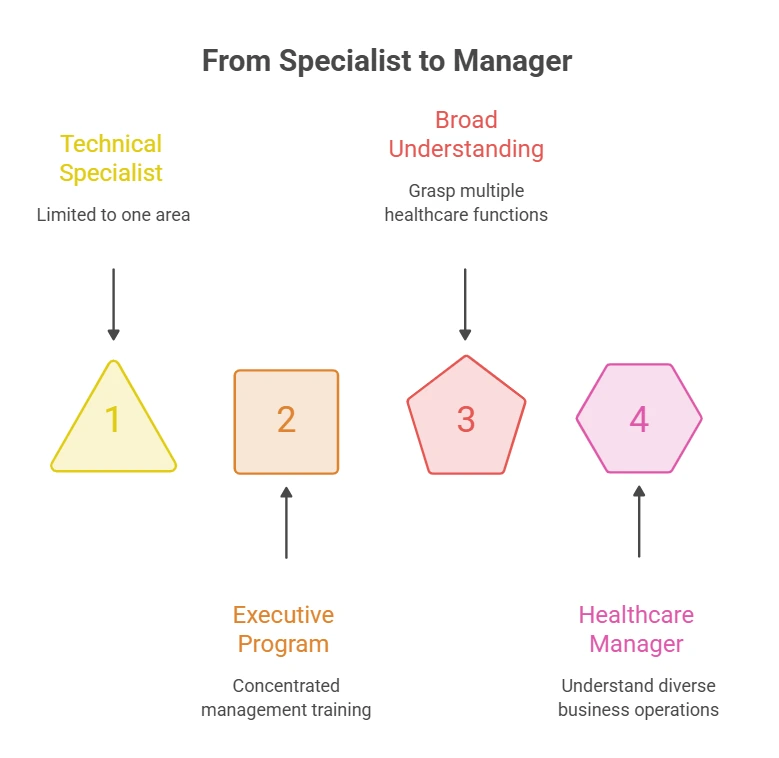
As professionals progress, they may need to understand several of these functions rather than remain limited to one technical specialization.
Is a 1-Year Executive MBA in Healthcare Worth It?
A one-year Executive MBA in Healthcare can be worth considering when the program directly supports your career objective, builds skills you currently lack, fits your work commitments, and provides appropriate academic and industry value relative to its total cost.
However, it is not automatically worthwhile for everyone.
Consider these five questions.
1. Do You Already Have Meaningful Work Experience?
Executive education usually becomes more valuable when students can connect management concepts with real professional situations.
For example, an experienced hospital administrator can immediately relate operations concepts to patient flow and capacity management.
Similarly, an insurance professional can connect finance and analytics concepts with claims and risk.
Without sufficient work exposure, a conventional MBA or PGDM may sometimes provide a more appropriate management foundation.
2. Do You Need Management Skills for Your Next Role?
Ask what is preventing your next career move.
Is it a lack of strategic thinking?
Do you need finance knowledge?
Are analytics skills becoming important?
Do you want to manage larger teams?
If the program addresses a genuine skill gap, the investment becomes easier to justify.
3. Does the Program Match Your Healthcare Segment?
Healthcare is not one industry function.
A professional working in pharmaceutical marketing has different requirements from a hospital operations manager.
Similarly, a health-tech professional may need different capabilities from a public-health administrator.
Therefore, evaluate the curriculum against your intended career path.
4. Can You Manage the Academic Workload?
"One year" does not necessarily mean easy.
A compressed program can require intensive classes, projects, assignments, group work, and examinations.
Working professionals should realistically assess whether they can balance their employment, family responsibilities, and academic commitments.
5. Does the Return Justify the Cost?
Do not measure return on investment only through an immediate salary increase.
An Executive MBA may create value through:
Broader responsibilities
Leadership skills
Internal career progression
Industry transition
Better strategic understanding
Professional network
Entrepreneurship
Long-term career mobility
However, none of these outcomes is guaranteed simply by completing the program.
Candidates generally need to submit an online or prescribed application form and applicable application fee.
Provide accurate information.
Professional experience should be represented clearly and truthfully.
Step 6: Prepare for the Selection Process
Some programs may use interviews, aptitude assessments, entrance examinations, or profile-based evaluation.
An executive-program interview may focus heavily on professional experience.
Candidates should therefore be prepared to discuss:executive MBA application process
Career progression
Leadership experiences
Business problems solved
Professional achievements
Career goals
Reasons for choosing healthcare management
Step 7: Review the Admission Offer
An admission offer should be evaluated carefully.
Check the total fees, payment schedule, refund conditions, program format, attendance requirements, academic calendar, and qualification awarded.
Only then should you make the final decision.
Turn Experience Into Leadership
Strengthen your healthcare experience with management expertise in strategy, operations, finance, technology, and analytics for greater career opportunities.
Exact 2027 application dates will depend on the institution.
Therefore, candidates should rely on official admission announcements rather than dates published on third-party websites.
What Is the Executive MBA Application Process for Working Professionals?
The is often more profile-focused than admission to a fresher-oriented program.
Why?
Because work experience becomes part of the candidate's value proposition.
A strong application should demonstrate progression.
For example, simply writing "five years of hospital experience" provides limited information.
A stronger profile demonstrates responsibilities and impact.
It might show experience managing hospital operations, coordinating teams, improving turnaround times, handling budgets, implementing systems, or leading projects.
Applicants should therefore quantify professional achievements wherever appropriate.
Examples can include:
Team size managed
Budget responsibility
Operational improvement
Revenue contribution
Cost reduction
Project completion
Process improvement
Patient-experience improvement
The objective is not to exaggerate achievements.
It is to demonstrate professional maturity.
Executive MBA Healthcare Fees: What Should You Budget?
Fees can vary considerably depending on the institution, program structure, delivery mode, duration, facilities, and additional learning components.
Therefore, candidates should avoid comparing programs only through headline tuition.
Calculate the total cost of participation.
This can include:
Tuition: The primary academic fee.
Application and admission charges: These may be separate.
Study resources: Some programs may charge additional amounts.
Campus modules: Travel and accommodation can increase costs.
Technology requirements: Online or hybrid learning may require suitable equipment and connectivity.
Opportunity cost: Professionals should consider whether attendance requires unpaid leave or reduced working hours.
How to Calculate Executive MBA ROI
A simple framework is:
Total Investment = Program Cost + Additional Expenses + Opportunity Cost
Then evaluate the potential benefits.
These may include improved skills, internal promotion potential, role transition, leadership opportunities, network value, or entrepreneurial capability.
Do not calculate ROI based on an assumed salary increase.
There is no guarantee that completing an Executive MBA will immediately increase your compensation.
What Will You Study in a 1-Year Executive Healthcare MBA?
Curriculum differs by program, but common management areas can include:
Healthcare Operations
Students may learn about patient flow, capacity, service delivery, quality, productivity, and hospital processes.
Healthcare Finance
Financial knowledge can help managers understand budgets, costs, revenue, investment decisions, and organisational performance.
Strategy
Healthcare leaders need to evaluate growth, competition, service expansion, partnerships, and technology investments.
Healthcare Marketing
Healthcare marketing can cover branding, patient acquisition, digital channels, consumer behaviour, and service marketing.
Business Analytics
Managers increasingly use data to monitor performance.
Therefore, students may study dashboards, analytical frameworks, decision-making, and healthcare metrics.
Digital Healthcare
Technology is reshaping healthcare delivery.
Relevant topics can include digital health platforms, hospital information systems, automation, artificial intelligence, and technology strategy.
Quality and Patient Experience
Healthcare managers need to understand process quality, patient experience, risk, and continuous improvement.
Leadership
Executive professionals must manage people.
Therefore, communication, negotiation, team leadership, change management, and decision-making are essential.
Career Scope After a 1-Year Executive MBA in Healthcare
An executive qualification does not reset a professional's career.
Instead, it generally works best when it builds on existing experience.
Depending on previous background, skills, and employer requirements, career pathways may include:
Career Area
Potential Direction
Hospital Operations
Operations or Unit Leadership
Healthcare Strategy
Strategy and Business Planning
Healthcare Consulting
Advisory and Consulting Roles
Health-Tech
Operations, Strategy or Growth
Health Insurance
Operations and Network Management
Pharmaceutical Sector
Commercial and Management Roles
Healthcare Analytics
Business and Operational Analytics
Quality
Quality and Process Management
Projects
Healthcare Project Management
Business Development
Growth and Partnerships
Patient Experience
Service and Experience Management
These are possible career directions rather than guaranteed job outcomes.
Is a 1-Year Executive MBA Good for Hospital Professionals?
It can be particularly relevant for professionals who already understand hospital operations but need broader management capabilities.
For example, an experienced administrator may know patient-flow processes extremely well.
However, a senior role may also require budgeting, strategic planning, analytics, technology evaluation, and people management.
An executive management program can help connect these functions.
This can prepare professionals to think beyond individual processes and understand the hospital as an integrated organisation.
Is It Suitable for Doctors and Clinical Professionals?
Healthcare leadership increasingly requires collaboration between clinical and management teams.
Therefore, doctors and other eligible clinical professionals may consider executive management education when their career goals involve:
Hospital leadership
Department management
Healthcare entrepreneurship
Strategy
Business development
Healthcare consulting
Administration
Clinical expertise remains distinct from management expertise.
A doctor may understand patient care deeply while still needing formal exposure to finance, strategy, marketing, operations, or organisational leadership.
However, clinicians should carefully evaluate workload before committing to an intensive one-year program.
Can You Change Careers Through an Executive Healthcare MBA?
A career transition is possible, but the degree alone does not guarantee it.
Suppose a professional works in healthcare sales and wants to move into strategy.
Management education can build relevant analytical and strategic capabilities.
However, the candidate may still need projects, networking, relevant assignments, and evidence of problem-solving skills to make the transition.
Similarly, someone outside healthcare may find the transition more challenging than an experienced healthcare professional.
Therefore, candidates should evaluate the distance between their current profile and target role.
The larger the career shift, the more additional preparation may be required.
1-Year Executive MBA vs 2-Year MBA: Which Is Better?
Neither format is universally better.
The correct choice depends on career stage.
A 1-Year Executive Program May Be Better If:
You already have meaningful work experience
You cannot leave employment for two years
You know your career objective
You need management skills rather than complete career exploration
You can handle an intensive schedule
A 2-Year MBA/PGDM May Be Better If:
You are a fresher
You have limited professional experience
You need internships and extensive campus exposure
You are exploring multiple career options
You want a longer management-learning experience
Therefore, working professionals should not choose a one-year program merely because it is faster.
The format should match their career stage.
How to Choose a 1-Year Executive MBA in Healthcare for 2027
Before submitting an executive MBA admission application, evaluate the program using eight questions:
What qualification will I receive?
What are the exact eligibility requirements?
Does the curriculum match my career goal?
Is the schedule compatible with my job?
What is the total program cost?
What practical and industry exposure is included?
What career support is available to executive participants?
What can graduates realistically do with the skills developed?
This framework helps candidates look beyond marketing claims.
Additionally, applicants should verify recognition, admission requirements, fees, curriculum, and dates directly through official institutional sources.
Skills Working Professionals Should Develop Alongside the Executive MBA
The qualification alone should not be the goal.
Professionals should use the program to develop transferable capabilities.
Financial literacy: Understand budgets, costs, revenue, and business performance.
Analytics: Learn to interpret data and build evidence-based recommendations.
Technology awareness: Understand how AI, automation, and digital systems affect healthcare.
Strategic thinking: Move from solving today's problem to planning for tomorrow.
Leadership: Learn to manage people, performance, and organisational change.
Operations: Understand how resources, capacity, processes, and service quality connect.
These skills can remain useful even if the professional changes healthcare segments later.
How Management Education Can Support Healthcare Leadership
Healthcare organisations need managers who can connect business decisions with service delivery.
A strong management education can help professionals understand strategy, finance, operations, analytics, marketing, technology, and leadership as interconnected disciplines.
At Asia Pacific Institute of Management, the emphasis on industry-oriented management education, practical learning, experienced faculty, corporate exposure, and placement support can help learners develop transferable business capabilities.
Working professionals exploring executive MBA healthcare admission 2027 should examine the relevant program's latest curriculum, format, eligibility, fees, and admission requirements before applying.
Conclusion: Should You Apply for Executive MBA Healthcare Admission 2027?
A one-year Executive MBA in Healthcare can be a valuable option for working professionals, but speed alone does not make a program worthwhile.
Before applying for executive MBA healthcare admission 2027, evaluate your experience, career objective, skill gaps, available time, and financial commitment.
Next, verify executive MBA healthcare eligibility, compare the complete executive MBA healthcare fees, and understand the executive MBA application process.
Most importantly, examine what you will actually learn.
Healthcare leaders increasingly need expertise across operations, finance, strategy, analytics, technology, and people management. A well-designed executive management program should help strengthen these capabilities.
Working professionals considering healthcare MBA admission 2027 can explore relevant management education opportunities at Asia Pacific Institute of Management and review the latest program and admission information.
The right decision is not necessarily the shortest program or the lowest fee. It is the program that best connects your existing professional experience with where you want your career to go next.
Advance Without Starting Over
Transform your professional experience into stronger business leadership skills and prepare for your next move across the healthcare industry.
Dr. Vikas Gupta is a distinguished academic in the education and research domain, specializing in finance and related interdisciplinary studies. He is known for his...
01.
Is a 1-year Executive MBA in Healthcare worth it?
It can be worthwhile for experienced professionals who need broader management capabilities and have clear career objectives. Its value depends on program quality, curriculum, professional experience, total cost, career goals, and the ability to apply learning at work.
02.
What is the executive MBA healthcare eligibility for 2027?
Eligibility varies by institution. Candidates generally need a recognised bachelor’s degree, while many executive programs also require professional experience. Applicants should verify the official 2027 criteria before applying.
03.
What are the executive MBA healthcare fees in India?
There is no standard fee. Executive MBA healthcare fees vary according to institution, duration, learning format, facilities, and additional components. Candidates should calculate tuition plus travel, accommodation, other charges, and opportunity costs.
04.
When will healthcare MBA admission 2027 begin?
Admission calendars differ between institutions. Candidates should monitor the official admission page of their chosen institution for confirmed 2027 application dates rather than relying on unofficial deadlines.
05.
What is the executive MBA application process?
The process can involve checking eligibility, registering, completing an application, uploading academic and employment documents, paying applicable fees, and participating in an interview or assessment. Exact requirements vary by institution.
06.
Can I pursue a 1-year Executive MBA while working?
Many executive programs are designed for working professionals through weekend, evening, online, hybrid, or modular formats. However, candidates should verify attendance and campus requirements before applying.
07.
Does an Executive MBA guarantee promotion or placement?
No. An Executive MBA cannot guarantee a promotion, salary increase, placement, or job transition. Outcomes depend on prior experience, acquired skills, performance, networking, employer requirements, and market conditions.
08.
Is a 1-year Executive MBA better than a 2-year MBA?
It depends on career stage. A one-year executive format can suit experienced professionals with defined goals. A two-year MBA or PGDM can be more appropriate for fresh graduates and candidates seeking extensive internships and campus-based career exploration.


















.webp) Call Us
Call Us




