Executive MBA vs Regular MBA in Healthcare: Which One Should You Choose?
Posted on 13 Sep 2026
By Dr. Vikas Gupta
Introduction
Choosing an MBA in Healthcare Management can be an important career decision, but there is another question many professionals and students face: should you pursue an Executive MBA or a regular MBA?
The executive MBA vs regular MBA decision largely depends on where you are in your career. A regular MBA in Healthcare Management is generally suited to graduates and early-career professionals who want structured management education and entry into the healthcare business ecosystem. An Executive MBA, on the other hand, is typically designed for experienced professionals who want to strengthen their managerial and leadership capabilities while continuing their careers.
Both can provide valuable healthcare management knowledge, but their learning formats, peer groups, eligibility requirements, career objectives, and professional outcomes can differ significantly.
This guide explains the executive MBA vs MBA comparison in detail so you can determine which route is better aligned with your healthcare career goals.
Experience Deserves Bigger Opportunities
Build strategic and leadership capabilities that complement your healthcare experience while preparing you for broader management responsibilities and growth.
A regular MBA healthcare management programme is typically a postgraduate management programme that combines general business education with healthcare-focused learning.
Students may study core subjects such as:
Marketing Management
Financial Management
Human Resource Management
Operations Management
Business Strategy
Organisational Behaviour
Business Analytics
These may be combined with healthcare-specific subjects such as hospital administration, healthcare operations, healthcare quality, patient experience, healthcare marketing, health economics, digital health, and healthcare analytics.
A regular MBA is generally suitable for recent graduates and professionals who are still in the early stages of their careers.
Depending on the institution, students from medicine, dentistry, pharmacy, life sciences, nursing, allied health sciences, and other academic backgrounds may be eligible.
What Is an Executive MBA in Healthcare?
An Executive MBA in Healthcare is generally designed for professionals who already have work experience and want to develop advanced business, management, and leadership capabilities.
The key executive MBA difference is not simply the programme name. Executive programmes are usually built around the requirements and experience levels of working professionals.
Rather than introducing every concept from the beginning, an Executive MBA may place greater emphasis on applying management frameworks to practical organisational challenges.
Students may study healthcare strategy, finance, operations, leadership, digital transformation, quality management, analytics, organisational change, and strategic decision-making.
An executive MBA for working professionals may also offer weekend, online, hybrid, modular, or other flexible learning formats, depending on the institution.
Executive MBA vs Regular MBA: Quick Comparison
Understanding the major differences can make your decision easier.
Factor
Executive MBA in Healthcare
Regular MBA in Healthcare
Target audience
Experienced professionals
Graduates and early-career professionals
Work experience
Usually required or preferred
Often not mandatory
Career stage
Mid-career or experienced
Early career
Learning approach
Applied and leadership-focused
Foundational + applied
Programme format
May be flexible, weekend, hybrid or online
Usually full-time classroom
Career break
Often not required
Usually required for full-time programmes
Peer group
Experienced professionals
Mostly students and early-career professionals
Main objective
Career advancement and leadership
Career entry and management foundation
Networking
Senior/professional network
Student, alumni and recruiter network
Healthcare focus
Strategic and managerial
Foundational and managerial
These are general differences. Actual programme structures and eligibility requirements vary by institution.
Executive MBA vs MBA: Understanding the Main Difference
When comparing an executive MBA vs MBA, the biggest difference is often the career stage of the learner.
Imagine two candidates.
Candidate A has recently completed a bachelor's degree and wants to build a career in hospital administration. This person needs management fundamentals, practical exposure, internships, and support in entering the job market.
Candidate B has already spent several years working in a hospital or healthcare company and now wants to move towards managerial or leadership responsibilities.
Their learning needs are different.
Candidate A may benefit more from a regular MBA, while Candidate B may find an Executive MBA better aligned with their experience.
Therefore, the question isn't necessarily which MBA is better overall. The more useful question is:
Which MBA is better for your current career stage?
Who Should Choose a Regular MBA in Healthcare Management?
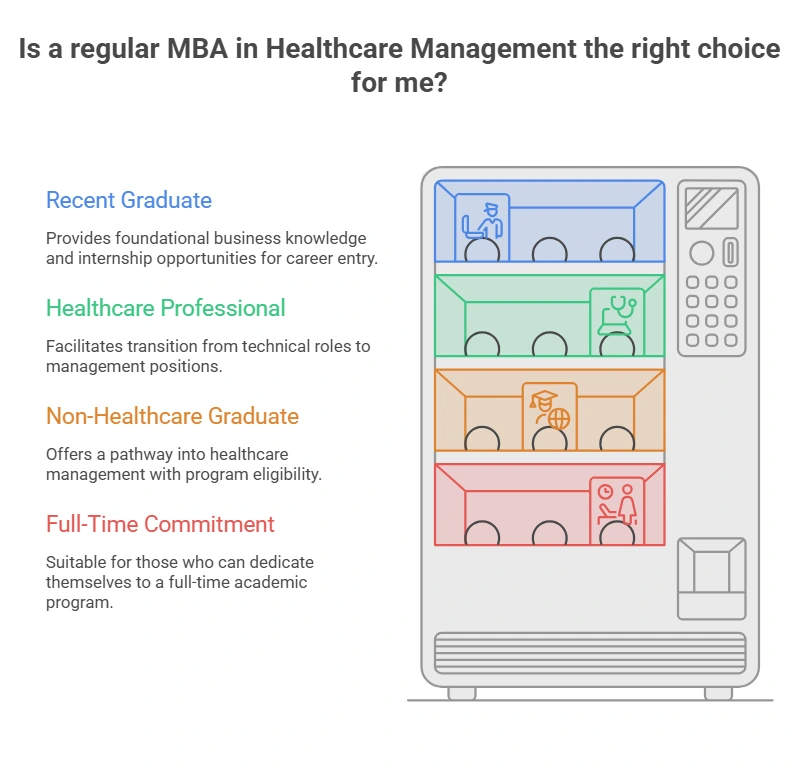
A regular MBA healthcare management programme can be a suitable option if you are a recent graduate or have limited professional experience.
It may be particularly relevant if you:
Have recently completed graduation
Want to enter healthcare management
Need foundational business knowledge
Want internship opportunities
Prefer classroom learning
Want structured placement support
Are planning a career transition immediately after graduation
Can commit to a full-time academic programme
Students from healthcare-related academic backgrounds may use a regular MBA to move from technical or clinical education towards business and management roles.
It may also be appropriate for non-healthcare graduates who want to enter healthcare management, subject to programme eligibility.
Who Should Choose an Executive MBA in Healthcare?
An Executive MBA is generally better suited to professionals who already have workplace experience.
A regular MBA usually spends considerable time developing management fundamentals.
Students may learn accounting, finance, economics, marketing, HR, operations, analytics, organisational behaviour, and business strategy before applying these concepts to healthcare.
This is useful for students who have little or no previous management education.
Executive MBA Curriculum
Executive programmes may move more quickly towards strategic and applied management topics.
The curriculum may focus on areas such as:
Healthcare leadership
Strategic management
Healthcare finance
Advanced healthcare operations
Digital healthcare transformation
Healthcare analytics
Organisational change
Healthcare quality
Innovation
Strategic decision-making
Because participants often bring professional experience into the classroom, case discussions and peer learning can become important parts of the programme.
Difference in Learning Experience
The classroom experience can be significantly different between the two formats.
In a regular MBA, students may learn alongside peers who are beginning their professional careers. Discussions often combine academic frameworks, case studies, internships, projects, and practical assignments.
In an Executive MBA, participants may already have experience managing teams, projects, clients, patients, operations, or business functions.
This means classroom discussions can include real workplace situations.
For example, a hospital operations professional might discuss patient-flow challenges, while a pharmaceutical professional could contribute perspectives on commercial strategy.
This experience-based interaction can be an important part of executive education.
Choose Career Progression
Continue working while developing finance, strategy, operations, and leadership expertise designed to strengthen your next healthcare career move.
Work experience is one of the most important factors in the executive MBA vs regular MBA decision.
A regular MBA may accept students directly after graduation, depending on institutional eligibility requirements.
Executive MBA programmes generally target professionals with prior work experience.
However, there is no universal experience requirement for every Executive MBA. Some institutions may require a specific number of years, while others may have different criteria.
Always check the official eligibility requirements of the programme you're considering.
Executive MBA vs Regular MBA: Learning Format
Regular MBA programmes are often delivered through full-time classroom learning.
Students attend lectures, participate in projects, complete internships, work on presentations, and take part in campus activities.
Executive MBA programmes can be more flexible.
Depending on the institution, they may use:
Weekend classes
Evening sessions
Online learning
Hybrid learning
Modular classes
Short campus residencies
This flexibility is one reason an executive MBA for working professionals can appeal to people who don't want to leave their current employment.
Can You Work While Pursuing an Executive MBA?
In many cases, yes.
Executive MBA programmes are often structured specifically so professionals can continue working while studying.
This has an additional advantage: concepts learned in the programme can potentially be applied directly in the workplace.
For example, a professional studying healthcare operations may use process-improvement frameworks within their hospital or healthcare organisation.
However, balancing work and study can be demanding.
Assignments, classes, group projects, examinations, and professional responsibilities require effective time management.
Can You Work While Pursuing a Regular MBA?
This depends on the programme format.
A full-time regular MBA generally requires a significant academic commitment. Classes, projects, internships, events, presentations, and placement activities can make maintaining full-time employment difficult.
Some institutions may offer part-time or flexible MBA formats, but these should be evaluated separately from traditional full-time programmes.
Your career objective should strongly influence your choice.
Choose a Regular MBA If You Want Career Entry
A regular MBA can help students build the knowledge and practical exposure needed to begin a healthcare management career.
Potential entry-level and early-career areas include:
Hospital Operations
Healthcare Administration
Patient Experience
Healthcare Marketing
Business Development
Quality Management
Healthcare Analytics
Health-Tech Operations
Choose an Executive MBA If You Want Career Progression
An Executive MBA is generally aimed at professionals seeking greater managerial responsibility.
Depending on previous experience and organisational opportunities, professionals may use executive education to strengthen their capabilities for roles in:
Healthcare Operations Leadership
Hospital Administration
Healthcare Strategy
Healthcare Consulting
Business Development
Healthcare Project Management
Health-Tech Management
Healthcare Quality Leadership
Functional Management
An MBA qualification alone does not guarantee a promotion or senior role. Career progression also depends on experience, performance, skills, industry knowledge, and organisational opportunities.
Career Outcomes: Executive MBA vs Regular MBA
Career outcomes should be viewed in relation to your starting point.
A fresh graduate completing a regular MBA may primarily be looking for their first management role.
An experienced healthcare professional completing an Executive MBA may instead be trying to accelerate an existing career.
Therefore, comparing only the salaries of graduates from the two programmes can be misleading.
The Executive MBA participant may already have several years of professional experience before beginning the programme.
A better way to evaluate outcomes is to ask what each programme could add to your current career position.
Executive MBA vs Regular MBA: Cost and ROI
Programme costs can vary widely based on institution, duration, delivery format, facilities, international exposure, and other programme features.
For regular MBA students, the total investment may include tuition fees, accommodation, food, transportation, study materials, and other living expenses.
There can also be an opportunity cost if the student leaves a job to pursue the programme full-time.
An Executive MBA may allow professionals to continue earning while studying. However, Executive MBA fees can also vary significantly.
When calculating ROI, consider:
Total Investment = Tuition + Additional Expenses + Living Costs + Opportunity Cost
Then assess this against potential long-term career value.
That value may include salary progression, promotions, leadership responsibilities, professional networks, new skills, and career mobility.
Networking: Which MBA Offers Better Opportunities?
Both programmes provide networking opportunities, but the nature of those networks may differ.
A regular MBA can connect you with classmates, alumni, recruiters, faculty, industry mentors, and internship organisations.
An Executive MBA cohort may include professionals with substantial industry experience.
For working professionals, interactions with experienced peers can create opportunities for knowledge exchange, industry insights, and professional networking.
Therefore, neither network is automatically better. They simply serve different career needs.
Executive MBA Difference: Leadership vs Foundation
One of the simplest ways to understand the executive MBA difference is through the balance between foundation and application.
A regular MBA generally asks:
How does business management work?
An Executive MBA may place greater emphasis on:
How can I apply management principles to make better organisational and leadership decisions?
This distinction is not absolute, but it helps explain why the programmes appeal to people at different stages of their careers.
Regular MBA Healthcare Management: Advantages
A regular MBA may offer several advantages for early-career students.
It provides structured management education, campus learning, internship exposure, peer interaction, and potentially stronger access to entry-level recruitment processes.
Students also have more time to explore different healthcare functions before deciding on a specialisation or career direction.
For someone entering healthcare management for the first time, this structured environment can be valuable.
Executive MBA in Healthcare: Advantages
An Executive MBA can provide a different set of benefits.
Professionals may be able to continue earning, immediately apply classroom learning, develop leadership capabilities, and interact with experienced peers.
It can also help professionals understand business functions outside their existing area of expertise.
For example, a healthcare operations professional may develop stronger knowledge of finance, strategy, marketing, analytics, and organisational leadership.
What About Doctors and Healthcare Professionals?
Doctors and other healthcare professionals often face a particularly interesting choice.
A medical professional who wants to transition completely from clinical practice into healthcare management may benefit from an intensive management programme.
An experienced doctor who already manages a clinic, department, hospital function, or healthcare business may prefer an executive format that allows continued professional practice.
The right choice therefore depends less on the candidate's original degree and more on their professional experience and future career objective.
Executive MBA vs Regular MBA: Which Is Better for Career Switchers?
For early-career professionals making a major transition into healthcare, a regular MBA may provide broader foundational education and structured recruitment opportunities.
For experienced professionals moving from one healthcare function to another—for example, from hospital operations to healthcare strategy—an Executive MBA may be more relevant.
Again, programme quality and individual experience matter considerably.
Questions to Ask Before Choosing
Before deciding between the two programmes, ask yourself:
How much work experience do I have?
If you have limited professional experience, a regular MBA may be more appropriate.
Can I leave my job?
If taking a career break isn't practical, an executive format may provide greater flexibility.
What is my career objective?
Career entry and career acceleration require different educational approaches.
Do I need management fundamentals or leadership development?
Early-career learners may need stronger foundations, while experienced professionals may benefit more from strategic and leadership-focused learning.
What type of peer group do I want?
Regular MBA and Executive MBA cohorts can provide very different networking and learning environments.
What is the total cost and expected value?
Evaluate tuition, additional costs, opportunity cost, career support, and potential long-term professional benefits.
Executive MBA vs Regular MBA: Which One Should You Choose?
There is no single winner in the executive MBA vs regular MBA comparison.
Your career stage should guide the decision.
Choose a Regular MBA in Healthcare Management if: you are a recent graduate or early-career professional, want comprehensive management foundations, prefer full-time classroom learning, need internships and structured career support, or want to enter healthcare management.
Choose an Executive MBA in Healthcare if: you already have meaningful professional experience, want to continue working, are preparing for greater management responsibility, want to strengthen strategic and leadership capabilities, or need management education that complements your existing professional expertise.
The best programme is the one that matches where you are today and where you want your career to go next.
Conclusion
The executive MBA vs regular MBA decision shouldn't be based only on programme duration, fees, or which qualification sounds more senior.
It should begin with your career stage.
A regular MBA healthcare management programme can provide a strong foundation for graduates and early-career professionals who want to enter healthcare management.
An Executive MBA, meanwhile, can be better aligned with experienced professionals who want to strengthen their business understanding, develop leadership capabilities, and potentially progress towards broader responsibilities without completely stepping away from their careers.
When evaluating healthcare executive MBA vs MBA options, compare eligibility, curriculum, learning format, faculty, peer group, industry exposure, career support, cost, and expected professional value.
Ultimately, the right MBA isn't simply the one with the strongest title. It is the one that provides the right learning experience for your current career stage and future goals.
Lead Beyond Your Role
Transform professional experience into stronger business decision making and prepare for strategic leadership opportunities across the evolving healthcare sector.
Dr. Vikas Gupta is a distinguished academic in the education and research domain, specializing in finance and related interdisciplinary studies. He is known for his...
01.
What is the main difference between an Executive MBA and a regular MBA?
The main executive MBA difference is typically the target audience and learning approach. Regular MBA programmes generally serve graduates and early-career professionals, while Executive MBA programmes are usually designed for experienced working professionals.
02.
Executive MBA vs MBA: which is better?
Neither is universally better. A regular MBA can be more appropriate for early-career candidates, while an Executive MBA can better suit experienced professionals seeking management or leadership development.
03.
Is an Executive MBA suitable for working healthcare professionals?
Yes, many Executive MBA programmes are designed around working professionals and may offer weekend, online, hybrid, or modular learning. Actual formats vary by institution.
04.
Do I need work experience for an Executive MBA in Healthcare?
Many Executive MBA programmes require or prefer professional work experience. The exact requirement varies, so applicants should check the eligibility criteria of individual institutions.
05.
Is a regular MBA in Healthcare Management suitable for fresh graduates?
Yes, many regular MBA programmes accept graduates with limited or no professional experience, subject to institutional eligibility requirements.
06.
Which is better for doctors: an Executive MBA or regular MBA?
It depends on career stage. An experienced doctor who wants to continue practising while developing management skills may prefer an Executive MBA, while an early-career candidate seeking a broader transition into management may consider a regular MBA.
07.
Can an Executive MBA help with healthcare leadership roles?
It can help professionals develop strategic, financial, operational, and leadership capabilities relevant to management roles. However, career progression also depends on previous experience, skills, performance, and available opportunities.
08.
Which has better ROI: Executive MBA or regular MBA?
ROI depends on programme fees, opportunity cost, existing salary, career outcomes, and long-term progression. Executive MBA students may continue earning while studying, whereas full-time MBA students may need to account for income forgone during the programme.


















.webp) Call Us
Call Us