Executive MBA in Healthcare Management: Course, Eligibility, Fees & Career Scope
Posted on 08 Sep 2026
By Dr. Vikas Gupta
Introduction
Healthcare today is more than clinical care. Hospitals, health-tech businesses, pharmaceutical organisations, insurance providers, diagnostics companies, and healthcare consulting firms need professionals who can manage people, operations, finances, technology, and growth.
For experienced professionals who want to develop these capabilities without starting their careers again, an executive MBA in healthcare management can be an attractive option.
An executive healthcare management program typically combines core management concepts with healthcare-sector knowledge. It can help professionals understand hospital operations, healthcare finance, strategy, marketing, analytics, quality, digital transformation, and leadership.
However, course structures, eligibility criteria, fees, delivery modes, and career outcomes vary significantly between institutions.
This guide explains what an Executive MBA in Healthcare Management involves, who should consider it, its typical eligibility and fee structure, and the career opportunities professionals can explore.
Lead Healthcare With Confidence
Build strategic, financial, operational, and leadership capabilities to advance your career across hospitals and the wider healthcare industry.
What Is an Executive MBA in Healthcare Management?
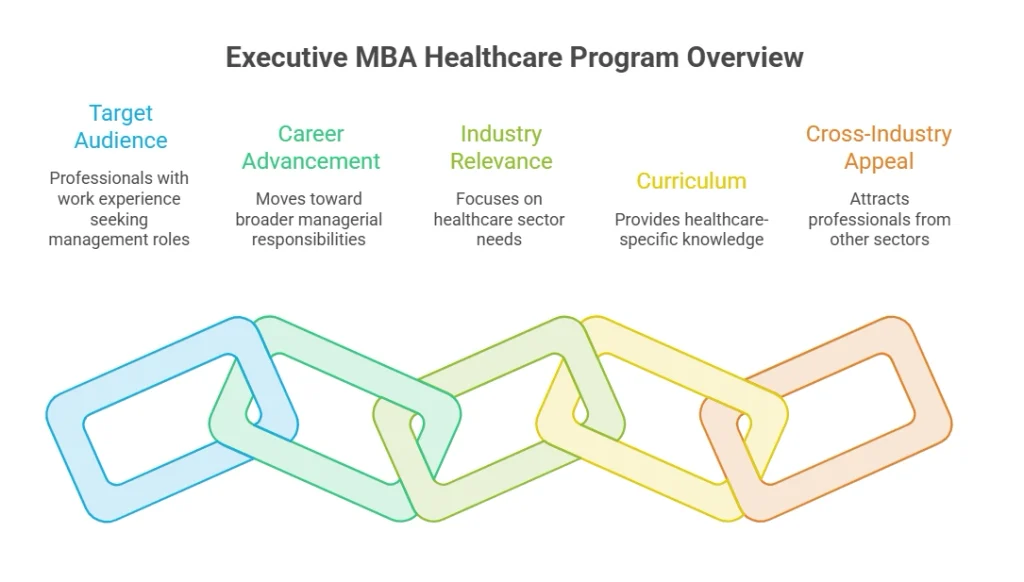
An executive MBA in healthcare management is a management program designed primarily for working or experienced professionals who want to develop leadership and business skills relevant to hospitals and the wider healthcare industry. It can cover healthcare operations, finance, strategy, marketing, analytics, quality, technology, and leadership.
An Executive MBA, commonly called an EMBA, differs from a conventional full-time MBA in its target audience and learning format.
Traditional MBA programs often attract graduates or early-career professionals. Executive programs, meanwhile, are generally structured for people who already have professional experience.
Therefore, classroom discussions can involve practical business situations alongside management theory.
Why Is Healthcare Management Becoming Important?
Healthcare organisations operate in a complex environment.
A hospital must simultaneously manage clinical services, patient experience, staff, infrastructure, finances, quality, technology, supply chains, and regulatory requirements.
The broader healthcare ecosystem adds further complexity.
Insurance, pharmaceutical businesses, diagnostics, digital health, medical technology, healthcare consulting, and outsourced services all require business management.
Moreover, digital transformation is changing how healthcare organisations operate.
Analytics, artificial intelligence, electronic systems, automation, and digital patient journeys are becoming increasingly relevant.
Consequently, healthcare organisations need professionals who understand business management while appreciating the unique requirements of the sector.
This creates a potential career path for professionals seeking leadership and managerial responsibilities in healthcare.
Executive MBA Healthcare: Who Should Consider the Program?
It is generally more relevant to professionals who already have work experience and want to move toward broader managerial responsibilities.
Potential participants may include:
Hospital administrators
Healthcare operations professionals
Doctors and other clinicians seeking management exposure
Pharmaceutical professionals
Health insurance professionals
Diagnostics professionals
Healthcare consultants
Medical technology professionals
Healthcare sales and marketing professionals
Health-tech professionals
Public health professionals
Healthcare entrepreneurs
Professionals from other industries who want to move into healthcare may also consider relevant programs.
However, they should first check whether the curriculum provides sufficient healthcare-sector exposure.
Healthcare Executive MBA vs Regular MBA: What Is the Difference?
Students sometimes use Executive MBA and MBA interchangeably. However, the two can have important differences.
Factor
Healthcare Executive MBA
Regular MBA/PGDM
Typical Audience
Experienced professionals
Fresh graduates and early-career professionals
Work Experience
Often required
May not always be required
Learning Approach
Experience-driven and managerial
Foundation plus advanced management
Schedule
Often designed around professionals
Usually full-time in conventional programs
Career Objective
Leadership, advancement or transition
Entry and progression into management
Peer Group
Usually experienced professionals
More varied experience levels
Healthcare Focus
Depends on chosen program
Depends on specialization/program
These are general differences rather than universal rules.
Institutions may use terms such as Executive MBA, Executive PGDM, executive management program, or healthcare management program differently.
Therefore, applicants should examine the actual qualification, recognition, curriculum, duration, delivery format, and admission criteria instead of selecting a course based only on its title.
What Does an Executive MBA in Healthcare Management Cover?
The exact curriculum differs across institutions.
However, a strong healthcare executive MBA should combine general management education with healthcare-specific learning.
Healthcare Operations Management
Healthcare organisations need efficient processes.
Students may study patient flow, capacity planning, hospital operations, service quality, productivity, and process improvement.
These concepts can help professionals understand how managerial decisions affect healthcare delivery.
Healthcare Finance
Managers need to understand the financial side of healthcare.
Relevant topics can include budgeting, financial statements, cost management, investment decisions, revenue, and financial performance.
This knowledge becomes particularly valuable for professionals moving into departmental or organisational leadership.
Healthcare Marketing
Healthcare marketing requires a different approach from conventional consumer marketing.
Professionals may study patient behaviour, service marketing, hospital branding, digital channels, business development, and patient acquisition.
Ethical communication and trust remain especially important.
Strategy
Senior healthcare professionals need to think beyond daily operations.
Strategy modules can help them evaluate growth opportunities, competition, service expansion, partnerships, technology investments, and organisational priorities.
Healthcare Analytics
Modern healthcare organisations generate significant amounts of data.
Managers can use analytics to evaluate patient flow, financial performance, operational efficiency, service quality, and other business indicators.
Therefore, data-driven decision-making is becoming an important healthcare management capability.
Quality and Patient Experience
Healthcare quality involves both systems and outcomes.
Management students may learn about quality frameworks, process improvement, patient experience, risk, and operational controls.
Healthcare Technology
Digital health is becoming increasingly relevant.
A contemporary program may discuss hospital information systems, electronic health records, digital patient journeys, analytics, automation, and artificial intelligence.
Leadership and Human Resource Management
Hospitals and healthcare businesses employ multidisciplinary teams.
Managers therefore need leadership, communication, negotiation, conflict-management, and people-management capabilities.
Executive MBA Healthcare Eligibility: Who Can Apply?
Therefore, applicants should always check the current admission criteria of the program they intend to join.
In general, eligibility may include:
Educational Qualification
Applicants are typically expected to hold a recognised bachelor's degree or equivalent qualification.
The required minimum marks, accepted degree types, and recognition conditions can differ by institution.
Work Experience
Professional experience is an important distinction in many executive programs.
Some institutions may require a specific minimum number of years of full-time work experience.
Others may offer programs aimed at professionals with varying levels of experience.
Therefore, candidates should not assume that every Executive MBA follows the same experience requirement.
Healthcare Background
A healthcare qualification is not necessarily compulsory for every program.
Depending on institutional criteria, candidates may come from management, medicine, pharmacy, life sciences, engineering, technology, insurance, or other professional backgrounds.
However, prior healthcare exposure can be useful when a course assumes familiarity with the sector.
Admission Process
Institutions may use different selection methods.
These can include:
Academic profile
Professional experience
Entrance examination
Personal interview
Statement of purpose
Employer information
Professional achievements
Applicants should verify the latest admission requirements directly before applying.
What Is the Duration of an Executive MBA in Healthcare?
There is no universal duration.
Depending on the institution and program format, executive healthcare management programs can range from shorter executive courses to programs lasting around one or two years.
The schedule may include:
Weekend classes
Evening sessions
Online learning
Campus modules
Hybrid learning
Intensive residential components
Working professionals should examine more than course duration.
They should also consider weekly workload, attendance requirements, examination schedules, group assignments, campus visits, and travel requirements.
A program is valuable only when the professional can realistically participate in the learning process.
There is no reliable single fee that represents the entire Indian market.
Costs depend on factors such as:
Institution
Program duration
Delivery mode
Campus facilities
Faculty
Curriculum
Residential components
International exposure, if applicable
Learning resources
Additional institutional charges
Therefore, applicants should compare the total cost of participation, not just the advertised tuition fee.
For example, a working professional may also need to consider travel, accommodation, examination fees, study materials, and income impact from required time away from work.
How Should You Evaluate Executive MBA Fees?
Instead of asking only, "How much does the program cost?", ask:
What exactly is included?
Check whether tuition covers learning materials, campus modules, examinations, certifications, accommodation, or other components.
Can I continue working?
A flexible program may reduce the opportunity cost associated with leaving employment.
Does the curriculum match my goal?
Paying for a healthcare-focused program makes sense only when the curriculum aligns with your intended career direction.
What practical exposure is available?
Industry projects, case studies, faculty expertise, and interaction with professionals can affect learning value.
What career support is available?
Executive candidates should clarify whether career services are designed for experienced professionals and what support is actually provided.
Advance Beyond Daily Operations
Turn your professional experience into stronger expertise across healthcare strategy, analytics, technology, finance, operations, and business decision making.
Healthcare is a large ecosystem involving service delivery, technology, insurance, pharmaceuticals, consulting, diagnostics, medical devices, and other businesses.
Depending on previous experience and acquired skills, professionals may explore functions such as:
Hospital operations
Healthcare strategy
Business development
Healthcare consulting
Quality management
Patient experience
Healthcare marketing
Healthcare analytics
Health insurance operations
Pharmaceutical management
Healthcare technology
Project management
Supply chain
International patient services
Healthcare finance
However, an Executive MBA does not automatically qualify someone for every healthcare position.
Career outcomes depend heavily on previous experience.
For example, a healthcare technology professional who adds management capabilities may follow a different career path from a clinician moving into hospital administration.
Therefore, applicants should evaluate an Executive MBA as an addition to their existing professional profile rather than a guaranteed route to a particular designation.
Career Roles After a Healthcare Executive MBA
Depending on experience, specialization, and employer requirements, professionals may eventually explore roles such as:
Career Area
Potential Roles
Hospital Operations
Operations Manager, Unit Manager
Healthcare Strategy
Strategy Manager, Business Planning Professional
Consulting
Healthcare Consultant, Management Consultant
Marketing
Healthcare Marketing Manager
Business Development
Business Development Manager
Quality
Quality Manager
Insurance
Healthcare Operations or Network Management Roles
Analytics
Healthcare Business Analyst, Analytics Manager
Health-Tech
Operations, Growth or Strategy Roles
Projects
Healthcare Project Manager
Supply Chain
Healthcare Supply Chain Manager
Patient Experience
Patient Experience Manager
These are possible career pathways, not guaranteed post-program designations.
Experienced professionals may also use executive education to strengthen their profiles for internal promotions or expanded responsibilities within their existing organisations.
Is an Executive MBA Useful for Doctors?
An Executive MBA can be relevant for doctors who want to develop business and leadership skills alongside clinical expertise.
For example, doctors may eventually take responsibility for departments, hospitals, clinics, healthcare ventures, or administrative functions.
Clinical training provides medical expertise.
However, leadership roles can also require knowledge of finance, operations, strategy, marketing, people management, and business planning.
An executive management program can help bridge this gap.
It may also be useful for doctors interested in entrepreneurship or healthcare consulting.
However, clinicians should evaluate the time commitment carefully, particularly if they continue full-time clinical practice.
Is an Executive MBA Useful for Hospital Administrators?
Hospital administrators may be among the professionals who can directly connect executive management concepts with their existing responsibilities.
An administrator may already understand day-to-day healthcare operations.
However, career progression can require broader capabilities.
For example, senior managers may need to interpret financial reports, manage budgets, develop strategy, lead teams, evaluate technology investments, and improve organisational performance.
Therefore, executive education can help administrators expand from operational execution toward strategic management.
Can an Executive MBA Help You Move into Healthcare Consulting?
Healthcare consulting can be an attractive career direction for professionals with strong analytical and problem-solving abilities.
Consulting projects can involve hospital strategy, operational improvement, digital transformation, market research, cost optimisation, health insurance, pharmaceuticals, or healthcare technology.
An Executive MBA can strengthen skills in:
Structured problem-solving
Strategy
Financial analysis
Data interpretation
Business communication
Presentation
Project management
However, completing an Executive MBA does not guarantee entry into consulting.
Employers may also consider previous experience, analytical ability, sector expertise, academic profile, and interview performance.
What Skills Should a Good Healthcare Executive MBA Develop?
The value of a management program should ultimately be measured through capabilities.
These capabilities can remain useful even when professionals change employers or healthcare segments.
How to Choose the Right Executive MBA in Healthcare Management
Selecting a program requires more than comparing advertisements.
Use a structured evaluation process.
1. Check Recognition and Program Credentials
Understand exactly what qualification or certificate is awarded and by which institution.
Applicants should verify applicable recognition or approval information from official sources.
2. Review the Curriculum
A healthcare management program should provide sufficient depth in both business and healthcare topics.
Look for a balance between operations, finance, strategy, analytics, technology, marketing, and healthcare-sector learning.
3. Evaluate Faculty and Industry Exposure
Faculty experience and interaction with industry professionals can add practical context.
4. Understand the Peer Group
Peer learning is an important component of executive education.
Therefore, examine the typical experience level and professional backgrounds of participants where this information is available.
5. Assess Schedule Flexibility
Working professionals need a realistic schedule.
Check live-class timings, campus requirements, attendance rules, and assessment workload.
6. Compare Total Fees
Do not compare only headline tuition.
Calculate the total financial and time commitment.
7. Examine Career Support
Understand what career services are offered specifically to executive participants.
Most importantly, distinguish career support from guaranteed placement.
8. Match the Program With Your Career Goal
A program should solve a specific professional need.
For example, a hospital administrator seeking leadership responsibility may have different requirements from a pharmaceutical professional planning a move into healthcare strategy.
Executive MBA vs Healthcare Certification: Which Should You Choose?
Not every professional needs a full Executive MBA.
A short healthcare certification may be appropriate when you need specialized knowledge in one area.
For example, a professional may want focused learning in healthcare analytics, quality, digital health, or hospital operations.
An Executive MBA is broader.
It is more relevant when the objective is to develop cross-functional management and leadership capabilities.
Therefore:
Choose focused certification when you need a specific technical or domain skill.
Consider executive management education when you want broader capabilities across strategy, finance, operations, leadership, and business decision-making.
Your experience and career objective should determine the choice.
How Management Education Supports Healthcare Leadership
Healthcare leaders must balance business performance with service quality and patient needs.
That requires cross-functional thinking.
Management education helps professionals understand how finance connects with operations, how technology affects strategy, and how people management influences organisational performance.
At Asia Pacific Institute of Management, the emphasis on industry-oriented management education, experienced faculty, practical learning, corporate exposure, and placement support helps students develop transferable management capabilities.
Professionals exploring healthcare leadership should examine relevant program offerings, current eligibility requirements, curriculum, delivery format, fees, and career support before making an admission decision.
This due diligence is particularly important for executive candidates because career goals and professional experience can differ significantly from one applicant to another.
Future Scope of Executive Healthcare Management
Healthcare management is becoming increasingly connected with technology and data.
Digital healthcare platforms, artificial intelligence, analytics, automation, insurance technology, and changing patient expectations are reshaping business models.
As a result, future healthcare leaders may need a wider combination of capabilities.
They must understand operations while thinking strategically.
They need financial knowledge while understanding technology.
Moreover, they must make data-driven decisions while maintaining a strong focus on patient experience.
Professionals who combine healthcare-domain expertise with management, analytics, technology, and leadership skills can build versatile career profiles.
Therefore, the long-term value of an executive MBA in healthcare management should be viewed through capability development rather than only the next job title.
An executive MBA in healthcare management can help experienced professionals develop the business capabilities required in an increasingly complex healthcare ecosystem.
The curriculum can combine operations, finance, strategy, marketing, analytics, technology, and leadership with healthcare-sector understanding.
However, applicants should evaluate the decision carefully.
Check executive MBA healthcare eligibility, curriculum, recognition, delivery format, faculty, industry exposure, and total executive MBA healthcare management fees before enrolling.
Most importantly, evaluate the executive MBA healthcare career scope against your existing experience.
For professionals seeking broader management capabilities, Asia Pacific Institute of Management offers an industry-oriented learning environment focused on practical management education, corporate exposure, experienced faculty, and career development.
Before applying, explore the current program details and admission requirements to determine whether the learning format aligns with your professional goals.
Build Your Leadership Edge
Expand your healthcare expertise with practical management skills designed for experienced professionals pursuing strategic and leadership driven career growth.
Dr. Vikas Gupta is a distinguished academic in the education and research domain, specializing in finance and related interdisciplinary studies. He is known for his...
01.
What is an Executive MBA in Healthcare Management?
An Executive MBA in Healthcare Management is designed primarily for experienced professionals seeking business and leadership skills relevant to healthcare. Depending on the program, subjects can include hospital operations, finance, marketing, strategy, analytics, quality, technology, and leadership.
02.
What is the executive MBA healthcare eligibility in India?
Eligibility differs by institution. Applicants generally need a recognised bachelor’s degree, while many executive programs also require professional experience. Minimum marks, work-experience requirements, entrance processes, and accepted qualifications should be checked directly with the institution.
03.
What are Executive MBA healthcare management fees?
There is no standard fee across India. Executive MBA healthcare management fees depend on the institution, duration, format, campus requirements, curriculum, and additional components. Candidates should verify the latest total program fee directly before applying.
04.
Can doctors pursue an Executive MBA in Healthcare Management?
Yes, subject to program eligibility. Doctors interested in hospital leadership, healthcare entrepreneurship, consulting, strategy, or administration may find management education relevant to their career goals.
05.
Can non-medical professionals pursue a healthcare Executive MBA?
Some programs accept professionals from non-medical backgrounds. However, eligibility differs between institutions. Candidates should check whether the program accepts their qualification and whether its healthcare curriculum supports their intended career transition.
06.
What is the executive MBA healthcare career scope?
Potential career areas include hospital operations, strategy, healthcare consulting, business development, insurance, pharmaceuticals, analytics, health-tech, quality, projects, supply chain, and patient experience. Opportunities depend on previous experience, skills, program quality, and employer requirements.
07.
Is an Executive MBA better than a regular MBA for healthcare?
Neither is universally better. A regular MBA or PGDM can be more appropriate for fresh graduates and early-career candidates. An Executive MBA is generally better suited to experienced professionals who want to build management capabilities while leveraging existing work experience.
08.
Does an Executive MBA guarantee a salary increase or promotion?
No. An Executive MBA cannot guarantee a promotion, job change, placement, or salary increase. Outcomes depend on professional experience, performance, skills, employer requirements, networking, market conditions, and the relevance of the program to the candidate’s career.


















.webp) Call Us
Call Us