Can Engineering Graduates Build a Career in Healthcare Management?
Posted on 21 Sep 2026
By Dr. Vikas Gupta
Introduction
Healthcare is no longer limited to doctors and clinical professionals. Modern healthcare organisations also need managers who understand technology, operations, analytics, finance, strategy, and business processes.
This creates an interesting opportunity for engineering graduates.
Healthcare management after engineering can be a practical career pathway for graduates who want to combine their technical background with business and management skills. An MBA in healthcare management can help bridge this gap by introducing healthcare operations, finance, strategy, marketing, analytics, leadership, and organisational management.
For BTech graduates, the transition may also open opportunities across hospital administration, health-tech, healthcare consulting, medical technology, insurance, pharmaceuticals, and healthcare operations.
However, choosing this path requires more than selecting an MBA course. Students should understand the eligibility requirements, skills involved, career opportunities, and long-term career fit.
Engineer Your Healthcare Career
Combine your engineering strengths with healthcare management knowledge and develop capabilities for technology, operations, analytics, and leadership roles.
Can Engineers Build a Career in Healthcare Management?
Yes. Engineering graduates can pursue healthcare management because management programs generally accept graduates from diverse academic backgrounds, subject to the specific institution's eligibility requirements.
The technical and analytical skills developed during engineering can be useful in healthcare management.
Engineers often develop capabilities in:
Analytical thinking
Problem-solving
Quantitative reasoning
Process improvement
Technology
Project management
Data interpretation
Structured decision-making
Healthcare organisations increasingly depend on these capabilities.
Therefore, an engineer who develops healthcare and business knowledge can potentially move into management roles where technology and operations intersect.
Why Healthcare Management After Engineering Is Gaining Attention
Healthcare is becoming increasingly technology-driven.
Hospitals and healthcare businesses use digital platforms, analytics, automation, electronic records, medical devices, online patient services, and technology-enabled operations.
At the same time, healthcare organisations need professionals who can manage people and processes.
This creates a space for professionals with both technical and management capabilities.
For example, an engineering graduate could develop expertise in:
Engineering + Management + Healthcare
This combination can be useful for roles involving operations, analytics, technology, strategy, project management, and business development.
However, career outcomes depend on the individual's skills, experience, program quality, and employer requirements.
MBA Healthcare After BTech: Is It a Suitable Choice?
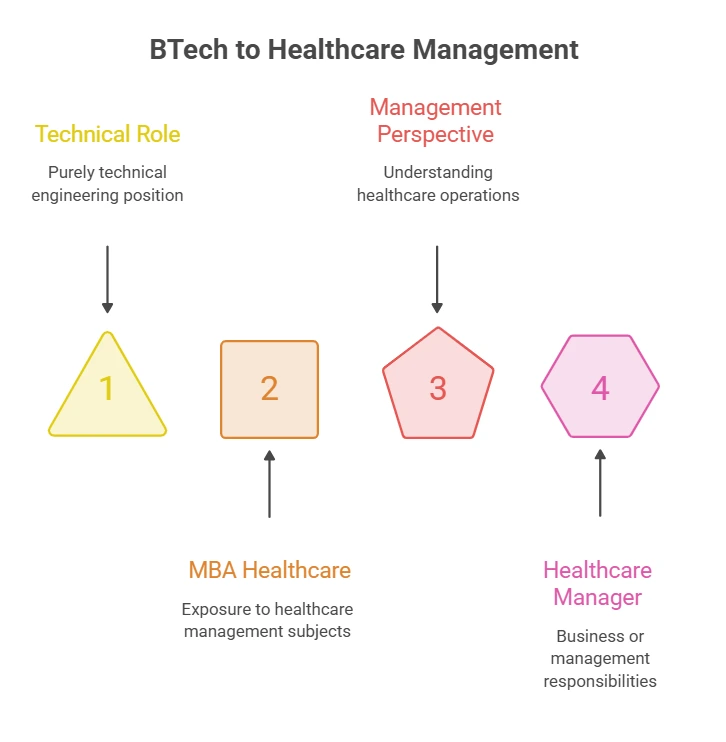
An MBA healthcare after BTech can make sense for graduates who want to move away from purely technical roles and toward business or management responsibilities.
The decision becomes more relevant when a student is interested in healthcare but does not necessarily want a clinical career.
An MBA can provide exposure to subjects such as:
Healthcare management
Healthcare operations
Financial management
Marketing management
Human resource management
Business analytics
Strategic management
Organisational behaviour
Healthcare quality
Digital healthcare
Leadership
This combination can help an engineer understand how healthcare organisations operate from a management perspective.
Who Should Consider an MBA in Healthcare After BTech?
The pathway may suit engineering graduates who:
Have a genuine interest in healthcare
Enjoy solving business problems
Want management responsibilities
Are interested in healthcare technology
Like working with data
Want to move into consulting or operations
Are interested in healthcare entrepreneurship
Prefer business roles over purely technical roles
On the other hand, students who strongly prefer coding, core engineering, or technical research may want to compare this pathway with other career options.
The right choice depends on career goals rather than the engineering degree alone.
Healthcare Careers for Engineers
Engineering graduates can explore several healthcare-related career directions after developing relevant management skills.
1. Healthcare Operations
Healthcare operations focuses on how services are delivered efficiently.
Professionals may work on:
Process improvement
Capacity planning
Resource allocation
Workflow management
Service quality
Performance monitoring
An engineering background can be useful because operations often require structured problem-solving.
For example, an engineer may apply process-mapping techniques to identify bottlenecks in a healthcare workflow.
2. Healthcare Analytics
Data is increasingly important for healthcare decision-making.
Healthcare analytics roles can involve:
Data interpretation
Business dashboards
Performance analysis
Demand analysis
Revenue analysis
Operational metrics
Engineers with strong quantitative skills can build on their existing capabilities through management and analytics training.
Knowledge of tools such as Excel, SQL, Power BI, statistics, and data visualisation can also strengthen a candidate's profile.
3. Health-Tech Management
Health-tech is another area where engineering and management skills can intersect.
Professionals may work around:
Digital healthcare platforms
Healthcare software
Telehealth solutions
Data systems
Digital patient services
Technology implementation
The role may require understanding both technology and business requirements.
Therefore, engineers can potentially bring useful technical context while developing management capabilities.
What Should Engineers Look for in an MBA Healthcare Program?
Not every healthcare management program will provide the same learning experience.
Therefore, evaluate the program carefully.
Curriculum
Check whether it covers both management fundamentals and healthcare-specific subjects.
Practical Learning
Look for case studies, projects, simulations, presentations, and industry-oriented assignments.
Faculty
Review faculty experience and academic expertise.
Industry Exposure
Corporate interactions and practitioner-led sessions can help students understand real-world challenges.
Analytics
Healthcare is becoming increasingly data-driven. Therefore, exposure to analytics can add value.
Career Support
Review the career services, placement support, industry connections, and career development opportunities offered by the institution.
Program Fit
Consider whether the course is suitable for your career stage, learning style, schedule, and long-term goals.
How Asia Pacific Institute of Management Can Support Your Management Journey
Asia Pacific Institute of Management focuses on industry-oriented management education, practical learning, experienced faculty, corporate exposure, and career development.
For engineering graduates exploring healthcare-related management careers, management education can help develop capabilities beyond their technical degree.
The combination of structured management learning, practical exposure, business knowledge, and leadership development can help students prepare for management-oriented career paths.
However, students should evaluate the latest program curriculum, eligibility requirements, admission process, fees, and career support before making an admission decision.
Is Healthcare Management After Engineering a Good Career Path?
There is no single career path that works for every engineering graduate.
Healthcare management after engineering can be relevant for students who are interested in healthcare, business, technology, analytics, operations, and leadership.
The pathway becomes particularly interesting when an engineer wants to apply technical and analytical skills to organisational problems.
However, the transition requires deliberate skill-building.
An engineering degree provides a foundation. Management education adds business knowledge. Healthcare exposure provides industry context.
Together, these capabilities can create a broader professional profile.
Engineering and healthcare may appear to be very different fields. However, modern healthcare increasingly depends on technology, analytics, operations, process improvement, and strategic management.
That makes healthcare management after engineering a potential pathway for graduates who want to combine technical skills with business and leadership capabilities.
An MBA in healthcare can help engineering graduates understand healthcare operations, finance, strategy, marketing, analytics, people management, and organisational leadership.
The key is to approach the transition strategically.
Understand the healthcare industry. Build management skills. Gain practical exposure. Develop communication and leadership capabilities. Most importantly, choose a program that aligns with your career goals.
For engineering graduates considering this transition, an industry-oriented management education can provide a structured foundation for exploring healthcare management careers.
Build Your Healthcare Edge
Develop management, strategy, finance, and healthcare expertise to complement your analytical foundation and explore diverse career pathways.
Dr. Vikas Gupta is a distinguished academic in the education and research domain, specializing in finance and related interdisciplinary studies. He is known for his...
01.
Can I pursue an MBA in healthcare after BTech?
Yes, engineering graduates can generally apply for management programs if they meet the institution’s eligibility requirements. A BTech background can be relevant for healthcare management, particularly in operations, analytics, technology, and project management.
02.
Is healthcare management suitable for engineering graduates?
It can be suitable for engineers interested in healthcare, business, operations, technology, analytics, and leadership. However, students should evaluate their career interests before choosing the field.
03.
What are the best healthcare careers for engineers?
Potential career directions include healthcare operations, healthcare analytics, health-tech management, consulting, medical technology management, business development, strategy, and project management.
04.
Can engineers work in hospital management?
Yes. Engineers can explore administrative and operational roles in hospitals after gaining relevant management knowledge. Their process, analytical, and technology skills can be useful in areas such as operations and facility management.
05.
Is an MBA healthcare for engineering graduates different from a regular MBA?
A healthcare-focused MBA combines general management subjects with healthcare-specific areas. These may include healthcare operations, administration, quality, healthcare finance, digital healthcare, and healthcare strategy.
06.
Do I need a medical background for healthcare management?
A medical degree is not universally required for healthcare management education or non-clinical management roles. However, program and employer requirements vary, so candidates should verify specific eligibility criteria.
07.
What skills should an engineer develop before entering healthcare management?
Engineers should develop healthcare industry knowledge, communication, financial understanding, leadership, business strategy, stakeholder management, and healthcare-specific operational knowledge.
08.
Can engineering graduates work in health-tech?
Yes. Health-tech can be a natural intersection between technology and healthcare. Engineering graduates can explore areas such as product management, implementation, analytics, project management, technology operations, and business development after building relevant healthcare and management knowledge.
















.webp) Call Us
Call Us