Salary is often one of the first questions students and parents ask before choosing a management specialization.
What is the starting salary after an MBA in healthcare management? Do hospitals pay more than pharmaceutical companies? Is healthcare consulting better paid? What about insurance and health-tech?
The answer depends on the role and sector.
In 2026, the MBA healthcare salary in India varies significantly across hospitals, pharmaceutical companies, health insurance, consulting, healthcare technology, and related services. Skills, prior experience, institute profile, city, job function, and employer also influence the final package.
Current published estimates generally place entry-level healthcare management opportunities in a broad ₹4–8 LPA range, although individual offers can fall below or above it.
Therefore, students should evaluate healthcare placements sector by sector rather than depending on one average salary figure.
This guide explains realistic entry-level salary trends, important job profiles, and the skills that can influence earning potential in 2026.
Boost Your Healthcare Career
Build practical management, analytics, finance, and communication skills to compete for rewarding opportunities across diverse healthcare sectors in India.
What Is the MBA Healthcare Salary in India in 2026?
MBA healthcare salary in India for entry-level candidates commonly falls around ₹4–8 LPA in 2026 based on published market estimates. However, actual packages vary considerably by employer, role, city, institute, prior experience, and skills. Consulting, health-tech, analytics, and specialized commercial roles may offer higher packages than general hospital administration.
Recent 2026 salary guides provide similar broad estimates.
For example, an August 2026 salary analysis from upGrad places starting salaries for MBA healthcare management graduates at approximately ₹4–8 LPA. Other 2026 education-sector salary reports place freshers around ₹5–7 LPA.
However, these figures are market estimates rather than a standardized national salary scale.
Actual job-level data can be lower. Indeed, for example, reported an average base salary of approximately ₹2.89 lakh per year for the broad "hospital administrator" title in India as of February 2026.
This difference highlights an important point:
Degree-level salary estimates and job-title salary averages measure different candidate populations.
An MBA graduate entering a management trainee, analyst, consulting, or corporate healthcare role may have a very different package from someone entering a general hospital administrator position.
Students can work across hospitals, pharmaceutical businesses, insurance companies, consulting, health-tech, diagnostics, and other healthcare services.
Indicative entry-level market ranges can be understood as follows:
Healthcare Sector
Indicative Entry-Level Range
Common Roles
Hospitals & Healthcare Operations
₹3–6 LPA
Admin, Operations, Quality
Pharmaceutical Sector
₹4–8 LPA
Sales, Projects, Marketing, Operations
Health Insurance
₹3–7 LPA
Claims, Provider Network, Operations
Healthcare Consulting
₹5–10 LPA
Analyst, Associate, Junior Consultant
Health-Tech
₹4–9 LPA
Operations, Growth, Product Support
Healthcare Analytics
₹4.5–9 LPA
Analyst, Business Analyst
Diagnostics & Healthcare Services
₹3.5–7 LPA
Operations, BD, Centre Management
Important: These are broad planning ranges synthesized from 2026 salary guides and role-level market information. They are not guaranteed packages or an Asia Pacific Institute of Management placement report.
Let us examine each sector more closely.
Hospital Admin Freshers Package: What Can Graduates Expect?
Hospitals are the most obvious employment destination for healthcare management graduates.
However, hospital management covers many different functions.
Published 2026 estimates commonly place entry-level hospital administration and related roles around ₹3–6 LPA, although some management trainee or specialized corporate-hospital roles can offer more.
Indeed's India salary data reported an average hospital administrator base salary of approximately ₹2.89 lakh per year in February 2026. Meanwhile, other 2026 salary guides put fresher MBA hospital-administration opportunities closer to ₹3–8 LPA.
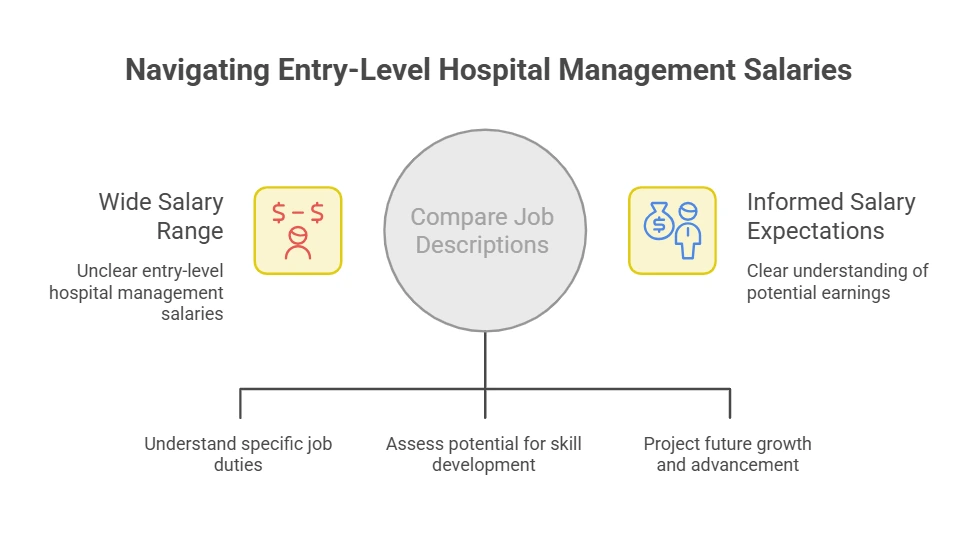
Why is the range so wide?
Because "hospital administration" covers very different employers and responsibilities.
A small healthcare facility and a large multi-specialty hospital may have different compensation structures. Similarly, an operations analyst may receive a different package from an administrative coordinator.
Therefore, students should compare the actual job description, responsibilities, learning opportunity, and career path.
What Is Tier 1 Hospital Placement?
Students frequently search for tier 1 hospital placement while evaluating healthcare management programs.
However, "Tier 1 hospital" is not a standardized salary classification.
The term is generally used informally to describe large, established, multi-specialty or corporate healthcare organisations.
Students targeting larger hospital organisations should prepare for competitive recruitment processes.
Recruiters may evaluate:
Communication: Hospital management requires interaction with patients, doctors, nurses, vendors, and senior management.
Operational thinking: Candidates should understand patient flow, capacity, quality, and service delivery.
Analytics: Hospitals increasingly rely on dashboards and operational data.
Problem-solving: Managers frequently deal with service bottlenecks and unexpected situations.
Healthcare knowledge: Understanding basic hospital functions can differentiate candidates.
Internship experience: Practical exposure can demonstrate that a student understands healthcare beyond classroom concepts.
Most importantly, placement with a large hospital brand does not automatically guarantee a specific salary.
The role and responsibilities matter.
Pharma vs Hospital Salary: Which Sector Pays More?
Pharmaceutical companies can offer roles across sales, marketing, product management, supply chain, market research, commercial operations, and project coordination.
Hospitals, meanwhile, offer roles across operations, administration, quality, business development, supply chain, patient experience, and analytics.
At entry level, pharmaceutical management roles can broadly fall around ₹4–8 LPA, depending on the function and employer.
Hospital roles may broadly begin around ₹3–6 LPA, although specialized roles can exceed this range.
Therefore, pharmaceutical opportunities can sometimes have a higher starting ceiling.
However, salary should not be the only consideration.
Choose Hospital Management If You Prefer:
Healthcare operations
Patient experience
Hospital systems
Quality management
Facility operations
Service delivery
Hospital strategy
Consider Pharma-Focused Roles If You Prefer:
Product and brand management
Sales and marketing
Supply chain
Commercial strategy
Market research
Business development
The better career depends on the student's strengths.
A ₹6 LPA role aligned with your long-term interests may offer greater career value than a ₹7 LPA role in a function you do not want to pursue.
Health Insurance Manager Salary: What Is the Entry-Level Potential?
Health insurance has become another important employment area for healthcare management graduates.
The sector connects healthcare delivery with risk assessment, claims, hospital networks, customer service, fraud control, and financial management.
Entry-level candidates may work as:
Claims Executive
Provider Network Executive
Operations Analyst
Healthcare Analyst
Underwriting Support Executive
Relationship Executive
Management Trainee
For freshers, relevant insurance roles may broadly offer around ₹3–7 LPA, depending on job function and employer.
However, students searching for health insurance manager salary should understand that a manager is generally not an entry-level designation.
One 2026 salary guide places broader Health Insurance Manager compensation around ₹5–19 LPA, with an estimated average around ₹9–10 LPA. These figures include professionals beyond the fresher level.
Therefore, students should not confuse a manager-level salary with an entry-level placement package.
Skills That Can Help in Health Insurance
Insurance employers may value:
Healthcare knowledge
Claims understanding
Excel
Data analysis
Financial awareness
Communication
Process management
Fraud and risk awareness
Knowledge of healthcare operations can be particularly useful when working with hospital networks and claims.
Big 4 Healthcare Consulting Pay: Is Consulting the Highest-Paying Option?
Healthcare consulting attracts considerable interest among MBA students.
Consultants may work on projects involving hospital strategy, operational improvement, digital transformation, healthcare analytics, life sciences, insurance, and market research.
However, students should interpret them carefully.
Analyst and associate-level consulting roles in India can broadly fall around ₹5–10 LPA, while associate consultant positions may reach approximately ₹7–12 LPA depending on the firm, function, location, campus, and candidate.
General consultant-level compensation can be substantially higher, but those positions may require prior experience and should not automatically be treated as fresher packages.
For example, reported India salary data for consultant-level positions at major professional-services firms can reach roughly ₹11 lakh or more annually on average. However, those figures include professionals at different experience levels and are not healthcare-MBA fresher averages.
Why Can Consulting Pay More?
Consulting requires a demanding combination of skills.
Candidates may need:
Structured problem-solving
Advanced Excel
PowerPoint
Data interpretation
Financial analysis
Research
Presentation skills
Business communication
Case-solving ability
Industry knowledge
Therefore, healthcare knowledge alone may not be sufficient.
Students targeting consulting should develop strong general management and analytical capabilities.
Healthcare Analytics and Health-Tech Salaries
Healthcare is becoming increasingly digital.
Hospitals, insurance companies, pharmaceutical organisations, and technology businesses generate significant amounts of data.
Consequently, healthcare graduates with analytical and digital skills may access a wider set of opportunities.
Entry-level health-tech and healthcare analytics roles can broadly fall between ₹4–9 LPA, depending on technical requirements and employer.
Roles may include:
Healthcare Analyst
Business Analyst
Operations Analyst
Implementation Associate
Product Operations Associate
Growth Associate
Healthcare Data Analyst
Candidates who understand both healthcare and data may have an advantage.
Useful skills can include:
Advanced Excel
Power BI
SQL fundamentals
Dashboard creation
Business analytics
Data visualisation
Healthcare KPIs
Therefore, students should not treat healthcare management as a purely administrative specialization.
Digital capabilities can materially broaden the available career paths.
Prepare For Better Placements
Strengthen your business and analytical capabilities to pursue competitive roles across hospitals, consulting, insurance, pharmaceuticals, and healthcare technology.
Two graduates from the same healthcare management program can receive different salaries.
Several factors explain this.
1. Job Function
A hospital administration role and a consulting analyst role require different capabilities.
Therefore, salaries differ.
2. Employer Type
A small hospital, large healthcare organisation, pharmaceutical business, consulting firm, and health-tech company may follow different compensation structures.
3. Location
Employment markets in Delhi NCR, Mumbai, Bengaluru, Hyderabad, Chennai, and other cities can have different salary levels and living costs.
4. Previous Experience
A candidate with relevant work experience may compete for different roles than a fresher.
Therefore, students should compare like-for-like salary data.
5. Internship Quality
A meaningful internship can strengthen a candidate's profile.
Students should aim to work on measurable projects rather than simply obtain an internship certificate.
6. Analytical Skills
Excel, Power BI, SQL, financial modelling, and business analytics can differentiate candidates for certain roles.
7. Communication
Managers must explain ideas clearly.
Strong presentations, interviews, business writing, and stakeholder communication can therefore influence employability.
8. Institute and Placement Ecosystem
Employer relationships, corporate exposure, curriculum, internships, placement preparation, and alumni networks can influence access to opportunities.
However, students should distinguish between access to opportunities and guaranteed outcomes.
Individual placement results always depend on multiple factors.
Entry-Level vs Manager Salary: Avoid This Common Mistake
One of the biggest mistakes students make during salary research is comparing salaries from different experience levels.
Consider this example.
A search for "health insurance manager salary" may show ₹9–10 LPA.
A search for "hospital operations manager" may show ₹8–12 LPA.
Meanwhile, a consultant role may show ₹10–18 LPA.
Does this mean a fresher should expect those packages?
Not necessarily.
The title manager usually indicates professional experience or greater responsibility.
Similarly, salary portals often combine employees with different levels of experience when calculating averages.
Students should therefore ask four questions whenever they see a salary figure:
Is this salary for a fresher?
How much experience does the role require?
Is the figure base salary or total CTC?
How large is the salary data sample?
This approach produces much more realistic expectations.
Which Healthcare Sector Has the Best Salary for Freshers?
There is no universal winner.
However, consulting, analytics, health-tech, and specialized commercial roles can offer higher entry-level ceilings than traditional administration positions.
A simplified comparison looks like this:
Hospital Operations: Strong for learning healthcare delivery and administration.
Pharma: Attractive for students interested in commercial, marketing, and supply-chain functions.
Health Insurance: Suitable for students interested in claims, operations, analytics, and financial aspects of healthcare.
Consulting: Potentially attractive compensation, but recruitment can be highly competitive.
Health-Tech: Suitable for students who combine healthcare understanding with digital and analytical skills.
Therefore, students should select a sector based on salary + role fit + learning + career progression.
How Can Students Improve Their Healthcare Placement Package?
Students cannot control the entire job market.
However, they can improve their employability.
Build Advanced Excel Skills
Healthcare organisations use data extensively.
Students should be comfortable with formulas, pivot tables, charts, and data analysis.
Learn Business Analytics
Power BI, dashboards, and basic SQL can help candidates target analytical roles.
Understand Healthcare KPIs
Learn metrics related to hospital occupancy, average length of stay, turnaround time, claims, revenue cycles, patient experience, and operational performance.
Gain Meaningful Internship Experience
Work on actual business problems.
For example, analyse patient waiting times, study operational bottlenecks, develop dashboards, or evaluate service processes.
Develop Consulting Skills
Students interested in consulting should practise case interviews, structured thinking, research, PowerPoint, and business presentations.
Understand Healthcare Finance
Knowledge of costs, revenue, insurance, billing, and profitability can strengthen management decision-making.
Improve Communication
Healthcare managers coordinate with diverse stakeholders.
Therefore, professional communication remains a valuable placement skill.
What Should Students Check in a Healthcare Placement Report?
Students and parents should avoid making admission decisions based only on the highest package displayed on a website.
A useful placement evaluation should consider:
Average package
Median package, when available
Highest package
Role offered
Sector
Recruiter profile
Internship opportunities
Number of participating students
Placement eligibility criteria
Location of roles
Median salary can be particularly informative because one unusually high package can distort perceptions of a batch's overall outcome.
Students should also verify whether reported packages apply to the complete management batch or specifically to healthcare-focused students.
Transparency matters.
Is Healthcare Management Worth It in 2026?
Healthcare management can offer a diverse career path for students interested in combining business with healthcare.
The field is no longer restricted to hospital administration.
Graduates can explore hospitals, pharmaceutical businesses, health insurance, consulting, analytics, health-tech, diagnostics, healthcare KPOs, and other services.
Published 2026 market estimates commonly place MBA healthcare salary in India for freshers around the ₹4–8 LPA range.
However, the strongest career outcomes depend on more than a degree.
Students need relevant internships, analytical ability, communication, industry knowledge, and practical management skills.
Long-term career growth should therefore matter as much as the first package.
How Management Education Can Prepare Students for Healthcare Careers
Healthcare organisations need professionals who understand both business and service delivery.
Management education can build foundations across operations, marketing, finance, analytics, strategy, technology, and leadership.
At Asia Pacific Institute of Management, the emphasis on industry-oriented education, practical learning, experienced faculty, corporate exposure, and placement support can help students develop these transferable capabilities.
Students interested in healthcare should also use projects and internships to understand real industry challenges.
Moreover, developing analytics and technology skills can broaden opportunities beyond traditional hospital administration.
When evaluating a management program, students should examine curriculum, practical exposure, recruiter engagement, placement support, and alignment with their career goals.
The MBA healthcare salary in India cannot be represented accurately by one number.
In 2026, published market estimates generally place fresh graduate packages around ₹4–8 LPA, while actual compensation varies considerably across sectors.
A hospital admin freshers package may differ from a pharmaceutical role. Similarly, health insurance manager salary data should not be confused with fresher compensation.
Healthcare consulting and analytics can offer attractive opportunities, but they also demand stronger analytical and problem-solving capabilities.
Therefore, students should not choose a healthcare career based solely on the highest salary displayed online.
Compare the role, learning opportunity, employer, sector, skills required, and long-term growth.
Students seeking to build these management capabilities can explore the industry-oriented learning environment at Asia Pacific Institute of Management, including practical learning, corporate exposure, experienced faculty, and placement support.
Ultimately, the strongest placement strategy is to become valuable across multiple healthcare functions rather than depending on a single job title or salary expectation.
Build Skills That Pay
Gain industry focused management expertise to unlock career opportunities in healthcare operations, analytics, consulting, technology, insurance, and pharmaceutical businesses.
Dr. Vikas Gupta is a distinguished academic in the education and research domain, specializing in finance and related interdisciplinary studies. He is known for his...
01.
What is the MBA healthcare salary in India for freshers in 2026?
Published 2026 market estimates commonly place entry-level MBA healthcare management salaries around ₹4–8 LPA. However, actual salaries vary according to role, employer, location, skills, institute, and previous experience.
02.
What is the hospital admin freshers package in India?
Entry-level hospital administration and related operations roles may broadly fall around ₹3–6 LPA. Individual offers can be lower or higher depending on the employer and responsibilities.
03.
Which pays more: pharma or hospital management?
Pharma roles can sometimes offer a higher entry-level ceiling, particularly in commercial or specialized functions. However, salaries vary significantly. Students should compare specific roles rather than sectors alone.
04.
What is the health insurance manager salary in India?
Manager-level health insurance salaries can be substantially higher than fresher salaries. One 2026 market estimate places broader manager compensation around ₹5–19 LPA. Entry-level insurance roles may be closer to ₹3–7 LPA depending on function and employer.
05.
What is Big 4 healthcare consulting pay for freshers?
Analyst and associate-level consulting opportunities may broadly fall around ₹5–10 LPA, while some associate consultant roles can be higher. Actual packages vary by firm, campus, role, city, and candidate profile.
06.
Does a Tier 1 hospital guarantee a high placement package?
No. A large hospital brand does not guarantee a specific package. Salary depends on the role, location, candidate profile, employer compensation structure, and recruitment process.
07.
Which healthcare management sector offers the best salary?
Consulting, analytics, health-tech, and specialized commercial functions can have attractive salary ceilings. However, the best sector depends on a student’s skills, interests, and long-term career goals.
08.
How can I get a higher package after an MBA in healthcare management?
Build skills in Excel, analytics, Power BI, communication, healthcare finance, operations, and problem-solving. Strong internships and practical projects can also strengthen your profile.


















.webp) Call Us
Call Us