Healthcare Marketing Strategy: How Top Hospitals Attract Global Patients
Posted on 03 Sep 2026
By Dr. Vikas Gupta
Introduction
A patient searching for treatment abroad rarely chooses a hospital after seeing one advertisement. The decision involves trust, medical expertise, treatment information, cost clarity, patient experience, and ongoing communication.
For hospitals seeking international patients, marketing must connect clinical credibility with digital visibility and patient support. Search engines, doctor profiles, educational content, reputation management, transparent treatment information, and international patient services all influence the journey.
This has also created new career opportunities for management professionals. Healthcare organisations increasingly need people who understand marketing, analytics, branding, patient experience, digital channels, and business development.
So, how do successful hospitals build global visibility and convert international enquiries into patients? Let us understand the strategy.
Lead Healthcare Marketing Growth
Build marketing, analytics, branding, and business skills to create trusted patient journeys and pursue growing healthcare management opportunities.
A healthcare marketing strategy is a structured plan used by hospitals, doctors, clinics, and healthcare organisations to build awareness, establish trust, educate patients, generate qualified enquiries, and strengthen patient relationships through digital and offline channels while maintaining ethical and accurate communication.
Unlike marketing many consumer products, healthcare marketing deals with highly sensitive decisions.
Patients are not simply comparing features. They may be dealing with serious medical conditions, financial concerns, travel arrangements, and uncertainty.
Therefore, trust must remain at the centre of healthcare communication.
Why Is Healthcare Marketing Different?
Healthcare is a high-trust industry.
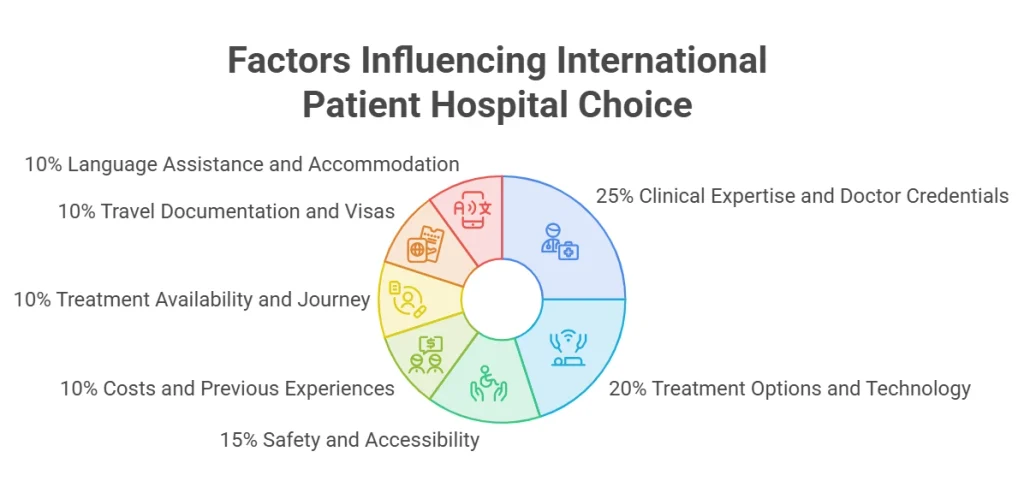
A patient choosing a hospital may evaluate clinical expertise, doctor credentials, treatment options, technology, safety, accessibility, costs, and previous patient experiences.
For an international patient, the decision becomes even more complex.
The patient may also need information about:
Treatment availability
Expected treatment journey
Estimated costs
Travel documentation
Medical visas
Language assistance
Accommodation
Airport transfers
Remote consultations
Follow-up care
Therefore, successful healthcare marketing connects promotion with genuine patient support.
Research also reinforces the importance of digital reputation. Systematic reviews have found that online patient reviews increasingly influence healthcare-provider selection and often correlate with measures of patient experience.
Consequently, hospitals cannot separate marketing from the actual patient experience.
Healthcare Marketing Strategy for Attracting Global Patients
A successful healthcare marketing strategy usually combines several interconnected activities.
Hospitals need visibility to be discovered. However, visibility alone is not enough.
They also need credibility to build trust and effective systems to convert patient enquiries into meaningful interactions.
A global patient acquisition framework can therefore be understood through six stages:
Why should a patient trust this healthcare organisation?
A hospital's brand is not limited to its logo, colours, or advertising campaign.
Instead, the brand represents what patients associate with the organisation.
This can include clinical expertise, patient experience, transparency, communication, infrastructure, technology, and service quality.
For global patients, hospitals should communicate their strengths clearly.
Useful brand elements may include:
Areas of medical expertise
Doctor qualifications and experience
Clinical infrastructure
Relevant accreditations and certifications
Patient-support services
International patient facilities
Treatment information
Ethical patient stories and testimonials
Transparent communication
However, hospitals should avoid exaggerated claims.
Statements such as guaranteed outcomes or unsupported superiority claims can damage credibility. Moreover, healthcare decisions require responsible communication.
Strong hospital brands therefore focus on evidence, expertise, transparency, and patient experience.
2. Build a Patient-Friendly Healthcare Website
For many international patients, the hospital website becomes the digital front door.
Therefore, the website must answer important questions quickly.
A global patient should be able to understand available specialties, doctor expertise, treatment options, international patient services, contact methods, and the enquiry process.
The website should also work effectively on mobile devices.
Additionally, international audiences may benefit from multilingual information where appropriate.
Important website features can include:
Clear specialty pages
Detailed doctor profiles
Treatment information
International patient section
Enquiry forms
Appointment options
Cost-estimate requests
Patient-support information
Location and travel guidance
Frequently asked questions
Secure communication channels
Trust also matters online. Research on digital healthcare shows that privacy concerns can negatively affect consumer trust.
Therefore, hospitals must take data privacy and secure patient communication seriously.
3. Use SEO to Reach Patients Searching for Treatment
Search Engine Optimisation, or SEO, can play a major role in healthcare discovery.
Patients often search for information before contacting a provider.
For example, they may search for treatment procedures, symptoms, specialists, recovery information, treatment costs, or medical travel guidance.
A hospital can create useful content around genuine patient questions.
The objective should not be to repeat keywords excessively.
Instead, healthcare SEO should provide accurate and understandable information that helps patients make informed decisions.
Specialty pages: Provide information about departments and services.
Doctor pages: Present qualifications, specialties, experience, and consultation information accurately.
Patient education: Answer common healthcare questions.
International patient pages: Explain the treatment and travel journey for overseas patients.
FAQ content: Address practical questions about appointments, documentation, payments, and follow-up.
Useful content builds organic visibility while strengthening trust.
4. Digital Marketing for Doctors: Building Professional Visibility
Doctors are an important part of a hospital's credibility.
Therefore, digital marketing for doctors should focus on professional expertise and patient education rather than aggressive promotion.
Useful content formats can include:
Educational articles
Doctor interviews
Treatment explainers
Health awareness videos
Webinars
Frequently asked questions
Preventive healthcare content
For example, a specialist can explain how a procedure works and what patients should discuss during consultation.
This approach demonstrates expertise while helping patients understand complex healthcare topics.
Doctor profiles should also remain accurate and current.
Information such as qualifications, specialization, clinical interests, and consultation availability can help patients make better decisions.
However, all communications should respect applicable professional, advertising, privacy, and patient-consent requirements.
Build Global Healthcare Brands
Develop digital marketing, patient experience, communication, and strategic management capabilities for careers connecting hospitals with patients across global markets.
The final cost can depend on the patient's condition, diagnostic requirements, procedure complexity, hospital stay, medical supplies, doctor recommendations, and complications.
Hospitals should therefore avoid presenting estimates as guaranteed final prices unless appropriate.
Instead, they can clearly explain what an indicative package includes and excludes.
For example, pricing communication can distinguish between:
Consultation
Diagnostics
Procedure charges
Hospital room
Medical supplies
Professional fees
Medicines
Follow-up services
Patients should also know that additional medical requirements can change the final cost.
Transparency can prevent misunderstandings and support informed decision-making.
7. International Patient Acquisition Requires More Than Advertising
Digital advertising can create awareness. However, successful acquisition requires a much broader system.
Hospitals need to understand the needs of patients from different regions.
Language, cultural expectations, treatment demand, travel accessibility, payment preferences, and communication behaviour can vary significantly.
Therefore, international marketing strategies should be market-specific rather than generic.
Hospitals can use:
Search marketing
Organic SEO
Educational content
Social media
International patient portals
Online consultations
Referral relationships
Patient-support teams
Reputation management
However, every enquiry should enter a structured patient-management process.
Without effective follow-up, marketing investment can generate leads without producing meaningful outcomes.
8. Healthcare Lead Generation: From Clicks to Qualified Enquiries
Healthcare lead generation means attracting potential patients who have expressed an interest in healthcare services.
A lead could originate from a website form, phone call, online consultation request, digital campaign, or other permitted channel.
However, not every lead is equally valuable.
A hospital should therefore focus on qualified enquiries rather than only lead volume.
For example, an international patient enquiry may need information about the medical condition, required specialty, previous medical records, preferred travel period, and communication details.
The process can then follow a structured journey:
Lead received → Initial response → Medical information collected → Clinical review → Treatment guidance → Cost estimate → Patient support → Appointment/admission
Speed also matters.
A patient making an international healthcare enquiry may contact several providers. Therefore, slow responses can reduce conversion opportunities.
9. Use CRM Systems for Better Patient Communication
Managing hundreds or thousands of enquiries manually can become difficult.
A Customer Relationship Management system can help organise the process.
Healthcare teams can use appropriate systems to track enquiries, communication, appointments, follow-ups, and lead sources.
This gives managers greater visibility into the patient journey.
For example, teams can identify:
Where enquiries originate
Which campaigns generate qualified leads
Response times
Appointment conversions
Common patient questions
Follow-up requirements
Reasons leads do not progress
Consequently, marketing decisions become more data-driven.
However, healthcare organisations must maintain appropriate safeguards for patient and personal data.
10. Reputation Management Can Influence Patient Decisions
A hospital can run excellent advertising campaigns. However, poor patient experiences can weaken the brand.
Online reviews have become an important source of information in healthcare decision-making.
Research examining patient reviews has found associations between online ratings and aspects of patient experience.
Therefore, reputation management should not mean simply trying to collect positive reviews.
Instead, hospitals should learn from feedback.
Common concerns may involve:
Communication
Waiting times
Billing
Appointment processes
Staff behaviour
Accessibility
Follow-up
Marketing teams can share recurring feedback with hospital operations.
Consequently, reputation management can contribute to service improvement rather than functioning only as a promotional activity.
11. Make the International Patient Journey Easier
International patients face challenges that domestic patients may not encounter.
Hospitals targeting overseas patients should therefore consider the entire journey.
Support may begin before the patient travels.
International patient teams can assist with medical documentation, appointments, estimated treatment plans, and relevant hospital letters.
India's official e-Visa system includes e-Medical and e-Medical Attendant visa categories. The government portal also specifies documentation requirements for medical travellers, including relevant hospital documentation.
Therefore, hospitals targeting international patients should ensure their teams understand current official processes.
After arrival, support may extend to coordination, interpretation, accommodation guidance, and follow-up communication.
A smoother journey can strengthen the overall patient experience.
12. Measure Healthcare Marketing Performance
Marketing cannot improve without measurement.
However, hospitals should look beyond impressions, followers, and website traffic.
Business and patient-journey metrics can provide deeper insights.
Important indicators may include:
Metric
What It Measures
Website conversion rate
Visitors who complete a desired action
Qualified leads
Relevant patient enquiries
Cost per lead
Marketing cost to generate an enquiry
Response time
Speed of initial patient communication
Consultation conversion
Leads progressing to consultations
Patient acquisition cost
Cost associated with acquiring patients
Lead source
Channel generating an enquiry
Organic traffic
Visitors arriving through search
Engagement
Interaction with useful content
Patient feedback
Experience and reputation indicators
Managers should connect these metrics with business objectives.
For example, a campaign generating 5,000 low-quality enquiries may perform worse than one producing 500 highly relevant enquiries.
Skills Required for a Career in Healthcare Marketing
The expansion of healthcare services creates opportunities for management professionals interested in marketing and business development.
Relevant career areas can include healthcare marketing, digital marketing, brand management, international patient services, business development, CRM, analytics, and patient experience.
Students interested in these careers should develop a combination of skills.
These include digital marketing, consumer behaviour, analytics, communication, branding, CRM, content strategy, and business development.
Moreover, healthcare marketers need ethical judgment.
They must understand that patients are not ordinary consumers. Healthcare communication can influence significant personal decisions.
Therefore, accuracy, empathy, privacy, and responsible marketing are essential.
How Management Education Can Prepare Students for Healthcare Marketing
Healthcare marketing sits at the intersection of marketing, technology, analytics, operations, and customer experience.
Therefore, management education can provide a useful foundation.
Marketing teaches students about segmentation, positioning, branding, and consumer behaviour.
Analytics helps them evaluate campaign performance. Additionally, technology skills can support digital marketing and CRM operations.
Operations knowledge can help students understand the complete patient journey.
At Asia Pacific Institute of Management, an industry-oriented curriculum, practical learning approach, experienced faculty, corporate exposure, and placement support can help students develop transferable management capabilities.
Students interested in healthcare marketing can use these capabilities across digital marketing, business development, brand management, analytics, and service-sector management roles.
The objective should be to build adaptable management skills rather than prepare for only one job title.
The future of healthcare marketing strategy will become increasingly personalised, data-driven, and technology-enabled.
Artificial intelligence can assist with content workflows, analytics, lead prioritisation, and communication support.
Marketing automation can help teams manage follow-ups at scale.
Moreover, analytics can help hospitals understand patient journeys across different digital touchpoints.
However, technology cannot replace trust.
Patients still need credible medical information, responsible communication, transparency, and human support.
Therefore, successful healthcare marketers will need to balance automation with empathy.
They will also need to balance performance marketing with ethical communication.
Conclusion
Attracting global patients requires far more than advertising.
A successful healthcare marketing strategy combines brand credibility, digital visibility, useful content, transparent communication, patient support, analytics, and an excellent service experience.
Strong hospital brand building establishes trust. Meanwhile, responsible digital marketing for doctors can showcase expertise and educate patients.
Transparent medical package pricing can support informed decisions. Additionally, structured healthcare lead generation and CRM processes can make international patient acquisition more efficient.
For management students, this transformation also creates an interesting career landscape.
Future healthcare marketers will need to understand not only marketing but also technology, analytics, operations, consumer behaviour, and ethical communication.
Students seeking to develop these broader management capabilities can explore the industry-oriented management programs at Asia Pacific Institute of Management. Practical learning, corporate exposure, experienced faculty, and placement support can help students prepare for evolving opportunities across healthcare and other service industries.
Shape Patient Growth Strategies
Master branding, digital channels, analytics, and patient engagement to prepare for dynamic marketing and business roles across healthcare organizations.
Dr. Vikas Gupta is a distinguished academic in the education and research domain, specializing in finance and related interdisciplinary studies. He is known for his...
A healthcare marketing strategy is a structured approach for building awareness, educating patients, generating qualified enquiries, strengthening reputation, and supporting patient relationships. It can combine SEO, content, digital advertising, branding, CRM, analytics, and patient-experience initiatives.
02.
How do hospitals attract international patients?
Hospitals can attract international patients through strong digital visibility, credible treatment information, doctor profiles, transparent communication, international patient support, reputation management, and effective enquiry follow-up.
03.
Why is hospital brand building important?
Hospital brand building creates recognition and trust. Patients may evaluate expertise, reputation, infrastructure, communication, and experience before choosing a provider. Therefore, a credible brand can influence consideration.
04.
What is healthcare lead generation?
Healthcare lead generation involves attracting potential patients who express interest in a medical service. Leads can originate from search engines, websites, digital campaigns, referrals, calls, or online consultation requests.
05.
How does digital marketing for doctors work?
Digital marketing for doctors can use educational content, professional profiles, SEO, videos, webinars, and other appropriate digital channels. It should focus on credible information and professional expertise rather than exaggerated promotional claims.
06.
Why is medical package pricing important for international patients?
International patients often need estimated costs to plan treatment and travel. Transparent pricing communication can help them understand expected expenses. However, estimates should clearly explain variables, inclusions, exclusions, and possible additional costs.
07.
What skills are required for healthcare marketing jobs?
Useful skills include marketing strategy, digital marketing, SEO, content, analytics, CRM, communication, brand management, consumer behaviour, and business development. Knowledge of healthcare operations can provide an additional advantage.
08.
Can management graduates build careers in healthcare marketing?
Yes, subject to employer requirements. Management graduates can explore opportunities in marketing, branding, business development, digital strategy, patient experience, analytics, and international patient services.


















.webp) Call Us
Call Us