MBA Healthcare After Biotechnology: Career Options in the Healthcare Industry
Posted on 29 Sep 2026
By Dr. Vikas Gupta
Introduction
Biotechnology is closely connected with healthcare, pharmaceuticals, diagnostics, medical research, and life sciences. However, not every biotechnology graduate wants to build a career in laboratory research or technical roles.
Some graduates want to move toward healthcare operations, hospital administration, consulting, business development, analytics, or management.
A biotechnology degree can provide an understanding of biological sciences, healthcare applications, research processes, and scientific concepts. An MBA can add business knowledge in areas such as finance, strategy, operations, marketing, analytics, and leadership.
This combination can help graduates explore management-oriented opportunities across the healthcare industry.
Advance Your Biotech Career
Build healthcare management expertise and explore leadership, operations, consulting, and business opportunities beyond traditional biotechnology careers.
The exact eligibility requirements can vary. They may include graduation criteria, minimum marks, entrance requirements, work experience, and other selection conditions.
Therefore, candidates should always verify the latest official requirements before applying.
For students interested in moving from technical or scientific roles into management, healthcare management can be a relevant career direction.
Why Consider an MBA After Biotechnology?
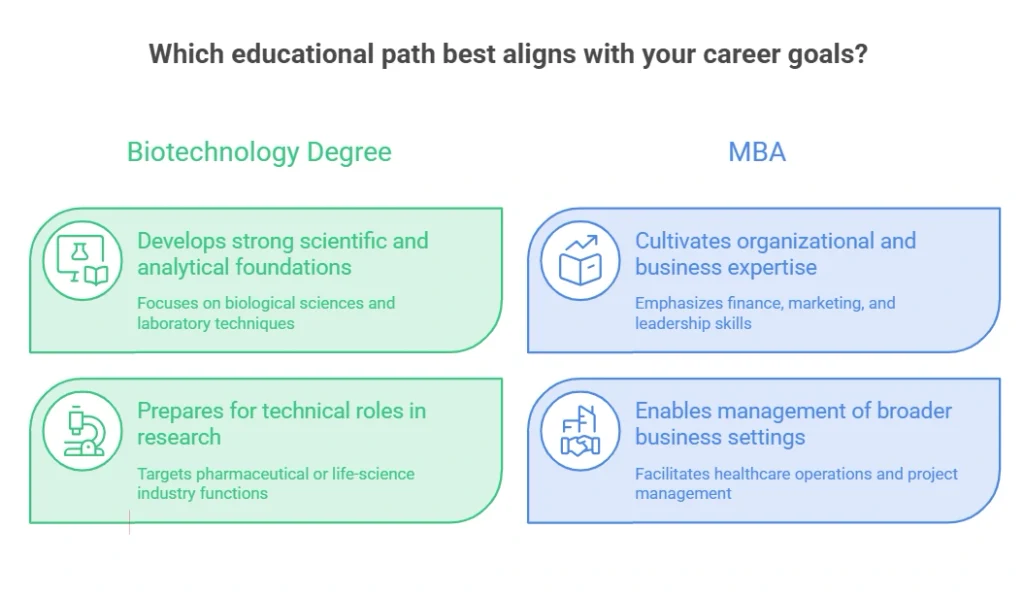
Biotechnology graduates often develop strong scientific and analytical foundations.
Their education may involve:
Biological sciences
Research methods
Laboratory techniques
Data interpretation
Scientific analysis
Healthcare applications
Pharmaceutical or life-science concepts
However, management roles require additional capabilities.
An MBA can help develop knowledge of:
Healthcare operations
Finance
Marketing
Human resources
Strategy
Business analytics
Leadership
Project management
Entrepreneurship
Therefore, an MBA does not replace biotechnology knowledge. Instead, it can help apply that knowledge in broader organisational and business settings.
Healthcare Management After Biotech: What Does It Mean?
A graduate may move away from laboratory-focused work and explore functions related to healthcare organisations, services, technology, products, and operations.
For example, a biotechnology graduate may understand the scientific side of a healthcare product.
After management education, the professional may also learn how to evaluate its market, manage projects, coordinate teams, understand costs, and develop business strategies.
This combination can be useful across several healthcare sectors.
Hospitals require professionals across many non-clinical functions.
These can include:
Hospital Operations
Operations professionals coordinate processes that support efficient healthcare delivery.
Responsibilities can involve resource utilisation, patient flow, departmental coordination, process improvement, and performance monitoring.
Hospital Administration
Administration involves supporting the effective functioning of different hospital departments.
Professionals may work on documentation, coordination, reporting, vendor relationships, and administrative processes.
Quality Management
Quality functions focus on improving processes, monitoring performance, and supporting healthcare quality initiatives.
A scientific background can provide useful analytical thinking for such responsibilities.
Business Development
Hospitals and healthcare organisations may require professionals who understand services, partnerships, market opportunities, and business development.
Patient Experience
Patient experience involves understanding how patients interact with healthcare services.
Professionals may work on service processes, communication, feedback, and operational improvements.
Is Healthcare Management a Good Fit for Biotechnology Graduates?
The answer depends on career goals.
Healthcare management may be relevant if you enjoy:
Business decision-making
Team management
Healthcare operations
Strategy
Communication
Data analysis
Problem-solving
Project management
Organisational leadership
However, students who strongly prefer laboratory research or technical scientific work may want to consider specialised scientific education instead.
Therefore, the decision should be based on your interests and long-term career direction.
How to Transition From Biotechnology to Healthcare Management
The transition can be planned in stages.
Step 1: Understand Your Career Goal
Decide why you want to move into management.
Do you want to work in hospitals, health-tech, consulting, pharmaceuticals, diagnostics, or healthcare services?
Step 2: Identify Your Skill Gaps
Assess your knowledge of finance, business strategy, operations, marketing, analytics, and leadership.
Step 3: Choose Relevant Management Education
An MBA in healthcare can provide structured exposure to these areas.
Step 4: Gain Practical Exposure
Participate in projects, internships, case studies, industry interactions, or healthcare-related assignments.
Step 5: Develop Business Skills
Strengthen communication, analytics, financial literacy, presentation, and problem-solving.
Step 6: Target Relevant Roles
Focus on roles where your biotechnology background and management skills complement each other.
Healthcare Management vs Biotechnology Career Path
The two paths can lead to different professional environments.
Biotechnology Career
Healthcare Management Career
Scientific and technical focus
Business and organisational focus
Laboratory and research roles
Management and operations roles
Scientific analysis
Business analytics
Research projects
Healthcare projects
Technical expertise
Leadership and management
Product or scientific development
Business and service development
Research-oriented progression
Management-oriented progression
Neither pathway is universally better.
The right direction depends on whether you prefer scientific work or management and organisational responsibilities.
Can Biotechnology Graduates Work in Hospital Administration?
Yes, biotechnology graduates can consider hospital administration if they meet the requirements of the relevant role.
An MBA in healthcare can strengthen their understanding of hospital operations, finance, HR, strategy, patient services, and administration.
However, some hospital roles may have specific professional or technical requirements.
Therefore, candidates should review individual job descriptions before applying.
Can Biotechnology Graduates Move Into Healthcare Consulting?
Healthcare consulting can be a potential career direction for biotechnology graduates with management education.
Consulting roles may involve:
Market research
Healthcare strategy
Business analysis
Operational improvement
Data analysis
Project management
Client presentations
Biotechnology knowledge can provide healthcare context, while MBA training can strengthen business and strategic capabilities.
Can Biotechnology Graduates Enter Health-Tech?
Yes, biotechnology graduates can explore health-tech roles, particularly when they combine healthcare knowledge with management and digital skills.
Potential areas include:
Health-tech operations
Product implementation
Healthcare project management
Customer success
Healthcare analytics
Business development
Digital healthcare services
Technology knowledge can become increasingly important as healthcare organisations adopt digital systems and data-driven processes.
Salary After an MBA in Healthcare for Biotechnology Graduates
Salary should be evaluated carefully.
There is no single fixed salary for biotechnology graduates after an MBA.
Compensation can vary based on:
Job role
Employer
Location
Experience
MBA institution
Industry
Technical skills
Management responsibilities
Analytical ability
Individual performance
For example, healthcare consulting, health-tech, hospital operations, pharmaceuticals, and analytics may have different compensation structures.
Similarly, an experienced professional may have a different compensation level from a recent graduate.
Therefore, students should consider salary alongside career growth, learning opportunities, role suitability, and long-term professional development.
How to Choose an MBA in Healthcare After Biotechnology
Before selecting a program, consider these factors.
Curriculum
Look for subjects covering:
Healthcare management
Finance
Marketing
Operations
Strategy
HR
Analytics
Leadership
Healthcare technology
Entrepreneurship
Practical Learning
Projects, case studies, presentations, simulations, and industry exposure can help connect theory with practical situations.
Faculty
Review faculty qualifications, academic expertise, and industry experience.
Industry Exposure
Corporate interactions and practical exposure can help students understand how healthcare organisations operate.
Career Support
Evaluate professional development, placement support, career guidance, and industry engagement.
Learning Format
Consider whether the schedule and format match your academic and personal commitments.
Why Asia Pacific Institute of Management Can Be Relevant
For biotechnology graduates moving toward healthcare management, the learning environment should support practical business understanding.
Asia Pacific Institute of Management focuses on industry-oriented management education, practical learning, experienced faculty, and corporate exposure.
These elements can help students develop management capabilities while building on their existing academic background.
For biotechnology graduates, the objective should be to combine scientific understanding with business, leadership, analytical, and operational skills.
Biotechnology graduates have a strong foundation in science and healthcare-related concepts. However, career opportunities do not have to remain limited to laboratory or research environments.
An MBA healthcare after biotechnology can help graduates develop business and management capabilities while retaining the value of their scientific background.
Healthcare management can open potential pathways across hospitals, health-tech, pharmaceuticals, diagnostics, consulting, healthcare services, and other sectors.
The most important step is to choose a career direction first and then build the skills required for that path.
For students who want to combine biotechnology knowledge with management education, an industry-oriented program can provide a structured foundation for developing business, leadership, operational, and analytical capabilities.
Explore healthcare management education at Asia Pacific Institute of Management and assess how the right management program can support your long-term career goals.
Shape Your Healthcare Future
Combine scientific knowledge with management education to pursue opportunities across hospitals, pharmaceuticals, diagnostics, health-tech, and consulting.
Dr. Vikas Gupta is a distinguished academic in the education and research domain, specializing in finance and related interdisciplinary studies. He is known for his...
01.
Can I do an MBA in healthcare after biotechnology?
Yes. Biotechnology graduates can consider healthcare management MBA programs if they meet the relevant eligibility requirements. Specific academic, entrance, and selection criteria vary by institution.
02.
What are the career options after biotechnology with an MBA?
Potential options include healthcare management, hospital administration, healthcare operations, consulting, health-tech, analytics, business development, healthcare marketing, pharmaceuticals, diagnostics, and project management.
03.
Can biotechnology graduates work in hospital management?
Yes. Biotechnology graduates can explore hospital management and administration roles where their qualifications and management skills meet the employer’s requirements.
04.
What are healthcare jobs for biotechnology graduates?
Potential healthcare jobs include healthcare operations executive, healthcare analyst, hospital administration executive, business development professional, healthcare consultant, health-tech professional, healthcare marketing professional, and project coordinator.
05.
Is an MBA after biotechnology useful?
An MBA can be useful for biotechnology graduates who want to move from scientific or technical roles toward business, management, strategy, operations, or leadership.
06.
Can biotechnology graduates enter health-tech after an MBA?
Yes. Biotechnology graduates with management and digital skills can explore health-tech roles involving operations, implementation, analytics, project management, business development, and customer-facing functions.
07.
Can I work in healthcare consulting after biotechnology?
Yes, depending on your management education, analytical skills, experience, and employer requirements. An MBA can help develop business strategy, analytics, communication, and problem-solving capabilities.
08.
Does an MBA guarantee a higher salary after biotechnology?
No. An MBA does not guarantee a specific salary. Compensation depends on role, employer, location, skills, experience, industry, and individual performance.


















.webp) Call Us
Call Us