MBA Healthcare After BHMS: Career Options in Hospitals & Healthcare Companies
Posted on 24 Sep 2026
By Dr. Vikas Gupta
Introduction
A BHMS degree can lead to a career in healthcare beyond clinical practice. For graduates interested in management, business, and healthcare operations, an MBA healthcare after BHMS can provide an alternative career pathway.
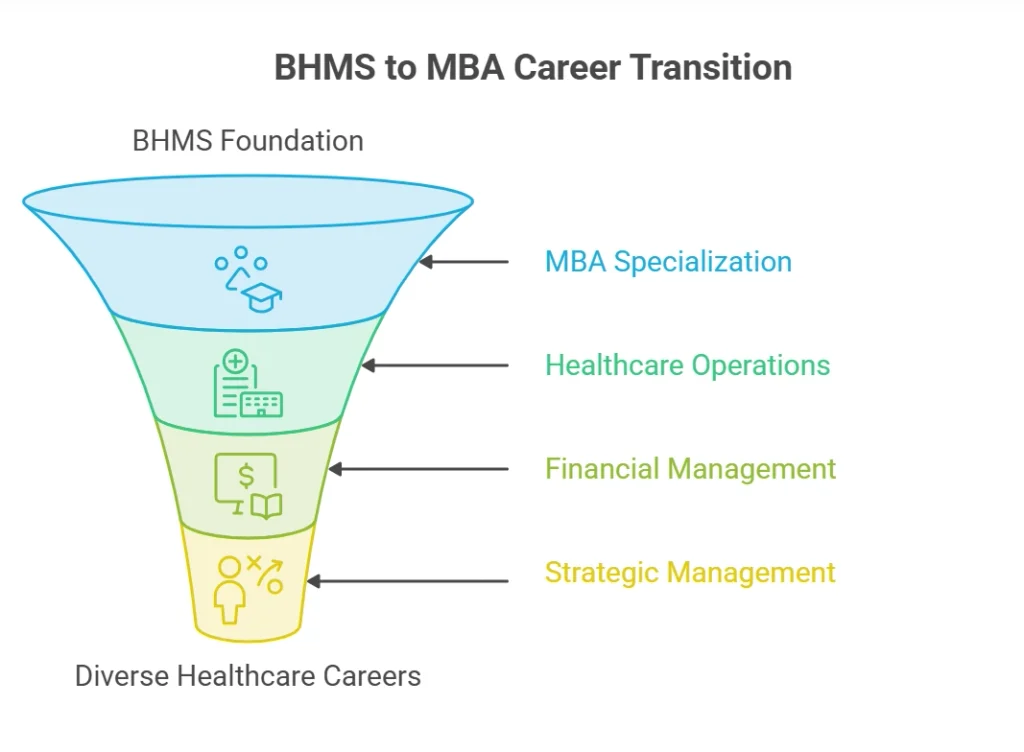
Healthcare organisations need professionals who understand healthcare delivery and business management. Therefore, BHMS graduates can consider management education to develop skills in operations, finance, marketing, analytics, leadership, and strategy.
This combination can be relevant for careers in hospitals, healthcare companies, health-tech organisations, insurance, consulting, and other healthcare-related businesses.
However, an MBA is not the only route available after BHMS. Your choice should depend on your interests, career goals, and preferred work environment.
Expand Your Healthcare Career
Combine your BHMS knowledge with management skills and explore opportunities across hospitals, healthcare companies, consulting, health-tech, and operations.
MBA healthcare after BHMS means pursuing a healthcare-focused MBA or management program after completing a Bachelor of Homeopathic Medicine and Surgery.
The combination brings together healthcare knowledge from BHMS with management skills in areas such as operations, finance, marketing, strategy, analytics, and leadership.
The exact eligibility requirements depend on the management program. Therefore, students should check the latest graduation, marks, entrance, and selection requirements before applying.
Why Consider an MBA After BHMS?
BHMS provides a foundation in healthcare and patient-related concepts. However, managing a healthcare organisation requires additional business and administrative knowledge.
An MBA after BHMS can help students understand:
Healthcare operations
Hospital administration
Financial management
Healthcare marketing
Human resource management
Business analytics
Strategic management
Quality management
Healthcare technology
Leadership and organisational behaviour
Moreover, healthcare companies need professionals who can coordinate people, processes, technology, and business objectives.
Therefore, management education can help BHMS graduates explore career paths beyond direct clinical practice.
Healthcare Management After BHMS: Career Scope
Healthcare management after BHMS can cover several functional areas. The right option depends on your skills, interests, experience, and additional qualifications.
1. Hospital Management
Hospital management is one of the most relevant options for BHMS graduates interested in healthcare administration.
Professionals can work across areas such as:
Hospital operations
Patient services
Administration
Quality management
Facility coordination
Process improvement
Staff coordination
Service delivery
A BHMS background can provide healthcare context. An MBA can then add business and management capabilities.
Therefore, hospital management after BHMS can be considered by graduates who want to work within healthcare organisations without focusing exclusively on clinical practice.
2. Healthcare Operations
Healthcare operations focuses on making services efficient and well-coordinated.
Operations professionals may work on:
Patient flow
Resource allocation
Process improvement
Staff coordination
Service quality
Operational planning
Vendor coordination
Performance monitoring
BHMS graduates can bring healthcare awareness to these responsibilities. Management education can further develop their problem-solving and decision-making skills.
3. Healthcare Administration
Healthcare administrators support the smooth functioning of healthcare facilities and services.
Responsibilities can include:
Administrative planning
Coordination between departments
Documentation
Staff coordination
Patient-service processes
Vendor management
Operational reporting
The role requires strong communication, organisational ability, and attention to detail.
An MBA can help graduates develop a broader understanding of how healthcare organisations operate.
Career Options in Healthcare Companies
The scope of an MBA after BHMS is not limited to hospitals.
Healthcare companies also require professionals across business and management functions.
Healthcare Business Development
Business development professionals help organisations identify growth opportunities.
Their responsibilities may include:
Market research
Partnership development
Client relationships
Business proposals
Market expansion
Revenue planning
BHMS graduates can bring healthcare understanding to conversations with healthcare stakeholders.
However, they also need strong communication, negotiation, and commercial awareness.
Healthcare Marketing
Healthcare marketing involves promoting healthcare services while communicating responsibly with patients and stakeholders.
An MBA can introduce concepts such as:
Brand management
Consumer behaviour
Digital marketing
Market research
Marketing strategy
Communication
A healthcare background can help graduates understand medical terminology and patient perspectives.
Healthcare Analytics
Healthcare organisations increasingly use data to improve operational and business decisions.
Analytics roles can involve examining:
Patient volumes
Service utilisation
Operational performance
Revenue indicators
Customer behaviour
Business performance
Students interested in this area should develop skills in Excel, data visualisation, dashboards, and business analytics.
Health-Tech Management
Technology has become an important part of healthcare delivery and management.
Health-tech organisations may need professionals for:
Product coordination
Healthcare operations
Customer success
Business development
Project management
Implementation
Process management
For BHMS graduates, healthcare knowledge can be useful. However, technology awareness and business skills are equally important.
Build Healthcare Management Skills
Develop finance, strategy, analytics, operations, and leadership capabilities to prepare for management roles across the healthcare industry.
Professionals can support administrative and operational activities within healthcare facilities.
Healthcare Consulting
Healthcare consulting can involve market research, operational analysis, strategy, and process improvement.
Healthcare Marketing
This area combines healthcare knowledge with marketing and communication skills.
Business Development
Professionals can work on partnerships, market expansion, client relationships, and growth initiatives.
Healthcare Analytics
Graduates with an interest in data can explore analytics-related healthcare roles after developing the necessary technical skills.
Health-Tech
Healthcare technology businesses can offer opportunities in operations, implementation, customer success, project management, and business development.
Healthcare Insurance
Insurance organisations require professionals across operations, customer service, business development, analytics, and healthcare-related functions.
MBA After BHMS: Skills That Matter
The value of an MBA depends partly on the skills you build during the program.
Healthcare Operations
Understand how hospitals and healthcare organisations manage processes, resources, and services.
Financial Management
Learn about budgeting, cost management, financial analysis, and business decisions.
Marketing
Develop an understanding of healthcare branding, customer behaviour, digital channels, and market research.
Business Analytics
Learn to use data for operational and business decision-making.
Leadership
Build capabilities in communication, team management, negotiation, and conflict resolution.
Strategic Thinking
Understand how organisations analyse markets, develop strategies, and plan growth.
These skills can help BHMS graduates move from a healthcare-only academic background toward broader management responsibilities.
Hospital Management After BHMS: What Should You Study?
If your goal is hospital management after BHMS, look for a curriculum that combines healthcare knowledge with core management education.
Important areas include:
Healthcare Operations
Learn about patient flow, resource utilisation, process design, and service delivery.
Hospital Administration
Understand administrative structures, coordination, documentation, and healthcare workflows.
Healthcare Finance
Learn how budgets, costs, revenue, and financial decisions affect healthcare organisations.
Human Resource Management
Healthcare organisations depend on multidisciplinary teams. Therefore, workforce planning and people management are important.
Quality Management
Understand how healthcare organisations monitor and improve service quality.
Healthcare Marketing
Learn how healthcare organisations communicate services and understand market needs.
Business Analytics
Develop the ability to interpret data and use insights for decision-making.
Strategic Management
Understand long-term planning, organisational strategy, and business development.
Additionally, practical projects and industry exposure can help students connect theoretical concepts with real healthcare situations.
Can BHMS Graduates Move Into Healthcare Companies?
Yes. A BHMS graduate with management education can explore roles beyond traditional clinical practice.
However, employers usually assess more than the academic degree.
They may consider:
Communication skills
Business knowledge
Analytical ability
Industry awareness
Leadership skills
Relevant experience
Internship exposure
Technology skills
Problem-solving ability
Therefore, students should build a balanced professional profile.
How to Prepare for an MBA After BHMS
A planned approach can make the transition smoother.
Step 1: Identify Your Career Direction
Start by asking what type of work interests you.
Do you prefer hospitals, consulting, healthcare companies, health-tech, marketing, analytics, or administration?
Step 2: Check Eligibility
Review the latest admission criteria for your chosen MBA program.
Eligibility may include graduation requirements, minimum marks, entrance examinations, work experience, and selection criteria.
These requirements vary between programs.
Step 3: Select a Relevant Curriculum
Do not choose a program only because it contains the word “healthcare.”
Review the actual subjects and practical components.
Look for areas such as:
Healthcare management
Operations
Finance
Marketing
Analytics
Strategy
Leadership
Digital healthcare
Step 4: Develop Practical Skills
Alongside your MBA, build practical skills in:
Excel
Business communication
Presentation
Data analysis
Digital tools
Project management
Financial basics
Step 5: Gain Industry Exposure
Internships, live projects, case studies, industry interactions, and practical assignments can help you understand how healthcare organisations operate.
How BHMS Can Complement Management Education
A BHMS background can provide useful healthcare knowledge.
Healthcare Understanding
You have already studied healthcare concepts and patient-related subjects.
Patient Perspective
Clinical education can help you understand patient expectations and healthcare experiences.
Healthcare Terminology
Familiarity with medical terminology can support communication with healthcare professionals.
Understanding of Clinical Environments
Healthcare education can provide context when working with hospitals and other healthcare organisations.
However, these strengths do not replace business skills.
Therefore, BHMS graduates should focus on developing finance, analytics, strategy, communication, and leadership capabilities.
How to Choose an MBA Healthcare Program After BHMS
Before applying, evaluate the program from a career perspective.
Consider the following:
Eligibility: Do you meet the current admission requirements?
Curriculum: Does it cover both healthcare and management?
Practical learning: Are there projects, case studies, and practical assignments?
Industry exposure: Does the program provide corporate or industry interaction?
Faculty: Does the faculty bring relevant academic or professional experience?
Career support: What type of career guidance and placement support is provided?
Learning environment: Does it encourage teamwork and practical problem-solving?
Cost: What is the total financial commitment?
For students seeking management education, Asia Pacific Institute of Management provides an industry-oriented learning environment with practical learning, corporate exposure, experienced faculty, and career-focused management education.
Career Growth After an MBA Healthcare Program
An MBA can help build capabilities for broader management responsibilities. However, career progression depends on several factors.
These include:
Job role
Employer
Experience
Professional skills
Performance
Location
Industry
Leadership capabilities
Therefore, students should not view an MBA as an automatic guarantee of a particular job title or salary.
Instead, consider the degree as a structured opportunity to develop management capabilities and expand career options.
Is MBA Healthcare After BHMS Right for You?
An MBA may be relevant if you:
Want to move beyond clinical practice
Are interested in hospital administration
Want to work in healthcare operations
Enjoy business and strategy
Want to explore health-tech
Are interested in healthcare marketing
Prefer management responsibilities
Want to combine healthcare knowledge with business skills
On the other hand, an MBA may not be necessary if your primary goal remains clinical practice.
Therefore, begin with your career objective rather than the degree title.
Conclusion
An MBA healthcare after BHMS can help graduates explore career options beyond clinical practice. The combination of homeopathic healthcare knowledge and management education can support opportunities across hospitals, healthcare companies, health-tech, consulting, insurance, marketing, analytics, and business development.
However, your career direction should determine your education choice.
If you are interested in healthcare operations, leadership, strategy, or business, an MBA can help you develop the capabilities required for management-oriented roles.
Asia Pacific Institute of Management focuses on industry-oriented management education, practical learning, corporate exposure, experienced faculty, and career support.
Before applying, review the curriculum, eligibility requirements, practical exposure, and career support available for your chosen program.
Take the next step toward building a management-focused healthcare career after BHMS with practical learning and industry-oriented education.
Dr. Vikas Gupta is a distinguished academic in the education and research domain, specializing in finance and related interdisciplinary studies. He is known for his...
Yes, BHMS graduates can consider MBA programs if they meet the eligibility requirements of the chosen institution. Requirements may differ based on the program.
02.
Is MBA healthcare after BHMS a good career option?
It can be relevant for BHMS graduates interested in healthcare management, hospital administration, operations, consulting, marketing, analytics, and health-tech. Its suitability depends on individual career goals.
03.
What are the non clinical jobs after BHMS?
Potential non-clinical career areas include hospital administration, healthcare operations, consulting, marketing, business development, analytics, health-tech, insurance, quality management, and project management.
04.
Can I pursue hospital management after BHMS?
Yes, BHMS graduates can explore hospital management after developing appropriate management skills and meeting the requirements of the relevant program or employer.
05.
What are healthcare careers for homeopathy graduates?
Homeopathy graduates can explore healthcare administration, hospital operations, consulting, marketing, business development, analytics, health-tech, insurance, and other non-clinical management functions.
06.
Is an MBA necessary for hospital management after BHMS?
Not every hospital management position requires an MBA. However, management education can help develop knowledge of operations, finance, leadership, strategy, analytics, and organisational management.
07.
Can BHMS graduates work in health-tech?
Yes. With relevant management and technology skills, BHMS graduates can explore health-tech roles in operations, implementation, customer success, project management, and business development.
08.
What should I consider before choosing an MBA after BHMS?
Consider eligibility, curriculum, industry exposure, practical learning, faculty, career support, program format, total cost, and alignment with your career goals.


















.webp) Call Us
Call Us