MBA in Healthcare Management After BDS: Career Options, Jobs & Salary
Posted on 22 Sep 2026
By Dr. Vikas Gupta
Introduction
A BDS degree can open the door to a clinical career in dentistry. However, not every dental graduate wants to spend their entire career in clinical practice.
Some BDS graduates become interested in healthcare administration, hospital operations, consulting, health-tech, healthcare marketing, insurance, pharmaceuticals, or business management.
An MBA combines business knowledge with healthcare industry understanding. Therefore, it can help BDS graduates develop skills in finance, operations, strategy, analytics, marketing, leadership, and organisational management.
However, the decision requires careful consideration. Students should understand the eligibility requirements, career options, potential job roles, salary expectations, and skills required before choosing this path.
Expand Beyond Clinical Dentistry
Combine your dental expertise with healthcare management skills and explore opportunities across hospitals, consulting, health-tech, analytics, and business development.
Can BDS Graduates Pursue an MBA in Healthcare Management?
Yes. BDS graduates can generally pursue healthcare management or related management programs if they meet the specific eligibility requirements of the institution.
A dental background can provide useful healthcare knowledge.
BDS graduates already understand:
Patient care environments
Clinical workflows
Healthcare terminology
Medical professionals
Patient communication
Healthcare ethics
Dental practice operations
An MBA can complement this clinical foundation with business and management skills.
The result can be a professional profile combining:
Dental knowledge + Healthcare understanding + Business management + Leadership
This combination can be useful in non-clinical healthcare roles.
Why Consider an MBA After BDS?
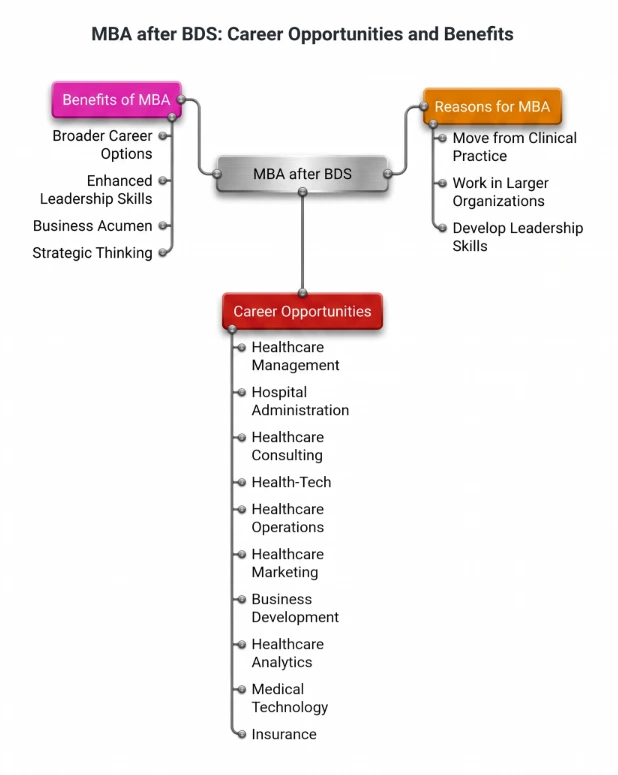
An MBA after BDS may be considered for several reasons.
Some graduates want to move away from full-time clinical practice. Others want to work in larger healthcare organisations or develop business and leadership responsibilities.
An MBA can potentially help BDS graduates explore:
Healthcare management
Hospital administration
Healthcare consulting
Health-tech
Healthcare operations
Healthcare marketing
Business development
Healthcare analytics
Medical technology
Insurance
Pharmaceutical management
Moreover, management education can be relevant for dentists who want to eventually manage clinics, healthcare businesses, or other healthcare ventures.
Healthcare Management After BDS: What Changes?
A BDS degree primarily develops clinical and dental knowledge.
Healthcare management education focuses on how organisations operate.
This means students may move from questions such as:
"How do I treat a patient?"
toward questions such as:
"How can a healthcare organisation deliver services efficiently while maintaining quality and financial sustainability?"
That shift is important.
Healthcare managers may work with:
Budgets
Teams
Operations
Technology
Patient experience
Business strategy
Marketing
Quality
Data
Service delivery
Therefore, an MBA can help BDS graduates build skills beyond clinical practice.
There is no single salary figure for BDS graduates with an MBA.
Salary depends on:
Prior work experience
Job function
Employer
Location
MBA institution
Industry
Skills
Role seniority
Performance
A fresher entering a healthcare management role should not compare their salary with that of an experienced healthcare manager.
Similarly, salaries in consulting, health-tech, hospitals, insurance, pharmaceuticals, and analytics can differ significantly.
Therefore, salary figures should be used as market benchmarks rather than guarantees.
What Can Influence Your Starting Salary?
Previous Experience
BDS graduates with clinical, administrative, business, or project experience may have different opportunities from fresh graduates.
Role
Specialised roles in analytics, consulting, strategy, product management, or business development may have different compensation structures from entry-level administrative positions.
Skills
Skills in analytics, finance, digital marketing, project management, and communication can strengthen employability.
Location
Healthcare employment opportunities and compensation can vary across Indian cities and markets.
Employer
Large organisations, specialised healthcare businesses, hospitals, health-tech companies, and other employers may have different compensation structures.
Should You Compare MBA Salary With Dentist Income?
This comparison can be misleading.
A dental career and a healthcare management career follow different paths.
Clinical dentistry can involve practice-based income, while management careers typically involve salaried employment, performance progression, and organisational responsibilities.
Therefore, BDS graduates should compare careers based on:
Work preferences
Career progression
Leadership opportunities
Work environment
Income expectations
Long-term goals
Interest in clinical versus non-clinical work
The decision should not depend only on the first-year salary.
Is an MBA in Healthcare Management After BDS Worth Considering?
The answer depends on your career objective.
An MBA can be relevant if you want to:
Move into healthcare management
Work in hospital administration
Enter healthcare consulting
Explore health-tech
Build business skills
Develop leadership capabilities
Manage healthcare operations
Explore healthcare entrepreneurship
However, an MBA may not be necessary if your primary goal is to continue a purely clinical dental career.
Therefore, start with your desired career role and work backwards.
Ask yourself:
What kind of work do I want to do five years from now?
If the answer involves management, strategy, operations, business, or leadership, an MBA may deserve serious consideration.
BDS graduates should not select a program based only on the word "healthcare."
Review the program carefully.
1. Curriculum
Check whether it covers:
Healthcare management
Operations
Finance
Strategy
Marketing
Analytics
Leadership
Digital healthcare
2. Practical Learning
Look for:
Case studies
Projects
Industry assignments
Presentations
Simulations
Practical business problems
3. Faculty
Review the academic and professional experience of the faculty.
4. Industry Exposure
Corporate interaction can help students understand real-world management challenges.
5. Career Support
Review placement support, career counselling, industry connections, and professional development opportunities.
6. Program Format
Working professionals should consider schedule, attendance requirements, duration, and learning format.
How Asia Pacific Institute of Management Can Help BDS Graduates
Asia Pacific Institute of Management focuses on industry-oriented management education, practical learning, experienced faculty, corporate exposure, and career development.
For BDS graduates considering a transition into management, this type of learning environment can help build business capabilities beyond clinical education.
Management education can expose students to areas such as strategy, finance, operations, marketing, analytics, leadership, and organisational decision-making.
BDS graduates should review the latest program-specific eligibility, curriculum, admission requirements, fees, and career support before applying.
A Practical Career Roadmap for BDS Graduates
A structured approach can make the transition easier.
Stage 1: Identify Your Direction
Decide whether you prefer:
Hospitals
Consulting
Health-tech
Insurance
Healthcare marketing
Analytics
Medical technology
Healthcare entrepreneurship
Stage 2: Build Business Knowledge
Develop an understanding of finance, strategy, marketing, operations, and organisational behaviour.
Stage 3: Gain Practical Experience
Internships and management projects can help you understand real healthcare business problems.
Stage 4: Develop Technical Skills
Consider learning:
Excel
Power BI
SQL
Business analytics
Presentation tools
Project management
The right combination depends on your target role.
Stage 5: Build a Healthcare Management Resume
Your resume should connect your BDS experience with your management skills.
For example:
BDS → healthcare knowledge → MBA → management skills → target healthcare role
An MBA in healthcare management after BDS can provide an alternative pathway for dental graduates who want to explore management rather than remain exclusively in clinical practice.
Your BDS degree already provides healthcare knowledge and exposure to patients. An MBA can add business, analytics, operations, strategy, finance, marketing, and leadership capabilities.
Together, these skills can support career exploration across hospitals, consulting, health-tech, healthcare analytics, insurance, medical technology, and other healthcare businesses.
However, the right decision depends on your long-term goals.
If you want to build a career in healthcare management, start by identifying your target role. Then choose a program that provides relevant subjects, practical projects, industry exposure, experienced faculty, and career support.
For BDS graduates ready to explore the management side of healthcare, the transition can be approached as a gradual shift from clinical knowledge to healthcare business and leadership.
Build Your Healthcare Future
Add business and management expertise to your BDS background and prepare to explore diverse non clinical healthcare career pathways.
Dr. Vikas Gupta is a distinguished academic in the education and research domain, specializing in finance and related interdisciplinary studies. He is known for his...
Yes. BDS graduates can pursue management programs if they meet the eligibility criteria of the institution. Healthcare management can be particularly relevant because BDS already provides healthcare-sector exposure.
02.
What are the best non-clinical careers after BDS?
Potential areas include healthcare management, hospital administration, consulting, health-tech, healthcare analytics, insurance, medical technology, marketing, business development, and healthcare operations.
03.
Can I get healthcare management jobs after BDS and an MBA?
Yes. Depending on your skills, experience, MBA curriculum, and employer requirements, potential roles can include healthcare operations, consulting, analytics, business development, marketing, project management, and strategy.
04.
What is the MBA healthcare salary after BDS?
There is no fixed salary for BDS graduates after an MBA. Compensation depends on the role, employer, location, prior experience, skills, and level of responsibility. Market salary figures should therefore be treated as indicative.
05.
Is healthcare management after BDS better than clinical dentistry?
These are different career pathways and should not be ranked universally. Clinical dentistry focuses on patient care, while healthcare management focuses on organisational, business, and operational responsibilities. The appropriate path depends on individual career goals.
06.
Can BDS graduates work in hospital administration?
Yes. BDS graduates with relevant management education can explore hospital administration and operations roles, subject to employer requirements.
07.
Can BDS graduates enter health-tech after an MBA?
Yes. Health-tech can provide opportunities in product management, business development, implementation, operations, project management, and customer-facing roles. Healthcare knowledge can be useful in understanding users and clinical workflows.
08.
Is an MBA in healthcare management useful for starting a healthcare business?
It can provide useful knowledge in finance, strategy, marketing, operations, HR, and leadership. However, entrepreneurial success also depends on market understanding, execution, capital, regulatory considerations, and business experience.
















.webp) Call Us
Call Us