Can Arts Students Pursue an MBA in Healthcare Management?
Posted on 18 Sep 2026
By Dr. Vikas Gupta
Introduction
Yes, arts students can pursue an MBA in Healthcare Management, provided they meet the eligibility criteria of the institute they choose. A medical or science background is not always mandatory for healthcare management programmes. In fact, students with a Bachelor of Arts (BA) degree can bring valuable skills in communication, research, critical thinking, people management and social sciences to the healthcare sector.
Healthcare organisations need professionals who understand more than clinical care. Hospitals, diagnostic centres, health-tech companies, pharmaceutical businesses and healthcare service providers also require managers who can handle operations, finance, marketing, human resources, patient experience and strategy.
This makes an MBA Healthcare Management for arts students a potential pathway for BA graduates who want to combine their existing academic strengths with business and healthcare management knowledge.
Turn Arts Into Opportunity
Combine your arts background with healthcare management expertise and build practical skills for diverse non clinical career opportunities.
Can Arts Students Do an MBA in Healthcare Management?
Yes. Arts students can do an MBA in Healthcare Management if they satisfy the eligibility requirements of the particular institution and programme.
An MBA in Healthcare Management focuses on applying management principles to healthcare organisations. Students generally learn about areas such as:
Healthcare and hospital administration
Healthcare operations
Financial management
Human resource management
Healthcare marketing
Healthcare quality management
Business analytics
Healthcare strategy
Patient experience
Digital healthcare
Healthcare policy and management
For an arts graduate, the programme can provide an opportunity to develop business and management skills while gaining an understanding of the healthcare industry.
However, eligibility criteria vary between institutions. Students should always check the specific academic qualification, entrance examination and other admission requirements of the programme they plan to join.
Why Is Healthcare Management Relevant for Arts Graduates?
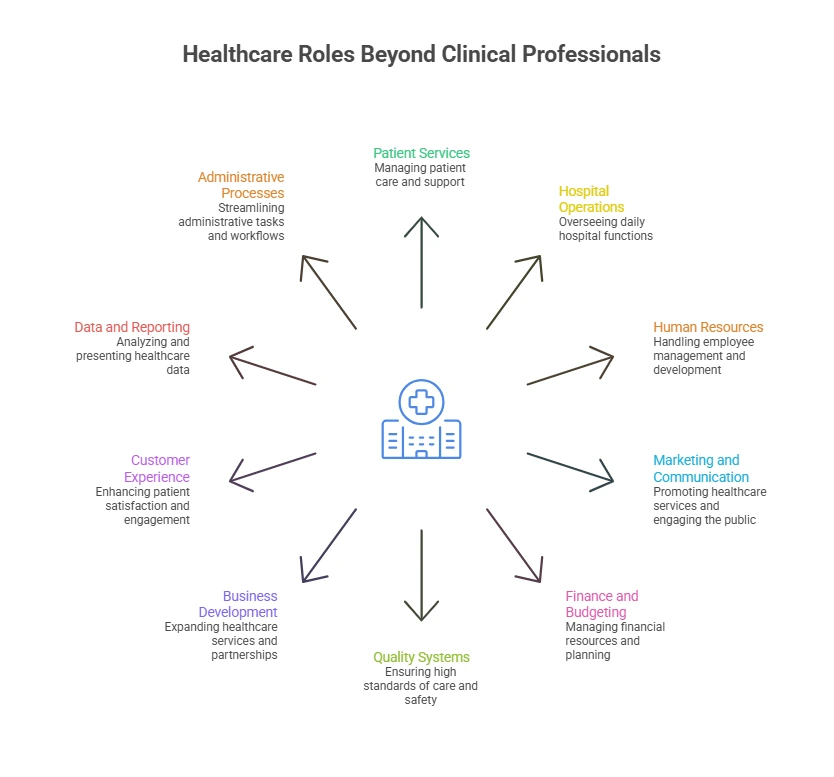
Healthcare is not limited to doctors, nurses and other clinical professionals. Every large healthcare organisation involves multiple non-clinical functions.
Consider a hospital. Along with doctors and nurses, it needs professionals who can manage:
Patient services
Hospital operations
Human resources
Marketing and communication
Finance and budgeting
Quality systems
Business development
Customer and patient experience
Data and reporting
Administrative processes
Arts graduates can potentially contribute to several of these areas because their undergraduate education may develop skills related to communication, social sciences, research, writing, analysis and understanding people.
An MBA can then add structured knowledge of business, management and healthcare operations.
MBA Healthcare After BA: Is It a Suitable Option?
For students researching an MBA healthcare after BA, the key question is not simply whether their undergraduate degree is from the arts stream. They should consider whether they are interested in management and healthcare and whether they meet the programme's eligibility requirements.
A BA graduate may have studied subjects such as:
Economics
Psychology
Sociology
Political Science
English
History
Public Administration
Geography
Social Work
Other humanities and social science disciplines
These backgrounds can provide transferable skills that may be useful in healthcare management.
For example, a student with psychology exposure may be interested in patient experience or human resources. Someone with economics knowledge may be interested in healthcare finance or analytics. A graduate with strong communication skills may explore healthcare marketing, public relations or patient engagement.
The MBA component helps bridge the gap between an arts education and formal management knowledge.
What Does an MBA in Healthcare Management Add to a BA Degree?
A BA degree provides an academic foundation, but an MBA in Healthcare Management can add industry-specific management capabilities.
BA Background
MBA Healthcare Management Adds
Communication
Healthcare communication and management
Research
Business and healthcare analysis
Social sciences
Organisational and patient understanding
Critical thinking
Strategic decision-making
Academic knowledge
Practical management skills
Subject-specific knowledge
Healthcare industry knowledge
General graduate qualification
Specialised management education
The combination can be useful for students who want to move towards non-clinical healthcare roles.
What Will Arts Students Learn in an MBA Healthcare Management?
The exact curriculum differs by institution, but healthcare management programmes commonly combine general management subjects with healthcare-focused areas.
1. Healthcare Management
Students learn how healthcare organisations are structured and managed. This can include healthcare systems, administration and organisational management.
2. Hospital Administration
Hospital administration introduces students to the operational side of hospitals, including coordination, resources, services and administrative processes.
3. Healthcare Operations
Healthcare operations focus on improving the way services are delivered. Students may study processes, resource utilisation, service efficiency and operational planning.
4. Healthcare Finance
Healthcare organisations need professionals who understand budgeting, financial planning, cost management and financial decision-making.
Students from commerce backgrounds may already have some exposure to finance, while arts students can develop these skills through the MBA curriculum.
5. Human Resource Management
Hospitals and healthcare organisations depend on multidisciplinary teams. HR management helps students understand recruitment, employee development, performance management and organisational behaviour.
6. Healthcare Marketing
Healthcare organisations also need communication and marketing strategies to reach patients, build awareness and develop services.
This can be particularly relevant to arts graduates with strong communication, writing or media-related interests.
7. Healthcare Quality Management
Quality management focuses on maintaining and improving standards of healthcare services, processes and patient experiences.
8. Healthcare Analytics
Data is increasingly important in healthcare. Students may develop an understanding of data-driven decision-making, reporting and business analytics.
9. Digital Healthcare
Technology is changing how healthcare services are delivered. Healthcare management students may study digital transformation, health-tech and technology-enabled services.
10. Strategic Management
Strategic management helps students understand how healthcare organisations plan, compete, grow and respond to changing industry requirements.
MBA Hospital Management After Arts: What Career Areas Can You Explore?
Students searching for an MBA hospital management after arts pathway should understand that hospital management is broader than clinical work.
Depending on their skills, experience and the requirements of employers, graduates may explore areas such as:
Hospital Administration
Hospital administrators and management professionals support the efficient functioning of healthcare facilities.
Healthcare Operations
Operations professionals work on processes, coordination, resources and service delivery.
Patient Experience
Patient experience roles focus on improving communication, service quality and the overall patient journey.
Healthcare Marketing
Healthcare organisations require marketing professionals to manage campaigns, communication, brand positioning and outreach.
Human Resources
HR professionals can work on recruitment, employee engagement, training and workforce management.
Business Development
Business development teams identify opportunities, develop partnerships and support organisational growth.
Healthcare Analytics
Analytics roles involve using data to support operational and business decisions.
Healthcare Consulting
Consulting organisations may hire management graduates for projects involving healthcare strategy, operations and organisational improvement.
Health-Tech
The growth of digital healthcare has created opportunities across technology-enabled healthcare services, digital platforms and healthcare operations.
Healthcare Insurance
Insurance companies also require professionals who understand healthcare services, business processes and customer requirements.
Build Your Healthcare Career
Develop management, communication, analytics, and healthcare knowledge to explore meaningful opportunities across hospitals and growing healthcare organisations.
Healthcare Careers After BA: What Options Are Available?
An MBA can broaden the potential healthcare careers after BA by adding management expertise to an arts graduate's existing skills.
Potential career areas include:
Career Area
Relevant Skills
Hospital Administration
Administration, coordination, leadership
Healthcare Operations
Process management, problem-solving
Healthcare Marketing
Communication, creativity, marketing
Patient Experience
Communication, empathy, service management
Human Resources
People management, organisational behaviour
Business Development
Communication, negotiation, strategy
Healthcare Analytics
Data interpretation and analytical thinking
Healthcare Consulting
Research, analysis, strategy
Health-Tech
Business understanding and digital awareness
Healthcare Insurance
Healthcare and business knowledge
Actual job titles, responsibilities and career progression depend on the employer, role, candidate's skills and experience.
Do Arts Students Need a Medical Background?
No, not necessarily.
Healthcare management and clinical medicine are different career areas.
A doctor is trained primarily to diagnose and treat patients, while a healthcare management professional focuses on the management and business side of healthcare organisations.
An MBA in Healthcare Management may therefore be suitable for students who want to work in the healthcare industry without becoming clinical practitioners.
That said, arts graduates entering healthcare management should be willing to learn basic healthcare terminology, healthcare processes, industry regulations and the structure of healthcare delivery.
What Skills Can Arts Students Bring to Healthcare Management?
Arts education can develop several transferable skills that are relevant to management.
Communication
Healthcare management involves communication with patients, employees, healthcare professionals, vendors and other stakeholders.
Critical Thinking
Managers frequently need to evaluate information, identify problems and make decisions.
Research Skills
Healthcare organisations operate in a complex environment where research and information analysis can support decision-making.
Understanding Human Behaviour
Students with backgrounds such as psychology or sociology may have useful perspectives on people, behaviour and organisations.
Writing and Presentation
Management professionals often prepare reports, presentations, proposals and communication materials.
Adaptability
Healthcare is evolving rapidly due to technology, changing patient expectations and new business models. Adaptability can be valuable in such an environment.
How Can Arts Students Prepare for an MBA in Healthcare Management?
If you are considering an MBA after a BA degree, you do not necessarily need to wait until the programme begins to learn about healthcare.
You can start by:
1. Learn Healthcare Basics
Understand how hospitals, diagnostics, health insurance, pharmaceutical companies and health-tech businesses operate.
2. Improve Your Business Knowledge
Become familiar with basic concepts in finance, marketing, operations and management.
3. Develop Analytical Skills
Learn how to interpret data, create presentations and use spreadsheets effectively.
4. Follow Healthcare Industry Trends
Read about digital health, healthcare technology, hospital operations, healthcare policy and patient experience.
5. Build Communication Skills
Work on presentation, professional writing, public speaking and interpersonal communication.
6. Gain Practical Exposure
Internships, volunteering, projects or work experience in healthcare organisations can help you understand the industry better.
Arts vs Science Background for Healthcare Management
Both arts and science graduates can bring different strengths to healthcare management.
Factor
Arts Graduate
Science/Medical Graduate
Communication
Often a strong transferable skill
Depends on individual
Healthcare knowledge
Usually needs to be developed
May have prior exposure
Clinical knowledge
Limited unless separately studied
May have relevant background
Business knowledge
Developed through MBA
Developed through MBA
Research
Depends on academic discipline
Often developed through academic training
Management skills
Developed through MBA
Developed through MBA
Career direction
Primarily non-clinical management roles
Clinical + management possibilities depending on background
The relevant choice depends on the student's academic background, career goals and interest in healthcare management.
Who Should Consider an MBA Healthcare Management After BA?
An MBA in Healthcare Management may be worth exploring if you:
Have completed or are completing a BA degree
Want to enter the healthcare industry
Are interested in management rather than clinical practice
Enjoy working with people and organisations
Want to develop business and leadership skills
Are interested in hospital or healthcare operations
Want to explore healthcare marketing or business development
Are interested in health-tech and digital healthcare
Want to combine your humanities or social science background with management education
Who May Not Need an MBA in Healthcare Management?
An MBA may not be the most relevant path for everyone.
For example, if your primary goal is to pursue a purely clinical profession, a healthcare management MBA may not provide the professional qualification you need for that clinical pathway.
Similarly, students who have no interest in healthcare or management may want to explore programmes more closely aligned with their interests.
The right postgraduate programme should ultimately depend on your intended career direction.
How to Choose a Healthcare Management MBA After BA
Before applying, arts graduates should evaluate more than the programme title.
Consider these factors:
Eligibility
Check whether your BA qualification and academic marks meet the institute's requirements.
Curriculum
Look for a curriculum that covers both management fundamentals and healthcare-specific subjects.
Faculty
Review faculty expertise and academic as well as industry exposure.
Industry Exposure
Internships, live projects, guest sessions and industry interaction can provide practical understanding.
Career Support
Check what career guidance, placement assistance and employer engagement the institute provides.
Programme Format
Compare full-time, executive, weekend and online formats based on your circumstances and eligibility.
Fees and Overall Cost
Consider tuition fees as well as living expenses, learning resources, travel and other costs.
Alumni Network
An active alumni network can provide opportunities for professional networking and industry insights.
Common Concerns Arts Students Have About MBA Healthcare Management
“I have never studied biology. Can I still pursue healthcare management?”
A medical or biology background is not universally required for healthcare management. However, programme-specific eligibility rules apply, and students should be prepared to learn basic healthcare concepts.
“Will I be able to understand hospital management?”
Yes, management programmes are designed to teach relevant concepts. Students may initially need to become familiar with healthcare terminology and processes.
“Can I work in a hospital after a BA?”
A BA alone may qualify you for certain general roles depending on the employer and job requirements. An MBA in Healthcare Management can add specialised management education for students targeting healthcare management positions.
“Is MBA Healthcare Management only for doctors?”
No. Healthcare management can involve professionals from management, commerce, science, arts and other academic backgrounds, subject to programme and employer requirements.
An arts background does not automatically prevent a student from entering healthcare management. A BA graduate can use an MBA to develop management, business and healthcare-specific knowledge and explore non-clinical opportunities across hospitals, health-tech companies, diagnostics, insurance, consulting and other healthcare organisations.
The important question is not whether you studied arts, but whether you are interested in combining your existing skills with management education and building a career in the healthcare industry.
Before applying, compare the programme's eligibility, curriculum, industry exposure, career support, fees and learning format. This can help you determine whether an MBA in Healthcare Management fits your academic background and long-term career plans.
Step Into Healthcare Management
Transform your humanities strengths into management capabilities and prepare to contribute across healthcare operations, marketing, HR, and strategy.
Dr. Vikas Gupta is a distinguished academic in the education and research domain, specializing in finance and related interdisciplinary studies. He is known for his...
01.
Can arts students pursue an MBA in Healthcare Management?
Yes. Arts students can pursue an MBA in Healthcare Management if they meet the eligibility criteria of the institute offering the programme.
02.
Can I do an MBA in Healthcare Management after BA?
Yes, an MBA healthcare after BA can be an option for graduates who meet the programme’s eligibility requirements and are interested in healthcare management.
03.
Can arts students do MBA Healthcare without studying biology?
In many programmes, a biology or medical background is not mandatory. However, eligibility varies by institution.
04.
Is MBA hospital management after arts possible?
Yes. Arts graduates may pursue hospital management or healthcare management programmes where their academic background satisfies the institution’s eligibility criteria.
05.
What are the healthcare careers after BA with an MBA?
Potential areas include hospital administration, healthcare operations, patient experience, marketing, HR, business development, healthcare analytics, consulting, health-tech and healthcare insurance.
06.
Do arts students have an advantage in healthcare management?
Arts graduates can bring transferable skills such as communication, research, critical thinking and understanding of people. Whether these become an advantage depends on the student’s individual skills and the requirements of the role.
07.
Do I need work experience for an MBA in Healthcare Management after BA?
Not necessarily. Eligibility and work-experience requirements vary by programme. Students should check the admission criteria of their chosen institute.
08.
What should arts students learn before starting an MBA in Healthcare Management?
Basic healthcare terminology, business fundamentals, data analysis, communication, healthcare industry trends and general management concepts can help students prepare.


















.webp) Call Us
Call Us