MBA Healthcare Management Admission 2027: Eligibility, Fees & Selection Process
Posted on 09 Sep 2026
By Dr. Vikas Gupta
Introduction
Healthcare is becoming one of the most important management sectors in India.
Hospitals, health-tech companies, insurance businesses, pharmaceutical organisations, diagnostics providers, and healthcare consulting firms all need professionals who understand both business and healthcare operations.
This growing demand has increased interest in MBA healthcare management admission 2027 among graduates who want to build careers in hospital administration, healthcare consulting, operations, analytics, insurance, and related sectors.
However, admission requirements can vary significantly between institutions.
Eligibility, entrance requirements, fees, interviews, and selection criteria may all differ.
Therefore, students should understand the complete admission process before applying.
This guide explains MBA healthcare admission 2027, including eligibility, fees, documents, entrance requirements, selection stages, career scope, and important factors to check before taking admission.
Start Your Healthcare Journey
Build management, analytics, finance, and healthcare expertise to prepare for rewarding opportunities across hospitals, consulting, insurance, and technology.
MBA healthcare management admission 2027 refers to the admission process for management programs that combine core business education with healthcare-sector knowledge. Applicants may need to meet academic eligibility, appear for an entrance or institutional selection process, submit required documents, and complete interviews or other evaluation stages.
The exact process depends on the institution.
Some programs may admit students through national-level management entrance examinations.
Others may use institutional tests, academic profiles, interviews, or a combination of multiple factors.
Therefore, students should never assume that one admission process applies to every MBA healthcare management program.
Why Consider an MBA in Healthcare Management in 2027?
Healthcare management offers opportunities beyond traditional hospital administration.
Modern healthcare organisations require expertise in:
Operations
Finance
Marketing
Analytics
Strategy
Insurance
Technology
Supply chain
Quality
Patient experience
Business development
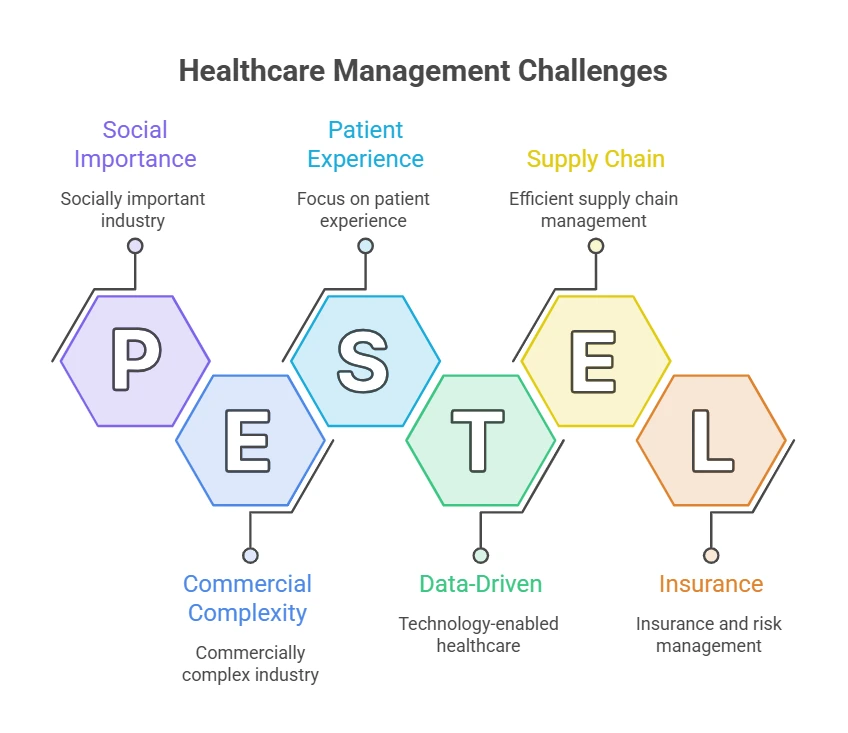
As healthcare becomes more data-driven and technology-enabled, managers need broader business capabilities.
For example, a hospital operations manager may work with patient flow, capacity, staffing, and service quality.
A healthcare analyst may work with business data and dashboards.
Similarly, an insurance professional may manage claims, provider networks, risk, or customer operations.
Therefore, an MBA in healthcare management can appeal to students who want management careers within a socially important and commercially complex industry.
MBA Healthcare Selection Process: What Do Colleges Evaluate?
The MBA healthcare selection process generally aims to evaluate whether the candidate is prepared for management education and has a clear career direction.
Several factors may be considered.
Academic Performance
Academic records help institutions understand a student's educational foundation.
However, academics may be only one part of the selection decision.
Entrance Performance
Where an entrance examination is required, the score may play an important role in shortlisting.
Students should check which examinations are accepted for the specific program.
Communication Skills
Healthcare managers interact with multiple stakeholders.
These can include patients, doctors, administrators, vendors, teams, and senior management.
Therefore, clear communication matters.
Career Clarity
Interviewers may ask why the candidate wants to enter healthcare management.
Weak answers such as "healthcare is growing" are often too generic.
A stronger response connects the candidate's background, interests, and target roles.
General Awareness
Students may be expected to understand current business and healthcare developments.
Reading about hospital operations, insurance, digital health, public health, and healthcare technology can improve interview preparation.
Problem-Solving Ability
Management programs value structured thinking.
Candidates may be asked situational questions to assess reasoning and decision-making.
How to Prepare for an MBA Healthcare Management Interview
The interview can be one of the most important stages of the admission process.
Students should prepare systematically.
Know Why You Want Healthcare Management
Be specific.
For example:
"I am interested in hospital operations and want to build skills in analytics, finance, and service management."
This is stronger than saying:
"I want to work in healthcare."
Understand the Healthcare Ecosystem
Know the major sectors within healthcare.
These include:
Hospitals
Insurance
Pharmaceuticals
Diagnostics
Health-tech
Medical technology
Consulting
Healthcare services
This shows that you understand the field beyond one job title.
Prepare Your Graduation Subjects
Students may be asked questions related to their undergraduate background.
Review important concepts.
Know Your Strengths and Weaknesses
Avoid memorised answers.
Use practical examples from academics, internships, projects, or work experience.
Follow Healthcare Trends
Students should understand topics such as:
Digital health
Healthcare analytics
Patient experience
Insurance
Hospital operations
Technology adoption
Healthcare infrastructure
This improves interview depth.
MBA Healthcare Fees: What Should Students Expect?
MBA healthcare fees vary considerably depending on the institution, location, program structure, facilities, and duration.
There is no single national fee for an MBA in healthcare management.
Students should therefore compare the total cost rather than only tuition.
Potential components can include:
Tuition fees
Registration fees
Examination fees
Learning resources
Hostel charges
Mess charges
Security deposits
Industry visits
Other institutional charges
How to Compare MBA Healthcare Fees Properly
Do not choose a college only because its headline fee looks lower.
Ask:
What is included in the fee?
A lower tuition fee may not include hostel, examination, or other charges.
What practical exposure is available?
Projects, internships, industry interaction, and corporate exposure can affect learning value.
What career support is available?
Understand how placement support works and what employers recruit for relevant roles.
What is the total two-year cost?
Students and parents should calculate the complete financial commitment.
This produces a more realistic comparison.
What Subjects Are Taught in an MBA in Healthcare Management?
Curriculum varies, but students generally study both core management and healthcare-related subjects.
Core Management Areas
These may include:
Marketing
Finance
Human resources
Operations
Business analytics
Economics
Strategy
Organisational behaviour
Healthcare-Specific Areas
Programs may also include:
Hospital operations
Healthcare finance
Healthcare marketing
Quality management
Healthcare analytics
Health insurance
Healthcare policy
Digital health
Patient experience
Healthcare supply chain
A strong curriculum should help students understand both business fundamentals and healthcare-sector applications.
MBA healthcare graduates can explore roles across multiple sectors.
Potential areas include:
Sector
Possible Entry-Level Roles
Hospitals
Operations Executive, Admin Executive
Health Insurance
Claims or Network Operations Roles
Healthcare Consulting
Analyst, Associate
Health-Tech
Operations or Business Analyst
Pharmaceuticals
Marketing, Operations, Business Development
Diagnostics
Centre Operations, Business Development
Healthcare Analytics
Business Analyst, Healthcare Analyst
Quality
Quality Executive
Patient Experience
Patient Relations or Experience Roles
Job titles vary by employer.
Therefore, students should focus on skills and responsibilities rather than titles alone.
Skills That Improve Healthcare Management Employability
Admission is only the first step.
Students should use the MBA period to build capabilities employers actually need.
Excel and Analytics
Healthcare organisations generate large amounts of data.
Students should develop comfort with spreadsheets, dashboards, and business analysis.
Communication
Healthcare managers coordinate across multidisciplinary teams.
Professional communication therefore matters.
Operations Thinking
Understanding patient flow, capacity, waiting time, and service efficiency can support hospital roles.
Financial Understanding
Managers should know basic budgeting, cost analysis, and financial decision-making.
Digital Awareness
Technology is becoming central to healthcare.
Knowledge of digital health, analytics, automation, and business systems can be valuable.
Problem-Solving
Recruiters value candidates who can identify issues, analyse information, and recommend practical solutions.
How to Choose the Right MBA Healthcare Management Program
Students should evaluate programs using a decision framework.
Check the Curriculum
Look for a balance of general management and healthcare subjects.
Evaluate Practical Learning
Case studies, live projects, internships, and industry interaction can improve understanding.
Review Faculty Exposure
Experienced faculty can connect theoretical concepts with practical management situations.
Assess Corporate Exposure
Interaction with professionals helps students understand employer expectations.
Review Placement Support
Placement support is important, but students should distinguish support from guaranteed employment.
Understand Location Advantage
Location can affect access to hospitals, companies, internships, and corporate interaction.
Compare Fees Against Value
The lowest fee is not always the best option.
Similarly, a higher fee does not automatically guarantee better outcomes.
Evaluate overall value.
Why Practical Management Education Matters
Healthcare is operationally complex.
Managers deal with people, technology, finances, processes, quality, and service delivery at the same time.
Therefore, classroom theory should be supported by practical learning.
At Asia Pacific Institute of Management, the emphasis on industry-oriented management education, experienced faculty, corporate exposure, practical learning, and placement support can help students build transferable management capabilities.
Students considering MBA healthcare management admission 2027 should review the relevant program details, eligibility, curriculum, fee structure, admission process, and placement support before applying.
A well-informed admission decision should consider both academic learning and long-term career fit.
MBA Healthcare Admission 2027 Checklist
Before applying, students should confirm:
Am I eligible?
Which entrance scores are accepted?
What documents are required?
What is the application deadline?
What is the total fee?
Is there an interview?
What does the curriculum include?
Are internships available?
What healthcare sectors are covered?
What placement support is offered?
What are the refund rules?
This checklist can prevent common admission mistakes.
Conclusion
MBA healthcare management admission 2027 is an important decision for students who want to build management careers within the healthcare industry.
The right program should provide more than a healthcare label.
Students should carefully evaluate MBA in healthcare management eligibility, MBA healthcare fees, curriculum, practical exposure, faculty, corporate interaction, and the MBA healthcare selection process.
Most importantly, choose a program that develops transferable skills across analytics, operations, finance, strategy, communication, and technology.
Students exploring MBA healthcare admission 2027 can review relevant management education opportunities at Asia Pacific Institute of Management, with its focus on industry-oriented learning, practical exposure, experienced faculty, corporate interaction, and placement support.
Make Your 2027 Move
Take the next step toward healthcare management with industry focused learning, practical exposure, corporate interaction, and career preparation.
Dr. Vikas Gupta is a distinguished academic in the education and research domain, specializing in finance and related interdisciplinary studies. He is known for his...
01.
What is MBA healthcare management admission 2027?
MBA healthcare management admission 2027 refers to the application and selection process for healthcare-focused management programs starting in the 2027 academic cycle. The process may include eligibility screening, entrance scores, applications, interviews, and document verification.
02.
What is the MBA in healthcare management eligibility?
Applicants generally need a recognised bachelor’s degree or equivalent qualification. Minimum marks, accepted academic backgrounds, entrance requirements, and other criteria differ by institution.
03.
What are MBA healthcare fees in India?
MBA healthcare fees vary significantly by institution, location, duration, facilities, and program structure. Students should check the official fee schedule and calculate tuition plus hostel and other applicable charges.
04.
What is the healthcare management admission process?
The process typically involves researching programs, checking eligibility, completing an application, submitting documents, appearing for required entrance or selection stages, attending an interview, and completing admission formalities after selection.
05.
What is the MBA healthcare selection process?
Selection may involve entrance examination scores, academics, interviews, group discussions, written assessments, work experience, or profile evaluation. The exact process varies between institutions.
06.
Can students from non-medical backgrounds apply?
Many healthcare management programs accept graduates from diverse academic backgrounds. However, students should verify the specific 2027 eligibility requirements of the institution.
07.
Is work experience required for MBA healthcare admission?
Work experience is not necessarily compulsory for a regular MBA. However, requirements vary by program. Executive healthcare programs are more likely to require professional experience.
08.
What careers can I pursue after an MBA in healthcare management?
Graduates may explore hospital operations, healthcare consulting, insurance, health-tech, analytics, pharmaceuticals, diagnostics, quality, patient experience, and business development roles.



















.webp) Call Us
Call Us