MBA Healthcare After Life Sciences: Jobs, Industries & Career Opportunities
Posted on 01 Oct 2026
By Dr. Vikas Gupta
Introduction
A degree in life sciences can provide a strong foundation in biology, healthcare, research, and scientific processes. However, not every graduate wants to continue in laboratory or research-oriented roles.
An MBA healthcare after life sciences can help graduates combine scientific knowledge with management and business skills. This combination can create opportunities across hospitals, healthcare services, pharmaceuticals, diagnostics, health-tech, consulting, and healthcare operations.
For graduates considering a transition from science to management, an MBA can provide structured exposure to strategy, finance, operations, marketing, analytics, and leadership. Moreover, healthcare-focused management education can help connect these skills with the needs of the healthcare industry.
Expand Your Healthcare Career
Combine life sciences knowledge with management skills to explore opportunities across hospitals, pharmaceuticals, health-tech, consulting, and healthcare operations.
Can You Pursue an MBA in Healthcare After Life Sciences?
Yes. Life sciences graduates can consider an MBA in healthcare management if they meet the eligibility requirements of the selected program.
A life sciences degree may include subjects related to biology, biotechnology, genetics, biochemistry, environmental science, or other scientific disciplines. The exact academic background varies by degree and institution.
An MBA adds a different skill set.
Students can develop knowledge of:
Healthcare management
Business strategy
Finance
Operations
Marketing
Human resources
Business analytics
Leadership
Project management
Therefore, an MBA can help life sciences graduates explore management-oriented healthcare careers.
However, eligibility requirements differ across programs. Students should always check the latest official admission criteria before applying.
Why Consider an MBA After Life Sciences?
An MBA after life sciences can be useful for graduates who want to move toward business, management, or healthcare administration.
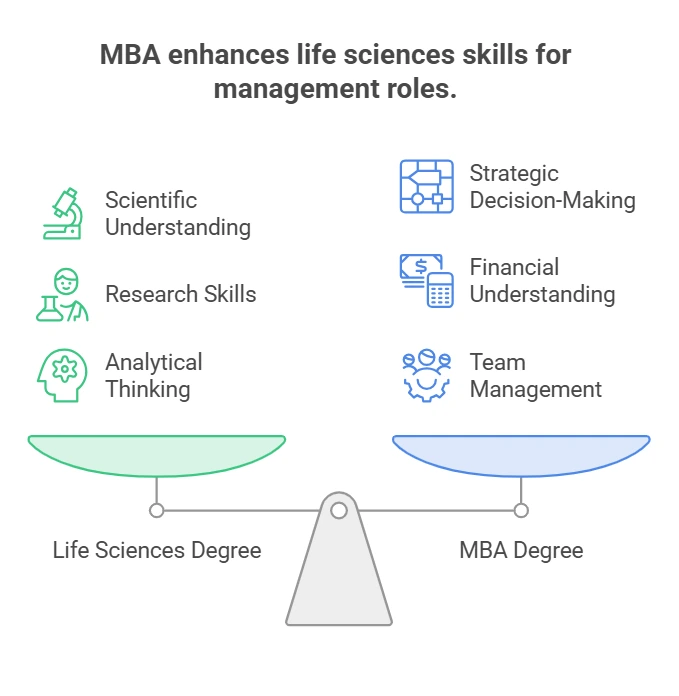
A life sciences degree can develop:
Scientific understanding
Research skills
Analytical thinking
Problem-solving
Data interpretation
Technical communication
Attention to detail
However, management roles require additional capabilities.
These include:
Strategic decision-making
Financial understanding
Team management
Business communication
Operations management
Marketing
Leadership
Project management
An MBA can help develop these capabilities in a structured learning environment.
Consequently, life sciences graduates can combine their scientific background with management expertise.
Their responsibilities can vary according to the organisation and position.
Some professionals may focus on hospital operations. Others may work in healthcare consulting, business development, analytics, health-tech, or pharmaceutical management.
Therefore, healthcare management offers multiple career directions beyond laboratory-based work.
Healthcare Jobs After Life Sciences
There are several potential healthcare jobs after life sciences for graduates who develop management capabilities.
1. Healthcare Operations
Healthcare operations professionals help organisations manage day-to-day processes.
Responsibilities may include:
Process coordination
Resource planning
Performance monitoring
Team coordination
Operational reporting
Service improvement
An MBA can help graduates understand the business principles behind operational decisions.
2. Hospital Administration
Hospital administration is another potential career direction.
Administrators may coordinate:
Administrative processes
Patient services
Staff requirements
Department activities
Operational planning
Documentation
Management education can provide knowledge of finance, operations, leadership, and organisational behaviour.
3. Healthcare Consulting
Healthcare consulting involves analysing organisational and business challenges.
Consultants may work on:
Market research
Healthcare strategy
Process improvement
Business planning
Operational efficiency
Organisational transformation
Life sciences graduates can bring scientific and analytical perspectives to consulting projects.
An MBA can complement these strengths with business and management knowledge.
4. Healthcare Business Development
Business development professionals help identify growth opportunities.
Their work can involve:
Market analysis
Partnership development
Client communication
Service development
Business planning
Relationship management
Communication and negotiation skills are especially important in this area.
5. Healthcare Analytics
Healthcare organisations increasingly use data to support decisions.
Professionals can work with data related to:
Operations
Markets
Customer behaviour
Business performance
Service utilisation
Organisational efficiency
Life sciences graduates already have analytical exposure. Additional training in business analytics can make that foundation more applicable to management roles.
6. Health-Tech Management
Technology is becoming an important part of healthcare delivery.
Health-tech organisations need professionals who understand healthcare environments and business operations.
Potential functions include:
Product operations
Business development
Healthcare partnerships
Project management
Customer success
Healthcare strategy
Additional digital skills can be valuable for technology-focused roles.
These roles generally focus on management, business, operations, or organisational functions rather than direct clinical practice.
However, job responsibilities vary between employers.
MBA Healthcare After Life Sciences: Industries to Explore
An MBA can help life sciences graduates explore several healthcare-related industries.
Hospitals and Healthcare Services
Hospitals and healthcare networks require professionals across administration, operations, quality, finance, business development, and patient services.
Pharmaceutical Industry
Pharmaceutical companies have management requirements across marketing, sales, operations, supply chain, strategy, and business development.
A life sciences background can provide useful scientific context.
Diagnostics
Diagnostics organisations combine scientific processes with complex business operations.
Graduates can explore management roles involving operations, quality, business development, and administration.
Health-Tech
Health-tech companies combine healthcare with technology.
Professionals may work across product operations, partnerships, business development, implementation, and strategy.
Medical Technology
Medical technology companies require professionals who understand healthcare markets and business processes.
Management roles can include sales management, business development, marketing, operations, and project management.
Healthcare Consulting
Consulting organisations work on strategic, operational, and business challenges across healthcare.
An MBA can help graduates develop structured problem-solving and business analysis capabilities.
Health Insurance
Healthcare financing and insurance involve business operations, customer management, analytics, claims processes, and strategic planning.
Professionals with healthcare knowledge and management skills can explore several functions within this sector.
Skills to Build Alongside an MBA
An MBA provides structured management education. However, students should also develop practical professional skills.
Business Communication
Management professionals regularly communicate with teams, clients, senior executives, and stakeholders.
Strong communication can therefore improve workplace effectiveness.
Data and Analytics
Data-driven decision-making is increasingly important.
Students can develop knowledge of:
Excel
Business intelligence
Data interpretation
Reporting
Healthcare metrics
Leadership
Leadership skills become increasingly important as responsibilities grow.
Students can build these skills through group projects, presentations, internships, and professional experience.
Financial Awareness
Healthcare decisions often involve budgets and resource allocation.
Basic financial understanding can help professionals evaluate business decisions more effectively.
Project Management
Healthcare projects require coordination between people, processes, timelines, and resources.
Project management skills can therefore be valuable across many healthcare functions.
MBA After Life Sciences: Choosing the Right Career Direction
Not every life sciences graduate has the same career goals.
Before choosing an MBA specialisation, consider your interests.
If You Like Operations
Consider healthcare operations or hospital administration.
If You Enjoy Analysis
Healthcare analytics or consulting may be worth exploring.
If You Prefer Business Development
Healthcare business development, partnerships, and commercial roles may be relevant.
If You Enjoy Technology
Health-tech and digital healthcare management can provide potential opportunities.
If You Prefer the Pharmaceutical Industry
Pharmaceutical management, marketing, operations, and business development may be relevant.
This approach can help students connect their existing strengths with their future career goals.
How to Transition From Life Sciences to Healthcare Management
The transition does not need to happen overnight.
Step 1: Understand Your Career Goal
Identify the type of role you want after your MBA.
Step 2: Identify Skill Gaps
Compare your current scientific skills with the capabilities required for your target role.
Step 3: Choose Relevant Management Education
Review the curriculum and identify whether it covers healthcare, strategy, operations, finance, analytics, and leadership.
Step 4: Gain Practical Exposure
Internships, projects, case studies, and industry interactions can provide useful experience.
Step 5: Build a Management-Oriented Resume
Highlight projects involving teamwork, leadership, analysis, communication, and problem-solving.
Step 6: Develop Industry Knowledge
Follow healthcare business developments, technology trends, regulatory changes, and organisational challenges.
This can help you speak confidently about the healthcare industry during interviews.
Career Growth After an MBA in Healthcare
Career progression depends on several factors.
These include:
Previous education
Work experience
Management skills
Technical capabilities
Communication
Employer
Industry
Job responsibilities
Professional performance
A graduate may initially enter an entry-level or associate role.
With experience, professionals may progress toward roles such as:
Assistant manager
Manager
Senior manager
Project lead
Strategy professional
Operations leader
Business development leader
However, career progression is not automatic.
Professionals need to demonstrate performance, leadership, and relevant expertise at every stage.
Salary After MBA Healthcare for Life Sciences Graduates
Salary expectations should be evaluated carefully.
There is no single salary applicable to all life sciences graduates after an MBA.
Compensation can vary based on:
Role
Organisation
Industry
Location
Previous experience
Management responsibilities
Skills
Academic profile
Professional performance
Therefore, students should evaluate career opportunities based on learning potential, role quality, growth opportunities, and responsibilities rather than salary alone.
Why Practical Learning Matters
Healthcare management is highly practical.
Students need to understand how management concepts apply to real organisations.
Therefore, case studies, projects, corporate interactions, presentations, and industry exposure can strengthen management learning.
Asia Pacific Institute of Management focuses on industry-oriented management education, practical learning, experienced faculty, and corporate exposure.
For life sciences graduates, this approach can help connect scientific knowledge with management concepts and real-world business challenges.
Common Mistakes Life Sciences Graduates Should Avoid
Choosing an MBA Without a Career Goal
First identify what you want to do after graduation.
Assuming Every Healthcare Role Is Clinical
Healthcare includes extensive management, business, technology, operations, and administrative functions.
Ignoring Communication Skills
Management careers require strong communication across multiple stakeholders.
Focusing Only on Salary
Consider the role, learning opportunities, industry, responsibilities, and career development potential.
Not Checking Eligibility
Always verify the latest admission requirements before applying.
Ignoring Practical Exposure
Try to build experience through projects, internships, case studies, and industry interactions.
An MBA healthcare after life sciences can help graduates move beyond traditional laboratory and research-oriented career paths. By combining scientific knowledge with management education, graduates can explore opportunities across hospitals, healthcare services, pharmaceuticals, diagnostics, health-tech, consulting, and healthcare operations.
The right career path depends on your interests, strengths, skills, and long-term goals. Therefore, research potential roles before selecting a management specialisation.
For students seeking industry-oriented management education, Asia Pacific Institute of Management offers practical learning, corporate exposure, experienced faculty, and career-focused development.
If you are a life sciences graduate planning a transition into healthcare management, explore how an MBA can help you build the business and leadership skills required for the next stage of your career.
Transform Science Into Management
Turn your scientific foundation into practical business capabilities for healthcare operations, consulting, analytics, and industry leadership opportunities.
Dr. Vikas Gupta is a distinguished academic in the education and research domain, specializing in finance and related interdisciplinary studies. He is known for his...
01.
Can I pursue an MBA in healthcare after life sciences?
Yes. Life sciences graduates can pursue healthcare management programs if they meet the eligibility requirements of the selected institution. An MBA can help them develop business, leadership, operations, and healthcare management skills.
02.
What are the healthcare jobs after life sciences with an MBA?
Potential roles include healthcare operations, hospital administration, healthcare consulting, business development, healthcare analytics, health-tech management, pharmaceutical management, diagnostics management, and project management.
03.
Is hospital management after life sciences a good career option?
Hospital management can be a suitable option for graduates interested in healthcare administration and operations. An MBA can provide knowledge of strategy, finance, operations, leadership, and organisational management.
04.
What are non-clinical careers for life sciences graduates?
Potential non-clinical careers include healthcare management, consulting, healthcare analytics, pharmaceutical management, diagnostics management, health-tech, business development, quality management, and healthcare operations.
05.
Can life sciences graduates work in healthcare consulting?
Yes. Life sciences graduates with management education can explore healthcare consulting. Their scientific and analytical background can complement skills in strategy, operations, business analysis, and client management.
06.
Can an MBA after life sciences lead to health-tech careers?
An MBA can provide business and management skills useful for health-tech roles. Graduates may explore product operations, partnerships, business development, implementation, project management, and strategy.
07.
Which industries can life sciences graduates enter after an MBA?
Potential industries include hospitals, healthcare services, pharmaceuticals, diagnostics, health-tech, medical technology, healthcare consulting, and health insurance.
08.
Does an MBA guarantee a management job?
No. An MBA does not guarantee a specific job or salary. Career outcomes depend on skills, experience, academic performance, employer requirements, market conditions, and professional development.


















.webp) Call Us
Call Us