Hospital Administration vs Healthcare Management: Roles, Skills & Career Scope
Posted on 12 Oct 2026
By Dr. Vikas Gupta
Introduction
The healthcare industry offers diverse career opportunities beyond clinical practice. Students interested in leadership, operations, and organizational strategy can explore careers in hospital administration or healthcare management. However, understanding hospital administration vs healthcare management is essential before choosing a suitable career path.
Both fields focus on improving healthcare services, supporting patients, and managing resources effectively. However, they differ in their scope, responsibilities, and career opportunities. Hospital administration generally focuses on the daily functioning of hospitals. Healthcare management can extend to broader healthcare organizations, systems, and services.
For students and working professionals in India, understanding these differences can help them make informed education and career decisions. This guide explains the roles, essential skills, career scope, and educational pathways associated with both fields.
Build Your Healthcare Career
Explore management education that builds essential leadership, operational, and business skills to help you pursue rewarding opportunities across the healthcare industry.
Hospital administration involves planning, coordinating, and supervising the operational activities of a hospital. Its primary objective is to ensure that hospital services function efficiently while maintaining patient safety and service quality.
Hospital administrators coordinate departments, manage resources, support regulatory compliance, and help improve the patient experience. They may work in multispecialty hospitals, specialty clinics, diagnostic centres, and other healthcare facilities.
Key responsibilities of hospital administrators
Hospital administrators handle several operational and administrative responsibilities, including:
Hospital operations: Coordinating departments, schedules, facilities, and daily activities.
Staff coordination: Supporting workforce planning and communication between clinical and non-clinical teams.
Budget management: Monitoring expenses, resource allocation, and operational budgets.
Patient services: Improving registration, admission, discharge, and grievance-handling processes.
Quality and compliance: Supporting hospital policies, documentation, safety standards, and applicable regulations.
Facility management: Overseeing equipment availability, maintenance coordination, and infrastructure requirements.
For example, a hospital administrator may address long patient waiting times by improving appointment scheduling and coordination between departments.
Therefore, hospital administration suits individuals who enjoy structured operations, problem-solving, team coordination, and service delivery.
What Is Healthcare Management?
Healthcare management is a broader discipline concerned with planning, leading, and improving healthcare organizations and services. It combines management principles with an understanding of healthcare delivery, public health needs, finance, technology, and organizational strategy.
Healthcare managers may work in hospitals, healthcare networks, diagnostic organizations, insurance companies, health technology businesses, and other healthcare-related organizations. Their responsibilities depend on the employer, department, and seniority of the role.
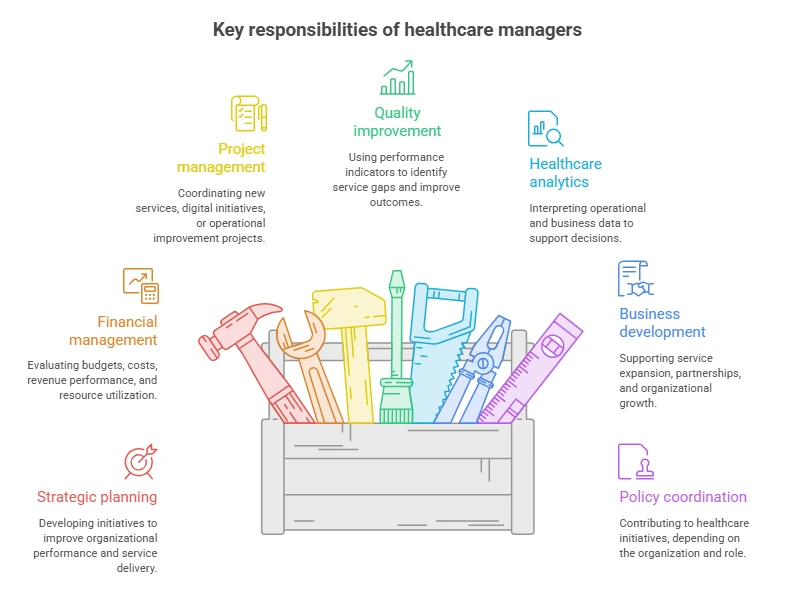
Strategic planning: Developing initiatives to improve organizational performance and service delivery.
Financial management: Evaluating budgets, costs, revenue performance, and resource utilization.
Project management: Coordinating new services, digital initiatives, or operational improvement projects.
Quality improvement: Using performance indicators to identify service gaps and improve outcomes.
Healthcare analytics: Interpreting operational and business data to support decisions.
Business development: Supporting service expansion, partnerships, and organizational growth.
Policy and programme coordination: Contributing to healthcare initiatives, depending on the organization and role.
For instance, a healthcare manager may evaluate whether a healthcare organization should expand its telehealth services or introduce a new patient-care programme.
Consequently, healthcare management may suit students who are interested in leadership, business strategy, analytics, and improving healthcare services across different settings.
Hospital Administration vs Healthcare Management: Key Differences
Although these disciplines overlap, their emphasis and potential career pathways can differ.
Comparison factor
Hospital administration
Healthcare management
Primary focus
Hospital operations and administration
Management across healthcare organizations and services
Typical workplace
Hospitals, clinics, and healthcare facilities
Hospitals, healthcare networks, insurers, health technology organizations, and other healthcare businesses
Main responsibilities
Daily operations, staff coordination, patient services, and compliance support
Strategy, finance, projects, performance improvement, and organizational development
Work environment
Often closely connected to hospital operations
May involve operational, corporate, analytical, or strategic work
Key skills
Coordination, communication, operations, and problem-solving
Leadership, analytical thinking, planning, finance, and decision-making
Career progression
May progress towards hospital operations or administrative leadership
May progress towards departmental, business, operational, or strategic leadership
Scope
Often focused on a specific healthcare facility or hospital network
Potentially broader across the healthcare sector
These differences are general rather than absolute. Large hospitals may have strategic management teams, while healthcare managers may also supervise daily hospital operations.
Hospital management generally concentrates on the efficient functioning of hospitals and their departments. Healthcare management can cover hospital operations as well as other healthcare businesses, systems, and services.
However, job titles vary between employers. Therefore, students should examine the actual responsibilities of a role instead of relying on its title alone.
Hospital Administrator vs Healthcare Manager: Roles and Responsibilities
Understanding the difference between a hospital administrator and a healthcare manager becomes easier when you consider their everyday work.
1. Hospital administrator
A hospital administrator focuses on operational coordination and administrative effectiveness. The role often involves working with clinical teams, support departments, vendors, and hospital leadership.
Typical responsibilities include:
Coordinating daily hospital activities.
Monitoring service efficiency and patient flow.
Supporting staffing and resource planning.
Maintaining administrative records and processes.
Helping implement quality and safety procedures.
Resolving operational issues through departmental coordination.
Depending on the hospital, an administrator may also contribute to budgets, strategy, and long-term planning.
2. Healthcare manager
A healthcare manager may focus on operational performance, business planning, service development, or broader organizational goals.
Typical responsibilities include:
Analysing performance and operational data.
Developing improvement plans and project proposals.
Supporting budgets and financial decisions.
Coordinating cross-functional teams.
Evaluating service expansion opportunities.
Monitoring performance indicators and business objectives.
For example, a hospital administrator might improve patient registration procedures. A healthcare manager might assess registration performance across several facilities and develop a wider improvement strategy.
In practice, these responsibilities can overlap considerably, especially in smaller organizations.
Essential Skills for Hospital Administration and Healthcare Management
Both career paths require strong communication, leadership, ethical judgment, and an understanding of healthcare delivery. However, some skills become more important depending on the position.
Skills needed for hospital administration
1. Operational planning
Hospital administrators must coordinate people, schedules, facilities, and services. Strong planning helps reduce operational delays and improve resource utilization.
2. Communication and coordination
Hospitals involve clinical and non-clinical teams working under pressure. Clear communication helps departments coordinate effectively and resolve service issues.
3. Problem-solving
Administrators often need to address scheduling conflicts, resource shortages, patient-service complaints, and workflow disruptions.
4. Knowledge of quality and compliance
An understanding of hospital policies, documentation, patient safety, and relevant regulations supports reliable operations.
5. Patient-service orientation
Although administrators may not provide clinical care, their decisions can affect patient experience. Therefore, they need to understand the importance of respectful, timely, and accessible services.
Skills needed for healthcare management
1. Strategic thinking
Healthcare managers should understand organizational goals and identify opportunities to improve performance.
2. Financial and business understanding
Budgeting, cost analysis, financial planning, and resource allocation can be important parts of management roles.
3. Data analysis
Performance dashboards, service indicators, and operational reports help managers identify trends and evaluate decisions.
4. Leadership and change management
Healthcare organizations continually adapt to new technologies, patient expectations, and operational requirements. Managers need to guide teams through these changes.
5. Project management
Healthcare managers may coordinate digital transformation, service expansion, quality improvement, or new operational initiatives.
Additionally, digital literacy is becoming increasingly valuable in both fields. Familiarity with healthcare information systems, electronic records, and data-driven workflows can strengthen a candidate's profile.
Explore Management Opportunities
Discover management learning opportunities that strengthen your decision-making, improve healthcare operations knowledge, and prepare you for evolving professional responsibilities.
The hospital administration career scope in India is connected to the need for organized healthcare delivery, efficient hospital operations, and better patient experiences.
Hospitals and other healthcare facilities need professionals who can coordinate services, manage resources, and support quality improvement. However, opportunities depend on qualifications, practical experience, location, and employer requirements.
Career opportunities in hospital administration
Graduates may explore entry-level or developing roles such as:
Hospital administration executive
Hospital operations coordinator
Patient services executive
Quality and accreditation coordinator
Medical records or administrative coordinator
Healthcare facility operations executive
With relevant experience, suitable qualifications, and demonstrated performance, professionals may progress towards roles such as hospital operations manager, administrative manager, or senior hospital leadership.
However, senior positions usually require substantial operational experience and a strong understanding of healthcare systems.
Where can hospital administrators work?
Potential workplaces include:
Multispecialty and specialty hospitals
Clinics and day-care facilities
Diagnostic and imaging centres
Rehabilitation and long-term care facilities
Hospital groups and healthcare networks
The specific opportunities available to a candidate depend on the employer's structure and the candidate's qualifications.
Healthcare Management Career Scope in India
Healthcare management can offer opportunities beyond hospital administration. Professionals may work in operational, business, project, analytical, or strategic functions across the healthcare sector.
As organizations evaluate service quality, financial sustainability, technology adoption, and patient experience, management capabilities can support a range of business and operational needs.
Career opportunities in healthcare management
Potential career paths include:
Healthcare management executive
Healthcare operations analyst
Healthcare project coordinator
Business development executive in healthcare
Healthcare quality improvement coordinator
Healthcare programme coordinator
Healthcare operations manager, with suitable experience
Depending on their qualifications and experience, professionals may also explore healthcare consulting, health technology operations, insurance operations, or healthcare network management.
Some specialist positions require additional technical knowledge, relevant experience, or professional credentials. Therefore, students should review job descriptions before selecting a course.
Emerging areas within healthcare management
Healthcare organizations increasingly use technology and data to improve service delivery. This creates potential opportunities in areas such as:
Digital health operations
Telehealth service coordination
Healthcare analytics
Patient experience management
Quality and process improvement
Healthcare supply chain management
Nevertheless, demand varies by region, employer, and role. Students should assess current job descriptions and employer requirements rather than assuming every emerging area offers immediate entry-level opportunities.
Salary Expectations: Hospital Administration vs Healthcare Management
Salary is an important consideration when comparing these career paths. However, there is no single salary range that applies to every hospital administrator or healthcare manager.
Compensation depends on several factors:
Educational qualifications and specialization
Relevant work experience
Employer size and organizational structure
City and cost of living
Functional responsibilities
Technical and managerial skills
Entry-level administrative positions generally have different responsibilities from experienced management roles. Similarly, a healthcare management graduate does not automatically qualify for a senior managerial position.
Therefore, compare salaries for similar job levels rather than comparing job titles alone. Review current vacancies, required experience, responsibilities, and compensation details before making a decision.
Students should also evaluate learning opportunities, career progression, work environment, and long-term professional goals alongside starting salary.
Which Course Should You Choose?
The right educational pathway depends on your interests, previous education, and intended career direction.
Choose hospital administration if you prefer:
Coordinating daily hospital operations.
Improving patient-service processes.
Working closely with hospital departments.
Managing administrative systems and resources.
Building a career in hospital operations and facility administration.
Choose healthcare management if you prefer:
Understanding healthcare business and strategy.
Working with budgets, projects, and performance data.
Exploring opportunities across different healthcare organizations.
Supporting organizational growth and service improvement.
Developing broader management and leadership capabilities.
These preferences are guidelines, not strict boundaries. Both disciplines can lead to operational and leadership responsibilities over time.
What should you check before enrolling?
Before selecting a programme, review the following factors:
Eligibility: Confirm the academic qualifications and entrance requirements.
Curriculum: Check whether the subjects align with your preferred career path.
Practical exposure: Look for relevant projects, case studies, internships, or industry interaction.
Faculty expertise: Assess the faculty's academic and professional experience.
Career support: Understand the placement assistance, employer engagement, and career guidance available.
Programme recognition: Verify the institution's applicable approvals and the programme's recognition status.
Total cost: Consider tuition, accommodation, travel, and other expenses.
Asia Pacific Institute of Management can be one institution to explore when researching management education. Prospective students should review its current programme offerings, curriculum, admission requirements, practical learning opportunities, and career support before deciding whether a particular programme fits their goals.
How to Prepare for a Career in Healthcare Management
Choosing a course is only one part of career preparation. Students can also develop practical capabilities that employers value.
Step 1: Understand the healthcare ecosystem
Learn how hospitals, diagnostic services, insurance providers, digital health businesses, and other healthcare organizations operate.
Step 2: Build management fundamentals
Develop your understanding of operations, accounting, organizational behaviour, communication, and project management.
Step 3: Gain practical exposure
Where possible, participate in internships, live projects, case studies, or healthcare-related assignments. These experiences can help connect classroom concepts with real operational challenges.
Step 4: Improve analytical skills
Learn to interpret basic performance indicators, spreadsheets, budgets, and operational reports. These skills can support both administrative and broader management responsibilities.
Step 5: Develop professional communication
Healthcare managers coordinate with people from different professional backgrounds. Clear writing, presentations, teamwork, and conflict resolution are therefore valuable.
Step 6: Research entry-level job requirements
Review vacancies for roles that interest you. Identify recurring skills, qualifications, software knowledge, and experience requirements. Use these findings to guide your learning plan.
The comparison of hospital administration vs healthcare management comes down to the scope of work, preferred responsibilities, and long-term career goals.
Hospital administration generally focuses on hospital operations, administrative coordination, and patient-service efficiency. Healthcare management may offer broader opportunities across healthcare operations, business planning, projects, analytics, and organizational development.
Both paths require communication, problem-solving, ethical judgment, and a commitment to improving healthcare services. Therefore, students should evaluate their interests, qualifications, preferred work environment, and career aspirations before choosing a programme.
If you are exploring management education, research the curriculum, practical learning opportunities, faculty expertise, and career support available at Asia Pacific Institute of Management. Review current programme details and admission requirements to determine whether the available options align with your professional goals.
Shape Your Leadership Future
Compare your career interests, explore relevant management education, and take the next step toward leadership opportunities in healthcare organizations.
Dr. Vikas Gupta is a distinguished academic in the education and research domain, specializing in finance and related interdisciplinary studies. He is known for his...
01.
What is the difference between hospital administration and healthcare management?
Hospital administration primarily focuses on the daily operations and administrative functions of hospitals. Healthcare management has a broader potential scope, including strategy, finance, projects, and operations across different healthcare organizations.
02.
Is hospital administration the same as healthcare management?
No. The disciplines overlap, but their emphasis can differ. Hospital administration generally centres on hospital operations, while healthcare management may cover wider organizational and business functions across the healthcare sector.
03.
Which is better: hospital administration or healthcare management?
Neither is universally better. Hospital administration may suit people interested in hospital operations and patient services. Healthcare management may suit those interested in broader business, analytical, strategic, or operational responsibilities.
04.
What are the main healthcare management roles?
Common possibilities include healthcare operations executive, project coordinator, quality improvement coordinator, business development executive, operations analyst, and healthcare programme coordinator. Specific eligibility depends on the position and employer.
05.
What is the career scope of hospital administration in India?
Hospital administration offers potential opportunities in hospitals, clinics, diagnostic centres, and healthcare networks. Career progression may lead towards operational and administrative leadership, depending on qualifications and experience.
06.
Can a hospital administrator become a healthcare manager?
Yes. A hospital administrator can move into healthcare management by developing skills in strategy, budgeting, analytics, project management, and organizational planning. Relevant experience and further education may support this transition.
07.
Is healthcare management suitable for non-medical students?
Many healthcare management programmes accept eligible graduates from non-medical backgrounds. However, admission criteria vary by programme. Students should verify eligibility and assess whether they have an interest in healthcare systems and management.
08.
What skills are important for a career in hospital administration?
Important skills include operational planning, communication, problem-solving, staff coordination, patient-service awareness, and knowledge of quality and compliance processes. The precise requirements depend on the employer and position.


















.webp) Call Us
Call Us