The Role of Healthcare Managers in Ayushman Bharat Digital Mission (ABDM) Implementation
Posted on 19 Jun 2026
By Dr. Vikas Gupta
Introduction
India's healthcare sector is undergoing a significant digital transformation. From electronic health records and telemedicine platforms to interoperable healthcare systems, technology is reshaping how healthcare services are delivered and managed.
At the center of this transformation is the Ayushman Bharat Digital Mission (ABDM), a nationwide initiative designed to create a seamless digital health ecosystem.
While technology forms the foundation of this mission, successful implementation depends heavily on healthcare managers who can bridge the gap between healthcare delivery, digital systems, and operational execution.
As healthcare organizations adopt digital platforms and new workflows, demand for professionals capable of managing these transitions is increasing rapidly. Consequently, ayushman bharat digital mission jobs are emerging as a promising career pathway for healthcare management graduates.
This article explores how healthcare managers contribute to ABDM implementation and why digital health expertise is becoming essential for future healthcare leaders.
Ayushman Bharat Digital Mission Jobs: Healthcare Manager Roles
What Is the Ayushman Bharat Digital Mission?
The Ayushman Bharat Digital Mission aims to create an integrated digital healthcare infrastructure that enables secure and efficient exchange of health information.
The mission seeks to improve:
Continuity of care
Patient access to health records
Healthcare efficiency
Data-driven decision-making
Interoperability across healthcare providers
Key components of the mission include:
ABHA (Ayushman Bharat Health Account)
Healthcare Professional Registry
Health Facility Registry
Electronic Health Records
Consent-based data sharing systems
The initiative supports a connected healthcare ecosystem across public and private sectors.
Why ABDM Matters for India's Healthcare System
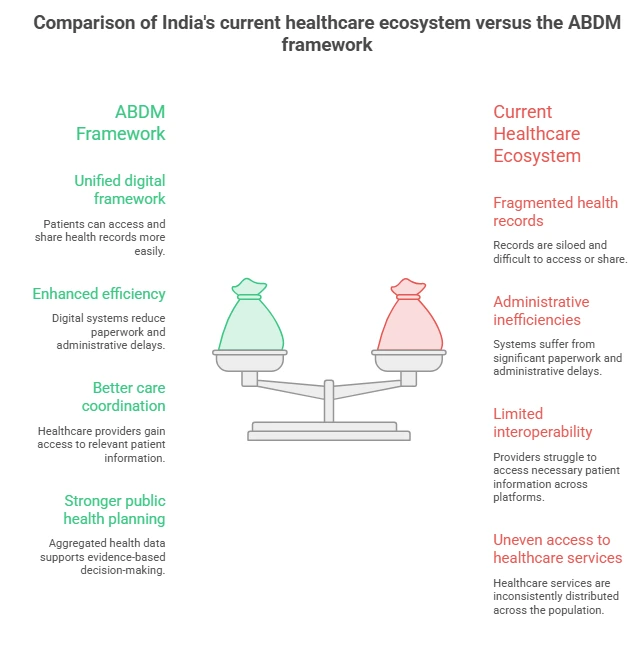
India's healthcare ecosystem faces several challenges.
These include:
Fragmented health records
Limited interoperability
Administrative inefficiencies
Uneven access to healthcare services
ABDM addresses these issues by creating a unified digital framework.
Collaboration between government agencies and private healthcare organizations supports:
Technology adoption
Infrastructure development
Service delivery innovation
Digital health expansion
Healthcare managers play an important role in coordinating these partnerships.
They help align stakeholder expectations, manage implementation challenges, and support sustainable healthcare innovation.
Challenges in ABDM Implementation
Despite its potential, implementation presents several challenges.
Technology Adoption
Healthcare professionals may require training and support.
Interoperability Issues
Different systems must communicate effectively.
Data Privacy Concerns
Organizations must protect sensitive patient information.
Change Management
Transitioning from traditional processes requires careful planning.
Healthcare managers help address these challenges through effective leadership and coordination.
Skills Required for Digital Health Leadership
Students interested in digital healthcare careers should focus on developing key competencies.
Healthcare Operations Knowledge
Understanding healthcare delivery systems.
Technology Awareness
Learning healthcare information systems and digital platforms.
Data Management Skills
Supporting data-driven decision-making.
Regulatory Understanding
Staying informed about digital health standards.
Leadership and Communication
Managing teams and driving organizational change.
These capabilities are increasingly valuable across healthcare organizations.
How Healthcare Management Education Supports Digital Careers
Healthcare management programs help students build expertise in:
Healthcare information systems
Hospital operations
Healthcare analytics
Digital transformation
Quality management
Strategic leadership
Industry-oriented learning ensures graduates understand both healthcare processes and technology implementation.
Institutions such as Asia Pacific Institute of Management emphasize practical exposure, healthcare-focused management education, and industry engagement that prepare students for emerging digital healthcare roles.
The Future of ABDM and Healthcare Careers
India's digital health ecosystem is expected to expand significantly in the coming years.
Future developments may include:
Wider adoption of electronic health records
Increased interoperability
Advanced healthcare analytics
AI-enabled healthcare solutions
Enhanced patient engagement
As these innovations accelerate, healthcare managers will play an increasingly strategic role.
Professionals who combine healthcare expertise with digital competencies will be well-positioned for future leadership opportunities.
Conclusion
The Ayushman Bharat Digital Mission represents a major step toward a more connected, efficient, and patient-centric healthcare system.
However, technology alone cannot drive transformation. Successful implementation depends on healthcare managers who can integrate digital systems into everyday healthcare operations.
As demand for ayushman bharat digital mission jobs continues to grow, professionals with expertise in digital health, healthcare operations, and change management will play a critical role in shaping India's healthcare future.
For students aspiring to build careers in healthcare leadership, understanding digital health ecosystems, the ABHA registration system, and public private partnership healthcare models will become increasingly important in the years ahead.
Shape Digital Healthcare
Develop leadership capabilities to manage healthcare ecosystems, implement technology solutions, and improve patient experiences.
Dr. Vikas Gupta is a distinguished academic in the education and research domain, specializing in finance and related interdisciplinary studies. He is known for his...



















.webp) Call Us
Call Us