Best Time to Pursue an Executive MBA in Healthcare During Your Career
Posted on 21 Sep 2026
By Dr. Vikas Gupta
Introduction
An Executive MBA can be an important step for healthcare professionals who want to move from functional responsibilities into broader management and leadership roles. However, timing matters.
The best time to pursue an executive MBA is not determined by age alone. It depends on your work experience, career goals, current responsibilities, learning needs, and readiness for management.
For healthcare professionals, the decision can be even more nuanced. Doctors, hospital administrators, pharmaceutical professionals, health-tech employees, insurance professionals, and healthcare operations managers may reach career transition points at different stages.
Therefore, instead of asking, "What is the perfect year to do an Executive MBA?", ask:
"Have I reached a point where management education can solve a real career need?"
This approach can help professionals make a more informed decision.
Advance Your Healthcare Leadership
Build strategic leadership skills and prepare for broader healthcare responsibilities when your experience and career goals align with management education.
The best time to pursue an executive MBA is generally when you have enough professional experience to understand management challenges and a clear reason to develop broader business and leadership capabilities.
For many professionals, this happens after gaining meaningful workplace exposure.
However, there is no universal experience requirement or ideal age. Program eligibility varies by institution, while career readiness depends on the individual.
An Executive MBA may become particularly relevant when you:
Start managing people
Take responsibility for business outcomes
Move into cross-functional projects
Participate in strategic decisions
Manage budgets or resources
Need stronger financial knowledge
Want to transition into leadership
Need broader business exposure
Want to move beyond a specialist role
The important factor is the connection between your current career situation and what you expect the program to provide.
When to Do Executive MBA: 5 Career Signals
Rather than choosing a program simply because you have reached a particular number of years in the workforce, look for career signals.
1. Your Responsibilities Are Expanding
Suppose you started your career in healthcare operations.
Initially, your work may have focused on individual processes. Over time, you may become responsible for teams, vendors, budgets, performance targets, or multiple departments.
At this stage, technical knowledge alone may not cover every management challenge.
An Executive MBA can provide structured learning in areas such as:
Finance
Strategy
Operations
Marketing
Leadership
Analytics
Organisational behaviour
2. You Are Moving Toward Management
Another signal is a planned move into management.
If your next career step involves managing teams or business units, you may benefit from formal management education.
For example, a healthcare professional may want to move from:
Functional role → Team leadership → Department management → Strategic responsibility
An Executive MBA can complement this progression by developing broader management knowledge.
Professional experience can provide context for classroom learning.
For example, a finance subject may become more meaningful when you have already encountered budgeting challenges. Similarly, organisational behaviour can become more practical when you have experienced team dynamics yourself.
Work experience can help you connect:
Theory → Workplace problem → Analysis → Management decision
However, more experience does not automatically mean better outcomes.
Someone with extensive experience but no clear learning objective may gain less from a program than someone with moderate experience and a well-defined career goal.
Therefore, quality of experience and career clarity matter alongside years of experience.
Should You Do an Executive MBA Early in Your Career?
Some professionals consider an Executive MBA relatively early.
This can make sense when the program's eligibility criteria are met and the professional has a clear management objective.
However, there are some questions to consider.
Ask yourself:
Do I understand the type of management work I want?
Have I experienced workplace responsibilities?
Can I relate business concepts to real situations?
Am I ready to balance work and study?
Will the program address a genuine skill gap?
If the answer to these questions is unclear, gaining additional professional exposure may help clarify your goals.
The decision should therefore be based on career readiness rather than simply completing a qualification as quickly as possible.
MBA for Mid-Career Professionals: When Does It Make Sense?
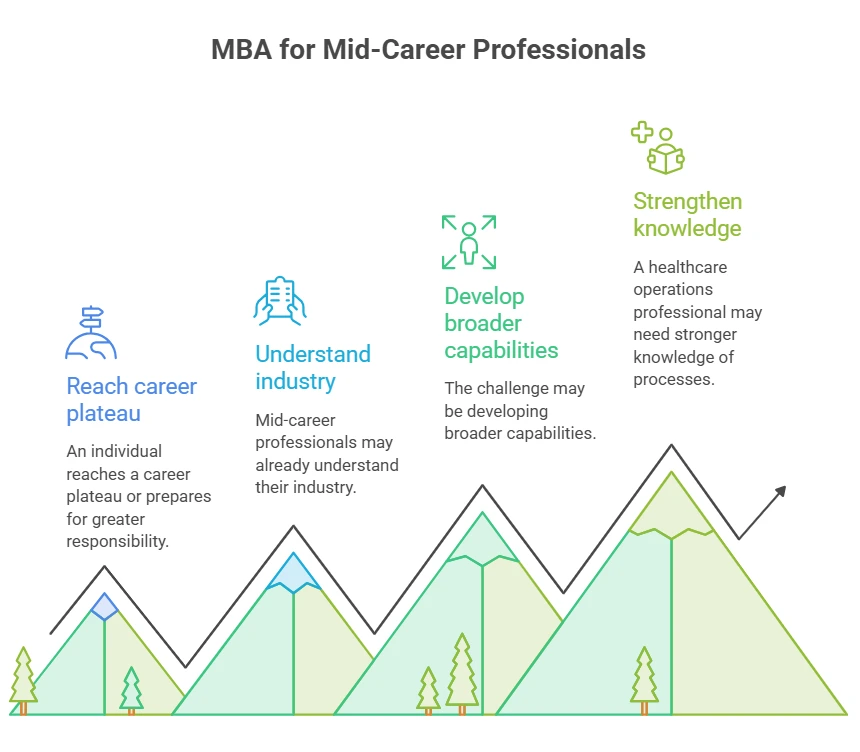
An MBA for mid career professionals can be particularly relevant when an individual reaches a career plateau or prepares for greater responsibility.
Mid-career professionals may already understand their industry.
Their challenge may instead be developing broader capabilities.
For example, a healthcare operations professional may understand day-to-day processes but need stronger knowledge of:
Business strategy
Financial management
Leadership
Organisational design
Analytics
Change management
An Executive MBA can provide a structured framework for developing these capabilities.
Signs You May Be Ready
You may want to consider an Executive MBA when:
You have meaningful professional experience.
Your responsibilities are expanding.
You want management or leadership responsibility.
You are involved in strategic projects.
You want to move across functions.
You have identified specific skill gaps.
You can realistically commit time to the program.
Healthcare Executive Education: Why Industry Context Matters
When Is the Right Time for Doctors and Clinical Professionals?
Doctors and other clinical professionals may approach an Executive MBA differently from other professionals.
A clinician may initially focus primarily on patient care.
Later, responsibilities may expand to include:
Department management
Team leadership
Hospital administration
Business decisions
Practice management
Healthcare entrepreneurship
Strategic planning
At that stage, management education can complement clinical expertise.
However, clinicians should first identify whether they want to remain primarily clinical or move toward management.
An Executive MBA is more directly relevant when management becomes part of the desired career path.
When Is the Right Time for Hospital and Healthcare Administrators?
Healthcare administrators may encounter management responsibilities earlier in their careers.
They may already be responsible for:
Staffing
Patient flow
Vendor coordination
Operational performance
Budgets
Quality
Service delivery
For these professionals, an Executive MBA can potentially strengthen the transition from operational management to broader organisational leadership.
The most useful timing may be when the professional begins encountering problems that require cross-functional decision-making.
When Is the Right Time for Health-Tech Professionals?
Healthcare technology is another area where management education can be relevant.
A technology professional may eventually move from implementation or technical responsibilities into:
Product management
Business development
Strategy
Project leadership
Operations
Digital transformation
An Executive MBA can help develop business knowledge alongside technical experience.
For health-tech professionals, subjects such as analytics, strategy, finance, product management, operations, and leadership may be particularly relevant.
Executive MBA Career Growth: What Can the Program Add?
An Executive MBA may help professionals strengthen several areas.
Broader Business Understanding
Professionals can understand how finance, operations, marketing, HR, strategy, and technology interact.
Leadership Development
Students can develop approaches to team management, communication, delegation, negotiation, and organisational change.
Strategic Thinking
Management education can help professionals move from short-term problem-solving toward longer-term planning.
Cross-Functional Perspective
Professionals can learn to evaluate problems from multiple business perspectives.
Professional Network
An executive classroom can bring together professionals from different functions and industries.
However, the practical value of networking depends on the program's participant profile and the individual's engagement.
Executive MBA Timing: A Simple Career Framework
You can use this framework to assess your readiness.
Career Situation
Consideration
Very early career
Build professional context and clarify goals
Growing responsibility
Evaluate whether management skills can support the next step
Team management
Consider leadership and organisational learning needs
Cross-functional role
Consider broader business education
Mid-career transition
Assess skill gaps and target roles
Senior management
Focus on strategy, leadership and organisational impact
This is a framework, not a universal rule.
Your professional circumstances may require a different timeline.
How to Know If You Are Too Early
There is no fixed definition of being "too early."
However, an Executive MBA may be less aligned with your needs if:
You have very limited workplace exposure.
You are unsure about your career direction.
You want to use the degree only to postpone career decisions.
You have not yet experienced management responsibilities.
You have not identified the skills you want to develop.
In such situations, gaining practical experience may help you get more value from future executive education.
How to Know If You Are Ready
You may be ready when you can clearly answer three questions:
What is my current career challenge?
For example, you may be struggling with strategic decision-making or managing a growing team.
What skills do I need?
You may need stronger knowledge of finance, strategy, analytics, operations, or leadership.
How will I apply those skills?
You should have a reasonable idea of how the learning can support your current or intended role.
If you can answer these questions clearly, you have a stronger basis for evaluating an Executive MBA.
Should You Wait for a Promotion Before Doing an Executive MBA?
Not necessarily.
Some professionals pursue executive education after receiving greater responsibility. Others use education as part of preparation for the next career move.
Both approaches can be reasonable.
The key is to understand the relationship between education and your career plan.
For example:
Current role → skill gap → Executive MBA → expanded responsibilities
This is more purposeful than pursuing a degree without understanding the desired outcome.
How to Choose the Right Executive MBA for Your Career Stage
Once you determine that the timing is appropriate, evaluate the program itself.
Curriculum
Check whether the curriculum matches your target role.
Healthcare professionals may look for subjects covering:
Healthcare management
Strategy
Finance
Operations
Analytics
Leadership
Digital transformation
Faculty
Review faculty qualifications and professional experience.
Industry Exposure
Look for case studies, practitioner interaction, corporate exposure, and practical projects.
Learning Format
Working professionals should evaluate:
Class schedule
Attendance
Program duration
Online or offline delivery
Project workload
Examination structure
Peer Group
Executive education can become more valuable when participants bring diverse professional experiences.
Career Support
Review the institution's career development and placement support. Also understand what outcomes the institution actually reports rather than relying on broad promises.
Balancing an Executive MBA With a Full-Time Career
Timing is not only about professional experience.
It is also about personal capacity.
An Executive MBA requires time for:
Classes
Assignments
Projects
Reading
Group work
Examinations
Working professionals should therefore assess their weekly schedule.
A practical approach is to identify busy periods at work before enrolling.
You should also discuss expectations with your employer where appropriate.
How Asia Pacific Institute of Management Fits Into the Decision
Asia Pacific Institute of Management focuses on industry-oriented management education, practical learning, experienced faculty, corporate exposure, and career development.
For professionals evaluating healthcare executive education, these factors can be relevant when comparing a program with their career goals.
The decision should also consider the latest curriculum, eligibility requirements, program schedule, fees, learning format, practical projects, and career support.
Professionals should review current program-specific information before applying.
A 5-Question Executive MBA Readiness Checklist
Before making a decision, ask yourself:
1. Do I have meaningful professional experience?
Consider the depth of your responsibilities rather than focusing only on years.
2. Do I know why I want the degree?
Your objective should be more specific than simply "career growth."
3. Do I have a management skill gap?
Identify the capabilities you need to develop.
4. Can I balance work and study?
Consider your actual weekly workload.
5. Does the curriculum match my target career?
A program should support the direction you want to take.
If these questions lead to clear answers, you can evaluate Executive MBA programs more systematically.
The best time to pursue an executive MBA is not simply a particular age or number of years after graduation.
For healthcare professionals, timing is closely connected to career responsibilities.
When you begin managing teams, budgets, projects, operations, or strategic initiatives, you may discover that technical expertise alone is not enough. At that point, structured management education can help you develop broader capabilities.
Whether you are a hospital administrator, healthcare professional, health-tech employee, pharmaceutical professional, or another experienced healthcare worker, start with your career objective.
Identify your skill gaps. Evaluate your professional readiness. Review the curriculum. Consider the program format. Then assess whether the Executive MBA fits your current career stage.
A well-timed management education decision should connect three things:
Your experience + Your skill gaps + Your future career direction.
That alignment can make the learning journey more relevant and practical.
Prepare For Bigger Responsibilities
Connect your professional experience with practical management learning and prepare for strategic roles across the healthcare sector.
Dr. Vikas Gupta is a distinguished academic in the education and research domain, specializing in finance and related interdisciplinary studies. He is known for his...
01.
When is the best time to pursue an Executive MBA?
The best time depends on your experience, career goals, management responsibilities, and learning needs. Many professionals consider an Executive MBA when their responsibilities expand and they need broader business or leadership capabilities.
02.
When should I do an Executive MBA after work experience?
There is no universal number of years. Consider it when you have enough workplace experience to understand management challenges and a clear objective for applying the learning.
03.
Is an Executive MBA suitable for mid-career professionals?
Yes. Mid-career professionals may use executive education to develop strategic, financial, operational, analytical, and leadership capabilities for broader responsibilities.
04.
Can I pursue an Executive MBA without management experience?
Program eligibility varies. Some programs may accept professionals without formal people-management experience, while others may have specific experience requirements. Always check the current admission criteria.
05.
Does an Executive MBA guarantee career growth?
No. An Executive MBA can develop skills, knowledge, networks, and management capabilities, but career progression also depends on experience, performance, opportunities, employer requirements, and individual career decisions.
06.
Is healthcare executive education useful for doctors?
It can be useful for doctors who want to develop management, strategy, operations, leadership, or healthcare business capabilities. The relevance depends on whether management forms part of their intended career path.
07.
Should I leave my job to pursue an Executive MBA?
Not necessarily. Many executive programs are designed around working professionals. However, the schedule and workload vary, so candidates should evaluate the specific program before enrolling.
08.
How do I know if I am ready for an Executive MBA?
Assess your professional experience, career objective, skill gaps, workload, and ability to apply management concepts to real workplace situations. A clear reason for pursuing the program is an important starting point.
















.webp) Call Us
Call Us