Is an Online Executive Healthcare Certificate Enough for a Promotion? A Real Review
Posted on 25 Jun 2026
By Dr. Vikas Gupta
Introduction
The executive healthcare certificate value has become a common question for working professionals in hospitals, clinics, diagnostics, pharma, health-tech, and insurance companies. Many professionals want a promotion but cannot leave their jobs for full-time study.
An online executive certificate looks attractive because it is flexible, short, and career-focused. However, the real question is simple: Is it enough for a promotion?
The honest answer is: sometimes, but not always.
An online executive healthcare certificate can support your promotion if you already have relevant experience, strong performance, and a clear career goal. However, it may not replace a full-time MBA or PGDM when the role demands broader leadership, strategic thinking, internships, networking, and placement support.
This blog gives a practical review for students, working professionals, and parents evaluating healthcare management education.
Upgrade Healthcare Leadership
Build deeper healthcare management skills through practical MBA learning, corporate exposure, and placement support for stronger career growth.
An executive healthcare certificate is a short-term professional programme designed for working professionals who want to improve their knowledge of healthcare management.
It usually covers areas such as:
Hospital administration
Healthcare operations
Patient experience
Healthcare finance
Quality management
Digital health
Healthcare analytics
Regulatory awareness
Leadership in healthcare
Unlike a full-time MBA or PGDM, an executive certificate is usually shorter. It may run for a few weeks or months. Additionally, it is often delivered online, hybrid, or weekend-based.
Understanding Executive Healthcare Certificate Value
Executive healthcare certificate value depends on three things: your current role, your career stage, and the credibility of the programme.
A certificate can be useful if you already work in healthcare and want to upgrade your skills. For example, a hospital operations executive may use a certificate to understand patient flow, quality systems, and department coordination better.
However, a certificate alone may not guarantee a promotion. Employers usually look at job performance, leadership ability, problem-solving skills, experience, and business impact.
Therefore, the certificate works best as a career enhancer, not as a magic shortcut.
Why Healthcare Professionals Are Choosing Online Certificates
India’s healthcare sector is expanding across hospitals, diagnostics, medical devices, telemedicine, health insurance, and digital health. IBEF notes that healthcare is one of India’s largest sectors by revenue and employment. It also projects strong growth in healthcare infrastructure, digital health, medical tourism, and Tier II–Tier III demand.
This growth has created demand for professionals who understand both healthcare and management.
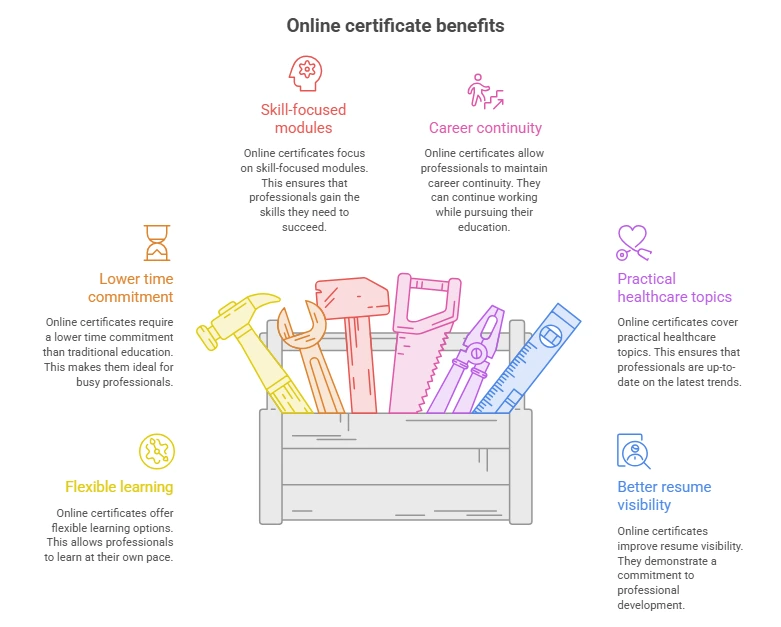
Working professionals choose online certificates because they offer:
Flexible learning
Lower time commitment
Skill-focused modules
Career continuity
Practical healthcare topics
Better resume visibility
Moreover, many professionals cannot pause their careers for full-time education. Therefore, online learning becomes a practical option.
Online Certificate vs Full Time MBA: Which Has More Career Impact?
Both options can help, but they serve different purposes.
Factor
Online Executive Certificate
Full-Time MBA/PGDM
Duration
Short-term
Usually 2 years
Best For
Working professionals
Freshers and career switchers
Learning Depth
Focused and limited
Broad and structured
Career Support
Limited or varies
Stronger placement support
Peer Learning
Moderate
Higher
Industry Exposure
Limited or virtual
Internships, projects, corporate sessions
Promotion Impact
Helpful for upskilling
Stronger for role transformation
Cost
Usually lower
Higher investment
Best Outcome
Skill upgrade
Career growth, leadership readiness
An online certificate is useful when you need focused knowledge. However, a full-time MBA or PGDM is better when you want a deeper career shift.
For example, if you want to move from a junior hospital operations role into management, a full-time management programme may provide stronger preparation.
Is an Online Executive Healthcare Certificate Enough for Promotion?
An online executive healthcare certificate may be enough for promotion when your employer already values your work and only expects additional management knowledge.
It can help in these situations:
1. You Already Work in Healthcare
If you already understand hospital systems, patient flow, billing, diagnostics, or operations, a certificate can strengthen your profile.
2. Your Promotion Is Skill-Based
Some promotions require specific knowledge. For example, a hospital may promote someone who understands quality improvement, healthcare analytics, or patient experience.
3. Your Manager Supports Upskilling
If your organisation values continuous learning, a certificate can show initiative.
4. You Apply Learning at Work
A certificate becomes more valuable when you use it to solve real problems. For example, reducing patient waiting time or improving department coordination can strengthen your promotion case.
5. You Need Quick Learning
A certificate can be useful when you need immediate knowledge without taking a career break.
However, the certificate may not be enough when the promotion requires leadership exposure, financial decision-making, team management, strategic planning, or cross-functional experience.
When a Certificate May Not Be Enough
A certificate has limits. It may not be enough if you are trying to make a major career shift.
For example, it may not fully support you if:
You are a fresher with no healthcare experience
You want campus placement support
You want to shift from clinical to management roles
You want a senior hospital administration position
You need structured internships or live projects
You want strong peer learning and networking
You need a recognised management qualification
Additionally, employers may treat certificates differently. Some value them highly. Others see them only as add-on learning.
Therefore, you should not judge a programme only by its title. You should check its curriculum, duration, evaluation method, faculty, industry relevance, and practical exposure.
Career Hike With Certification: What Is Realistic?
However, it may not automatically result in a salary hike.
Employers usually ask: What changed after the certification?
You should be able to show outcomes such as:
Improved department efficiency
Reduced patient complaints
Better reporting system
Stronger team coordination
Improved billing turnaround time
Better patient waiting experience
More accurate operational dashboards
Therefore, the real value comes from applying learning, not just completing the certificate.
Choose Career Growth
Move beyond short certificates with structured MBA training that develops leadership, analytics, strategy, and healthcare administration readiness skills.
A hospital admin course should not only teach theory. It should help learners understand real hospital problems.
Before choosing a course, check these factors:
1. Curriculum Relevance
The course should cover hospital operations, quality, finance, HR, patient experience, healthcare laws, and digital health.
2. Practical Learning
Look for case studies, projects, simulations, hospital visits, or real-world assignments.
3. Faculty Expertise
Faculty should understand healthcare systems, management practices, and industry expectations.
4. Recognition and Credibility
For online degrees, students should verify recognition status through official regulatory sources. UGC advises students to confirm the recognition or entitlement status of institutions before enrolling in online or distance learning programmes.
5. Career Support
If you want placement or career transition support, check whether the programme offers mentoring, resume guidance, industry exposure, and recruiter connections.
6. Learning Format
Some professionals prefer weekend classes. Others need self-paced learning. Choose a format that matches your schedule.
7. Assessment Method
A good course should evaluate learning through assignments, projects, presentations, or applied problem-solving.
Certificate vs Degree: What Employers Usually Notice
Employers usually evaluate candidates through a combination of qualification, experience, skills, and results.
A certificate may show that you are serious about learning. However, a degree or full-time PGDM may show deeper academic preparation.
Employers often notice:
Your current role
Your years of experience
Your achievements
Your problem-solving ability
Your communication skills
Your leadership potential
Your formal qualification
Your practical exposure
Therefore, a certificate can strengthen your profile. However, it should be supported by real workplace impact.
Who Should Choose an Online Executive Healthcare Certificate?
An online executive certificate may be a good choice for:
It is especially useful for people who cannot leave their job but want structured learning.
Who Should Choose a Full-Time MBA or PGDM?
A full-time MBA or PGDM may be better for:
Fresh graduates
Career switchers
Students seeking placement support
Professionals with limited management exposure
Candidates aiming for leadership roles
Students who need internships and live projects
Learners who want strong peer networking
Candidates targeting hospital management, healthcare consulting, or healthcare operations roles
A full-time management programme offers a more complete learning environment. It also builds communication, leadership, analytics, strategy, and decision-making skills.
At Asia Pacific Institute of Management, students benefit from an industry-oriented curriculum, experienced faculty, practical learning, corporate exposure, and placement support. These elements help students prepare for careers in healthcare management, hospital administration, and business leadership.
The executive healthcare certificate value depends on your career stage and how you use the learning. For working professionals, it can support promotion, improve confidence, and build healthcare management knowledge.
However, it is not always enough by itself. A certificate works best when combined with experience, measurable workplace impact, communication skills, and strong performance.
For students and professionals seeking deeper career growth, a full-time management programme may offer broader learning, peer exposure, practical training, and placement support.
Asia Pacific Institute of Management helps students build industry-ready management skills through practical learning, experienced faculty, corporate exposure, and career-focused guidance. For those aiming at healthcare management and hospital administration careers, structured management education can create a stronger foundation.
Build Management Edge
Prepare for hospital administration and healthcare business roles with industry-oriented MBA education, mentorship, and career-focused guidance from experts.
Dr. Vikas Gupta is a distinguished academic in the education and research domain, specializing in finance and related interdisciplinary studies. He is known for his...
01.
What is executive healthcare certificate value?
Executive healthcare certificate value refers to how much a certificate improves your professional knowledge, resume strength, promotion chances, and workplace performance in healthcare management roles.
02.
Is an online executive healthcare certificate enough for promotion?
It can help with promotion if you already have experience and strong performance. However, it may not be enough for senior roles that require deeper management education and leadership exposure.
03.
Which is better: online certificate vs full time MBA?
An online certificate is better for quick upskilling. A full-time MBA or PGDM is better for career transformation, placement support, internships, networking, and leadership development.
04.
Can I get a career hike with certification?
Yes, a career hike with certification is possible. However, it depends on your current role, employer expectations, experience, and how well you apply the learning at work.
05.
Is a hospital admin course useful?
Yes, a hospital admin course is useful if it covers hospital operations, patient experience, healthcare quality, finance, compliance, and practical case studies.
06.
Can freshers choose an executive healthcare certificate?
Freshers can choose a certificate for basic learning. However, a full-time MBA or PGDM may offer stronger career support, structured learning, and placement opportunities.
07.
How do I choose the right healthcare management programme?
Check curriculum, recognition, practical learning, faculty, industry exposure, career support, and fit with your long-term career goal.












.webp) Call Us
Call Us