Telemedicine & Health-Tech Startups: High-Paying Roles for MBA Freshers
Posted on 29 Aug 2026
By Dr. Vikas Gupta
Introduction
A patient can book a consultation through an app, speak with a doctor remotely, receive diagnostic services, manage digital records, order medicines, and use connected devices for ongoing health monitoring.
This shift is creating a new category of health tech management jobs for professionals who understand both business and healthcare.
For MBA freshers, these opportunities can extend beyond traditional hospital administration. Digital health businesses need professionals in product management, operations, growth, business development, analytics, partnerships, customer success, and strategy.
The opportunity is particularly relevant in 2026. India's digital health infrastructure continues to expand, while telemedicine, AI-enabled healthcare, and connected care are moving toward greater scale. Recent estimates also indicate strong continued growth in India's telemedicine market.
However, a health-tech MBA does not earn a premium simply because the company uses technology.
Higher-paying roles usually require a valuable combination:
Healthcare knowledge + Business skills + Digital literacy + Measurable execution
Launch Your Health-Tech Career
Build business, healthcare, analytics, and digital skills to pursue exciting opportunities across telemedicine, health-tech operations, product, and strategy roles.
Health tech management jobs are non-clinical business roles that help digital healthcare companies develop, operate, market, scale, and improve technology-enabled healthcare products and services. Common functions include product management, operations, business development, analytics, customer success, partnerships, and growth strategy.
Employers can include:
Telemedicine platforms
Digital pharmacies
Health apps
Remote monitoring companies
Healthcare SaaS businesses
Digital diagnostics platforms
AI healthcare companies
Insurance technology companies
Unlike conventional hospital administration, these businesses may operate with a technology-first model.
Therefore, MBA graduates need to understand both healthcare workflows and digital business models.
Why Health-Tech Careers Are Growing in India
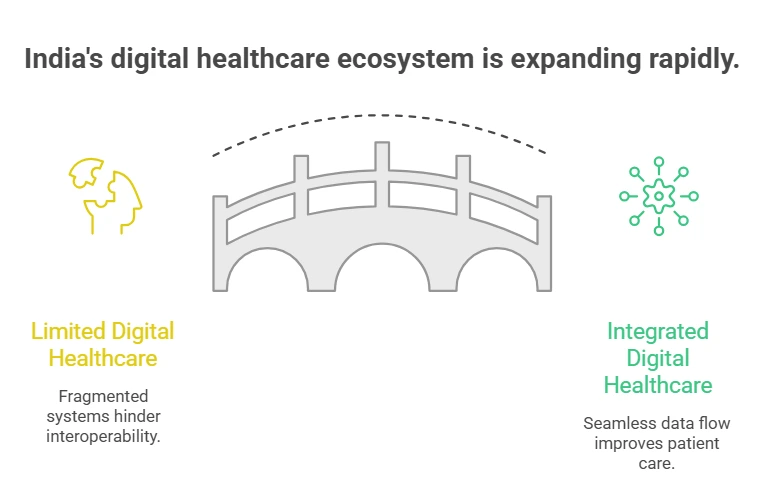
Several developments are supporting India's digital healthcare ecosystem.
These include:
Greater smartphone adoption
Digital payments
Teleconsultation
Digital health records
AI adoption
Connected medical devices
Healthcare platforms
Government digital-health infrastructure
India's Ayushman Bharat Digital Mission has helped create large-scale digital infrastructure for health records and healthcare interoperability. Meanwhile, platforms such as eSanjeevani have demonstrated the scale at which telemedicine can operate in India.
A June 2026 market estimate valued India's telemedicine market at USD 3.76 billion in 2025 and projected continued strong expansion through 2034. Such forecasts are estimates rather than guaranteed outcomes, but they illustrate the sector's growth expectations.
For MBA students, this expansion creates management problems that need solving.
Who acquires patients?
Who manages doctor supply?
Who improves the app experience?
Who builds partnerships?
Who monitors service quality?
Who makes the business profitable?
These are management questions.
Health-Tech Startup vs Hospital: How Are Careers Different?
A hospital is primarily a healthcare delivery organization.
A health-tech company often uses technology to solve a specific healthcare problem at scale.
For example:
A hospital operations manager may ask:
How can we reduce OPD waiting time?
A health-tech product team may ask:
How can we design a digital appointment system that reduces waiting across 500 clinics?
The scale and approach are different.
Health-tech environments may also involve:
Faster experimentation
Product metrics
Digital customer acquisition
Technology teams
Rapidly changing responsibilities
Therefore, students moving into startups need adaptability.
High-Potential Health Tech Management Jobs for MBA Freshers
MBA graduates can explore several functions.
However, "fresher" does not necessarily mean every role is available immediately.
Some positions, especially product manager and strategy roles, can require prior experience.
1. Health-Tech Business Analyst
Business analysts help companies understand performance and solve problems using data.
Responsibilities may include:
Dashboard reporting
Customer analysis
Funnel analysis
Process mapping
Revenue analysis
Market research
Useful skills include:
Excel
SQL
Power BI
Business problem-solving
Healthcare knowledge becomes an advantage when interpreting clinical or patient workflows.
Therefore, healthcare MBA graduates who understand both marketing and sector ethics can add value.
5. Business Development
Business development teams create partnerships.
Depending on the business, partners may include:
Hospitals
Clinics
Doctors
Employers
Insurers
Diagnostic centres
Responsibilities may include:
Lead generation
Presentations
Negotiations
Account management
Market expansion
This can suit MBA graduates with strong communication and commercial skills.
6. Customer Success
Health-tech businesses selling software to hospitals and clinics need professionals who ensure customers actually use the product successfully.
A customer-success manager may help with:
Onboarding
Training
Adoption
Issue coordination
Usage analysis
Renewals
This requires more than customer service.
You need to understand the client's business problem.
For healthcare SaaS, hospital knowledge can therefore become a competitive advantage.
7. Implementation Consultant
Imagine a health-tech company sells hospital-management software.
Signing the contract is only the beginning.
The technology must be implemented.
Implementation professionals may coordinate:
Requirements
Configuration
Workflow mapping
Training
Testing
Go-live
This is an excellent example of a role requiring both healthcare and technology understanding.
MBA healthcare students who understand hospital workflows can be valuable because they can communicate with both administrators and technology teams.
8. Healthcare Partnerships Manager
Partnership professionals may build relationships with:
Hospitals
Doctors
Employers
Insurers
Diagnostic providers
This role combines:
Business Development + Relationship Management + Healthcare Knowledge
For example, a telemedicine platform offering corporate healthcare services may need partnerships with employers and healthcare providers.
9. Strategy and Founder's Office Roles
Startups sometimes hire MBA graduates for strategy or founder's-office positions.
These roles can involve:
Market research
Competitive analysis
Business planning
Investor reporting
New initiatives
Operational problem-solving
The learning can be significant.
However, these jobs can also be demanding.
Responsibilities may change quickly.
Therefore, students should evaluate the actual job description rather than being attracted only by the title.
Remote Patient Monitoring Scope
Remote patient monitoring scope is expanding as connected devices allow selected health information to be captured outside traditional hospital settings.
Examples may include monitoring:
Blood pressure
Blood glucose
Heart rate
Oxygen saturation
Weight
The clinical suitability of monitoring depends on the patient, device, and care model.
For managers, the interesting part is the service ecosystem around the technology.
A remote monitoring business may need professionals to manage:
Patient onboarding
Device logistics
Care-team workflows
Customer support
Data dashboards
Hospital partnerships
Insurance relationships
Therefore, remote monitoring is not only a technology opportunity.
It is also an operations opportunity.
How a Remote Patient Monitoring Workflow Works
A simplified model might look like:
Patient enrolled → Device connected → Data collected → Platform receives data → Appropriate review → Escalation where required → Follow-up
Management teams need to ask:
Did the patient successfully onboard?
Is the device working?
Is data being transmitted?
Who reviews alerts?
What happens when an alert is missed?
How quickly should escalation occur?
This demonstrates why digital healthcare still needs strong operations.
Technology does not eliminate workflow.
It changes workflow.
Telemedicine Manager Salary in India
Telemedicine manager salary is difficult to represent with one reliable national figure because employers use different titles.
Comparable positions may be advertised as:
Telehealth Operations Manager
Healthcare Operations Manager
Digital Health Manager
Program Manager
Telemedicine Operations Lead
Compensation can depend on:
Experience
Employer
City
Team size
Product responsibility
Technical skills
Business responsibility
Freshers should therefore avoid assuming a guaranteed salary from broad online estimates.
Instead, compare current job descriptions and employer offers.
More importantly, identify whether the role develops valuable capabilities.
A slightly lower-paying first role that gives exposure to product, analytics, and operations may create better long-term ROI than a higher starting salary with limited learning.
Are Health-Tech Jobs Really High Paying?
Some are.
However, the phrase high-paying health-tech jobs needs context.
A fresher in routine operations may not receive technology-sector compensation simply because the employer is a startup.
Higher-paying roles generally reward scarce capabilities.
These can include:
Product management
Analytics
Strategy
Enterprise sales
Technology implementation
Growth management
Therefore, salary potential tends to increase when a candidate can solve commercially important problems.
The stronger question is not:
"Which health-tech job pays the most?"
It is:
"Which valuable health-tech capability can I build better than other candidates?"
Lead Digital Healthcare Growth
Develop management, product, analytics, and technology capabilities to solve real business challenges across India’s rapidly evolving digital healthcare ecosystem.
Practo, PharmEasy Hiring and the Health-Tech Job Ecosystem
Students often search for terms such as Practo PharmEasy hiring while exploring healthcare startup careers.
These companies demonstrate how broad digital-health business models can become.
Practo, for example, operates across online consultations, appointments, practice-management technology, hospital software, and other digital healthcare services. Its current leadership structure spans operations, strategy and marketing, product, HR, finance, and technology.
In 2026, Practo also announced senior appointments focused on AI, product, engineering, and data as it increased investment in AI-enabled healthcare experiences.
PharmEasy represents another part of India's digital-health ecosystem through pharmacy and related healthcare services.
However, students should not assume either company is hiring MBA freshers for a particular role unless an active vacancy confirms it.
Hiring changes continuously.
Always verify openings through official career pages before applying.
What Do Health-Tech Startups Look for in MBA Candidates?
A healthcare specialization can help.
However, startups often prioritize demonstrated capability.
They may ask:
Can you solve problems?
Can you analyze data?
Can you understand customers?
Can you work with technology teams?
Can you execute with limited supervision?
Therefore, MBA students need evidence.
Your resume should show more than coursework.
Skills MBA Freshers Should Build
Excel
Learn:
Pivot tables
Lookups
Data cleaning
Basic analysis
SQL
Basic SQL can significantly strengthen analytical roles.
Power BI or Tableau
Dashboard skills help with business intelligence.
Product Management Fundamentals
Understand:
User problems
Product requirements
Prioritization
Metrics
Healthcare Operations
Learn how:
Hospitals
Clinics
Telemedicine
Diagnostics
Pharmacy
actually function.
Digital Marketing
Useful for growth roles.
Financial Analysis
Startups care about unit economics.
Understand:
Revenue
Costs
Gross margin
Customer acquisition cost
Lifetime value
Health-Tech Metrics Every MBA Should Understand
Digital businesses use different metrics from conventional hospitals.
Customer Acquisition Cost
How much does acquiring a customer cost?
Conversion Rate
How many users complete the desired action?
Retention
Do customers continue using the service?
Churn
How many customers stop using it?
Consultation Completion Rate
How many scheduled teleconsultations are successfully completed?
Average Response Time
How quickly does the service respond?
Customer Lifetime Value
What economic value does a customer generate over the relationship?
Understanding these metrics can make an MBA candidate much more startup-ready.
A business must eventually create sustainable economics.
MBA graduates should understand:
Revenue per customer – Cost to serve customer = Contribution
Imagine a teleconsultation generates ₹500 in revenue.
If doctor cost, marketing, technology, customer support, and payment charges total more than ₹500, scaling the same model may increase losses.
Therefore, health-tech managers need both healthcare understanding and financial discipline.
The sector itself illustrates this shift. Practo reported ₹234 crore in FY25 revenue and ₹15 crore in operating EBITDA while emphasizing profitable growth and improved unit economics.
Healthcare technology companies still need core management capabilities.
They need professionals who understand:
Strategy
Marketing
Operations
Finance
Analytics
Leadership
Therefore, strong management fundamentals remain valuable even when the business is technology-led.
At Asia Pacific Institute of Management, an industry-oriented curriculum, experienced faculty, practical learning, corporate exposure, and placement support can help students build broader managerial capabilities.
Students interested in health-tech should complement these foundations with digital skills, healthcare understanding, analytics, and practical projects.
The objective should be to graduate not only with an MBA.
It should be to graduate with evidence that you can solve digital healthcare business problems.
Conclusion
Health tech management jobs are expanding the definition of a healthcare management career.
MBA graduates can now explore opportunities across:
Telemedicine operations
Digital health product management
Business analytics
Remote patient monitoring
Customer success
Implementation
Business development
Growth
Strategy
However, the highest career value does not come simply from joining a startup.
It comes from developing capabilities that a growing digital healthcare business needs.
For MBA freshers, that means combining healthcare knowledge with skills such as analytics, product thinking, digital marketing, financial understanding, and technology literacy.
The future healthcare manager may not always sit inside a hospital.
They could be designing a digital patient journey, improving a telemedicine platform, analyzing healthcare data, managing connected-care operations, or scaling a healthcare technology business.
Build Tomorrow’s Healthcare Career
Gain practical business and digital expertise for emerging careers in healthcare analytics, telemedicine, product management, operations, partnerships, and growth.
Dr. Vikas Gupta is a distinguished academic in the education and research domain, specializing in finance and related interdisciplinary studies. He is known for his...
Health tech management jobs are business roles within technology-enabled healthcare organizations. They can include product, operations, analytics, growth, business development, customer success, implementation, and strategy.
02.
Can MBA freshers get jobs in telemedicine startups?
Yes, depending on employer requirements. Entry routes can include operations, business analysis, sales, customer success, growth, and associate product positions.
03.
What does a digital health product manager do?
A digital health product manager identifies user problems, prioritizes features, coordinates with technology and business teams, and tracks whether a healthcare product achieves its intended outcomes.
04.
What is the telemedicine manager salary in India?
There is no single reliable salary because titles and responsibilities vary widely. Compensation depends on experience, employer, location, team responsibility, and skills. Candidates should verify current vacancies and formal offers.
05.
What is the remote patient monitoring scope in India?
Remote monitoring can support selected chronic-care, post-discharge, preventive, and home-care models. It also creates management needs in patient onboarding, device operations, analytics, partnerships, and service delivery.
06.
Are health-tech startup jobs higher paying than hospital jobs?
Some specialized product, analytics, strategy, and technology roles can offer higher compensation. However, startup employment does not automatically mean higher pay. Skills, experience, company stage, and role determine compensation.
07.
What skills should an MBA fresher learn for health-tech careers?
Useful skills include Excel, SQL, Power BI, product fundamentals, healthcare operations, financial analysis, digital marketing, business communication, and problem-solving.
08.
How should students check Practo or PharmEasy hiring?
Check current vacancies through the companies’ official career channels because openings change frequently. Do not rely on outdated recruitment posts or assume a particular MBA role is currently available.
















.webp) Call Us
Call Us