Can Commerce Students Pursue an MBA in Healthcare Management?
Posted on 16 Sep 2026
By Dr. Vikas Gupta
Introduction
Healthcare is one of the largest and most diverse industries, and it needs more than doctors and other clinical professionals. Hospitals, diagnostic centres, pharmaceutical companies, health-tech businesses, insurance providers, and healthcare startups also need professionals who understand finance, operations, marketing, business development, analytics, and strategy.
This raises an important question for BCom and other commerce graduates: Can commerce students pursue an MBA in Healthcare Management?
In many cases, yes. Commerce graduates can pursue an MBA in Healthcare Management if they meet the eligibility requirements of the institution. A medical background is not universally required because healthcare management focuses on managing healthcare organisations rather than providing clinical care.
For commerce students, the transition can be particularly interesting because their academic background may already provide a foundation in accounting, finance, economics, business, and organisational concepts.
However, moving into healthcare management also requires developing an understanding of the healthcare industry.
This article explains MBA healthcare management for commerce students, eligibility after BCom, career options, skills required, and how commerce graduates can prepare for a management career in healthcare.
Turn Commerce Into Healthcare
Combine your commerce foundation with healthcare expertise and develop practical management skills for diverse opportunities across the healthcare industry.
Yes, commerce students may be eligible for an MBA in Healthcare Management, depending on the institution's admission requirements.
Healthcare management is a management discipline. It focuses on areas such as:
Healthcare Operations
Hospital Administration
Healthcare Finance
Marketing
Human Resources
Business Analytics
Healthcare Quality
Patient Experience
Digital Health
Strategy
Leadership
A commerce student does not need to become a doctor to work in these areas.
For example, a hospital needs professionals who can manage budgets and financial processes. A diagnostic chain needs people who can analyse business performance. A health-tech company needs professionals who understand operations and commercial strategy.
These are areas where a commerce background can provide useful foundations.
MBA Healthcare After BCom: Is It Possible?
MBA healthcare after BCom can be a viable academic pathway for graduates who want to combine their commerce knowledge with healthcare management.
A BCom programme may provide exposure to:
Accounting
Finance
Economics
Business Law
Taxation
Business Management
Statistics
Business Communication
An MBA in Healthcare Management can then build on that foundation by introducing healthcare-specific knowledge.
You may study subjects such as:
Hospital Management
Healthcare Operations
Healthcare Finance
Healthcare Marketing
Healthcare Quality Management
Healthcare Analytics
Health Economics
Digital Healthcare
Healthcare Strategy
This combination can help create a profile that connects financial and business knowledge with healthcare industry understanding.
Why Is Commerce Relevant to Healthcare Management?
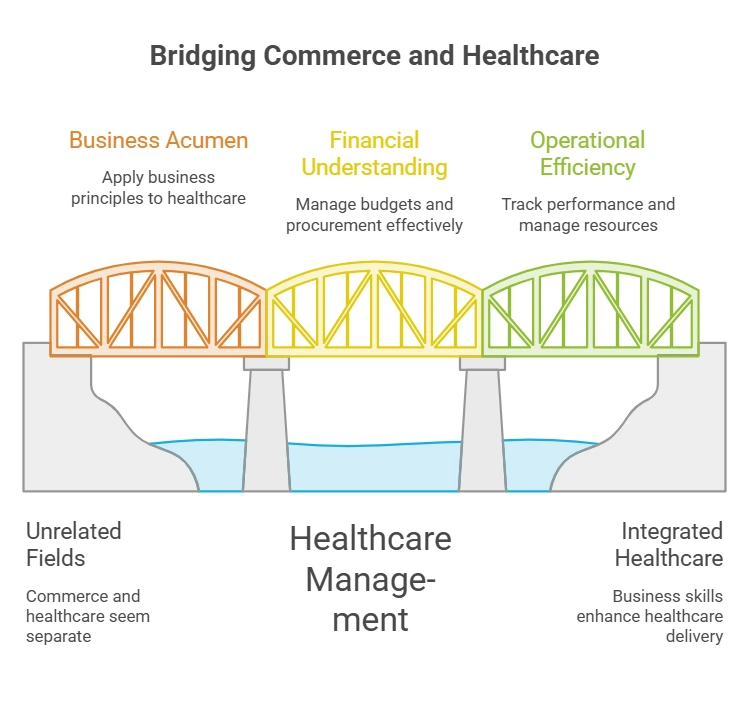
At first glance, commerce and healthcare may seem like unrelated fields.
But modern healthcare organisations operate as complex businesses as well as service institutions.
A hospital has revenue and expenses.
It has budgets and procurement processes.
It manages employees and vendors.
It invests in technology and infrastructure.
It tracks operational performance.
It needs to attract and retain patients.
It develops new services.
It must manage resources efficiently.
All these activities require business and financial understanding.
This is why healthcare management after commerce can make sense for graduates who are interested in the business side of healthcare.
What Does an MBA in Healthcare Management Teach Commerce Students?
A healthcare MBA can help commerce graduates move from general business knowledge towards healthcare-specific management.
Healthcare Operations
Students learn how healthcare facilities and services are organised and managed.
Topics may include patient flow, resource utilisation, process improvement, capacity planning, and operational efficiency.
Healthcare Finance
This area can build naturally on a commerce background.
Students may explore healthcare budgeting, cost management, financial planning, revenue management, and financial decision-making.
Healthcare Marketing
Healthcare organisations need to understand patients, market segments, communication, branding, and service positioning.
Management students learn about recruitment, performance management, employee engagement, leadership, organisational behaviour, and workforce planning.
Healthcare Quality
Quality management focuses on process improvement, patient safety, service standards, performance measurement, and accreditation-related concepts.
Healthcare Analytics
Healthcare generates large amounts of operational and financial data.
Students may learn to interpret KPIs, dashboards, business intelligence, and analytics for management decisions.
Digital Health
Technology is changing healthcare through telemedicine, digital platforms, electronic health systems, automation, and artificial intelligence.
Understanding these developments can help future managers work effectively with technology teams and digital healthcare businesses.
MBA Hospital Management for Commerce Students
A common misconception is that hospital management is exclusively for science or medical graduates.
MBA hospital management for commerce students can be possible when the institution accepts candidates from broader undergraduate backgrounds.
Hospital management includes many non-clinical responsibilities, including:
Finance
Administration
Operations
Human Resources
Marketing
Procurement
Quality
Patient Experience
Business Development
Analytics
Commerce graduates may therefore find their existing knowledge particularly relevant to certain functions.
For example, a BCom graduate with strong financial skills could explore healthcare finance-related roles, while another commerce graduate interested in communication and business could consider healthcare marketing or business development.
What Career Options Are Available After MBA Healthcare for Commerce Graduates?
Actual career opportunities depend on skills, internships, previous experience, programme quality, employer requirements, and individual performance.
Healthcare Finance
Commerce graduates can build on their accounting and financial knowledge by developing an understanding of healthcare-specific financial operations.
Potential areas include budgeting, cost analysis, financial planning, revenue management, and business performance.
Hospital Administration
Healthcare administrators help coordinate organisational functions and support the effective management of healthcare facilities.
Hospital Operations
Operations professionals work on processes, resource allocation, patient flow, service delivery, and organisational efficiency.
Healthcare Business Development
Business development professionals may identify partnerships, new markets, corporate relationships, service opportunities, and expansion possibilities.
Healthcare Marketing
Commerce graduates interested in marketing may explore healthcare branding, digital marketing, market research, communication, and patient acquisition.
Healthcare Analytics
Students with an interest in numbers and data can explore healthcare KPIs, dashboards, performance analysis, and business intelligence.
Healthcare Consulting
Consulting can involve strategy, operational improvement, market analysis, healthcare transformation, and organisational projects.
Health-Tech
Health-tech businesses need professionals who understand both business and healthcare.
Commerce graduates can potentially explore operations, business development, partnerships, implementation, and commercial functions.
Healthcare Insurance
Insurance organisations operate across healthcare, finance, risk, service delivery, and customer management.
Commerce graduates may find this intersection particularly relevant.
Where Can Commerce Graduates Work After Healthcare MBA?
An MBA in Healthcare Management can open exposure to multiple healthcare segments.
Hospitals
Potential functions include finance, administration, operations, marketing, quality, patient experience, and business development.
Diagnostic Centres
Large diagnostic networks require professionals for centre operations, expansion, finance, marketing, and business development.
Pharmaceutical Companies
Depending on the role and employer requirements, management graduates can explore commercial, marketing, business operations, project, and strategy functions.
Health-Tech Companies
Digital healthcare businesses may offer opportunities in operations, partnerships, implementation, growth, analytics, and business development.
Medical-Device Companies
Potential areas include marketing, sales strategy, operations, business development, and commercial management.
Healthcare Consulting Firms
Consulting organisations may hire management professionals for research, strategy, transformation, and operational projects.
Health Insurance
Potential functions can include provider management, healthcare operations, analytics, customer experience, and business functions.
Healthcare Startups
Startups often require professionals who can work across operations, growth, finance, partnerships, marketing, and strategy.
Does a BCom Background Give You an Advantage?
It can provide useful foundations, particularly in business and finance-oriented areas.
For example, BCom graduates may already be familiar with:
Financial statements
Accounting principles
Cost concepts
Economics
Business communication
Commercial decision-making
However, this doesn't automatically make a commerce graduate more suitable for every healthcare role.
A student interested in hospital operations may need to develop process and healthcare-delivery knowledge.
Someone interested in health-tech may need stronger digital and analytical capabilities.
The value of the BCom background depends on how effectively you combine it with healthcare knowledge.
Expand Your Career Horizons
Build healthcare knowledge alongside finance, operations, analytics, and strategy skills to explore rewarding management roles with confidence.
Understand how hospitals, diagnostics, pharmaceuticals, insurance, health-tech, and medical devices operate.
Data Analysis
Build practical skills in Excel, dashboards, data interpretation, and business analytics.
Communication
Healthcare managers work with doctors, patients, administrators, employees, vendors, and business partners.
Problem-Solving
Healthcare organisations face complex operational and financial challenges.
Project Management
The ability to plan, coordinate, and execute projects can be useful across healthcare organisations.
Leadership
Management careers require the ability to lead teams, manage stakeholders, and make decisions.
Digital Awareness
Understand how technology is changing healthcare delivery and management.
Do Commerce Students Need to Study Science Before an MBA Healthcare?
Not necessarily.
Whether a science background is required depends on the admission criteria of the institution.
An MBA in Healthcare Management is not the same as a medical or science degree.
You are not being trained to diagnose diseases or provide clinical treatment.
Instead, you are learning how to manage healthcare organisations and their business and operational functions.
However, learning basic healthcare terminology and industry concepts can make the transition easier for commerce graduates.
Can Commerce Students Manage Hospitals?
Yes, commerce graduates can potentially work in hospital management functions if they have the required education, skills, and experience.
However, management and clinical responsibilities should not be confused.
A hospital manager may be responsible for operations, finance, staffing, patient services, quality, or administration.
Clinical decisions remain the responsibility of appropriately qualified healthcare professionals.
This distinction is important for anyone considering hospital management as a career.
Commerce vs Medical Background in Healthcare Management
Both backgrounds can bring different strengths.
Area
Commerce Graduate
Medical/Healthcare Graduate
Finance
Often strong foundation
May require additional learning
Accounting
Often covered during graduation
Usually limited exposure
Business
General business exposure
Usually requires development
Clinical knowledge
Limited initially
Stronger foundation
Patient-care exposure
Usually limited
Usually stronger
Healthcare operations
Learned through MBA/experience
May have prior exposure
Management skills
Developed through MBA
Developed through MBA
Career direction
Business/management-focused roles
Clinical + management or non-clinical roles
Neither background guarantees a particular career outcome.
The MBA can help both profiles develop capabilities outside their existing expertise.
Is Healthcare Management After Commerce a Good Career Change?
For a commerce graduate interested in healthcare, it can be a meaningful career transition.
The important question is whether you're interested in healthcare itself.
Healthcare management is not simply a traditional MBA with the word "healthcare" added to it.
You'll need to understand the industry's unique challenges, including patient expectations, healthcare quality, clinical workflows, regulation, technology, and service delivery.
If you enjoy business but want to apply it within a socially important and complex industry, healthcare management can be an area worth exploring.
How to Prepare for MBA Healthcare After BCom
If you're currently studying BCom and considering healthcare management, you can start preparing before graduation.
Learn About the Healthcare Industry
Follow developments in hospitals, health-tech, pharmaceuticals, diagnostics, insurance, and digital health.
Develop Analytical Skills
Strengthen Excel, statistics, data interpretation, and presentation skills.
Seek Healthcare Internships
Even a short internship can help you understand how healthcare organisations operate.
Improve Communication
Work on presentations, professional writing, and interpersonal communication.
Understand Healthcare Terminology
You don't need medical-school-level knowledge, but basic healthcare terminology can make your transition easier.
Explore Career Roles
Research healthcare finance, hospital operations, marketing, consulting, business development, health-tech, and analytics to identify where your strengths fit.
How to Choose an MBA in Healthcare Management as a Commerce Graduate
Choosing the right programme matters as much as choosing the specialisation.
Look at:
Eligibility: Confirm that your BCom or other commerce qualification meets admission requirements.
Curriculum: Check whether the programme combines core management with healthcare-specific subjects.
Faculty: Review academic and industry experience.
Industry exposure: Look for internships, hospital projects, case studies, workshops, and industry interactions.
Career support: Understand which healthcare sectors and roles are relevant to the programme.
Alumni: Research where previous students work and which functions they entered.
Fees: Compare the complete cost rather than tuition alone.
Learning format: Consider whether a full-time, executive, weekend, online, or hybrid programme fits your situation.
Common Mistakes Commerce Students Should Avoid
Assuming Healthcare Is Only About Hospitals
The healthcare ecosystem includes many sectors beyond hospitals.
Ignoring Healthcare Knowledge
Business skills alone aren't enough. You need to understand the industry.
Choosing a Programme Only for Its Salary Claims
Career outcomes vary by role, employer, skills, experience, and market conditions.
Avoiding Internships
Practical exposure can help bridge the gap between commerce and healthcare.
Focusing Only on Finance
Your BCom background may make finance comfortable, but healthcare management offers opportunities across operations, marketing, analytics, strategy, and technology.
Future Scope for Commerce Graduates in Healthcare
Healthcare is becoming increasingly technology-driven and data-oriented.
Hospitals and healthcare businesses are adopting digital systems, analytics, automation, telemedicine, AI, and new service models.
These changes require professionals who understand business as well as technology and healthcare.
Commerce graduates can potentially contribute through finance, operations, analytics, business development, strategy, marketing, and other functions.
The key is to develop a combination of skills rather than relying solely on the BCom qualification.
Is MBA Healthcare Management Right for You?
Ask yourself these questions:
Do I want to work in healthcare?
If yes, the specialisation may be worth exploring.
Do I prefer management over clinical work?
Healthcare management focuses on organisational and business responsibilities.
Do I enjoy finance, business, operations, or strategy?
These skills can be highly relevant to healthcare organisations.
Am I willing to learn healthcare concepts?
A non-medical background means you'll need to build industry understanding.
Does my target programme accept commerce graduates?
Always verify the latest eligibility requirements.
What career do I want after the MBA?
Identify potential roles before choosing a programme.
So, can commerce students pursue an MBA in Healthcare Management?
Yes, they may be able to, provided they meet the institution's eligibility requirements.
A BCom background can provide useful foundations in finance, accounting, economics, and business, while an MBA in Healthcare Management can add healthcare-specific knowledge and broader management capabilities.
The combination can be relevant to several healthcare careers for commerce graduates, including healthcare finance, hospital administration, operations, business development, marketing, analytics, consulting, health-tech, and insurance-related functions.
However, success in healthcare management isn't determined by your undergraduate degree alone.
You need to develop healthcare industry knowledge, practical exposure, analytical ability, communication, leadership, and problem-solving skills.
If you're a commerce graduate who enjoys business and wants to apply those skills within healthcare, an MBA in Healthcare Management can be a pathway worth exploring.
The key is to choose a programme that matches your career goals and provides the healthcare exposure needed to turn your commerce background into a broader management profile.
Make Your BCom Go Further
Add healthcare management expertise to your commerce background and prepare for careers spanning hospitals, health-tech, finance, strategy, and operations.
Dr. Vikas Gupta is a distinguished academic in the education and research domain, specializing in finance and related interdisciplinary studies. He is known for his...
01.
Can commerce students do MBA Healthcare Management?
Yes, commerce graduates may be eligible for MBA Healthcare Management programmes, depending on the institution’s admission criteria. A medical background is not universally required.
02.
Can I pursue MBA Healthcare after BCom?
Yes, MBA healthcare after BCom can be a possible academic pathway if you meet the programme’s eligibility requirements. A BCom background can provide useful foundations in finance, accounting, economics, and business.
03.
Can BCom students pursue hospital management?
Yes, depending on the institution’s eligibility criteria. Hospital management includes finance, administration, operations, HR, marketing, quality, and other non-clinical functions where commerce knowledge can be relevant.
04.
Can commerce students pursue MBA hospital management without a science background?
Some programmes may accept commerce graduates without a science background. Eligibility differs between institutions, so candidates should verify the current admission requirements.
05.
What are the healthcare careers for commerce graduates?
Potential career areas include healthcare finance, hospital administration, hospital operations, healthcare marketing, business development, analytics, consulting, health-tech, diagnostics, pharmaceuticals, and insurance.
06.
Is MBA Healthcare Management difficult for commerce students?
Commerce students may find business and finance subjects familiar, but they may initially need to learn healthcare terminology, hospital workflows, patient journeys, quality concepts, and industry-specific practices.
07.
Do commerce students need medical knowledge for an MBA in Healthcare Management?
They don’t generally need clinical medical training. However, understanding basic healthcare concepts and industry terminology can make the programme and subsequent career transition easier.
08.
Can a commerce graduate work in a hospital after an MBA Healthcare?
Depending on qualifications, skills, and employer requirements, commerce graduates can explore non-clinical hospital roles such as administration, finance, operations, marketing, business development, quality, and patient experience.

















.webp) Call Us
Call Us