Executive MBA in Hospital Management vs Healthcare Management
Posted on 23 Sep 2026
By Dr. Vikas Gupta
Introduction
Choosing the right management specialisation can be challenging for healthcare professionals and working executives. Two options often considered are hospital management and healthcare management.
Although these fields overlap, their focus is not identical. Understanding hospital management vs healthcare management can help professionals select a program that matches their career goals.
Hospital management generally focuses on the administration and operations of healthcare facilities. Healthcare management has a broader scope. It can include hospitals, health-tech companies, insurance, diagnostics, healthcare consulting, pharmaceuticals, and other healthcare businesses.
An Executive MBA can help working professionals develop management skills while continuing their careers. However, the right specialisation depends on your current role, professional experience, and long-term objectives.
Build Healthcare Leadership
Develop practical management skills and prepare for leadership opportunities across hospitals, healthcare companies, operations, strategy, and administration.
Hospital Management vs Healthcare Management: Quick Difference
Hospital management focuses primarily on managing hospital operations, administration, resources, patient services, and healthcare facility performance. Healthcare management covers a wider ecosystem, including hospitals, health-tech, insurance, consulting, healthcare businesses, and other healthcare services.
The distinction can be summarised as follows:
Factor
Hospital Management
Healthcare Management
Primary focus
Hospital and facility operations
Broader healthcare ecosystem
Work environment
Hospitals and healthcare facilities
Hospitals, companies, health-tech, insurance and other organisations
Key areas
Administration, operations, patient services
Strategy, operations, finance, marketing, analytics and business
Career orientation
Facility-focused
Industry-wide
Suitable for
Hospital administration aspirants
Professionals seeking broader healthcare careers
Management scope
Primarily organisational/facility level
Organisational and sector-wide
However, actual curriculum and job responsibilities depend on the program and employer.
What Is Hospital Management?
Hospital management involves managing the administrative, operational, financial, and support functions required for a healthcare facility to operate efficiently.
A hospital is a complex organisation. It involves doctors, nurses, administrators, technicians, support staff, vendors, patients, and many other stakeholders.
Hospital managers help coordinate these functions.
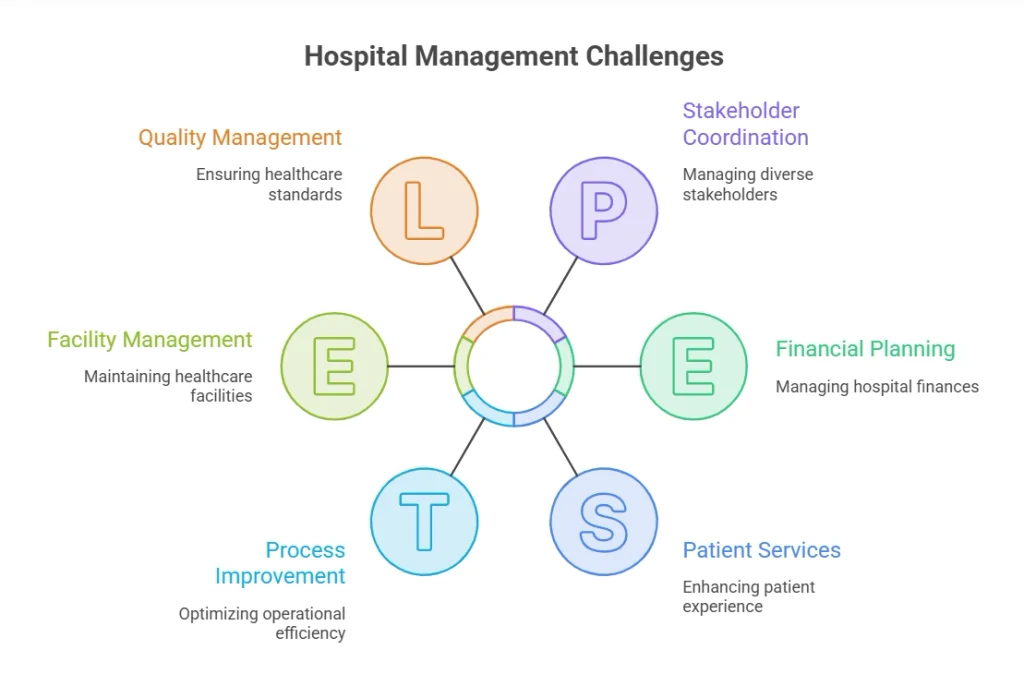
Key areas can include:
Hospital operations
Patient flow
Administration
Human resources
Facility management
Quality management
Financial planning
Procurement
Patient services
Process improvement
Therefore, hospital management is particularly relevant for professionals who want to build careers within healthcare facilities.
What Does an Executive MBA Hospital Management Program Cover?
Depending on the curriculum, subjects may include:
Hospital administration
Healthcare operations
Financial management
Human resource management
Healthcare marketing
Quality management
Strategic management
Business analytics
Leadership
Healthcare technology
The objective is not simply to understand hospital administration. It is also to develop the managerial capabilities needed to lead teams, manage resources, solve operational problems, and support organisational strategy.
What Is Healthcare Management?
Healthcare management has a wider scope than hospital administration.
It focuses on managing organisations, services, teams, processes, and business functions across the healthcare ecosystem.
Healthcare management can cover areas such as:
Hospital management
Healthcare consulting
Health-tech
Health insurance
Diagnostics
Pharmaceutical businesses
Medical technology
Healthcare marketing
Healthcare analytics
Healthcare business development
Therefore, healthcare management can be relevant to professionals who want flexibility across different healthcare sectors.
Hospital administration focuses on the functioning of a healthcare facility. Administrators may coordinate departments, manage resources, support patient services, monitor processes, and handle operational requirements.
Healthcare management takes a broader view.
Professionals may work on organisational strategy, healthcare business development, technology adoption, analytics, marketing, finance, operations, or consulting.
For example, a hospital administrator may focus on improving patient flow within a hospital.
A healthcare manager working in a health-tech organisation may focus on implementing a healthcare technology solution across multiple facilities.
Both require management skills. However, the operating environment can be very different.
Healthcare Management Difference: Key Areas to Understand
Hospital management usually has a facility-focused scope.
Healthcare management can involve multiple healthcare organisations and business functions.
2. Work Environment
Hospital management professionals typically work within hospitals or healthcare facilities.
Healthcare management professionals can work across hospitals, healthcare companies, consulting firms, insurance organisations, health-tech businesses, and other healthcare services.
The exact curriculum varies between institutions. Therefore, students should compare actual subjects instead of relying only on the program name.
Who Should Choose Hospital Management?
Hospital management may be suitable if you:
Want to work in hospital administration
Enjoy operational responsibilities
Want to manage healthcare facilities
Are interested in patient-service operations
Prefer facility-level management
Want to build a career in hospital leadership
Already work in a hospital environment
For example, a healthcare professional working in hospital operations may benefit from management education focused on administration, operations, finance, quality, and leadership.
Who Should Choose Healthcare Management?
Healthcare management may be suitable if you want a wider range of career opportunities.
You may consider it if you are interested in:
Healthcare consulting
Health-tech
Healthcare analytics
Insurance
Healthcare marketing
Business development
Strategy
Healthcare operations
Hospital management
Moreover, healthcare management can be relevant for professionals who are still exploring which part of the healthcare industry they want to enter.
Professionals can work on patient flow, resource allocation, process improvement, and operational performance.
Hospital Administration
Responsibilities may include departmental coordination, administrative planning, documentation, and service management.
Quality Management
Quality professionals support processes designed to improve service delivery and organisational performance.
Human Resources
Healthcare facilities require skilled professionals to manage recruitment, workforce planning, employee engagement, and performance.
Finance and Revenue Operations
Professionals may contribute to budgeting, financial planning, cost control, and revenue-related processes.
Facility Management
Large healthcare facilities require structured management of infrastructure, vendors, equipment, and support services.
Healthcare Management Career Opportunities
An MBA healthcare management pathway can open opportunities across a broader range of functions.
Potential areas include:
Healthcare consulting
Health-tech management
Healthcare analytics
Healthcare marketing
Business development
Healthcare operations
Insurance management
Strategy
Project management
Healthcare services
This broader scope can be useful for professionals who want to keep their career options open.
Which One Is Better for Working Professionals?
There is no universal answer because the two pathways serve different career objectives.
A working professional should first identify the type of responsibility they want to handle.
If your objective is to manage hospital departments, patient services, operations, or healthcare facilities, hospital management may align closely with your goals.
If you want to explore healthcare companies, consulting, health-tech, analytics, insurance, strategy, or broader business functions, healthcare management may offer a wider foundation.
Therefore, the decision should be based on career direction rather than simply choosing the broader-sounding degree.
Why an Executive MBA Can Be Useful for Healthcare Professionals
Working professionals often face a different challenge from fresh graduates.
They already understand their functional environment. However, they may need broader management skills to move into leadership responsibilities.
An Executive MBA can help develop capabilities in:
Strategic Thinking
Professionals learn to connect day-to-day decisions with long-term organisational objectives.
Financial Understanding
Managers need to understand budgets, costs, revenue, investments, and financial performance.
Leadership
Healthcare managers work with multidisciplinary teams. Therefore, communication, delegation, negotiation, and conflict management are important.
Business Analytics
Data can support operational and strategic decision-making.
Operations
Professionals can learn structured approaches to improving processes, resource utilisation, and service delivery.
Change Management
Healthcare organisations continuously adapt to technology, consumer expectations, regulations, and operational challenges.
Executive MBA Hospital Management: Who Can Consider It?
Professionals from different backgrounds may consider hospital management education if they meet the program's eligibility criteria.
Potential candidates can include:
Hospital administrators
Healthcare operations professionals
Doctors moving into management
Nurses interested in administration
Healthcare executives
Medical and healthcare service professionals
Hospital support-function managers
The exact admission requirements vary. Some programs may require work experience, while others may have different eligibility structures.
Therefore, always check the latest requirements before applying.
Healthcare management programs can be relevant for professionals from broader backgrounds.
Potential candidates may include:
Healthcare professionals
Hospital employees
Healthcare administrators
Pharma professionals
Health-tech professionals
Insurance professionals
Healthcare consultants
Business professionals moving into healthcare
The suitability depends on the curriculum and admission requirements.
How to Choose Between Hospital Management and Healthcare Management
Use the following framework before selecting a program.
Choose Hospital Management If:
You want hospital-focused responsibilities.
You are interested in hospital operations.
You want to manage healthcare facilities.
Patient-service operations interest you.
You want to build expertise in hospital administration.
Consider Healthcare Management If:
You want broader healthcare exposure.
You are interested in health-tech.
You want to explore consulting.
You are interested in healthcare analytics.
You want exposure to strategy and business development.
You want flexibility across healthcare sectors.
This framework can help you connect the program with your desired career direction.
What Should You Look for in an Executive MBA?
Program selection requires more than comparing course names.
Consider the following factors:
Curriculum
Check whether the curriculum covers healthcare and core management subjects.
Practical Learning
Look for case studies, projects, simulations, and real-world business applications.
Industry Exposure
Corporate interactions and industry-oriented learning can help professionals understand current business challenges.
Faculty
Consider faculty experience and academic expertise.
Career Support
Understand what career guidance and placement support the institution provides.
Schedule
Working professionals should carefully evaluate class schedules, attendance requirements, workload, and program duration.
Return on Learning
Do not evaluate the program only by fees. Consider the skills, exposure, network, and career relevance it can provide.
Asia Pacific Institute of Management focuses on industry-oriented management education, practical learning, corporate exposure, experienced faculty, and career-focused development. These factors can be useful for professionals evaluating management education.
Common Mistakes When Choosing a Healthcare MBA
Choosing Based Only on the Program Name
Two programs with similar names can have very different curricula.
Ignoring Career Goals
A program should support your intended career direction.
Focusing Only on Salary
Career outcomes depend on experience, skills, employer, location, role, and performance.
Overlooking Practical Exposure
Management is application-oriented. Therefore, practical learning can be important.
Not Checking Eligibility
Always verify the latest admission criteria before applying.
Ignoring Work-Life Balance
Working professionals should understand the academic workload before enrolling.
Understanding hospital management vs healthcare management is important before choosing an Executive MBA pathway.
Hospital management focuses more closely on healthcare facilities, administration, operations, patient services, and hospital leadership. Healthcare management has a wider scope that can include hospitals, health-tech, insurance, consulting, analytics, marketing, and healthcare businesses.
Therefore, the right choice depends on where you want your career to go.
If you want to build expertise in hospital operations and administration, an Executive MBA hospital management pathway may align with your goals. If you want broader exposure across the healthcare industry, MBA healthcare management may provide a wider management foundation.
Asia Pacific Institute of Management offers industry-oriented management education with practical learning, corporate exposure, experienced faculty, and career-focused support.
Before enrolling, compare the curriculum, learning approach, eligibility requirements, practical exposure, and career support. Most importantly, choose a program that matches your professional goals and the type of management responsibility you want to pursue.
Advance Your Management Skills
Strengthen strategy, finance, analytics, operations, and leadership capabilities while preparing for broader responsibilities in healthcare.
Dr. Vikas Gupta is a distinguished academic in the education and research domain, specializing in finance and related interdisciplinary studies. He is known for his...
01.
What is the difference between hospital management and healthcare management?
Hospital management focuses mainly on the administration and operations of healthcare facilities. Healthcare management has a broader scope covering hospitals, health-tech, insurance, consulting, healthcare businesses, and other healthcare services.
02.
Is hospital management part of healthcare management?
Yes. Hospital management can be considered a specialised area within the broader healthcare management field. Healthcare management can also include functions beyond hospitals.
03.
Is an Executive MBA hospital management suitable for working professionals?
It can be suitable for professionals seeking management responsibilities within hospitals, provided they meet the program’s eligibility requirements and can manage the academic workload.
04.
What is the difference between hospital administration and healthcare management?
Hospital administration focuses on managing the administrative and operational functions of a healthcare facility. Healthcare management covers a wider range of healthcare organisations and business functions.
05.
What careers can I pursue after an MBA healthcare management program?
Potential areas include healthcare operations, consulting, health-tech, analytics, marketing, business development, insurance, strategy, and hospital management.
06.
Is a hospital management MBA only for doctors?
No. Eligibility depends on the specific program. Management programs can be relevant to healthcare professionals and graduates from other eligible backgrounds.
07.
Should I choose hospital management or healthcare management?
The choice depends on your career objective. Hospital management suits professionals targeting healthcare-facility operations, while healthcare management may suit those seeking broader opportunities across the healthcare ecosystem.
08.
What should I check before choosing an Executive MBA?
Review the curriculum, eligibility, schedule, practical learning, faculty, industry exposure, career support, total cost, and alignment with your professional goals.


















.webp) Call Us
Call Us