NABH Accreditation Guidelines: Essential Quality Skills for Healthcare MBAs
Posted on 31 Aug 2026
By Dr. Vikas Gupta
Introduction
It depends on how patients enter the hospital, how medicines are handled, how infections are controlled, how incidents are reported, how facilities are maintained, and how leadership monitors performance.
NABH accreditation provides a structured framework for improving healthcare quality and patient safety across clinical and administrative functions. Its current Hospital Accreditation Programme applies the 6th Edition standards across the whole organization rather than selected departments.
For MBA students, NABH knowledge is useful because quality management sits at the intersection of operations, compliance, analytics, patient safety, documentation, and leadership.
A future hospital administrator may not personally perform every audit.
However, they should understand how quality systems work.
This guide explains the major NABH concepts, essential quality skills, audit readiness, patient safety, compliance roles, and how healthcare MBAs can build a stronger hospital-management profile.
Lead Healthcare Quality
Build practical skills in quality, patient safety, operations, analytics, and leadership to prepare for responsible hospital management careers.
NABH accreditation for hospitals is a formal quality and patient-safety framework that evaluates healthcare organizations against defined standards covering patient care, medication management, infection control, governance, facilities, human resources, information systems, and continuous quality improvement.
NABH is a constituent board of the Quality Council of India.
Its Hospital Accreditation Programme is the flagship accreditation programme for larger hospitals and evaluates critical clinical and administrative functions across the institution.
The programme is intended to support:
Patient safety
Standardized processes
Quality improvement
Regulatory compliance
Better governance
Performance monitoring
Therefore, accreditation is more than a certificate.
The real objective is to build systems that continue working after the assessment team leaves.
What Does the NABH 6th Edition Cover?
The current NABH hospital standards are organized around major areas of healthcare delivery and management.
These include chapters such as:
Access, Assessment and Continuity of Care
Care of Patients
Management of Medication
Patient Rights and Education
Hospital Infection Control
Patient Safety and Quality Improvement
Responsibilities of Management
Facilities Management and Safety
NABH also covers areas such as human resources and information management within its wider hospital framework.
For MBA students, this structure is important.
It shows that quality is not owned only by doctors or nurses.
Finance, HR, operations, facilities, quality, and senior management all contribute.
Why Healthcare MBAs Should Understand NABH
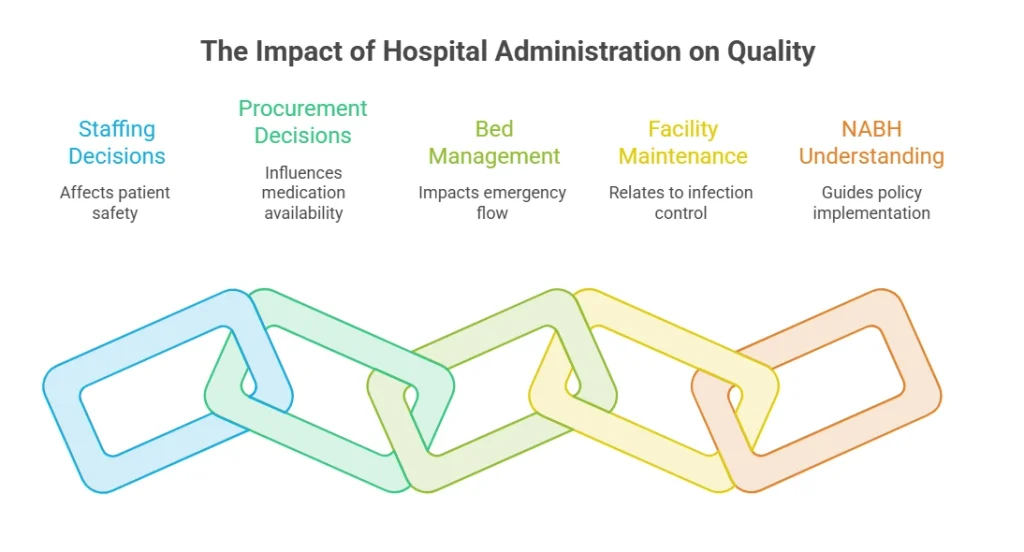
Hospital administrators make decisions that affect quality every day.
For example:
A staffing decision may affect patient safety.
A procurement decision may affect medication availability.
A bed-management decision may affect emergency flow.
A facility-maintenance failure may affect infection control.
Therefore, healthcare managers need quality awareness even when they do not work in a dedicated quality department.
Corrective action addresses an identified problem.
Preventive action aims to reduce recurrence or similar future risks.
For example:
Finding: Staff repeatedly use the wrong consent form.
Weak action:
“Staff advised to be careful.”
Stronger action:
Remove obsolete forms
Update document control
Train staff
Audit compliance
The second approach changes the system.
Quality Indicators and KPIs
Quality management increasingly depends on data.
NABH's 2026 KPI training describes mandatory organizational and department-specific indicators and emphasizes standardized data collection, validation, trend analysis, benchmarking, RCA, and CAPA.
Healthcare MBAs should therefore learn:
KPI definition
Data sources
Numerator
Denominator
Target
Trend interpretation
Possible indicators include:
Waiting time
Falls
Medication incidents
Infection rates
Patient satisfaction
Discharge turnaround
Collecting data alone is not enough.
The question is:
What management action does the data require?
Quality Dashboards
Dashboards can help managers identify trends.
A simple dashboard may show:
KPI
Current Status
Management Question
Patient falls
Increasing
Which departments show the rise?
OPD waiting time
Above target
Where is the bottleneck?
Medication errors
Stable
Are recurring causes present?
Complaints
Increasing
What themes are repeated?
The dashboard should lead to investigation.
It should not become decorative reporting.
Hospital Compliance Officer Role
A hospital compliance officer focuses more strongly on whether the organization meets applicable legal, regulatory, policy, and governance requirements.
Depending on the hospital, responsibilities may include:
Regulatory tracking
Licences
Compliance audits
Policy review
Documentation
Risk reporting
The compliance function may work closely with:
Quality
Legal
HR
Operations
Clinical leadership
Quality and compliance overlap.
However, they are not identical.
Quality Manager vs Compliance Officer
A quality manager may ask:
How can we improve this process?
A compliance officer may ask:
Are we meeting the required standard or law?
Both are important.
For example, biomedical waste management involves:
Regulatory compliance
Infection control
Quality monitoring
Staff training
Therefore, hospitals need coordination rather than departmental silos.
Documentation Control
Quality systems depend on reliable documentation.
Hospitals may manage:
Policies
SOPs
Forms
Checklists
Manuals
Document control should ensure:
Correct version
Approval
Review date
Accessibility
Removal of obsolete copies
A common audit problem occurs when departments use outdated forms.
Therefore, document control is an operational skill.
Staff Training and Competency
Accreditation cannot succeed when only the quality department understands the standards.
Staff should understand their own responsibilities.
Training should answer:
What should I do?
Why does it matter?
What must I document?
When should I escalate?
Attendance alone does not prove competency.
Hospitals may also need:
Demonstrations
Assessments
Observation
Re-training
Healthcare managers should therefore understand training effectiveness.
Management Review
Senior leadership has a major role in quality.
Management review may consider:
KPIs
Complaints
Incidents
Audits
Resource needs
Improvement projects
Quality problems often require management decisions.
For example, repeated equipment failures may require capital investment.
The official NABH programme describes a structured process.
Hospitals access the 6th Edition standards, implement them internally for at least three months, submit an application, undergo review, and proceed through assessment.
A simplified preparation cycle is:
Standards → Gap Analysis → Implementation → Training → Internal Audit → Corrective Action → Assessment → Continuous Improvement
The important point is that accreditation preparation begins well before the external assessment.
Gap Analysis
Gap analysis compares:
What the standard requires
with:
What the hospital currently does
The result identifies:
Missing policies
Process gaps
Documentation gaps
Training needs
Infrastructure issues
MBA students interested in quality should learn how to conduct structured gap analysis.
It is useful beyond accreditation too.
Internal Audit
Internal audits help hospitals check whether improvements actually work.
An audit may include:
Department visits
Staff interviews
Record review
Observation
KPI review
Findings should be documented clearly.
A good audit does not exist to embarrass departments.
It exists to identify risk before an external assessment or patient-safety event reveals it.
Preparing for an External Assessment
Hospitals should not create a temporary "inspection mode."
Instead, daily operations should already reflect approved systems.
Preparation may include:
Verifying documentation
Closing audit findings
Reviewing KPIs
Staff refreshers
Facility rounds
NABH's current Programme on Implementation explicitly focuses on practical implementation, documentation, compliance, and creating internal counsellors who can sustain quality systems.
JCI Accreditation India: How Is It Different?
Students often search for JCI accreditation India when comparing domestic and international quality frameworks.
Joint Commission International is an international accreditation organization.
Its current Hospital Standards are in the 8th Edition, effective January 1, 2025. JCI states that its standards define the performance expectations, structures, and functions hospitals must have to achieve accreditation.
JCI focuses heavily on:
Patient-centred standards
Healthcare organization management
Quality measurement
International patient safety goals
Global health impact
NABH and JCI are separate accreditation systems.
Hospitals may pursue accreditation depending on their strategy, market, patient profile, and organizational goals.
Healthcare MBA students should therefore understand both frameworks conceptually without treating them as interchangeable.
Quality management connects several business disciplines.
It involves:
Operations + Data + Risk + Compliance + People + Leadership
That makes it valuable for healthcare management students.
A good quality professional understands clinical risk without pretending to be a clinician.
They also understand how systems, policies, people, and data affect outcomes.
At Asia Pacific Institute of Management, an industry-oriented curriculum, experienced faculty, practical learning, corporate exposure, and placement support can help students develop broader managerial capabilities.
For students interested in hospital careers, combining management fundamentals with quality, patient safety, analytics, and accreditation knowledge can strengthen career readiness.
Conclusion
Understanding NABH accreditation for hospitals gives healthcare MBA students a practical view of how quality is managed inside real healthcare organizations.
Accreditation is not simply about preparing documents for an assessor.
It requires:
Patient safety protocols
Clear processes
Reliable documentation
Staff competency
Internal audits
Quality indicators
RCA
CAPA
Leadership involvement
Healthcare managers need these capabilities because operational decisions affect patient safety every day.
For students, the most valuable skill is not memorizing NABH clauses.
It is learning to ask:
What is the process?
How do we know it works?
What does the data show?
Why did the problem happen?
How can we prevent it from recurring?
That mindset is useful whether you work as a quality manager, compliance officer, hospital administrator, or operations leader.
As healthcare becomes increasingly data-driven and quality-focused, MBA graduates who understand both management and patient-safety systems can build a stronger foundation for hospital leadership.
Build Quality Leadership Skills
Combine management fundamentals with accreditation, compliance, analytics, and patient-safety knowledge for growing opportunities across modern healthcare organizations.
Dr. Vikas Gupta is a distinguished academic in the education and research domain, specializing in finance and related interdisciplinary studies. He is known for his...
NABH accreditation is a structured quality and patient-safety framework for healthcare organizations. It evaluates clinical and administrative processes across the organization.
02.
Which NABH edition is currently applicable?
The NABH Hospital Accreditation Standards, 6th Edition, became effective on January 1, 2025.
03.
What does a hospital quality manager do?
A quality manager coordinates audits, KPIs, policies, incident review, RCA, CAPA, accreditation, patient safety, and continuous improvement.
04.
What should a NABH audit checklist include?
It should include relevant patient-care, medication, infection-control, safety, documentation, compliance, and quality-improvement processes based on applicable standards and hospital policies.
05.
What are patient safety protocols?
Patient safety protocols are structured practices that reduce avoidable risks related to identification, medication, infections, falls, procedures, handovers, and other care processes.
06.
What does a hospital compliance officer do?
A compliance officer helps monitor regulatory, policy, legal, and organizational requirements and coordinates corrective action where gaps exist.
07.
Is JCI the same as NABH?
No. NABH and JCI are separate accreditation systems. JCI is international, while NABH is India’s national healthcare accreditation framework under the Quality Council of India.
08.
Is NABH knowledge useful for healthcare MBA students?
Yes, particularly for careers in hospital quality, operations, compliance, patient safety, and administration. Practical understanding of audits, KPIs, RCA, and CAPA can strengthen a student’s profile.


















.webp) Call Us
Call Us




