Non Clinical Jobs After MBBS BAMS: Top 10 Careers

PGDM Applications at AIM Are Closing Soon | Secure Your Seat Now

Top 10 High-Paying Non-Clinical Jobs After MBBS, BAMS, or BHMS

By Dr. Vikas Gupta

Top 10 High-Paying Non-Clinical Jobs After MBBS, BAMS, or BHMS

Introduction

A medical degree does not automatically mean spending your entire career in OPDs, wards, or private practice.

Today, doctors and AYUSH graduates can build careers in hospital management, healthcare consulting, health-tech, insurance, clinical research, medical writing, quality management, and corporate healthcare.

This makes non clinical jobs after MBBS BAMS increasingly relevant for graduates who enjoy healthcare but want to reduce or move away from direct patient care.

BHMS graduates are also exploring similar transitions, particularly through healthcare management, administration, insurance, operations, quality, and digital-health roles.

However, not every non-clinical career is equally accessible to every qualification.

Some scientific positions strongly prefer or specifically require MBBS, MD, pharmacy, life-science, or research qualifications. Others are much more open to BAMS, BHMS, and graduates who add an MBA or relevant management skills.

Therefore, career planning should begin with eligibility, skills, and long-term growth rather than salary alone.

Here are ten promising non-clinical career paths to consider in India in 2026.

Move Beyond Clinical Practice

Combine your medical knowledge with management skills to pursue rewarding careers in healthcare operations, consulting, strategy, and administration.

Apply Now

What Are Non-Clinical Jobs After MBBS, BAMS, or BHMS?

Non-clinical jobs after MBBS, BAMS, or BHMS are healthcare careers that use medical or healthcare knowledge without making direct bedside diagnosis and treatment the main responsibility. They include hospital administration, consulting, healthcare operations, insurance, quality, research, medical writing, health-tech, analytics, and corporate healthcare roles.

These jobs can suit graduates who enjoy:

  • Management
  • Business
  • Research
  • Technology
  • Data
  • Writing
  • Quality
  • Strategy

The best option depends on your qualification and interests.

Why Doctors Are Exploring Alternative Careers

There is nothing inherently wrong with clinical practice.

For many graduates, it remains the right career.

However, others discover that their strengths lie elsewhere.

They may enjoy:

  • Managing teams
  • Improving hospital systems
  • Working with data
  • Building healthcare businesses
  • Conducting research
  • Developing strategy

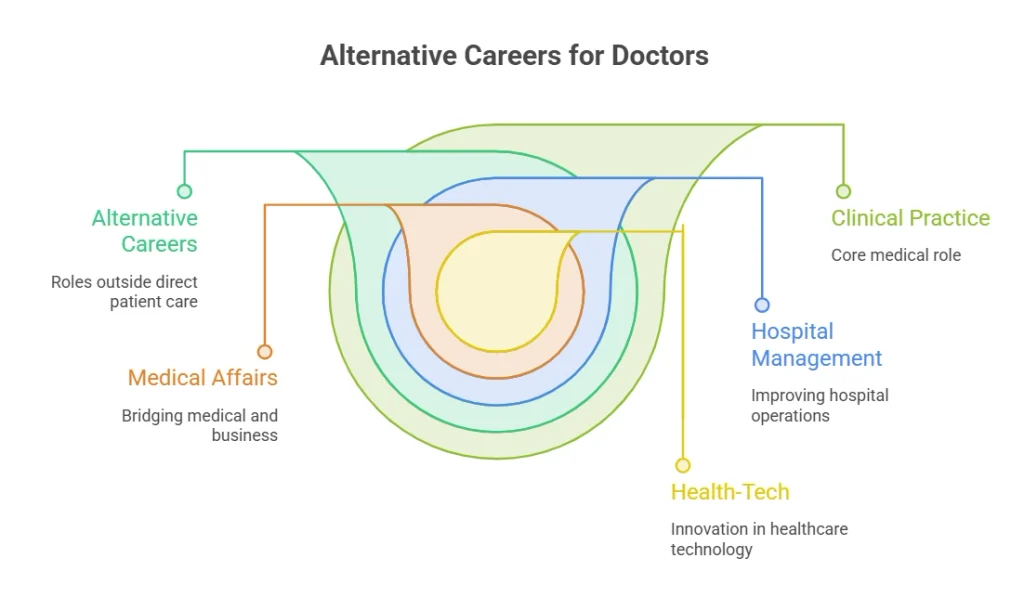
That is why searches for alternative careers for doctors continue to grow.

Current 2026 career-market reports identify hospital management, medical affairs, clinical research, pharmacovigilance, medical writing, insurance, health-tech, and consulting among the major non-clinical pathways.

The important point is that moving away from direct practice does not necessarily mean leaving healthcare.

Your medical knowledge can remain a competitive advantage.

Top 10 High-Paying Non-Clinical Jobs After MBBS, BAMS, or BHMS

1. Hospital Administrator

Hospital administration is one of the clearest management pathways for medical graduates.

Hospital administrators help manage:

  • Operations
  • Staffing
  • Finance
  • Patient flow
  • Quality
  • Facilities
  • Strategy

An MBBS, BAMS, or BHMS graduate can bring valuable clinical context to administration.

However, management positions generally require business skills beyond medical knowledge.

That is why many candidates pursue an MBA or healthcare-management qualification.

Why It Can Pay Well

Hospital administration compensation often increases with responsibility.

A fresher may begin in operations or administration.

Over time, professionals can progress toward:

Executive → Assistant Manager → Operations Manager → Administrator → Unit Head → Senior Leadership

Current 2026 career guides generally place entry hospital-management compensation in India in the mid-single-digit lakh range, while senior administrators can earn substantially more. Actual packages vary significantly by hospital size, city, responsibility, and experience.

Best Fit

Suitable for:

  • MBBS
  • BAMS
  • BHMS

particularly when combined with strong management education.

2. Healthcare Consultant

Healthcare consulting for doctors can be one of the most attractive corporate pathways.

Consultants help healthcare organizations solve business problems.

Projects may involve:

  • Hospital strategy
  • Process improvement
  • Cost optimization
  • Expansion
  • Market analysis
  • Digital transformation
  • Quality improvement

Doctors can bring something valuable to consulting:

clinical understanding.

However, consulting also demands:

  • Excel
  • Presentations
  • Structured problem-solving
  • Financial analysis
  • Communication

Therefore, an MBA can significantly strengthen this transition.

Salary Potential

Healthcare consulting can offer strong long-term compensation.

However, salary depends heavily on employer, MBA profile, experience, and role seniority.

Current career-market reports indicate that experienced healthcare consultants and medically trained professionals with business expertise can move into high-paying strategy roles.

Freshers should not assume senior consulting salary ranges apply immediately.

Best Fit

Potentially suitable for:

  • MBBS
  • BAMS
  • BHMS

with strong management, analytics, and business skills.

3. Healthcare Operations Manager

Operations management focuses on making healthcare delivery work smoothly.

You may manage:

  • OPD workflows
  • Bed management
  • Discharge
  • Diagnostics coordination
  • Patient services
  • Department productivity

This is different from practicing medicine.

The manager focuses on the system rather than individual clinical decisions.

A medical graduate can understand operational problems quickly because they already know the patient journey.

Career Growth

A possible path is:

Operations Executive → Assistant Manager → Operations Manager → Senior Manager → Unit Operations Head

Hospital operations can eventually lead toward broader administration and leadership.

Best Fit

Suitable for:

  • MBBS
  • BAMS
  • BHMS

especially after management training.

4. Medical Affairs or Medical Advisor

Medical affairs is one of the higher-paying corporate pathways associated with medical qualifications.

Medical advisors may work with:

  • Scientific evidence
  • Medical communication
  • Clinical strategy
  • Product teams
  • Regulatory teams
  • Healthcare professionals

However, this is one area where qualification requirements need careful attention.

Many Medical Advisor and Medical Science Liaison roles strongly prefer or require:

  • MBBS
  • MD
  • PharmD
  • PhD
  • Relevant life-science qualifications

Therefore, BAMS or BHMS graduates should never assume automatic eligibility.

Always check the job description.

Non-Clinical Medical Salary Potential

Current 2026 salary reports indicate that Medical Advisor and Medical Affairs roles can offer some of the strongest long-term compensation among non-clinical medical careers.

Indicative reports place experienced medical-affairs professionals well above many entry-level hospital-management positions.

However, higher-paying positions usually require relevant experience.

A direct high-paying fresher role is not guaranteed.

Best Fit

Strongest fit:

  • MBBS
  • MD or relevant advanced qualifications

BAMS/BHMS eligibility depends on specific employers and positions.

5. Clinical Research Professional

Clinical research offers opportunities in:

  • Clinical trials
  • Study coordination
  • Research operations
  • Trial documentation
  • Data review

Potential roles include:

  • Clinical Research Coordinator
  • Clinical Research Associate
  • Clinical Operations Executive
  • Medical Monitor

The qualification requirement becomes stricter as the role becomes more medically responsible.

For example, Medical Monitor positions may specifically require MBBS or equivalent accepted medical qualifications.

Salary Potential

Current 2026 career-market data suggest clinical research can offer solid progression, particularly after several years of experience.

Entry positions typically pay less than experienced clinical leadership roles.

Useful Skills

Build knowledge in:

  • Clinical research methodology
  • Good Clinical Practice
  • Documentation
  • Data interpretation
  • Research ethics

Best Fit

Potentially suitable for:

  • MBBS
  • Some BAMS/BHMS graduates in eligible research or coordination roles

Always verify role-specific requirements.

Bonus: Hospital Operations Skills & Career Growth 

6. Medical Writer

If you enjoy research and communication, medical writing can be an attractive desk-based career.

Medical writers may create:

  • Scientific articles
  • Educational content
  • Regulatory documents
  • Research summaries
  • Patient education material
  • Training material

This career requires a different form of expertise.

Instead of treating the patient, you translate complex health information into accurate written communication.

What Skills Matter?

You need:

  • Strong English
  • Medical terminology
  • Literature research
  • Referencing
  • Critical thinking
  • Scientific accuracy

Non-Clinical Medical Salary

Medical writing may not always offer the highest starting salary.

However, specialized regulatory and senior scientific-writing roles can offer stronger long-term compensation.

Current 2026 career reports suggest entry-level writing salaries can start modestly, while experienced specialist writers can progress substantially.

Best Fit

Potentially suitable for:

  • MBBS
  • BAMS
  • BHMS

depending on employer and content specialization.

Turn Medicine Into Leadership

Add business, finance, analytics, and leadership capabilities to your healthcare background and unlock diverse opportunities beyond direct patient care.

Apply Now

7. Health-Tech Product or Operations Manager

Digital healthcare is creating a new class of non-clinical medical careers.

Health-tech businesses may operate across:

  • Telemedicine
  • Digital health
  • Remote monitoring
  • Hospital software
  • Healthcare analytics
  • Patient platforms

Doctors and AYUSH graduates can bring valuable healthcare knowledge to these businesses.

Potential roles include:

  • Clinical Operations Manager
  • Healthcare Product Analyst
  • Product Manager
  • Healthcare Business Analyst
  • Implementation Manager

Why Medical Graduates Have an Advantage

A software engineer may understand the technology.

A medical graduate understands healthcare users.

A management-trained medical professional can connect:

Patient Need + Healthcare Workflow + Business Model + Technology

That combination can be valuable.

Salary Potential

Health-tech roles vary widely.

Product, strategy, analytics, and experienced operations roles can offer strong packages, while entry-level positions may be more modest.

The sector rewards digital and analytical skills rather than a medical degree alone.

Best Fit

Potentially suitable for:

  • MBBS
  • BAMS
  • BHMS

especially with MBA, product, analytics, or technology skills.

8. Healthcare Insurance and Claims Management

Insurance creates several non-clinical healthcare roles.

Possible areas include:

  • Medical claims
  • Medical review
  • Provider management
  • Utilization-related processes
  • Insurance operations
  • Fraud review

Some positions specifically seek doctors.

Others may accept broader healthcare backgrounds.

Why Doctors Are Useful

Medical knowledge helps professionals understand:

  • Diagnoses
  • Treatment records
  • Hospital bills
  • Medical necessity
  • Documentation

However, candidates should understand insurance policy and operational processes as well.

Salary Growth

Entry-level insurance medical positions may not always rank among the highest-paying careers.

However, professionals can progress toward:

  • Medical Manager
  • Claims Head
  • Provider Network Leadership
  • Insurance Operations Leadership

Best Fit

MBBS may have stronger access to medical-review roles.

BAMS and BHMS graduates can explore eligible claims, operations, coordination, or related positions depending on employer requirements.

9. Hospital Quality and Accreditation Manager

Healthcare quality is another promising alternative career for doctors.

Quality professionals work on:

  • NABH accreditation
  • Audits
  • Patient safety
  • SOPs
  • KPIs
  • Incident analysis
  • Compliance

Doctors can bring clinical understanding into quality management.

However, the role also requires strong administrative discipline.

Career Progression

A typical route may be:

Quality Executive → NABH Coordinator → Quality Manager → Quality Head

Quality professionals can also move into hospital administration.

Important Skills

Learn:

  • NABH standards
  • Audit methodology
  • Root Cause Analysis
  • CAPA
  • Patient safety
  • Data interpretation

Best Fit

Suitable for:

  • MBBS
  • BAMS
  • BHMS

depending on employer requirements.

Management and quality training can strengthen eligibility.

10. Healthcare Business Development and Corporate Strategy

Healthcare organizations need professionals who can grow services.

Business-development managers may work on:

  • Partnerships
  • Corporate accounts
  • New services
  • Market expansion
  • Doctor engagement
  • Institutional relationships

Medical graduates can understand healthcare products more deeply than many general sales professionals.

An MBA adds:

  • Marketing
  • Finance
  • Strategy
  • Negotiation
  • Business development

Over time, strong performers may progress into:

  • Business Head
  • Strategy Manager
  • Regional Manager
  • Corporate Growth Leadership

Best Fit

Potentially suitable for:

  • MBBS
  • BAMS
  • BHMS

particularly with management education.

Quick Comparison of the Top 10 Non-Clinical Careers

CareerClinical Knowledge ValueMBA ValueIncome Potential
Hospital AdministrationHighVery HighHigh
Healthcare ConsultingHighVery HighVery High
Healthcare OperationsHighHighHigh
Medical AffairsVery HighModerateVery High
Clinical ResearchVery HighModerateHigh
Medical WritingHighHelpfulModerate–High
Health-Tech ManagementHighVery HighHigh–Very High
Healthcare InsuranceHighHighModerate–High
Quality & AccreditationHighHighHigh
Business DevelopmentModerate–HighVery HighHigh

These categories indicate career potential rather than guaranteed salaries.

What Is a Realistic Non-Clinical Medical Salary in India?

The term non clinical medical salary covers very different professions.

Therefore, quoting one average is misleading.

Current 2026 market guides suggest broad patterns such as:

  • Entry hospital-management roles often fall in the mid-single-digit lakh range.
  • Entry clinical-research and medical-writing jobs can also begin in moderate salary bands.
  • Medical-affairs roles may pay significantly more, but often require MBBS and relevant experience.
  • Experienced healthcare consultants, product managers, administrators, and medical-affairs professionals can achieve much higher compensation.

Students should check:

  • Qualification requirements
  • Experience requirements
  • City
  • Company
  • Role level

before comparing salaries.

A ₹15 lakh role that requires three years of experience should not be compared with a fresher role.

MBA After AYUSH: Does It Make Sense?

An MBA after AYUSH can make sense for BAMS or BHMS graduates who want to build careers beyond clinical practice.

An MBA can add competencies that clinical education does not usually emphasize deeply.

These include:

  • Finance
  • Operations
  • Marketing
  • HR
  • Strategy
  • Analytics

That can support movement toward:

  • Hospital administration
  • Healthcare operations
  • Quality
  • Health-tech
  • Insurance
  • Business development

However, the MBA does not convert an AYUSH qualification into an MBBS qualification.

This distinction is critical.

If a job legally or professionally requires an MBBS-qualified physician, completing an MBA does not remove that requirement.

The real value of the MBA is different.

It helps you compete for management positions where healthcare understanding is useful.

Hospital Management After BHMS: Is It a Good Career?

Hospital management after BHMS can be a practical transition for graduates who enjoy healthcare systems more than direct clinical practice.

A BHMS graduate already understands:

  • Patients
  • Medical terminology
  • Healthcare environments
  • Documentation

Management education can add:

  • Hospital operations
  • Quality
  • Finance
  • HR
  • Strategy

A possible pathway could be:

BHMS → MBA Healthcare → Management Trainee → Hospital Operations → Assistant Manager → Operations Manager

Actual progression depends on performance and employer requirements.

The important advantage is that you are not beginning healthcare knowledge from zero.

How MBBS Graduates Can Use an MBA

MBBS graduates can use an MBA to move from:

Clinical Decision-Making

toward:

Organizational Decision-Making

Potential pathways include:

  • Healthcare consulting
  • Hospital strategy
  • Health-tech
  • Operations
  • Business development
  • Healthcare leadership

The combination can be particularly valuable because senior healthcare decisions often require understanding both medicine and business.

However, an MBA should be chosen because it supports your target career.

It should not be used only as an escape from clinical work.

Which Non-Clinical Careers Require an MBA?

An MBA is especially useful for:

  • Hospital administration
  • Healthcare consulting
  • Healthcare operations
  • Health-tech management
  • Business development
  • Corporate strategy

An MBA may be helpful but not essential for:

  • Medical writing
  • Clinical research
  • Medical affairs
  • Pharmacovigilance

These paths may value specialized scientific training more.

Therefore, the right qualification depends on the destination.

How to Choose the Right Career

Ask yourself these questions.

Do You Enjoy Business Problems?

Consider:

  • Management
  • Consulting
  • Operations

Do You Enjoy Scientific Research?

Consider:

  • Clinical research
  • Medical affairs

Do You Enjoy Writing?

Consider:

  • Medical writing

Do You Enjoy Technology?

Consider:

  • Health-tech
  • Analytics
  • Digital health

Do You Enjoy Quality Systems?

Consider:

  • Accreditation
  • Patient safety
  • Compliance

Career clarity should come before additional qualifications.

Career Roadmap for MBBS, BAMS, and BHMS Graduates

Step 1: Select Two Target Careers

Do not prepare for ten paths simultaneously.

Choose:

Primary role + Backup role

For example:

Primary: Hospital Administration
Backup: Quality Management

Step 2: Identify the Skill Gap

A medical degree already gives you healthcare knowledge.

You may need:

  • Finance
  • Analytics
  • Excel
  • Management
  • Business communication

Step 3: Add the Right Qualification

Choose an MBA when management is the goal.

Choose research training when research is the goal.

Choose digital tools when health-tech is the goal.

Step 4: Build Practical Evidence

Complete:

  • Internships
  • Projects
  • Case studies
  • Certifications

Step 5: Rewrite Your Resume

Do not present yourself only as someone trying to leave medicine.

Present yourself as a healthcare professional adding a new capability.

For example:

Medical Knowledge + MBA + Hospital Operations

is stronger than:

Doctor looking for a desk job.

Skills That Increase Non-Clinical Earning Potential

High-paying careers generally reward skill combinations.

Useful skills include:

Excel and Analytics

Important for business decisions.

Power BI

Useful for healthcare dashboards.

Finance

Essential for management and consulting.

Presentation Skills

Important for leadership and corporate roles.

Project Management

Useful across healthcare organizations.

Quality Management

Especially useful for hospitals.

Digital Health Knowledge

Important for future-facing healthcare careers.

Business Communication

Doctors moving into corporate environments need to communicate with senior management, clients, and cross-functional teams.

Clinical Degree + Management Skills: Why the Combination Works

Think about a hospital expansion project.

A general MBA graduate may understand:

  • Finance
  • Strategy
  • Operations

A doctor understands:

  • Clinical workflows
  • Patient needs
  • Medical departments

A medically trained MBA can potentially connect both perspectives.

That can create value in:

  • Hospital leadership
  • Consulting
  • Health-tech
  • Strategy

This is the central advantage of transitioning into management.

You do not have to discard your medical education.

You build on it.

Common Mistakes Doctors Make During a Career Shift

Chasing Salary Alone

A high salary today does not guarantee a strong career.

Assuming Every Medical Job Accepts Every Degree

MBBS, BAMS, and BHMS are different qualifications.

Always check eligibility.

Doing an MBA Without a Career Goal

Management education works best when the destination is clear.

Ignoring Business Skills

Clinical knowledge alone may not be enough in corporate jobs.

Expecting an Instant Senior Role

Your medical degree is valuable.

However, you may still be new to management.

Respect the learning curve.

Which Career Has the Highest Earning Potential?

There is no universal answer.

Some medical-affairs positions can be highly paid.

Senior healthcare consulting can also offer strong compensation.

Hospital leadership and health-tech management can provide substantial long-term upside.

However, these jobs require different qualifications.

Therefore, the better question is:

Which high-value role can I realistically become excellent at?

That provides a more sustainable career strategy.

Bonus: Green Belt Certification for Healthcare Students 

How Asia Pacific Institute of Management Can Support a Healthcare Career Shift

Moving from clinical education to management requires more than theoretical business knowledge.

Students need exposure to:

  • Strategy
  • Finance
  • Operations
  • Marketing
  • Analytics
  • Communication

At Asia Pacific Institute of Management, an industry-oriented curriculum, experienced faculty, practical learning, corporate exposure, and placement support can help students build wider managerial capabilities.

For MBBS, BAMS, or BHMS graduates exploring management careers, combining healthcare knowledge with business skills can support movement into administration, consulting, health-tech, operations, quality, and other corporate healthcare functions.

The goal is not simply to become a non-clinical professional.

It is to become a professional who understands healthcare and management.

Conclusion

The search for non clinical jobs after MBBS BAMS reflects a larger change in healthcare careers.

Medical graduates are no longer limited to one professional pathway.

They can contribute through:

  • Management
  • Strategy
  • Research
  • Technology
  • Insurance
  • Quality
  • Consulting

However, MBBS, BAMS, and BHMS graduates should not assume every corporate healthcare role has the same eligibility requirements.

Some scientific and physician-level positions may specifically require MBBS or advanced medical qualifications.

Management roles are often more flexible.

This is where an MBA after AYUSH or an MBA after MBBS can create value.

The strongest career formula is:

Healthcare Knowledge + Specialized Skill + Business Understanding + Experience

For one graduate, that may lead to healthcare consulting.

For another, it may lead to hospital administration.

For another, health-tech could become the right path.

The objective should not be to escape medicine.

It should be to identify where your medical knowledge can create the most value outside direct clinical practice.

Build Your Healthcare Future

Transform your clinical foundation into business expertise for growing opportunities across hospital management, health-tech, quality, consulting, and corporate healthcare.

Apply Now

About the Author

author

Dr. Vikas Gupta

Dr. Vikas Gupta is a distinguished academic in the education and research domain, specializing in finance and related interdisciplinary studies. He is known for his...

Read Full Bio →

Frequently Asked Questions (FAQs)

01. What are the best non clinical jobs after MBBS BAMS?

Popular options include hospital administration, healthcare consulting, hospital operations, quality management, health-tech, medical writing, insurance, research, and business development. Eligibility varies by qualification.

02. What are good alternative careers for doctors who do not want clinical practice?

Doctors can explore healthcare management, consulting, health-tech, medical affairs, research, medical writing, insurance, analytics, and quality management.

03. Can BAMS graduates pursue an MBA?

Yes, eligible BAMS graduates can pursue management programmes. An MBA can support careers in hospital administration, healthcare operations, health-tech, marketing, and related management areas.

04. Is hospital management after BHMS possible?

Yes. BHMS graduates can explore healthcare-management education and eligible roles in administration, operations, quality, insurance, and other non-clinical functions.

05. Does an MBA after AYUSH guarantee a corporate job?

No. An MBA builds management skills but does not guarantee employment. Internships, business skills, communication, role targeting, and practical projects also matter.

06. Is healthcare consulting for doctors high paying?

It can offer strong long-term compensation, particularly for candidates combining medical knowledge with business, analytics, and strategic problem-solving skills. Entry salaries and eligibility still vary significantly.

07. What is the average non clinical medical salary?

There is no meaningful single average because jobs range from writing and operations to medical affairs and senior consulting. Compensation depends on qualification, experience, specialization, employer, and city.

08. Which non-clinical career is best after MBBS, BAMS, or BHMS?

The best career depends on your qualification and strengths. Management-focused candidates may prefer administration or consulting, while research-focused candidates may prefer clinical research or scientific roles.

Follow Us

Subscribe to Our Newsletter

Download Brochure

BBA Brochure

PGDM Brochure

MBA Brochure

Apply Now Call Us Email WhatsApp