B.Sc Nursing to MBA Healthcare: Salary Hike, Desk Roles & Career Roadmap
Posted on 28 Aug 2026
By Dr. Vikas Gupta
Introduction
A B.Sc Nursing degree builds valuable capabilities in patient care, clinical coordination, documentation, communication, and hospital workflows. However, after spending several years in clinical environments, some nurses begin considering a different career question:
Can I move from bedside nursing into healthcare management?
For many professionals, pursuing an MBA healthcare after BSc Nursing can create a pathway toward hospital operations, quality management, patient experience, healthcare administration, insurance, corporate healthcare, and other non-clinical roles.
The transition does not mean nursing experience becomes irrelevant. In fact, clinical exposure can become a major advantage.
A nurse already understands patient journeys, hospital departments, clinical teams, documentation requirements, and real operational problems. An MBA can add business knowledge in finance, operations, HR, strategy, analytics, and leadership.
However, candidates should not pursue an MBA based only on expectations of an immediate salary hike or desk job.
The real value comes from combining clinical experience with management capabilities.
This guide explains career options, salary considerations, management roles, required skills, and a practical career roadmap for nurses considering healthcare management in India.
Move Beyond Bedside Care
Transform your nursing experience into management expertise and prepare for rewarding careers across hospital operations, quality, administration, and healthcare leadership.
MBA healthcare after BSc Nursing is a management education pathway for nursing graduates who want to add business, administrative, operational, and leadership skills to their clinical knowledge. It can support career movement into hospital administration, operations, quality, insurance, healthcare consulting, and other non-clinical functions.
Eligibility depends on the individual programme and institution.
Therefore, candidates should always verify:
Graduation requirements
Minimum marks
Entrance requirements
Work-experience criteria
Programme structure
The bigger question, however, is not whether nurses can study management.
It is whether the qualification supports the career they want.
Why Are Nurses Considering Management Careers?
Clinical nursing can be highly demanding.
It may involve:
Shift duties
Night schedules
Emergency responsibilities
Physical demands
Direct patient-care pressure
Some professionals enjoy bedside nursing throughout their careers.
India's healthcare sector also continues to expand across hospitals, insurance, diagnostics, health-tech, medical devices, pharmaceuticals, and other services. Healthcare remains one of India's largest employment sectors.
Consequently, nursing graduates can explore a wider range of healthcare roles than bedside care alone.
Why Nursing Experience Can Be Valuable in Management
A management graduate without healthcare exposure may need time to understand how hospitals actually function.
Nurses already have significant practical exposure.
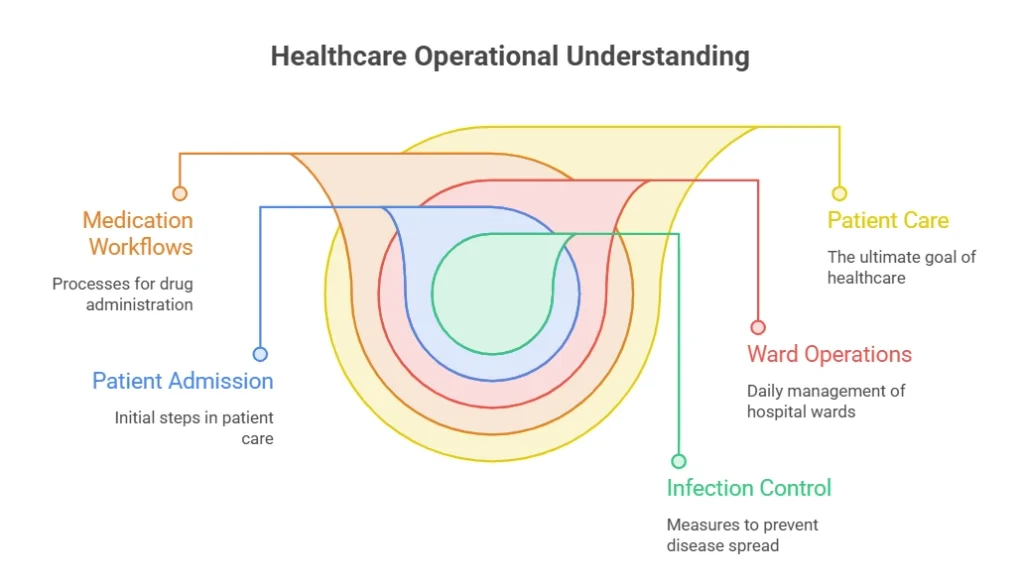
They understand:
Patient admission
Ward operations
Medication workflows
Doctor-nurse coordination
Infection control
Documentation
Discharge
Patient communication
This creates an important advantage.
Consider hospital operations.
A management graduate may understand the theory of patient flow.
A nurse has experienced patient flow personally.
The MBA can then help the nurse examine that experience through a managerial lens.
For example:
Clinical thinking: Why is my patient's discharge delayed?
Management thinking: Why are 30% of today's discharges delayed, and which process is causing the bottleneck?
That transition from individual cases to system-level problems is central to healthcare management.
Nursing to Corporate Shift: What Actually Changes?
A nursing to corporate shift does not necessarily mean leaving healthcare.
Instead, your responsibilities change.
A bedside nurse primarily focuses on direct patient care.
A healthcare manager may focus on:
Processes
Teams
Performance
Quality
Costs
Patient experience
Strategy
Your clinical knowledge remains useful.
However, your performance may increasingly be evaluated through organizational outcomes.
For example, instead of managing one patient's care, you may work on improving the patient journey across an entire ward.
A nursing superintendent already handles substantial leadership responsibilities.
These may include:
Nursing workforce management
Rosters
Standards
Training
Quality
Coordination
Patient safety
This creates a strong management foundation.
However, broader hospital administration may require additional capabilities in:
Finance
Marketing
Strategy
Supply chain
Business planning
Analytics
An MBA or relevant healthcare-management education can help bridge these gaps.
The professional then moves from leading primarily nursing services toward understanding the entire healthcare organization.
What Does an MBA Add to Nursing Knowledge?
An MBA should add capabilities that clinical education may not cover deeply.
Finance
You may learn to understand:
Budgets
Costs
Revenue
Financial statements
Investment decisions
This becomes important in senior hospital roles.
Operations
You can study:
Capacity
Patient flow
Inventory
Waiting time
Process improvement
Human Resources
Management involves:
Recruitment
Performance
Training
Workforce planning
Employee engagement
Strategy
Senior professionals need to understand:
Growth
Competition
New services
Technology investment
Business models
Marketing
Healthcare organizations also need to understand patients, markets, services, and communication.
Analytics
Modern hospital managers increasingly work with dashboards and KPIs.
Therefore, data literacy can strengthen career progression.
Can an MBA Healthcare Increase a Nurse's Salary?
Potentially, but an MBA does not guarantee an immediate salary hike.
This distinction is important.
Salary depends on:
Previous experience
MBA quality
Employer
City
Role
Management responsibility
Technical skills
Negotiation
Industry segment
A nurse moving into an entry-level administrative position may not receive a dramatic salary increase immediately.
However, management education can potentially expand the range of roles available over time.
The better ROI question is:
Does the MBA create a credible pathway toward roles with greater responsibility and long-term earning potential?
Turn Experience Into Leadership
Add business, finance, operations, analytics, and leadership capabilities to your clinical foundation and confidently pursue healthcare management opportunities.
Compensation varies significantly between entry-level executives, managers, administrators, and senior hospital leaders.
Public salary guides commonly show entry-level hospital administration opportunities in the broad range of roughly ₹3–8 lakh annually, while experienced managers and senior administrators can earn considerably more. These figures should be treated as market indications rather than guaranteed outcomes.
Candidates should check current vacancies and employer offers when making career decisions.
More importantly, salary growth often follows responsibility.
A professional responsible for one process usually earns differently from someone managing:
Multiple departments
Large teams
Budgets
Hospital units
Strategic initiatives
Therefore, career progression matters more than one starting salary number.
A Realistic Salary-Growth Model
Instead of assuming:
B.Sc Nursing → MBA → Immediate high salary
think about progression like this:
Clinical Experience → Management Education → Entry into Relevant Function → Demonstrated Results → Larger Responsibility → Salary Growth
This model is more realistic.
For example, a nurse may move into quality management.
After developing expertise in audits, accreditation, patient safety, and team management, the professional may progress toward quality leadership.
Similarly, someone entering operations may progress toward hospital-wide management.
The MBA creates capabilities and options.
Performance converts them into career growth.
MBA Healthcare After BSc Nursing: Career Roadmap
A structured roadmap can make the transition easier.
Stage 1: Define Why You Want to Move
Do not begin with the degree.
Begin with the career.
Ask yourself:
Do I dislike bedside work, or do I genuinely enjoy management?
Do I want hospital leadership?
Do I enjoy data?
Do I prefer quality?
Am I interested in insurance or consulting?
Your answer determines what skills you should build.
Stage 2: Identify Transferable Nursing Skills
Create a list of what nursing has already taught you.
For example:
Patient coordination
Documentation
Teamwork
Shift management
Communication
Infection control
Emergency response
Then translate these into management language.
Instead of writing:
"Handled patients in ward."
Your management profile could emphasize:
"Coordinated multidisciplinary patient-care workflows in a high-volume ward environment."
Keep every claim accurate.
The objective is to communicate your experience in business-relevant language.
Healthcare organizations need leaders who understand what happens on the hospital floor.
Nurses bring that perspective.
They have seen:
Patient anxiety
Workflow failures
Staffing pressure
Documentation challenges
Coordination problems
Safety risks
Management education can help convert these observations into system-level solutions.
At Asia Pacific Institute of Management, an industry-oriented curriculum, experienced faculty, practical learning, corporate exposure, and placement support can help learners develop broader managerial capabilities.
For nursing graduates considering management, the goal should be to retain the value of clinical experience while adding finance, strategy, analytics, operations, and leadership skills.
That combination can create a differentiated healthcare-management profile.
Conclusion
Pursuing an MBA healthcare after BSc Nursing can be more than a move from bedside work to a desk.
It can represent a shift from managing individual patient-care responsibilities toward improving healthcare systems, teams, processes, and organizations.
Nursing graduates already bring something valuable to management:
real healthcare experience.
They understand patients, clinical teams, hospital workflows, and the practical consequences of administrative decisions.
An MBA can add the missing business layer through:
Finance
Operations
Strategy
HR
Analytics
Leadership
However, the degree should not be viewed as an automatic shortcut to a high salary.
For nurses who genuinely want to move into operations, quality, administration, insurance, patient experience, or other corporate healthcare functions, this combination can create a compelling long-term career pathway.
Advance Your Nursing Career
Build on your clinical knowledge with practical management skills for growing opportunities in healthcare administration, operations, quality, and corporate roles.
Dr. Vikas Gupta is a distinguished academic in the education and research domain, specializing in finance and related interdisciplinary studies. He is known for his...
01.
Can I pursue MBA healthcare after BSc Nursing?
Yes, nursing graduates can pursue eligible MBA or healthcare-management programmes. However, admission requirements differ, so candidates should verify the specific programme’s eligibility criteria.
02.
What are the best non-clinical jobs for nurses?
Possible areas include hospital operations, quality management, patient experience, healthcare insurance, administration, training, clinical operations, and selected consulting roles.
03.
Does MBA after nursing guarantee a salary hike?
No. Salary depends on experience, role, employer, location, skills, and responsibility. An MBA can expand career options but cannot guarantee an immediate salary increase.
04.
Can a nurse become a hospital administrator?
Yes, nursing professionals can progress toward hospital administration by developing relevant management skills and experience. Senior roles typically require broader expertise beyond clinical nursing.
05.
Can a nursing superintendent move into administration?
A nursing superintendent already has valuable leadership experience. Additional knowledge in finance, operations, strategy, analytics, and business management can support movement toward broader administrative responsibilities.
06.
Are corporate nurse roles completely desk-based?
Not always. Quality, operations, patient experience, and administration roles can involve hospital rounds, meetings, department coordination, and extended schedules.
07.
What is the hospital administration salary after an MBA?
There is no fixed salary. Compensation varies significantly by experience, employer, city, hospital size, job function, and management responsibility.
08.
Which skills should nurses learn before moving into healthcare management?
Important skills include Excel, finance, operations, business communication, analytics, healthcare quality, leadership, presentation, and process improvement.


















.webp) Call Us
Call Us