How to Manage Academic Workload During PGDM Without Missing Deadlines
Posted on 29 Aug 2026
By Dr. Vikas Gupta
Introduction
Managing a PGDM academic workload can be challenging because students often handle lectures, case studies, presentations, group projects, examinations, research, and professional-development activities at the same time. Without a clear system, several manageable tasks can quickly turn into competing deadlines.
For PGDM students, effective workload management is not about studying every available hour. It involves knowing what needs attention first, breaking complex assignments into smaller actions, coordinating group work, and protecting enough time for revision and rest. This performance guide explains how to organise academic responsibilities, plan around deadlines, handle overlapping submissions, reduce last-minute pressure, and build study habits that support consistent performance throughout a PGDM program.
PGDM Management Lab
Master essential business simulations and practical strategy models. Boost your management career now!
Maintain one master system for recording every assignment, presentation, examination, project, and submission date.
Break large academic tasks into smaller milestones with personal deadlines before the official submission date.
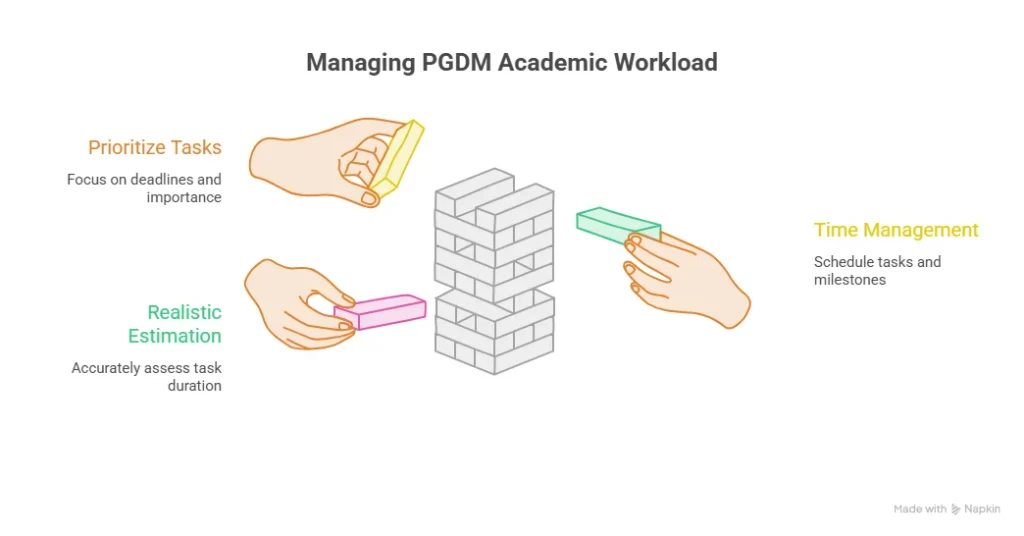
Prioritise work according to urgency, complexity, academic importance, and the time required for completion.
Coordinate group projects early by assigning responsibilities, internal deadlines, and review time.
Build buffer time into your weekly schedule so unexpected academic work does not immediately disrupt existing plans.
What Is PGDM Academic Workload?
PGDM academic workload refers to the combined academic responsibilities students manage during a post graduate diploma in management, including classes, readings, case studies, assignments, presentations, group projects, examinations, research, and related preparation. The workload can vary by institution, term, subjects, assessment structure, and individual academic responsibilities.
Unlike a schedule built around one type of assessment, a PGDM course may require students to switch frequently between individual and collaborative work.
One day may involve preparing a case discussion, while another requires working on a presentation or completing an analytical assignment. The challenge is therefore not simply the amount of work. Students must also manage different formats, priorities, dependencies, and deadlines.
A reliable workload-management system helps turn these responsibilities into visible, actionable tasks. Bonus:life in PGDM college
Why Does PGDM Academic Workload Become Difficult to Manage?
PGDM academic workload becomes difficult when multiple assignments, classes, presentations, group projects, examinations, and extracurricular commitments compete for limited time. Problems usually increase when students underestimate task duration, delay difficult work, accept too many commitments, or rely on memory instead of maintaining a clear schedule of deadlines and intermediate milestones.
Management education can involve frequent context switching. Preparing for a marketing presentation requires a different approach from analysing numerical information, reading a business case, or coordinating a group project.
Students may also focus heavily on the nearest deadline while ignoring another substantial assignment due shortly afterward. When the first submission is completed, the second suddenly becomes urgent.
Common workload problems include:
Starting assignments too close to submission dates
Treating every task as equally important
Underestimating research and revision time
Waiting for teammates before beginning dependent work
Taking on too many campus activities
Leaving examination preparation until assessments approach
Forgetting smaller academic requirements
Recognising these patterns early makes them easier to correct.
How Can PGDM Students Plan Their Academic Week?
PGDM students can plan effectively by reviewing all upcoming classes, assignments, examinations, presentations, and project milestones at the beginning of each week. Fixed commitments should be entered first, followed by focused work blocks for important tasks. The schedule should also include buffer periods so unexpected academic requirements can be handled without disrupting every planned activity.
Start by maintaining a master list or calendar containing every known academic deadline. Use the official academic calendar, course instructions, faculty communication, and learning platforms applicable to your institution rather than relying only on memory or informal group messages.
At the beginning of each week, identify three categories:
Must finish: Work with immediate or fixed deadlines.
Must progress: Larger assignments that are not due immediately but require steady work.
Should prepare: Revision, reading, research, or preparation that prevents future pressure.
Then allocate actual time blocks rather than writing vague instructions such as "work on project." A clearer entry would be "analyse case data from 4:00 to 5:00 PM."
Specific tasks make progress easier to measure.
How Should Students Prioritise Multiple PGDM Deadlines?
Students should prioritise deadlines by considering submission date, academic importance, task complexity, dependencies, and estimated completion time. The closest deadline is not automatically the only priority. A major project due next week may need attention before a small assignment due tomorrow if the larger task requires research, teamwork, analysis, or several rounds of revision.
A simple priority system can prevent reactive decision-making.
Priority
Type of Work
Recommended Action
High
Important and due soon
Schedule focused work immediately
High
Important, complex, due later
Begin milestones now
Medium
Short routine assignment
Complete in an appropriate smaller block
Medium
Revision for future assessment
Schedule recurring sessions
Low
Optional activity without immediate value
Do after essential work
Estimate how long each assignment will take before scheduling it. Then consider adding extra time for difficult or unfamiliar work.
Prioritisation should remain flexible. New academic requirements may appear, so review priorities regularly instead of treating the week's original plan as permanent. Bonus:PGDM dissertation guide
How Can Students Break Large Assignments Into Manageable Tasks?
Large PGDM assignments become easier to manage when students convert the final deliverable into smaller, clearly defined actions. Instead of scheduling "complete report," identify stages such as understanding the brief, researching information, analysing evidence, preparing an outline, drafting sections, reviewing references, editing, formatting, and conducting a final submission check.
This approach creates multiple small deadlines before the official one.
For example, a report due in ten days might be divided into:
Day 1: Understand requirements and assessment criteria
Days 2-3: Research and organise relevant material
Day 4: Create the structure
Days 5-6: Draft the main sections
Day 7: Complete analysis
Day 8: Review and revise
Day 9: Check references and formatting
Day 10: Final verification and submission
The same principle works for presentations. Separate research, storyline development, slide preparation, editing, and rehearsal instead of attempting everything in one session.
Students working on specialised subjects, including PGDM in marketing management, PGDM in data analytics, or PGDM in banking and finance, can adapt these stages according to the type of assignment involved.
How Can PGDM Students Manage Group Projects Without Delays?
PGDM students can manage group projects by agreeing on the expected output, dividing responsibilities clearly, establishing internal deadlines, and reviewing progress before the official submission date. Teams should identify dependencies early because one delayed section can affect several members. Regular, brief progress checks are generally more useful than discovering incomplete work immediately before submission.
Begin each project by confirming what the team must actually deliver. Then divide responsibilities according to the work required rather than simply dividing the number of pages or slides equally.
Assign ownership clearly. Every member should know:
What they are responsible for
When their contribution is due internally
What information they need from others
Who will combine the final output
When the team will review the complete project
When presentation practice will happen, if required
Set the team's internal completion date earlier than the institution's deadline. This creates time for correcting inconsistencies, improving analysis, and handling unexpected delays.
Collaborative work is common in a post graduate diploma in management because it also develops communication, coordination, and responsibility. Treat project management itself as part of the learning process.
How Can Students Avoid Procrastination During a PGDM Course?
Students can reduce procrastination by making the first action small, specific, and easy to begin. Tasks such as "study finance" or "prepare marketing assignment" feel broad and can encourage delay. Defining the next physical action—reading the brief, creating an outline, reviewing one case, or finding three credible sources—makes starting considerably easier.
Another useful approach is to distinguish between planning and working. Spending an hour redesigning a timetable does not replace completing the assignment.
Use focused study periods with a specific outcome. During that period, minimise unrelated notifications and keep only the resources required for the task available.
If you repeatedly postpone one subject, identify the reason. The task may be unclear, difficult, boring, or dependent on information you do not yet have. Each problem requires a different response.
For difficult concepts, seek clarification early. For large tasks, reduce the first step. For unclear instructions, verify requirements instead of postponing the entire assignment.
How Can Students Balance Classes, Assignments and Exam Preparation?
Students can balance classes, assignments, and examinations by making revision a recurring part of the weekly schedule rather than an activity reserved for exam periods. Short review sessions after classes help maintain familiarity with concepts, while dedicated assignment blocks protect submission deadlines. As examinations approach, revision time can increase without completely displacing ongoing coursework.
After a class, identify the main concepts, frameworks, questions, or calculations that require further attention. This reduces the amount of material that must be reconstructed later.
Students across different areas may need different revision methods. A marketing program may involve concepts, cases, consumer behaviour, and presentations, while big data analytics may require more regular analytical or tool-based practice. Banking financial services subjects may involve concepts, applications, calculations, or industry context.
Do not assume one study technique works equally well for every subject. Match the method to the learning task.
Most importantly, protect regular revision time even when no examination is immediately approaching.
How Can PGDM Students Build Buffer Time Into Their Schedule?
Buffer time is unscheduled capacity reserved for tasks that take longer than expected, new academic requirements, project delays, corrections, or personal disruptions. PGDM students should avoid filling every available hour with planned work because one unexpected change can otherwise affect several deadlines. A realistic schedule deliberately includes flexibility rather than assuming perfect execution every day.
One practical approach is to finish important work before the actual deadline whenever possible. A personal deadline 24 to 48 hours earlier can provide valuable review time, depending on the assignment.
Students should also avoid using weekends as automatic rescue periods for unfinished weekday work. Keep some weekend capacity available, but plan essential academic progress throughout the week.
If your timetable repeatedly collapses, review your estimates. You may be allocating one hour to work that consistently requires two.
Effective planning becomes more accurate when students compare estimated time with actual completion time and adjust future schedules accordingly. Bonus:stress management for PGDM students
What Should Students Do When They Are Already Behind?
Students who are already behind should first list every outstanding responsibility, confirm actual deadlines, and identify the consequences and requirements of each task. They should then prioritise essential work, reduce optional commitments, break urgent assignments into immediate actions, and communicate appropriately when clarification or legitimate academic support is required rather than avoiding the problem.
Do not spend valuable time trying to create the perfect recovery plan. Create a workable one.
Start with the most consequential and time-sensitive tasks. Remove unnecessary activities temporarily and focus on completing defined portions of work.
Avoid rushing so much that you ignore submission instructions, referencing requirements, or academic integrity expectations. A deadline does not justify inappropriate shortcuts.
If circumstances genuinely affect your ability to meet academic requirements, consult the relevant faculty member or institutional process as early as possible. Policies concerning extensions, attendance, assessment, and late submissions vary, so rely on your institution's official rules.
Conclusion
Managing PGDM academic workload successfully depends on planning ahead, setting priorities, and turning large responsibilities into manageable actions. Students should maintain one reliable deadline system, schedule focused work blocks, create internal milestones, coordinate group projects early, and revise throughout the term. Buffer time is equally important because academic schedules do not always unfold exactly as planned. Whether handling case studies, presentations, examinations, research, or specialised subjects, consistent progress is usually more sustainable than repeated last-minute effort. A practical workload system does more than prevent missed submissions; it helps PGDM students use their time deliberately and maintain dependable academic performance throughout the program.
Explore PGDM Labs!
Gain valuable real-world executive skills inside modern corporate labs. Enroll in our program today!
Dr. Vikas Gupta is a distinguished academic in the education and research domain, specializing in finance and related interdisciplinary studies. He is known for his...
01.
How many hours should a PGDM student study every day?
There is no universal number of study hours suitable for every PGDM student. Required time depends on the academic schedule, subjects, assessments, individual preparation, and current deadlines. Instead of targeting a fixed number, students should schedule focused sessions around specific outcomes and adjust study time during examinations, presentations, projects, or particularly demanding academic periods.
02.
Which productivity tools are useful for managing PGDM assignments?
Digital calendars, task managers, spreadsheets, and note-taking applications can help students organise deadlines and academic tasks. The specific tool matters less than consistent use. A simple calendar combined with a prioritised task list may be sufficient. Students should avoid maintaining several disconnected systems because information can become duplicated, outdated, or overlooked.
03.
Should PGDM students complete assignments before the deadline?
Yes, completing important assignments before the official deadline can provide time for review, corrections, formatting, reference checks, and unexpected problems. The appropriate buffer depends on the assignment’s complexity. For major projects or presentations, setting an earlier personal or team deadline can be particularly useful because revisions and coordination often require additional time.
04.
How should PGDM students handle two assignments due on the same day?
Students should begin by comparing the complexity, estimated time, academic requirements, and progress of both assignments. Divide each into smaller tasks and schedule them across the available days rather than finishing one completely before considering the other. Starting early is especially important when either assignment requires research, collaboration, faculty clarification, or extensive revision.
05.
Is multitasking effective for managing PGDM academic work?
Usually, focused work is more practical for demanding academic tasks than repeatedly switching between unrelated activities. Writing a report while responding continuously to group messages, for example, can interrupt concentration. Students can instead group similar administrative tasks together and reserve uninterrupted periods for reading, analysis, writing, calculations, or presentation preparation.
06.
How can students manage PGDM workload during placement preparation?
Students can manage both by allocating separate recurring blocks for academic responsibilities and career preparation. Academic deadlines should remain visible while time is reserved for activities such as aptitude practice, interviews, or resume preparation when relevant. During especially demanding periods, students may need to reduce lower-priority extracurricular commitments rather than sacrificing essential academic work.
07.
What should students do if a group member repeatedly misses internal deadlines?
Students should address the problem early and focus on specific responsibilities, deadlines, and project requirements rather than personal criticism. Clarify what remains incomplete and agree on the next action. If repeated delays threaten an assessed project and cannot be resolved within the team, students should follow the relevant faculty or institutional process for guidance.
08.
How can students maintain academic performance without studying late every night?
Students can improve consistency by distributing academic work across the week, revising regularly, starting assignments early, and protecting focused study periods. Late nights often become necessary when several tasks accumulate simultaneously. Better task estimation and earlier milestones can reduce this pattern, while sufficient rest should remain part of a sustainable academic routine rather than being treated as expendable time.

















.webp) Call Us
Call Us