MBA in Healthcare Management Eligibility: Who Can Apply?
Posted on 10 Sep 2026
By Dr. Vikas Gupta
Introduction
Healthcare management is no longer limited to doctors or hospital administrators. Modern healthcare organisations need professionals who understand operations, finance, marketing, analytics, technology, insurance, and patient services.
As a result, graduates from many academic backgrounds are exploring healthcare management as a career.
In India, candidates generally need a recognised bachelor's degree to apply for an MBA or similar postgraduate management program in healthcare. However, minimum marks, entrance requirements, accepted qualifications, and selection criteria can vary by institution.
Importantly, a medical degree is not necessarily required.
This guide explains MBA healthcare eligibility, academic requirements, eligibility for non-medical students, entrance considerations, work experience, and what candidates should check before applying.
Your Degree Can Qualify
Turn your academic background into healthcare management potential by building practical business, analytical, communication, and industry focused capabilities.
What Is the MBA in Healthcare Management Eligibility?
MBA in healthcare management eligibility generally requires candidates to hold a recognised bachelor's degree or equivalent qualification. Depending on the institution, applicants may also need to meet minimum graduation marks and admission or entrance requirements. Students from healthcare as well as non-medical academic backgrounds may be eligible.
This is a general framework rather than a universal admission rule.
Every management institution can have its own admission criteria within applicable regulatory and academic requirements.
Therefore, candidates should always verify the current eligibility conditions of the program before submitting an application.
Healthcare management attracts students from diverse educational backgrounds.
Depending on program requirements, applicants may include graduates from:
Commerce
Business and management
Science
Engineering
Pharmacy
Medicine
Nursing
Dentistry
Life sciences
Biotechnology
Allied health sciences
Humanities and social sciences
Other recognised bachelor's degree disciplines
Therefore, healthcare management should not automatically be viewed as a medical-only management specialization.
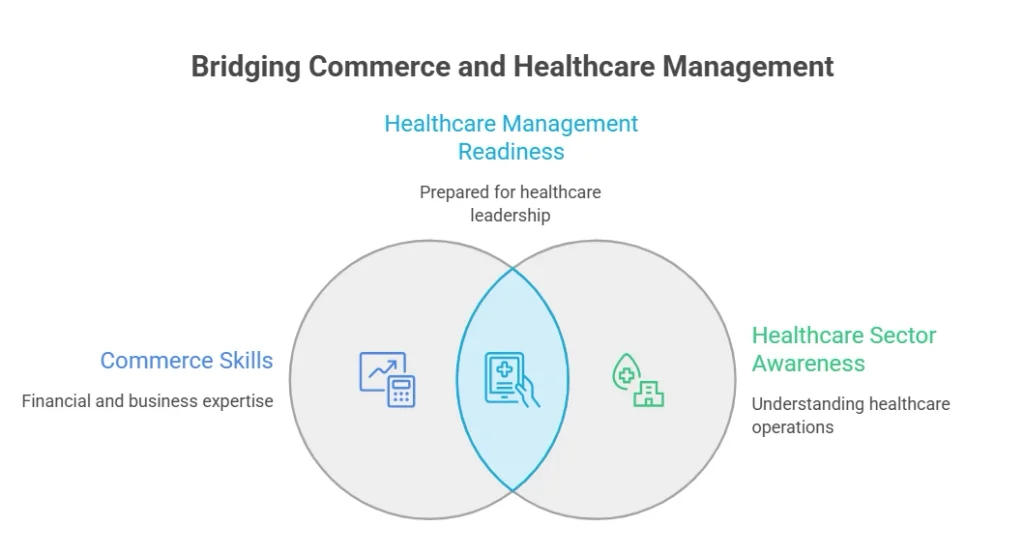
A commerce graduate may bring financial understanding.
An engineering graduate may contribute analytical and process-oriented thinking. Similarly, a life-sciences student may already understand aspects of the healthcare ecosystem.
Management education can help candidates develop the business capabilities required to apply their existing knowledge in new ways.
Do You Need a Medical Degree for an MBA in Healthcare Management?
No, a medical degree is not necessarily required for many healthcare management programs.
Healthcare management focuses primarily on the business and administrative side of healthcare rather than clinical practice.
For example, healthcare managers may work with:
Hospital operations
Finance
Marketing
Human resources
Business development
Insurance
Analytics
Quality systems
Supply chains
Patient experience
Healthcare technology
These responsibilities require management skills rather than authority to diagnose or clinically treat patients.
Therefore, graduates without an MBBS, BDS, nursing, or other clinical qualification may still be eligible for healthcare management programs, subject to the institution's admission rules.
Can B.Com Graduates Apply for an MBA in Healthcare Management?
Yes, B.Com graduates can potentially pursue healthcare management if they meet the eligibility requirements of the chosen institution.
A commerce background can actually support several healthcare-management functions.
Students may already have exposure to:
Accounting
Finance
Economics
Business law
Taxation
Business administration
These foundations can be useful in healthcare finance, hospital administration, insurance, procurement, and business operations.
However, commerce graduates should develop healthcare-sector awareness during their MBA.
Understanding how hospitals, insurance, pharmaceuticals, diagnostics, and healthcare services operate can strengthen employability.
Their undergraduate education may already cover management fundamentals such as marketing, finance, operations, human resources, and organisational behaviour.
An MBA focused on healthcare can help them apply these concepts to the healthcare industry.
For example, a BBA graduate may eventually explore healthcare operations, business development, patient experience, marketing, or analytical roles.
Again, admission depends on the specific program's criteria.
Can B.Sc. and Life Sciences Students Apply?
Science and life-sciences graduates can be well positioned to explore healthcare management.
Potential backgrounds include:
Biotechnology
Microbiology
Biochemistry
Zoology
Botany
Biomedical sciences
Other life-science disciplines
These candidates may already understand scientific concepts relevant to healthcare.
Management education can then add capabilities in finance, strategy, operations, analytics, marketing, and leadership.
This combination may be useful across hospitals, diagnostics, pharmaceutical businesses, healthcare services, and related sectors.
Can Pharmacy Graduates Pursue an MBA in Healthcare Management?
A pharmacy background can provide familiarity with medicines, healthcare systems, pharmaceutical processes, and patient-related services.
An MBA can add business knowledge.
Depending on interests and opportunities, candidates may explore areas such as:
Pharmaceutical management
Healthcare marketing
Business development
Hospital management
Healthcare supply chain
Operations
Healthcare consulting
Insurance
Healthcare analytics
Therefore, pharmacy plus management can create a multidisciplinary professional profile.
Can Doctors Pursue an MBA in Healthcare Management?
Yes, eligible medical professionals may pursue healthcare management education.
Doctors who want to move toward leadership, hospital administration, strategy, healthcare entrepreneurship, consulting, or business management may find an MBA relevant.
Clinical education develops expertise in patient care.
However, managing a healthcare organisation requires additional capabilities.
These can include:
Financial management
Operations
Strategy
People management
Marketing
Analytics
Technology decisions
Business planning
Therefore, management education can complement clinical expertise for professionals seeking non-clinical or leadership responsibilities.
However, an MBA does not replace medical qualifications for clinical roles.
Eligibility for MBA in Hospital Management vs Healthcare Management
Students often use hospital management and healthcare management interchangeably.
However, their scope can differ.
Hospital management focuses more specifically on the administration and operation of hospitals and healthcare facilities.
Healthcare management can cover a broader ecosystem.
Candidates commonly need a recognised bachelor's degree.
However, specific requirements can differ.
Therefore, students should evaluate both eligibility and curriculum before selecting a program.
MBA Healthcare Qualification: What Academic Degree Do You Need?
The basic MBA healthcare qualification is generally an undergraduate degree from a recognised institution, subject to the specific admission rules of the management program.
Students should check four important areas.
1. Recognition of Bachelor's Degree
The undergraduate qualification should satisfy the institution's stated recognition requirements.
Candidates with less common or international qualifications should confirm equivalence requirements where applicable.
2. Minimum Graduation Marks
Institutions may prescribe minimum graduation marks or equivalent grades.
The percentage can differ according to the institution and applicable admission rules.
Therefore, avoid assuming that one percentage applies across India.
3. Final-Year Graduation Status
Some institutions may allow final-year students to apply provisionally.
However, selected candidates may need to complete their graduation and submit proof within a specified deadline.
4. Accepted Academic Background
Some healthcare management programs accept graduates from almost any discipline.
Others may prefer or require particular academic backgrounds.
Always check this before applying.
Are Final-Year Students Eligible for MBA Healthcare Management?
Final-year students may be eligible to apply to certain programs, subject to institutional rules.
However, provisional eligibility comes with responsibilities.
Students may need to:
Complete graduation within the required timeline
Meet the minimum marks requirement
Submit final results before the specified deadline
Provide required academic documents
Failure to meet final eligibility conditions can affect admission.
Therefore, final-year students should read provisional-admission conditions carefully.
Is Work Experience Required for MBA Healthcare Management?
For a regular MBA or PGDM, work experience is not necessarily mandatory.
Many candidates enter management education directly after graduation.
However, requirements depend on the program.
Executive healthcare management programs are different.
An Executive MBA or another program designed for working professionals may require a specific amount of professional experience.
Therefore:
Regular MBA/PGDM: Fresh graduates may be eligible.
Executive management program: Work experience may be required.
Students should not apply the eligibility criteria of an Executive MBA to a regular MBA, or vice versa.
Are Entrance Exams Required for MBA Healthcare Management?
Entrance requirements depend on the institution.
Some management programs may consider national or other recognised management entrance examinations.
Others may use their own selection mechanisms.
Admission can potentially involve:
Entrance examination score
Academic profile
Application review
Personal interview
Group discussion
Written assessment
Work experience
Overall candidate profile
Therefore, candidates should check which entrance examinations and selection stages are accepted for their target program.
Healthcare Careers Start Here
Explore management education that welcomes diverse graduates and prepares you for opportunities across hospitals, insurance, consulting, technology, and pharmaceuticals.
During an interview, candidates should be prepared to explain why they want to study healthcare management.
Non-medical students should particularly demonstrate that they understand the industry and have a clear reason for choosing the specialization.
Career Scope After MBA in Healthcare Management
Students should consider career scope while evaluating eligibility because the program should connect with their professional goals.
Healthcare management graduates may explore opportunities in:
Hospital operations
Healthcare administration
Healthcare consulting
Health insurance
Pharmaceutical businesses
Diagnostics
Healthcare analytics
Health-tech
Quality management
Business development
Patient experience
Healthcare marketing
Supply chain
Actual roles depend on skills, internships, previous education, employer requirements, and market conditions.
An MBA does not guarantee a particular designation or salary.
How Management Education Helps Students From Different Backgrounds
One advantage of management education is that students can bring different academic strengths into the classroom.
Healthcare management then provides an industry context for those skills.
For example, finance concepts can be applied to hospital budgeting.
Operations concepts can help analyse patient flow.
Marketing can support healthcare brand and patient-acquisition strategies.
Analytics can help managers understand operational performance.
At Asia Pacific Institute of Management, the focus on industry-oriented management education, practical learning, experienced faculty, corporate exposure, and placement support can help students build transferable management capabilities.
Students interested in healthcare should review the relevant program curriculum and current admission criteria to determine whether it aligns with their background and career goals.
Conclusion
Understanding MBA in healthcare management eligibility is the first step toward making an informed admission decision.
In general, candidates need a recognised bachelor's degree. However, minimum marks, entrance requirements, accepted academic backgrounds, and selection procedures can vary.
Most importantly, healthcare management is not necessarily restricted to medical graduates.
Students from commerce, business, science, engineering, pharmacy, life sciences, and several other academic backgrounds may be able to pursue the field.
Therefore, candidates researching MBA healthcare eligibility or eligibility for MBA in hospital management should focus on the official requirements of their chosen program rather than assumptions about their graduation stream.
Students considering management education at Asia Pacific Institute of Management should review the current program-specific eligibility, admission process, curriculum, and selection requirements before applying.
Meeting the eligibility criteria gets you to the starting line. Building strong management, analytical, communication, and healthcare-industry skills can help you make the most of the opportunity that follows.
Move Into Healthcare Management
Build on your graduation strengths with management expertise designed for growing opportunities across the dynamic and evolving healthcare sector.
Dr. Vikas Gupta is a distinguished academic in the education and research domain, specializing in finance and related interdisciplinary studies. He is known for his...
01.
What is the MBA in healthcare management eligibility?
Candidates generally need a recognised bachelor’s degree or equivalent qualification. Minimum marks, entrance requirements, accepted academic backgrounds, and selection criteria vary by institution and should be verified before applying.
02.
Who can do MBA healthcare management?
Graduates from healthcare and non-healthcare backgrounds may be eligible, depending on the program. Applicants can potentially come from commerce, management, science, engineering, pharmacy, medicine, life sciences, humanities, and other recognised disciplines.
03.
Can a non-medical student pursue an MBA in healthcare management?
Yes, many healthcare management programs can accept non-medical graduates. Healthcare management focuses on business functions such as operations, finance, analytics, marketing, strategy, and administration rather than clinical practice.
04.
Is MBBS required for MBA healthcare management?
No, MBBS is not universally required. A recognised bachelor’s degree may be sufficient for many programs, subject to the institution’s specific eligibility criteria.
05.
What is the eligibility for MBA in hospital management?
Candidates generally need a recognised undergraduate degree. However, minimum marks, accepted graduation streams, entrance requirements, and other conditions differ between institutions.
06.
Can B.Com or BBA students pursue healthcare management?
Yes, subject to institutional eligibility. Commerce and management graduates can use their existing business foundation while developing healthcare-sector knowledge during the program.
07.
Can final-year students apply for an MBA in healthcare management?
Some institutions allow final-year students to apply provisionally. Such candidates must usually complete graduation and provide required documentation within the institution’s specified timeline.
08.
Is work experience required for MBA healthcare eligibility?
Work experience is not necessarily required for a regular MBA or PGDM. However, executive healthcare management programs may require professional experience. Candidates should verify the requirements of the specific program.



















.webp) Call Us
Call Us