Disaster Management in Hospitals: How Operations Heads Handle Crises
Posted on 05 Sep 2026
By Dr. Vikas Gupta
Introduction
A hospital operates under pressure even on a normal day. During a fire, flood, disease outbreak, infrastructure failure, or mass-casualty event, that pressure can increase within minutes.
Beds may fill rapidly. Emergency departments can receive many patients at once. Critical supplies may run short. Moreover, communication and infrastructure must continue working when disruption is at its highest.
Hospital operations heads play an important role in preparedness and coordination. They help convert emergency plans into workable systems covering people, infrastructure, supplies, communication, patient movement, and continuity of essential services.
For management students interested in healthcare, disaster management also demonstrates why hospital administration requires operational leadership alongside clinical expertise.
Lead Hospital Crisis Operations
Build operations, leadership, risk, and decision making skills to manage complex healthcare environments and strengthen hospital emergency preparedness.
Hospital disaster management is the structured process of preparing for, responding to, and recovering from emergencies that can disrupt healthcare services or create a sudden increase in patient demand. It includes risk assessment, emergency planning, resource allocation, communication, evacuation, triage support, business continuity, and post-event recovery.
The objective is simple but critical: hospitals must protect people while maintaining essential healthcare services.
Disaster planning therefore cannot begin after an emergency occurs.
Hospitals need defined responsibilities, trained teams, communication systems, evacuation procedures, backup resources, and regular preparedness exercises.
Why Is Disaster Management Important for Hospitals?
Hospitals face a unique challenge during disasters.
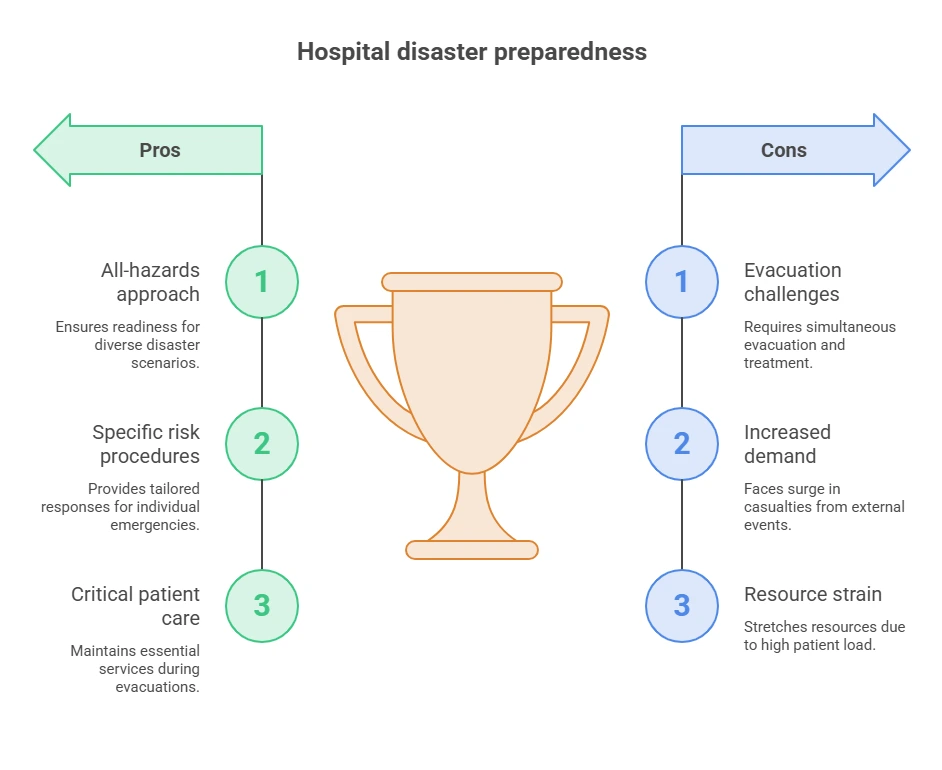
Other buildings may be evacuated and closed. However, hospitals may simultaneously need to evacuate one area while continuing to treat critically ill patients elsewhere.
Additionally, an external disaster can dramatically increase demand.
For example, a major transport accident can send multiple casualties to an emergency department within a short period.
Hospitals must therefore prepare for both internal and external emergencies.
Internal emergencies can include:
Fire
Electrical failure
Medical gas disruption
Structural damage
IT or communication failure
Hazardous material incidents
Water supply disruption
External emergencies can include:
Floods
Earthquakes
Major accidents
Disease outbreaks
Industrial incidents
Other mass-casualty events
Each situation requires a different operational response.
Therefore, hospital disaster plans should use an all-hazards approach while defining procedures for specific risks.
What Is the Role of a Hospital Operations Head During a Crisis?
Doctors and nurses make clinical decisions. However, a hospital crisis also creates major operational challenges.
Who coordinates additional beds?
How are supplies moved?
Who communicates with different departments?
What happens when normal patient flow becomes impossible?
How does the hospital maintain electricity, oxygen, water, security, and essential equipment?
These questions illustrate the responsibilities of healthcare operations.
An operations head may coordinate multiple administrative and support functions during an emergency.
Responsibilities can include:
Activating relevant emergency procedures
Coordinating departments
Supporting patient-flow planning
Mobilising staff and resources
Monitoring bed availability
Coordinating supplies
Maintaining essential infrastructure
Supporting evacuation
Managing internal communication
Coordinating with external stakeholders
Maintaining operational records
Supporting recovery
The exact authority and responsibilities depend on the hospital's approved disaster plan and command structure.
Therefore, operations managers need to understand their assigned role before an emergency begins.
An effective hospital disaster management framework can be understood through four broad stages.
1. Mitigation
Mitigation focuses on reducing risks before an emergency.
Hospitals may conduct hazard assessments and identify vulnerabilities in infrastructure, equipment, utilities, fire protection, access routes, and operational processes.
For example, a hospital may identify areas where fire risks require additional controls.
Similarly, facilities in flood-prone locations may need specific infrastructure and continuity measures.
The objective is to reduce the probability or impact of disruption.
2. Preparedness
Preparedness focuses on getting the hospital ready.
This can include:
Disaster plans
Staff responsibilities
Emergency contact systems
Training
Mock drills
Evacuation planning
Backup utilities
Emergency supplies
Communication protocols
Coordination arrangements
Preparedness converts a document into operational capability.
A disaster plan that employees have never practised may provide limited support during a real emergency.
3. Response
Response begins when an emergency occurs.
The hospital may activate its command structure, mobilise teams, reorganise patient flow, increase capacity, manage supplies, and coordinate communication.
Speed matters.
However, speed without coordination can create confusion.
Therefore, predefined roles and escalation mechanisms are important.
4. Recovery
Operations do not end when the immediate danger passes.
Hospitals need to restore normal services, replenish supplies, assess damage, review performance, support staff, and document lessons.
A post-event review can identify what worked and what failed.
Consequently, each incident or drill can strengthen future preparedness.
Emergency Room Triage Protocols During a Crisis
A sudden increase in patients can overwhelm normal emergency department capacity.
Triage is a clinical process used to prioritise patients according to urgency and medical need. During mass-casualty situations, the goal is to help clinical teams identify which patients require the most immediate attention within the available capacity.
Hospital administrators should not make clinical triage decisions unless appropriately qualified.
However, operations teams support the system around clinical triage.
They can help ensure:
Appropriate triage areas are available
Patient movement routes remain clear
Registration processes can adapt
Additional staff can be mobilised
Beds are identified quickly
Supplies reach treatment areas
Communication remains functional
Patient records and tracking processes continue
Therefore, effective triage depends on both clinical judgment and operational readiness.
What Is Mass Casualty Incident Management?
A mass casualty incident occurs when the number or needs of casualties place exceptional pressure on available healthcare resources.
Mass casualty incident management requires hospitals to expand capacity quickly while prioritising resources effectively.
Normal workflows may need to change.
For example, hospitals may create additional treatment areas or reorganise patient movement.
Operations managers may also coordinate with emergency services and relevant authorities.
Surge Capacity
Surge capacity refers to a hospital's ability to handle a sudden increase in demand.
Operations teams should consider three essential areas:
Staff: Are enough trained personnel available?
Space: Where can additional patients be safely managed?
Supplies: Are medicines, equipment, blood products, oxygen, PPE, and other essential resources available?
Technology and systems form another important consideration.
Patient registration, communication, laboratory services, imaging, and hospital information systems may all experience higher demand.
Therefore, surge planning must cover the complete hospital ecosystem.
Hospital Crisis Response: Building a Command Structure
A major emergency can generate hundreds of decisions.
Without a defined structure, different departments may act independently and create confusion.
Emergency Ward Admin: Managing Patient Flow Under Pressure
Emergency ward admin becomes particularly challenging during high-demand events.
Patient flow can quickly become a bottleneck.
For example, incoming patients may need emergency assessment while existing patients require admission, discharge, transfer, diagnostics, or movement to other departments.
Operations managers therefore need real-time visibility into hospital capacity.
Useful information can include:
Emergency department occupancy
Available beds
ICU capacity
Operating theatre availability
Isolation capacity
Staffing
Ambulance arrivals
Pending admissions
Discharge opportunities
Diagnostic capacity
A dashboard or hospital information system can help administrators monitor these variables.
However, technology is only useful when teams maintain accurate data and have clear escalation procedures.
Fire Safety and NABH Norms in Hospitals
Fire is a significant operational risk in healthcare facilities because hospitals contain electrical systems, medical equipment, oxygen-related infrastructure, medicines, and patients who may have limited mobility.
Therefore, fire safety NABH norms and applicable statutory requirements need serious attention.
NABH hospital accreditation standards include facility management and safety as an important area. Hospitals seeking accreditation need systems for maintaining a safe environment and managing relevant safety risks.
However, NABH accreditation requirements should not be treated as a substitute for applicable fire and building regulations.
Hospitals must also comply with requirements imposed by relevant government and local authorities.
An effective fire-safety programme may address:
Fire detection and alarm systems
Fire-fighting equipment
Emergency exits
Evacuation routes
Signage
Staff training
Fire drills
Electrical safety
Medical gas safety
Emergency communication
Preventive maintenance
Required documentation
Operations managers play an important coordination role.
They may work with engineering, security, clinical departments, administration, and external authorities to maintain preparedness.
Why Hospital Evacuation Is More Complex Than Office Evacuation
Evacuating a hospital is not as simple as asking everyone to leave.
Some patients cannot walk.
Others may depend on oxygen, ventilators, monitors, intravenous therapy, or other medical support.
Moreover, moving critically ill patients can itself create clinical risk.
Therefore, evacuation planning should define routes, responsibilities, communication, assembly or transfer arrangements, and appropriate patient-movement procedures.
Operations teams should also understand dependencies.
For example, what happens if a lift cannot be used?
What happens if one exit route becomes inaccessible?
Where can patients be moved safely?
Such questions should be addressed during planning and drills rather than during the emergency itself.
Supply Chain Management During Hospital Disasters
A hospital cannot operate without supplies.
Disasters can increase consumption while simultaneously disrupting deliveries.
Therefore, supply chain planning is a core component of hospital preparedness.
Critical resources may include:
Medicines
Medical consumables
Oxygen and medical gases
Personal protective equipment
Blood and blood products
Food
Water
Fuel
Linen
Emergency equipment
Operations teams need to identify critical inventory and alternative suppliers.
Moreover, they should understand which items have long replenishment times.
Inventory planning should balance preparedness with storage limitations, expiry risks, and financial constraints.
This is where supply chain and operations-management skills become particularly valuable.
Technology and Communication During Hospital Emergencies
A crisis creates an enormous demand for accurate information.
Senior management needs operational updates.
Clinical teams need patient and resource information.
Families may require communication.
External agencies may need coordination.
Therefore, hospitals need reliable communication systems.
Backup communication arrangements are also important because primary networks may fail.
Hospital information systems can support patient tracking, bed management, inventory, laboratory workflows, and other functions.
However, organisations should also prepare for technology disruptions.
Business continuity planning should therefore address both physical and digital infrastructure.
Data and Dashboards for Hospital Crisis Management
Operations heads need situational awareness.
A crisis dashboard can help decision-makers monitor important indicators.
These may include:
Operational Metric
Why It Matters
Available beds
Indicates remaining treatment capacity
ICU capacity
Tracks critical-care availability
Emergency arrivals
Shows incoming demand
Staffing levels
Identifies workforce gaps
Critical inventory
Helps prevent shortages
Oxygen availability
Supports continuity of critical services
Ambulance activity
Helps anticipate patient arrivals
Infrastructure status
Identifies operational disruptions
Patient transfers
Supports capacity management
However, managers should avoid collecting data simply because it is available.
A useful dashboard focuses on information that supports timely decisions.
Importance of Mock Drills and Staff Training
A written disaster plan is only the beginning.
Employees need to know what to do.
Regular training can help staff understand alarms, communication systems, evacuation responsibilities, emergency roles, and escalation processes.
Mock drills can then test whether those plans work in practice.
A drill may reveal problems that are difficult to identify on paper.
For example, an evacuation route may become congested. Communication may fail between departments. Staff may misunderstand their assigned roles.
These findings are valuable.
Operations teams can document gaps, assign corrective actions, and conduct follow-up reviews.
Therefore, drills should be treated as learning exercises rather than formalities.
During a crisis, these elements become even more interconnected.
Management education can help students understand operations, supply chains, analytics, finance, communication, strategy, and leadership.
For example, operations management can teach process and capacity thinking.
Supply chain concepts can support inventory planning. Moreover, analytics can help managers interpret hospital data and allocate resources.
Leadership and communication become equally important when coordinating multidisciplinary teams.
At Asia Pacific Institute of Management, the focus on industry-oriented management education, practical learning, experienced faculty, corporate exposure, and placement support can help students build transferable management skills.
Students interested in healthcare operations can combine these skills with healthcare-sector knowledge, internships, projects, and relevant professional learning.
Future of Hospital Disaster Management
The future of hospital disaster management will increasingly involve technology, analytics, resilience planning, and integrated command systems.
Real-time dashboards can improve visibility into capacity.
Digital systems can support resource monitoring and communication. Moreover, simulation exercises can help teams prepare for complex emergency scenarios.
Hospitals must also prepare for diverse risks.
These can include natural disasters, disease outbreaks, infrastructure failures, cyber incidents, supply disruptions, and large-scale accidents.
Consequently, future healthcare operations leaders will need to think beyond everyday hospital administration.
They must understand resilience.
A resilient hospital is not one that never experiences disruption. It is one that can prepare, respond, maintain critical functions, and recover effectively.
Conclusion
Hospitals cannot wait for a disaster to develop a response.
Effective hospital disaster management begins with preparation. Hospitals need risk assessments, trained teams, reliable communication, adequate supplies, safe infrastructure, tested procedures, and clear responsibilities.
During emergencies, operations heads help connect these systems.
They support emergency room triage protocols through operational coordination, maintain hospital crisis response, strengthen fire preparedness, manage surge capacity, and help implement mass casualty incident management plans.
For management students, this field demonstrates how operations knowledge can have a direct impact on healthcare resilience.
Students interested in hospital operations should therefore develop capabilities in analytics, supply chain, project management, communication, risk management, and leadership.
For those seeking an industry-oriented management education, Asia Pacific Institute of Management offers a practical learning environment supported by experienced faculty, corporate exposure, and placement support.
Building strong management fundamentals can prepare students to explore healthcare operations and other complex service-management careers where effective decisions matter most.
Build Resilient Healthcare Leadership
Gain management capabilities to coordinate people, resources, technology, and infrastructure while preparing for impactful hospital operations leadership careers.
Dr. Vikas Gupta is a distinguished academic in the education and research domain, specializing in finance and related interdisciplinary studies. He is known for his...
Hospital disaster management is the structured process of preparing for, responding to, and recovering from emergencies affecting healthcare operations. It includes risk assessment, emergency planning, resource management, communication, patient-flow support, evacuation, continuity planning, and recovery.
02.
What is the role of an operations manager during a hospital emergency?
An operations manager may coordinate resources, infrastructure, staffing support, supplies, communication, patient flow, logistics, and departmental activities according to the hospital’s approved emergency plan.
03.
What are emergency room triage protocols?
Emergency room triage protocols help appropriately trained clinical teams prioritise patients according to medical urgency and applicable hospital procedures. Administrative teams support triage through patient flow, space, staffing, registration, logistics, and resource coordination.
04.
What is mass casualty incident management?
Mass casualty incident management involves coordinated response when casualty numbers or needs place exceptional pressure on available resources. Hospitals may need to increase staff, space, supplies, and operational capacity.
05.
What are NABH requirements for hospital fire safety?
NABH accreditation standards address facility management and safety, while hospitals must also meet applicable statutory fire and building requirements. Specific obligations depend on the hospital, accreditation edition, building, and relevant authorities.
06.
Why are mock drills important in hospitals?
Mock drills allow hospitals to test emergency plans before a real crisis. They can identify communication problems, infrastructure limitations, unclear responsibilities, and other preparedness gaps.
07.
Can MBA or PGDM graduates work in hospital emergency management?
Management graduates may explore hospital operations, administration, quality, supply chain, facility management, risk, consulting, and related roles depending on employer requirements. Emergency preparedness may form part of these responsibilities.
08.
What skills are required for emergency ward administration?
Important skills include operations management, communication, patient-flow coordination, data interpretation, resource planning, leadership, problem-solving, and knowledge of hospital procedures.

















.webp) Call Us
Call Us