Who Should Pursue an Executive MBA in Healthcare Management?
Posted on 10 Sep 2026
By Dr. Vikas Gupta
Introduction
Healthcare professionals often reach a stage where technical knowledge is no longer enough for career growth.
A doctor may want to lead a hospital department. A hospital administrator may want to move into strategy. A pharmaceutical professional may seek broader business responsibilities. Similarly, a health-tech professional may want to manage teams, budgets, and growth.
An Executive MBA can be relevant for experienced professionals who want to combine their existing expertise with skills in strategy, finance, operations, analytics, technology, and leadership.
However, an Executive MBA is not automatically the right choice for every healthcare professional.
Career stage, work experience, professional goals, available time, and expected outcomes all matter.
This guide explains who can benefit from an Executive MBA healthcare management program and how working professionals can decide whether it fits their career plans.
Turn Experience Into Leadership
Build strategic, financial, analytical, and leadership capabilities to transform your healthcare experience into greater management responsibilities and career growth.
Who Should Pursue Executive MBA Programs in Healthcare?
Experienced professionals should pursue Executive MBA programs when they want to move toward leadership, strategy, business management, or broader organisational responsibilities without ignoring the value of their existing work experience. In healthcare, this can include doctors, administrators, pharmaceutical professionals, consultants, insurance professionals, and health-tech managers.
The important factor is career stage.
An Executive MBA is generally designed around professionals who already have workplace experience.
Therefore, students can connect classroom concepts with problems they have actually encountered.
For example, an experienced hospital administrator may understand patient-flow challenges. Management education can then provide frameworks for capacity planning, financial decision-making, analytics, and strategy.
This combination of experience and structured management knowledge is one of the central ideas behind executive education.
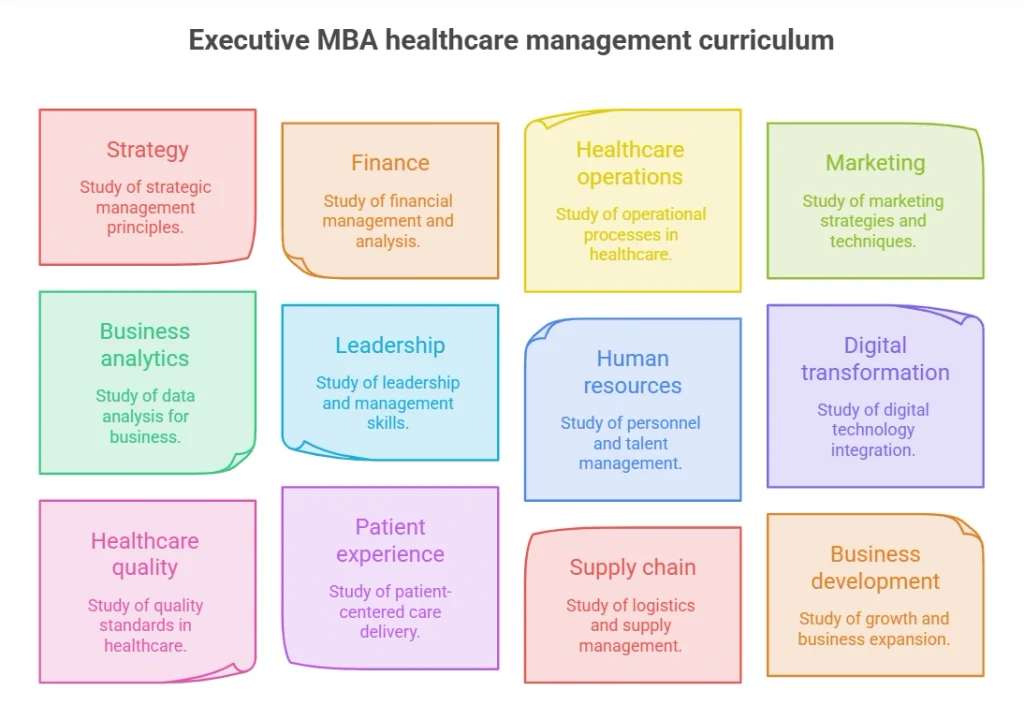
What Is an Executive MBA in Healthcare Management?
The exact curriculum differs between institutions.
Similarly, duration and delivery format can vary.
Some executive programs use weekend or modular classes. Others may include online, hybrid, or campus-based learning.
Therefore, professionals should evaluate the actual curriculum and format rather than relying only on the "Executive MBA" label.
How Is an Executive MBA Different From a Regular MBA?
The biggest difference is usually the participant profile.
A regular MBA or PGDM can be suitable for fresh graduates and early-career candidates who need a broad management foundation.
An Executive MBA is generally designed for experienced professionals.
Factor
Regular MBA/PGDM
Executive MBA
Typical Candidate
Fresher or early-career professional
Experienced professional
Work Experience
May not be mandatory
Often important or required
Learning Context
Builds management foundation
Builds on professional experience
Career Goal
Entry into management
Progression, leadership or transition
Peer Learning
Mixed experience levels
Often experience-driven
Schedule
Frequently full-time
May be designed around professionals
These are general differences.
Program definitions and eligibility requirements can vary by institution.
Therefore, candidates should verify the qualification awarded, recognition, eligibility, duration, curriculum, and delivery format before applying.
1. Doctors Moving Toward Leadership Roles
Doctors are among the professionals who may consider executive healthcare management education.
Clinical training prepares doctors to diagnose and treat patients.
However, leading a hospital, department, healthcare business, or large clinical team requires additional capabilities.
A leadership position can involve:
Budgeting
Workforce management
Operations
Strategic planning
Technology decisions
Quality management
Patient experience
Business development
A doctor may therefore have deep clinical expertise but limited formal training in finance or strategy.
An Executive MBA can help bridge that gap.
However, doctors should consider the time commitment carefully. Clinical responsibilities can make intensive management education challenging.
2. Hospital Administrators Seeking Career Progression
Hospital administrators often develop strong operational knowledge through experience.
They may understand admissions, patient flow, billing, quality, staffing, facilities, and service processes.
However, senior management requires a broader organisational perspective.
An administrator moving toward leadership may need to understand questions such as:
How should the hospital allocate capital?
Which service line should be expanded?
How can operating costs be controlled?
Which technologies should the organisation invest in?
How can patient experience improve without reducing efficiency?
These are strategic management questions.
Therefore, healthcare management for working professionals can become relevant when administrators want to move from executing processes to influencing larger business decisions.
3. Healthcare Operations Professionals
Operations professionals deal with the systems that keep healthcare organisations functioning.
Their responsibilities may involve:
Patient flow
Capacity
Turnaround times
Staffing coordination
Service quality
Resource utilisation
Process improvement
Experience teaches professionals how the system works.
Management education can help them understand why certain strategic and financial decisions are made.
For example, an operations professional may know that additional capacity is required.
However, a leadership role may require that person to develop a business case, estimate financial impact, analyse alternatives, and present the recommendation to senior management.
This is where broader management capabilities become valuable.
4. Pharmaceutical Professionals Seeking Business Roles
The healthcare ecosystem extends beyond hospitals.
Pharmaceutical professionals may also consider executive management education when moving toward commercial or leadership functions.
Potential areas can include:
Product management
Marketing
Sales leadership
Strategy
Supply chain
Business development
Market access
Operations
A technical or scientific background can provide valuable industry knowledge.
However, senior commercial responsibilities also require an understanding of markets, customers, finance, competition, and organisational strategy.
Therefore, management education can complement existing pharmaceutical experience.
Health insurance sits at the intersection of healthcare and finance.
Professionals may work across claims, provider networks, operations, customer experience, analytics, underwriting support, or business development.
As responsibilities increase, they may need broader capabilities in:
Strategy
Finance
Risk
Data analytics
Operations
Leadership
Negotiation
An Executive MBA can be relevant when the professional's next role requires cross-functional decision-making rather than expertise in only one insurance process.
6. Health-Tech Professionals
Technology is becoming central to healthcare.
Digital health platforms, analytics, automation, AI-enabled systems, hospital software, and connected healthcare services are creating new management challenges.
A technical professional may understand how a healthcare product works.
However, leadership requires additional questions:
Who is the customer?
What problem does the product solve?
How should it be priced?
What is the growth strategy?
How does implementation affect hospital operations?
What metrics determine success?
Therefore, technology professionals seeking product, strategy, operations, or business leadership can potentially benefit from management education.
Healthcare consultants need a combination of industry knowledge and structured problem-solving.
Projects may involve:
Hospital strategy
Operational improvement
Cost optimisation
Digital transformation
Healthcare analytics
Market research
Insurance
Pharmaceutical strategy
An experienced consultant may eventually need stronger capabilities in finance, leadership, client management, and business strategy.
Executive management education can support these areas.
However, candidates should evaluate whether a broad Executive MBA or a more specialized program better addresses their specific skill gaps.
8. Healthcare Entrepreneurs and Business Owners
Not every Executive MBA candidate is seeking a promotion.
Some want to build businesses.
Healthcare entrepreneurship can involve clinics, diagnostics, health-tech, consulting, medical services, or other healthcare ventures.
A founder may understand the healthcare problem extremely well.
However, building a sustainable organisation requires additional skills.
These include:
Business modelling
Finance
Marketing
Hiring
Operations
Pricing
Strategy
Growth
Negotiation
An Executive MBA can provide structured exposure to these areas.
However, entrepreneurs should assess whether the time and financial commitment fit the stage of their business.
9. Professionals Planning a Healthcare Career Transition
An Executive MBA can also attract professionals who want to change roles.
For example, someone may want to move:
From hospital operations → healthcare strategy
From pharmaceutical sales → product management
From technology → health-tech business leadership
From clinical work → hospital administration
From insurance operations → healthcare consulting
Management education can help build missing capabilities.
However, candidates should understand one important limitation.
An Executive MBA does not automatically create a career transition.
Employers also evaluate previous experience, transferable skills, projects, networking, interview performance, and industry knowledge.
Therefore, the larger the career change, the more deliberate the transition strategy needs to be.
Move Beyond Technical Expertise
Expand your professional strengths with business, strategy, finance, and management skills designed for experienced professionals across the healthcare ecosystem.
Executive MBA for Healthcare Professionals: When Is the Right Time?
There is no universal "perfect" career stage.
However, Executive MBA for healthcare professionals becomes more relevant when a person can clearly identify a gap between current capabilities and future responsibilities.
Consider these signs.
Your Responsibilities Are Becoming Cross-Functional
You are no longer responsible for only one process.
Instead, your decisions increasingly affect finance, people, technology, operations, or strategy.
You Are Managing Teams
People management requires skills beyond technical expertise.
Leadership, communication, motivation, conflict management, and performance management become important.
You Are Participating in Business Decisions
Senior professionals need to evaluate investments, budgets, growth opportunities, and risks.
Formal management knowledge can improve decision-making.
You Want to Move Into Leadership
A technical expert and a business leader require overlapping but different capabilities.
Executive education can help develop the second set.
You Understand Why You Need the Degree
This is perhaps the most important sign.
"I need an MBA because everyone has one" is not a strong reason.
"I need stronger financial and strategic capabilities to move from operations into business-unit leadership" is much clearer.
Who May Not Need an Executive MBA Yet?
Executive education is not automatically the best choice.
Fresh Graduates
Students without meaningful work experience may benefit more from a regular MBA or PGDM.
They often need foundational management learning, internships, campus exposure, and entry-level placement opportunities.
Professionals Without a Clear Goal
An Executive MBA requires a substantial investment of time and money.
Without a clear objective, it becomes difficult to evaluate whether the program offers value.
Candidates Seeking Only a Salary Increase
Higher education should not be treated as a guaranteed salary multiplier.
A qualification may strengthen capabilities, but salary outcomes depend on experience, role, employer, performance, market conditions, and other factors.
Professionals Needing One Specific Skill
Someone who only needs healthcare analytics, finance, project management, or another focused capability may benefit from a specialized course instead.
A full Executive MBA offers broader management education.
What Should You Check Before Choosing an Executive MBA Healthcare Management Program?
Working professionals should evaluate programs carefully.
Consider:
Qualification awarded
Current eligibility requirements
Work-experience requirements
Curriculum
Faculty
Industry exposure
Delivery format
Class schedule
Total fees
Career support
Peer profile
Practical learning opportunities
Most importantly, determine whether the program fits your current career stage.
A prestigious-sounding program title cannot compensate for poor alignment with your professional goals.
How Management Education Can Support Healthcare Leaders
Healthcare leadership requires professionals to understand the organisation as a complete system.
Operations affect finance.
Technology affects patient experience.
Staffing affects service quality.
Marketing influences demand.
Strategy determines where resources are invested.
Therefore, healthcare leaders need cross-functional thinking.
At Asia Pacific Institute of Management, the focus on industry-oriented management education, practical learning, experienced faculty, corporate exposure, and placement support can help learners develop transferable business capabilities.
Working professionals interested in healthcare leadership should review the relevant program's current eligibility, curriculum, learning format, fees, and career support before making an admission decision.
The objective should be to select education that complements existing experience rather than simply adding another qualification to a résumé.
Conclusion: Should You Pursue an Executive MBA in Healthcare Management?
The answer to who should pursue Executive MBA programs depends less on job title and more on career stage.
Doctors, hospital administrators, pharmaceutical professionals, insurance professionals, healthcare consultants, health-tech managers, entrepreneurs, and other experienced professionals may all find executive management education relevant.
However, they should have a clear reason for pursuing it.
An Executive MBA healthcare management program can be valuable when professionals need broader capabilities in strategy, finance, operations, analytics, technology, and leadership.
It can also support professionals who want to move from technical expertise toward organisational decision-making.
Before applying, assess your experience, career goals, skill gaps, available time, and expected return.
Professionals exploring healthcare management for working professionals can also evaluate relevant management education opportunities at Asia Pacific Institute of Management, with its emphasis on practical learning, industry orientation, experienced faculty, corporate exposure, and placement support.
Lead Your Next Move
Prepare for broader healthcare responsibilities by developing practical expertise in operations, technology, analytics, strategy, finance, and people leadership.
Dr. Vikas Gupta is a distinguished academic in the education and research domain, specializing in finance and related interdisciplinary studies. He is known for his...
Executive MBA programs are generally most suitable for experienced professionals who want broader management, strategic, and leadership capabilities. Candidates should ideally have clear career goals and enough workplace exposure to apply management concepts to real professional situations.
02.
Is an Executive MBA healthcare management program suitable for doctors?
It can be relevant for doctors interested in hospital leadership, administration, strategy, entrepreneurship, or healthcare business management. However, candidates should evaluate eligibility and workload before applying.
03.
Is an Executive MBA useful for hospital administrators?
Yes, it can help experienced administrators develop broader skills in finance, strategy, analytics, technology, and leadership. These capabilities can become increasingly important as professionals move toward senior responsibilities.
04.
Can non-medical professionals pursue an Executive MBA in healthcare?
Potentially, yes. Eligibility varies by institution. Professionals from technology, insurance, pharmaceuticals, consulting, business, and other sectors may consider healthcare-focused management education when it aligns with their career goals.
05.
What are the main Executive MBA benefits?
Potential benefits include broader business understanding, strategic thinking, leadership development, peer learning, and the ability to apply management concepts at work. However, promotions, placements, and salary increases are not guaranteed.
06.
Is healthcare management for working professionals worth it?
It can be valuable when the program addresses specific skill gaps and supports a defined career objective. Professionals should evaluate curriculum, time commitment, fees, learning format, and career relevance before enrolling.
07.
Is an Executive MBA better than a regular MBA?
Neither is universally better. Regular MBA or PGDM programs can suit fresh graduates and early-career candidates. Executive programs are generally designed for experienced professionals who want to build on existing workplace knowledge.
08.
Can an Executive MBA help me become a healthcare leader?
It can help develop relevant management and leadership capabilities, but a degree alone does not create a leader. Career progression also depends on experience, performance, decision-making, communication, professional reputation, and opportunities.


















.webp) Call Us
Call Us