Is MBA in Healthcare Management Worth It? Career Scope, Salary & ROI
Posted on 12 Sep 2026
By Dr. Vikas Gupta
Introduction
Healthcare is no longer limited to doctors, nurses, and clinical professionals. Behind every hospital, diagnostic network, pharmaceutical company, health-tech platform, and healthcare organisation is a complex management system responsible for operations, finance, quality, technology, marketing, people, and patient experience.
This expanding business side of healthcare has created growing interest in specialised management education. But before investing two years and a significant amount of money in a postgraduate degree, students naturally ask: Is MBA in Healthcare Management worth it?
The answer depends on your career goals, programme quality, previous education, skills, industry exposure, and the opportunities you pursue after graduation.
For students who want to build careers at the intersection of business and healthcare, an MBA in Healthcare Management can provide specialised knowledge and access to diverse management roles. However, evaluating its real value requires looking beyond the degree itself.
This guide explores MBA healthcare career scope, potential salary, ROI, career growth, benefits, and the factors you should consider before deciding whether this MBA is right for you.
Build Your Healthcare Future
Gain practical management, analytics, and leadership capabilities to pursue rewarding opportunities across hospitals, consulting, technology, pharmaceuticals, and healthcare businesses.
An MBA in Healthcare Management is a postgraduate management programme that combines traditional business education with specialised knowledge of the healthcare industry.
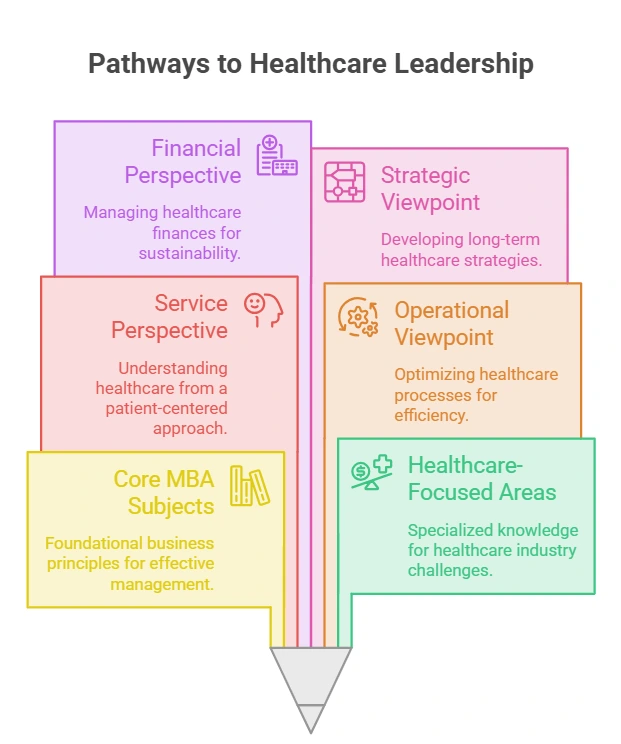
Students typically study core MBA subjects such as:
Marketing Management
Financial Management
Human Resource Management
Operations Management
Business Analytics
Organisational Behaviour
Strategic Management
These subjects may be combined with healthcare-focused areas such as:
Hospital Administration
Healthcare Operations
Healthcare Quality Management
Patient Experience
Healthcare Finance
Healthcare Marketing
Digital Health
Healthcare Analytics
Health Economics
Healthcare Strategy
The objective is to prepare students to understand healthcare organisations not only from a service perspective but also from operational, financial, strategic, and managerial viewpoints.
Is MBA in Healthcare Management Worth It?
So, is MBA in Healthcare Management worth it?
It can be worthwhile if you have a genuine interest in healthcare management and want to build a career in hospitals or the wider healthcare ecosystem.
Its value can be particularly strong for students and professionals who want to work in areas such as hospital operations, administration, healthcare consulting, quality management, health-tech, healthcare marketing, business development, patient experience, and healthcare strategy.
However, simply completing the degree doesn't guarantee a high salary or senior management position.
The real value depends on factors including:
Programme quality: A relevant curriculum, experienced faculty, industry exposure, and practical learning can significantly affect your development.
Internships: Healthcare management is highly practical. Exposure to real hospitals and healthcare businesses can help you understand how organisations actually function.
Previous background: Your undergraduate degree and prior work experience may influence which healthcare roles are most accessible after graduation.
Skills: Communication, analytical ability, problem-solving, digital awareness, leadership, and business understanding matter alongside the qualification.
Career objective: The MBA is more likely to provide value when you know which part of healthcare management you want to explore.
Therefore, rather than asking whether the degree is universally worth it, ask whether it is worth it for your specific career objective.
Why Is Healthcare Management Becoming Important?
Healthcare organisations are becoming larger, more technology-driven, and operationally complex.
Hospitals need professionals who can coordinate departments, manage resources, improve patient experience, monitor quality, analyse performance, manage costs, and support organisational growth.
At the same time, healthcare is expanding beyond traditional hospitals.
Digital health is also changing the sector through artificial intelligence, telemedicine, analytics, electronic health systems, automation, and digital patient services.
One of the major advantages of healthcare management is that career opportunities aren't restricted to a single type of organisation.
Graduates may explore opportunities across different parts of the healthcare ecosystem.
Hospitals
Hospitals are among the most obvious career destinations.
Management graduates may work in operations, administration, quality, patient experience, business development, marketing, projects, and other non-clinical functions.
Health-Tech Companies
Technology has created a rapidly evolving segment within healthcare.
Health-tech companies may require professionals for operations, implementation, partnerships, business development, customer success, product-related functions, and strategy.
Pharmaceutical Companies
Pharmaceutical organisations offer opportunities across marketing, business operations, project management, sales strategy, market research, and other commercial functions.
Diagnostic Networks
Large diagnostic businesses need managers to handle centre operations, service quality, expansion, partnerships, business development, and customer experience.
Healthcare Consulting
Consulting can appeal to students interested in solving business and operational problems.
Healthcare consultants may work on strategy, operational improvement, digital transformation, market entry, organisational design, and related projects.
Health Insurance
Insurance organisations operate at the intersection of healthcare, finance, operations, technology, and customer service.
This creates potential opportunities for management professionals across multiple functions.
Medical-Device Companies
Medical-device organisations may hire professionals for business development, operations, marketing, product support, strategy, and commercial functions.
Healthcare Startups
Startups can provide exposure to multiple business functions, including operations, growth, partnerships, marketing, product strategy, and expansion.
This variety makes healthcare management career growth possible across different segments rather than only traditional hospital administration.
Career options depend on your educational background, skills, experience, internships, and employer requirements.
Potential roles include:
Hospital Operations Manager
Hospital operations professionals help coordinate processes, resources, departments, patient flow, and service delivery.
Healthcare Administrator
Healthcare administrators support the management and coordination of healthcare facilities and services.
Patient Experience Manager
These professionals work to understand and improve different stages of the patient journey, including communication, service quality, feedback, and satisfaction.
Healthcare Quality Manager
Quality professionals focus on process improvement, patient safety, quality systems, compliance, and healthcare accreditation.
Healthcare Business Development Manager
Business development professionals identify partnerships, growth opportunities, new markets, corporate relationships, and service expansion opportunities.
Healthcare Marketing Manager
Healthcare marketers work on branding, digital communication, patient acquisition, market research, reputation, and service positioning.
Healthcare Consultant
Healthcare consultants help organisations solve strategic, operational, technology, financial, and organisational challenges.
Health-Tech Operations Manager
These professionals help manage operations within digital healthcare businesses and technology-enabled healthcare services.
MBA healthcare salary varies considerably based on role, employer, location, previous experience, institution, skills, and industry segment.
Fresh graduates usually begin in entry-level or junior management positions, while experienced professionals may be considered for more advanced roles depending on their previous responsibilities.
Instead of treating one salary figure as the standard for every graduate, students should understand that compensation can differ across healthcare sectors.
For example, salaries in hospital administration may differ from healthcare consulting, pharmaceutical management, health-tech, insurance, or medical devices.
Your starting salary also shouldn't be the only measure of career value.
The potential for responsibility, skill development, industry exposure, and long-term salary progression can be equally important.
What Determines Your Salary After an MBA in Healthcare?
Several factors can influence your earning potential.
Your Previous Education
Someone with a clinical, pharmaceutical, technical, or life-sciences background may bring domain knowledge that can be useful for certain healthcare roles.
Work Experience
Experienced candidates may have different career opportunities than fresh graduates.
Institution and Programme Quality
The strength of the curriculum, recruiter network, alumni base, faculty, and industry relationships can affect career exposure.
Internships
Relevant internships can help demonstrate practical understanding of healthcare organisations.
Location
Compensation can vary significantly between cities and regions.
Industry Segment
Hospitals, consulting firms, health-tech companies, pharmaceuticals, insurance companies, and medical-device businesses can have different compensation structures.
Skills
Employers increasingly value professionals who combine healthcare knowledge with analytical, digital, financial, communication, and leadership capabilities.
MBA Healthcare ROI: How Should You Calculate It?
MBA healthcare ROI means evaluating the value you receive relative to the total investment made in the programme.
A simple financial calculation can be expressed as:
ROI (%) = [(Financial Benefit – Total Investment) ÷ Total Investment] × 100
However, calculating MBA ROI based only on your first salary can be misleading.
The total investment can include:
Total MBA Investment = Tuition Fees + Accommodation + Living Expenses + Additional Academic Costs + Opportunity Cost
Opportunity cost refers to income you may give up if you leave employment to pursue a full-time programme.
ROI Is More Than Your First Salary
Suppose Student A chooses a programme purely because it offers the highest initial salary opportunity.
Student B chooses a programme that provides strong healthcare exposure, develops specialised skills, creates useful professional connections, and supports long-term progression.
Looking only at the first year could make Student A's choice appear better.
But five years later, the picture could be very different.
That is why MBA healthcare ROI should ideally be considered from a longer-term perspective.
Potential value can include:
Salary progression
Promotions
Managerial responsibilities
Professional network
Healthcare industry expertise
Career mobility
Leadership capabilities
Entrepreneurial opportunities
Financial return matters, but it isn't the only form of return.
The programme allows students to understand healthcare through a business and management lens.
This can be particularly useful for graduates with technical, clinical, pharmaceutical, or life-sciences backgrounds who have limited formal management education.
Diverse Career Options
Healthcare management isn't restricted to hospital administration.
Graduates may explore hospitals, pharmaceuticals, health-tech, diagnostics, consulting, medical devices, insurance, startups, and other related sectors.
Management Skill Development
Students can develop capabilities across finance, marketing, operations, strategy, human resources, analytics, and leadership.
Industry Specialisation
Unlike a general MBA, healthcare management provides industry-specific context.
This can help students understand healthcare terminology, organisational structures, patient journeys, quality systems, and industry challenges.
Leadership Development
As professionals progress, they need to manage more than tasks.
They may need to lead teams, make financial decisions, manage stakeholders, improve processes, and contribute to organisational strategy.
Management education can help build these capabilities.
Opportunities Beyond Clinical Roles
Healthcare professionals who want to explore non-clinical careers may use management education to build knowledge relevant to administration, operations, consulting, strategy, business development, and related functions.
A graduate may begin in an operational or administrative role, develop expertise in a specific healthcare function, take responsibility for a team or department, and eventually progress towards broader management responsibilities.
Actual job titles and progression differ substantially between organisations.
Career growth depends on performance, experience, skills, employer structure, industry segment, and professional development.
Skills That Can Improve Career Growth
An MBA qualification provides a foundation, but career growth depends heavily on what you can actually do.
Healthcare management professionals can benefit from developing skills such as:
Communication
Data analysis
Financial understanding
Problem-solving
Project management
Operations management
Leadership
Negotiation
Digital healthcare awareness
Patient experience management
Quality management
Strategic thinking
Students who combine management knowledge with practical skills and industry exposure may be better positioned to respond to changing healthcare requirements.
MBA Healthcare Management vs General MBA
A general MBA provides broad management education that can be applied across industries.
An MBA in Healthcare Management adds specialised healthcare context.
If you're uncertain about which industry you want to enter, a general MBA may provide greater flexibility.
If you're already interested in hospitals, health-tech, pharmaceuticals, diagnostics, medical devices, healthcare consulting, or related sectors, a specialised healthcare MBA may offer more relevant industry exposure.
The right choice depends on your career direction rather than one programme being universally superior.
Is MBA in Healthcare Management Good for Medical Graduates?
It can be particularly relevant for medical and allied-health graduates who want to explore the management side of healthcare.
Doctors, dentists, pharmacists, nurses, physiotherapists, life-sciences graduates, and other healthcare professionals may already understand parts of the healthcare ecosystem.
An MBA can complement this domain knowledge with finance, operations, marketing, strategy, and leadership capabilities.
However, eligibility requirements vary by institution and should always be checked before applying.
Is MBA in Healthcare Management Good for Non-Medical Students?
Healthcare management isn't necessarily restricted to students with clinical degrees.
Depending on institutional eligibility requirements, graduates from business, commerce, engineering, humanities, science, and other disciplines may also pursue healthcare management.
Non-medical students may need to invest additional effort in understanding healthcare terminology, industry structure, hospital functions, patient journeys, and regulatory concepts.
Their management, analytical, financial, technological, or business skills can still be valuable within the healthcare ecosystem.
When Is an MBA in Healthcare Management Worth It?
An MBA in Healthcare Management may be worth considering when:
You genuinely want to work in healthcare.
You are interested in management rather than purely clinical work.
Your chosen programme has relevant industry exposure.
You want to build business and leadership capabilities.
You understand the financial investment involved.
You have researched potential career paths.
You are prepared to develop practical skills alongside your degree.
The programme's curriculum aligns with your career goals.
In these circumstances, the degree can provide a structured pathway into healthcare management.
When Might It Not Be the Right Choice?
An MBA in Healthcare Management may not be the best option if you have no interest in the healthcare industry or are choosing it solely because you expect an immediate high salary.
It may also be worth reconsidering if the programme requires a significant financial investment but offers limited industry exposure, an outdated curriculum, or little alignment with your intended career path.
If your goal requires only one specialised skill, a shorter professional certification could sometimes be more appropriate than a full MBA.
Understanding your objective before enrolling is essential.
How to Choose an MBA Healthcare Management Programme
If you've decided the field aligns with your goals, the next step is evaluating individual programmes carefully.
Consider the following factors:
Curriculum: Does it cover both management fundamentals and current healthcare topics?
Faculty: Do professors have relevant academic and industry expertise?
Healthcare exposure: Are hospital visits, internships, industry projects, or healthcare case studies included?
Industry connections: Does the institution regularly engage with healthcare organisations?
Alumni: Where are previous graduates working?
Career support: What kind of placement and career assistance is available?
Fees: What is the complete programme cost?
ROI: Does the investment make sense in relation to your career goals?
Global exposure: Does the programme provide international learning opportunities if that matters to you?
A programme should be evaluated as a complete learning and career ecosystem rather than only by its degree title.
How to Improve Your MBA Healthcare ROI
Students can actively improve the value they receive from their MBA.
Don't wait until the final semester to start thinking about your career.
Use internships to gain practical exposure. Participate in healthcare projects and case competitions. Build familiarity with Excel, analytics, dashboards, healthcare KPIs, digital health, and financial concepts.
Attend industry events and interact with professionals.
Most importantly, develop a clear understanding of the healthcare function you want to enter.
The more intentionally you use your MBA experience, the greater the potential professional value it can create.
The Future of Healthcare Management Careers
Healthcare management is evolving alongside the wider healthcare industry.
Artificial intelligence, analytics, telemedicine, automation, digital patient platforms, changing consumer expectations, and new healthcare delivery models are changing how organisations operate.
Future managers may increasingly need to understand both traditional healthcare operations and digital transformation.
Professionals who combine healthcare knowledge with business, technology, analytics, and leadership skills may be well positioned to contribute to this evolving environment.
Conclusion: Is MBA in Healthcare Management Worth It?
So, is MBA in Healthcare Management worth it?
For the right candidate, it can be.
If you want to build a long-term career in the business and management side of healthcare, the programme can provide specialised industry knowledge, management capabilities, professional exposure, and access to diverse career paths.
But the degree should not be viewed as an automatic shortcut to a high salary.
Your MBA healthcare salary, ROI, and long-term career growth will depend on the quality of the programme you choose, your previous background, internships, skills, professional network, performance, and how effectively you use the opportunities available.
The best way to decide is to look beyond the degree itself.
Ask whether the programme gives you the knowledge, exposure, network, and capabilities required for the healthcare career you actually want.
If the answer is yes—and the investment makes financial sense—an MBA in Healthcare Management can be a valuable step towards building a career in the evolving healthcare industry.
Make Your MBA Valuable
Invest in industry focused management education that builds healthcare knowledge, professional capabilities, and foundations for sustained career growth.
Dr. Vikas Gupta is a distinguished academic in the education and research domain, specializing in finance and related interdisciplinary studies. He is known for his...
01.
Is MBA in Healthcare Management worth it in India?
It can be worthwhile for students and professionals who want to build careers in hospital management and the wider healthcare ecosystem. Its value depends on programme quality, cost, skills, industry exposure, and individual career goals.
02.
What is the career scope after MBA in Healthcare Management?
MBA healthcare career scope can include hospitals, health-tech companies, pharmaceuticals, diagnostics, healthcare consulting, medical devices, insurance, wellness businesses, and healthcare startups.
03.
What salary can I expect after MBA in Healthcare Management?
MBA healthcare salary varies according to experience, role, employer, location, institution, skills, and healthcare segment. Students should avoid treating one salary figure as representative of all graduates.
04.
What is the ROI of an MBA in Healthcare Management?
MBA healthcare ROI compares the total investment in the degree with the financial and professional value it generates. Consider tuition, living expenses, opportunity cost, salary progression, career growth, and long-term opportunities.
05.
What are the benefits of MBA in Healthcare Management?
Potential benefits include specialised healthcare knowledge, business and management skills, diverse career opportunities, industry exposure, professional networking, and preparation for managerial responsibilities.
06.
Is MBA Healthcare Management suitable for doctors and medical graduates?
Yes, it can be relevant for medical and allied-health professionals who want to move towards hospital administration, operations, consulting, strategy, healthcare business, or other non-clinical management roles.
07.
Can non-medical students pursue MBA in Healthcare Management?
Many programmes accept candidates from non-medical backgrounds, subject to their eligibility requirements. Applicants should check the specific criteria of the institution before applying.
08.
Does MBA in Healthcare Management have good career growth?
Healthcare management can provide career progression across operational, administrative, commercial, consulting, technology, and strategic functions. Actual career growth depends on experience, skills, performance, and available opportunities.



















.webp) Call Us
Call Us